The formation of Greater Victoria Acting Together (GVAT), and its relation to the Industrial Areas Foundation in the US
The article examines the structure of GVAT’s relation to the IAF.
Important questions about cross border political influence and data harvesting are raised.
By Sasha Izard
August 8, 2026
—————————————————————————————————
Recently I wrote the following article:
Greater Victoria Acting Together (GVAT) appears to be run by a member of the political pressure group Homes For Living. – CRD Watch Homepage
—————————————————————————————————
In that article I looked at some of the history of GVAT, and how some of those involved with it have also been involved and/or supporters of former Victoria Mayor Lisa Helps’ campaign, and Together Victoria, noting that the name Greater Victoria Acting Together, appeared not too much time before the 2018 election, which saw Together Victoria gaining a significant presence on Victoria Council, with Helps as re-elected Mayor.
The purpose of this article is to dig deeper to connect the dots as to how the organization was founded, and as to what are its relations to the Industrial Areas Foundation, an organization in the United States that has a vast network of international affiliates under its umbrella.
—————————————————————————————————
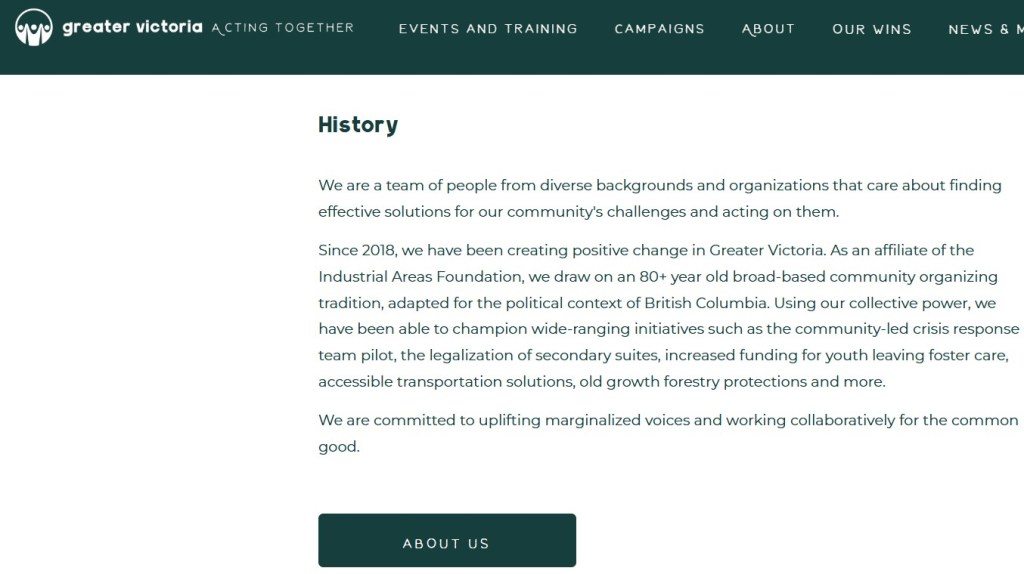
For the history, I’ll start by quoting from GVAT’s own brief blurb about it’s history from the homepage page of its website https://www.gvat.ca/ at the time of writing:
“History
We are a team of people from diverse backgrounds and organizations that care about finding effective solutions for our community’s challenges and acting on them.
Since 2018, we have been creating positive change in Greater Victoria. As an affiliate of the Industrial Areas Foundation, we draw on an 80+ year old broad-based community organizing tradition, adapted for the political context of British Columbia.”
—————————————————————————————————
I’ve written more in-depth about GVAT and the Industrial Areas Foundation in this previous article: ‘Livable CRD’, and its alliance of astroturfing organizations, seeking to influence the outcome of the 2026 local government election. – CRD Watch Homepage
—————————————————————————————————
In this article though I will look more about the structure of GVAT and the IAF, in addition to information about GVAT’s formation.
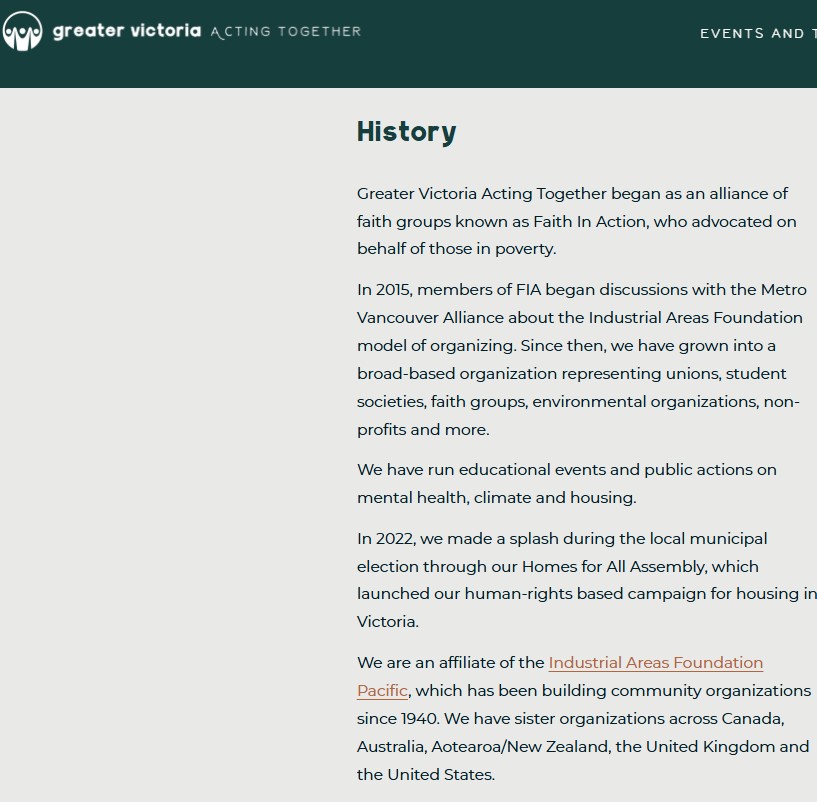
GVAT’s About page on its website https://www.gvat.ca/about contains more information about its history.
“History
Greater Victoria Acting Together began as an alliance of faith groups known as Faith In Action, who advocated on behalf of those in poverty.
In 2015, members of FIA began discussions with the Metro Vancouver Alliance about the Industrial Areas Foundation model of organizing. Since then, we have grown into a broad-based organization representing unions, student societies, faith groups, environmental organizations, non-profits and more.
We have run educational events and public actions on mental health, climate and housing.
In 2022, we made a splash during the local municipal election through our Homes for All Assembly, which launched our human-rights based campaign for housing in Victoria.
We are an affiliate of the Industrial Areas Foundation Pacific, which has been building community organizations since 1940. We have sister organizations across Canada, Australia, Aotearoa/New Zealand, the United Kingdom and the United States.”
—————————————————————————————————
As they stated, GVAT is an affiliate of the Industrial Areas Foundation Pacific. The Iaf Pacific is also an affiliate of the Industrial Areas Foundation (IAF). The Iaf Pacific is registered in Seattle Washington.
Home | Iaf Pacific
The following text is from the Iaf Pacific’s landing page (you can see screenshots of this in Appendix 1 at the end of this artcile):
AF Pacific
The Industrial Areas Foundation Pacific is non-partisan, not-for-profit registered in Washington State as IAF Northwest. IAFNW dba IAF Pacific is a 501(c)4 organization with a sister 501(c)3 charitable organization.
We do not accept money from governments or political parties.
What we do:
We are a regional network of non-partisan broad-based community alliances in Washington, Oregon, Montana, Canada, Australia and Aotearoa-New Zealand.
Non-Partisan
IAF Pacific prides itself on being nonpartisan and pragmatic in its approach. The network does not endorse candidates or align with any political party.
Common Good
Instead, it focuses on issues and values that cut across typical partisan lines – like the dignity of work, access to healthcare, safe neighborhoods, and accountable governance.
Broad-based
Alliances deliberately include a broad spectrum of groups (e.g. business leaders alongside union workers, evangelical & Catholic churches alongside secular non-profits), finding common ground on community problems despite differing ideologies.
This broad-based, non-ideological stance is a conscious strategy to solve problems and build power with as many people as possible and to engage constructively with public officials of any stripe.
Our Values
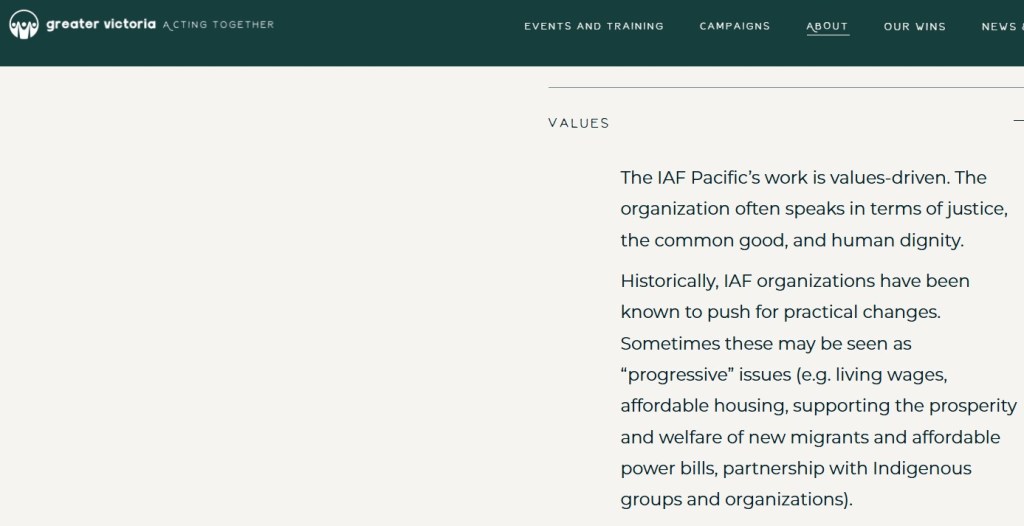
At the same time, IAF Pacific’s work is values-driven. The organization often speaks in terms of justice, the common good, and human dignity.
Historically, IAF organizations have been known to push for practical changes. Sometimes these may be seen as “progressive” issues (e.g. living wages, affordable housing, supporting the prosperity and welfare of new migrants and affordable power bills, partnership with Indigenous groups and organizations).
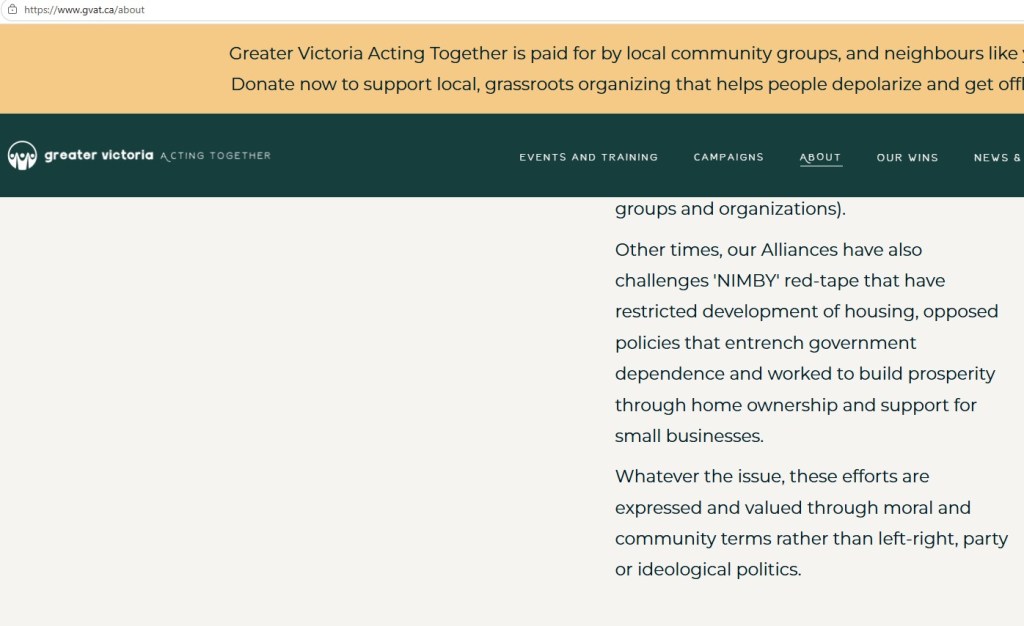
Other times, our Alliances have also challenges ‘NIMBY’ red-tape that have restricted development of housing, opposed policies that entrench government dependence and worked to build prosperity through home ownership and support for small businesses.
Whatever the issue, these efforts are expressed and valued through moral and community terms rather than left-right, party or ideological politics.
The Training
The training curriculum emphasizes an analysis of power (“the world as it is”) and the need for ordinary people to organize to create “the world as it should be”. In practice, this means IAF Pacific might work with conservative rural congregations on one issue and urban progressives on another, as long as they share an interest in that particular change.
The nonpartisan posture helps the network build unusual coalitions – for example, uniting faith-based groups with labor unions and small businesses – and also lends credibility when lobbying policymakers (since they can’t be easily dismissed as an arm of one party).
IAF Pacific is ideologically pluralistic: its alliances are open to all who commit to working for the common good, and it navigates political divides by focusing on tangible community outcomes rather than party agendas.
Strengthening Democratic and Civic Life
Supporting democratic participation and vibrant civic life is at the heart of IAF Pacific’s work. The organization explicitly aims to “foster democracy” in an era when many feel disillusioned or powerless. One way it does this is by developing the leadership of everyday people – teaching citizens how to run meetings, speak publicly, conduct research, and effectively advocate for their interests. Over time, those trained leaders become school board members, neighborhood council chairs, or simply more active congregants, thereby renewing the fabric of local democracy.
Strong civic institutions are the foundations of our communities
IAF Pacific also strengthens civic institutions themselves.
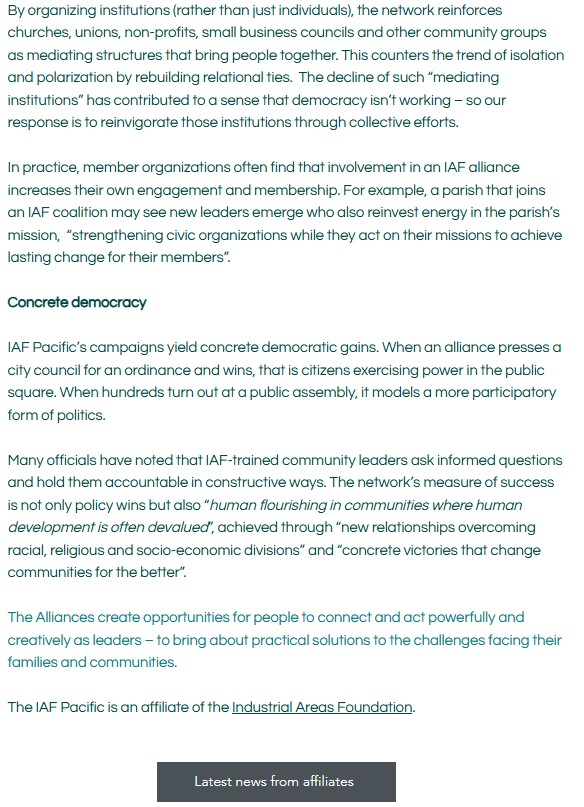
By organizing institutions (rather than just individuals), the network reinforces churches, unions, non-profits, small business councils and other community groups as mediating structures that bring people together. This counters the trend of isolation and polarization by rebuilding relational ties. The decline of such “mediating institutions” has contributed to a sense that democracy isn’t working – so our response is to reinvigorate those institutions through collective efforts.
In practice, member organizations often find that involvement in an IAF alliance increases their own engagement and membership. For example, a parish that joins an IAF coalition may see new leaders emerge who also reinvest energy in the parish’s mission, “strengthening civic organizations while they act on their missions to achieve lasting change for their members”.
Concrete democracy
IAF Pacific’s campaigns yield concrete democratic gains. When an alliance presses a city council for an ordinance and wins, that is citizens exercising power in the public square. When hundreds turn out at a public assembly, it models a more participatory form of politics.
Many officials have noted that IAF-trained community leaders ask informed questions and hold them accountable in constructive ways. The network’s measure of success is not only policy wins but also “human flourishing in communities where human development is often devalued”, achieved through “new relationships overcoming racial, religious and socio-economic divisions” and “concrete victories that change communities for the better”.
The Alliances create opportunities for people to connect and act powerfully and creatively as leaders – to bring about practical solutions to the challenges facing their families and communities.
The IAF Pacific is an affiliate of the Industrial Areas Foundation.
—————————————————————————————————
I have highlighted a couple sections of the text from the Iaf Pacific, because it appears to me to be examples of corporate regionalism based in the United States, and cross border political influence that relates particularly to how GVAT has operated:
“our Alliances have also challenges ‘NIMBY’ red-tape that have restricted development of housing, opposed policies that entrench government dependence and worked to build prosperity through home ownership and support for small businesses.”
“The nonpartisan posture helps the network build unusual coalitions – for example, uniting faith-based groups with labor unions and small businesses – and also lends credibility when lobbying policymakers (since they can’t be easily dismissed as an arm of one party).”
This section is also quoted verbatim from the Iaf Pacific, on GVAT’s website in the About section at the time of writing under the section Values, which is a subheading of the section “Our Principles”:
—————————————————————————————————
The structure of GVAT’s relation to the IAF:
At the bottom of GVAT’s website at the time of writing is the following:

Next to its copyright is the logo of the US Industrial Areas Foundation, see below:

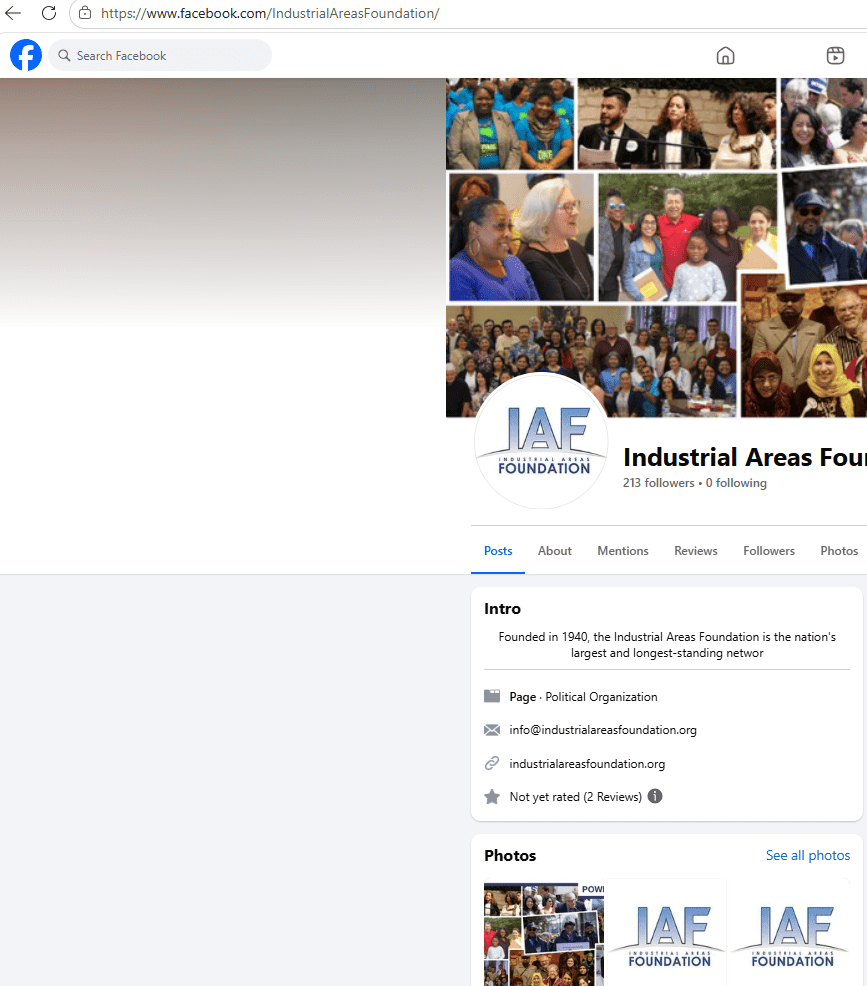
While GVAT is affiliated with the Iaf Pacific and the IAF Pacific is affiliated with the IAF, GVAT’s affiliation also goes another direction to the IAF.
GVAT’s parent organization in Canada is the Industrial Areas Foundation Canada:
Industrial Areas Foundation Canada
As its website states:
We Build Leaders
“I went to the training and discovered practical ways that I can build relationships and take action to bring about change in our city.”

The Industrial Areas Foundation Canada is a registered charity that was created to teach community organizing skills and develop leaders who can create effective local community organizing organizations. Currently, four organizations are its affiliates.
The Calgary Alliance for the Common Good (CACG), Greater Edmonton Alliance (GEA), Greater Victoria Acting Together (GVAT) and Metro Vancouver Alliance (MVA).
The charitable purposes of the Industrial Areas Foundation Canada are:
- To educate and inform the public and other registered charities by providing courses, conferences, workshops and seminars on community involvement, leadership training and volunteerism;
- To educate the public about community development through workshops and seminars; and,
- To conduct research relating to social and economic issues and to disseminate the results of such research.
The Industrial Areas Foundation Canada is a member of the Industrial Areas Foundation and is a part of the North West Region of the Industrial Areas Foundation.
—————————————————————————————————
Which incidentally links back to Seattle, Washington State USA:
About Us – Industrial Areas Foundation Northwest
The following is at the bottom of the IAF Northwest homepage:


“IAF Pacific (formerly IAF Northwest) is a regional network of 12 broad-based Affiliates in Washington, Oregon, Montana, Canada, New Zealand-Aotearoa and Australia. The Affiliates are broad based member organizations and work with faith-based organizations, education, health, labour and community organizations united to act effectively to bring about practical solutions to advance the common good.
Mission:
The IAF Pacific provides training and development of citizen leadership skills, promotes cross-cultural understanding and cooperation, and conducts research and public education on issues of concern to residents in areas served by IAF Northwest affiliated organizations.
Vision:
To Achieve the Common Good.
- Use our collective power to help inspire hope among our members, to stimulate our imaginations in developing creative solutions to the challenges we face and to motivate us to create and pursue our vision of the world as it should be and could be.
The measure of IAF’s success is the extent to which its organizations contribute to human flourishing in communities where human development is often devalued and human dignity trampled. These successes, when they occur, take the form of imaginative responses to seemingly intractable problems, new relationships overcoming racial, religious and socio-economic divisions and immediate, concrete victories that change communities for the better and inspire hope in the future.”
—————————————————————————————————
I include the following excerpt and bolded part of it:
“The IAF Pacific provides training and development of citizen leadership skills, promotes cross-cultural understanding and cooperation, and conducts research and public education on issues of concern to residents in areas served by IAF Northwest affiliated organizations.”
I bolded this section, because it appears to me that the IAF Northwest, which is based in Washington State is conducting research on residents in Canada as well, and that information/data could be hoovered back and harvested.
Given that the organization is clearly seeking a level of international political influence, this to me could be considered foreign interference.
—————————————————————————————————
The Metro Vancouver Alliance (MVA)
As mentioned earlier in this article according to GVAT:
“Greater Victoria Acting Together began as an alliance of faith groups known as Faith In Action, who advocated on behalf of those in poverty.
In 2015, members of FIA began discussions with the Metro Vancouver Alliance about the Industrial Areas Foundation model of organizing.”
(See also in regard to its model of organizing: Greater Victoria Acting Together / GVAT – Acting together for change – From Faith Tides (Accessed Aug 8, 2026))
At the time of writing, the Industrial Areas Foundation website lists its direct Canadian affiliates.

GVAT is not listed, although GVAT would be an indirect affiliate through affiliation with IAF groups in the pacific northwest.
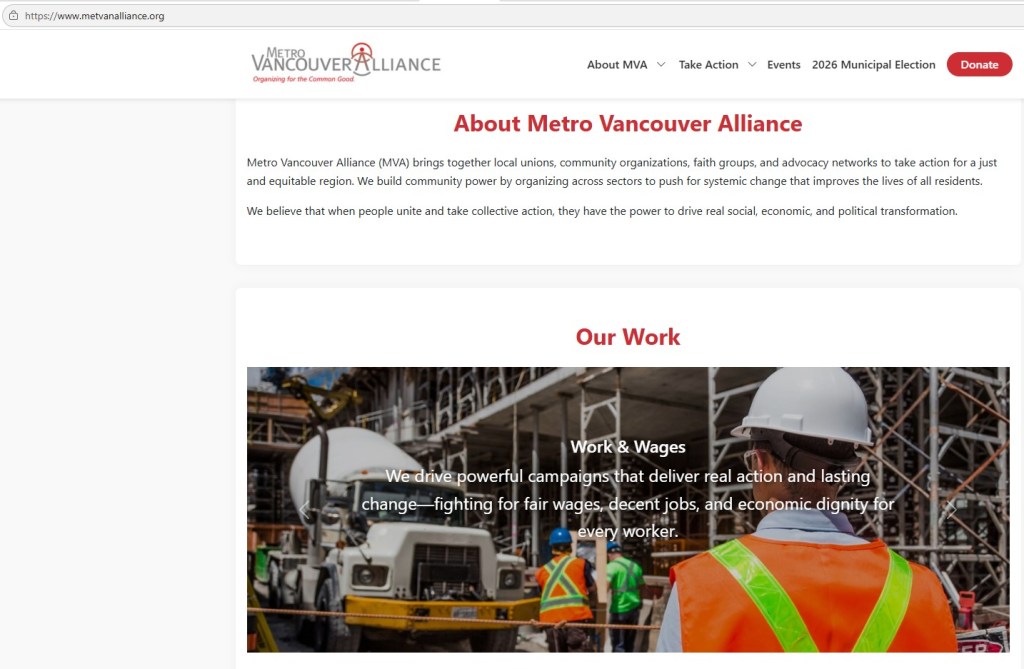
Screen captures from the Metro Vancouver Alliance website at the time of writing:
Metro Vancouver Alliance

—————————————————————————————————
The following is a brief history from GVAT’s blog revealing the IAF and its affiliates influence on the formation that led to GVAT (I have bolded some of the text for particular relevance to this article):
Greater Victoria Acting Together / GVAT – A brief history of GVAT’s beginnings in Victoria, by Peggy Wilmot
“A brief history of GVAT’s beginnings in Victoria, by Peggy Wilmot
Dec 2, 2022
• Feb., 2010 Faith in Action (an alliance of faith communities advocating for those in Poverty) holds “Begging for Justice” event on steps of the legislature.
In the course of preparing for it, a source in Vancouver (BCTF social Justice Chair) suggests that Faith in Action look at Metro Vancouver Alliance (MVA), a model that had very successfully advocated for Social Justice from a much broader base than faith communities only. Faith in Action starts to get interested.
- Feb-March, 2015 Peggy Wilmot travels to Vancouver to meet with MVA organizer Deborah Littman. She brings back a story of organizing across civil society to make significant differences based on local issues and grassroots leadership. Key leaders (Gord Stuart, Michael Purves, Barbara Hansen, Penny Tennenhouse, Philip Symons, Tricia Sanders, Sister Joyce Harris) are enthusiastic, and support FIA inviting Deborah to hold an information session for folks in Victoria. Peggy uses the FIA networks and mailing list and sends out an invitation to local leaders.
- April 14, 2015 Deborah Littman from MVA holds an information session in Victoria for anyone interested in learning more. 75 people attend!
- October, 2015 Deborah Littman offers a 2-day workshop in Victoria and 30 people attend. It is hosted by Fairfield United and Faith in Action.
- Feb., 2016 Peggy Wilmot, Gord Stuart and Patricia Lane attend a 5-day IAFNW regional training in North Vancouver.
- Feb- November 2016, A steering committee is formed, a not for profit certification obtained and an organizing strategy mapped out and implemented.
Key leaders in addition to Patty, Gord and Peggy include Joe Barrett, Tricia Sanders, Eric Doherty, Sister Joyce Harris, Marion Pape.
The Sisters of St Ann and an anonymous donor agree to provide our first funding tranche; Community and Social Services Credit Union provides our second donation. By the end of the year we have raised pledges for $300,000 over the next 3 years. Sierra Club of BC, the BCTF and the BCGEU are early joiners and major financial contributors. Faith In Action provides much needed behind the scenes help ranging from financial commitments, to relationship building, to helping to cater events.
20 house parties, 4 lunches and dinners with community leaders and countless coffee meetings are held. Attendees experience relational organizing, strengthen their own networks and learn about the history of IAF organizing and the theory of change for Victoria. Joe Chrastil and Maribeth Larkin from IAFNW are often guest speakers. Patricia remarks that the worst thing that will happen is that we will have met the nicest people in Victoria.
Fall, 2016 We begin to share an “intern” organizer with Metro Vancouver Alliance, Flossie Baker. We have a small, but mighty Board with a very involved steering committee.
Spring, 2017 Flossie joins us full time in Victoria, and things really take off! Flossie’s strong relationship skills and vision for justice draw more and more members. House meetings happen frequently. We hold our own leadership training sessions, using local leaders.
May, 2018 GVAT hosts its first civil society learning event, “Destigmatizing the Opioid Crisis” to deepen understanding of the overdose challenges facing Victoria. This is attended by many decision makers including Judy Darcy, Minister for Mental Health and Addictions, who shared a very moving personal story with us.
June, 2018 GVAT hosts the first major event, a launch of our Listening “season”. Representatives from all our member orgs attend, as well as many regional mayors and councilors, eager to learn more about this emerging alliance!
November 2018 GVAT now has 22 dues paying member organizations including front line service organizations, unions, environmental advocacy groups, not for profits, student societies and faith groups. The first GVAT Delegates Assembly is held at Cadboro Bay United Church, with over 100 people in attendance and 30 groups represented as either members or seriously considering membership.
Together they represent more than 50,000 people in the Greater Victoria Area. This Assembly discerns the shared priorities as homelessness and the lack of affordable housing, addictions and the lack of adequate affordable mental health care, and a GVAT wide concern for action on climate.
December, 2018 Flossie sadly, must return to the UK, as her visa could not be renewed.
January 2019-July 2019, GVAT continues to grow, while searching for a new Lead Organizer. Joe Chrastil provides needed support to the volunteer team leading through this challenging time.
July, 2019 Chet Phillips is hired as Lead Organizer. He quickly lends his many skills to the continued growth of GVAT. There are soon three Action Research Teams (Housing, Mental Health and Addictions, and Climate).
Feb. – March 2020. Plans are well underway for our Founding Assembly, when the pandemic is declared. All in person meetings are cancelled. We all become “experts” on Zoom, membership reaches 32 organizations representing 70,000 people.
In 2021, GVAT created a new website with a blog. You can read more about our recent work and wins at www.gvat.ca/blog
————————————————————————————————–
On Patricia Lane’s website (at the time of writing), it is written: https://awesomeclimatestories.ca/about-me/ ” I co-founded Greater Victoria Acting Together bringing unions, faith groups, enviro orgs and service delivery organisations together to work on shared priorities one of which is climate fairness.
Over the years I have learned something about how to bridge differences to help people work towards solutions they can all support.”
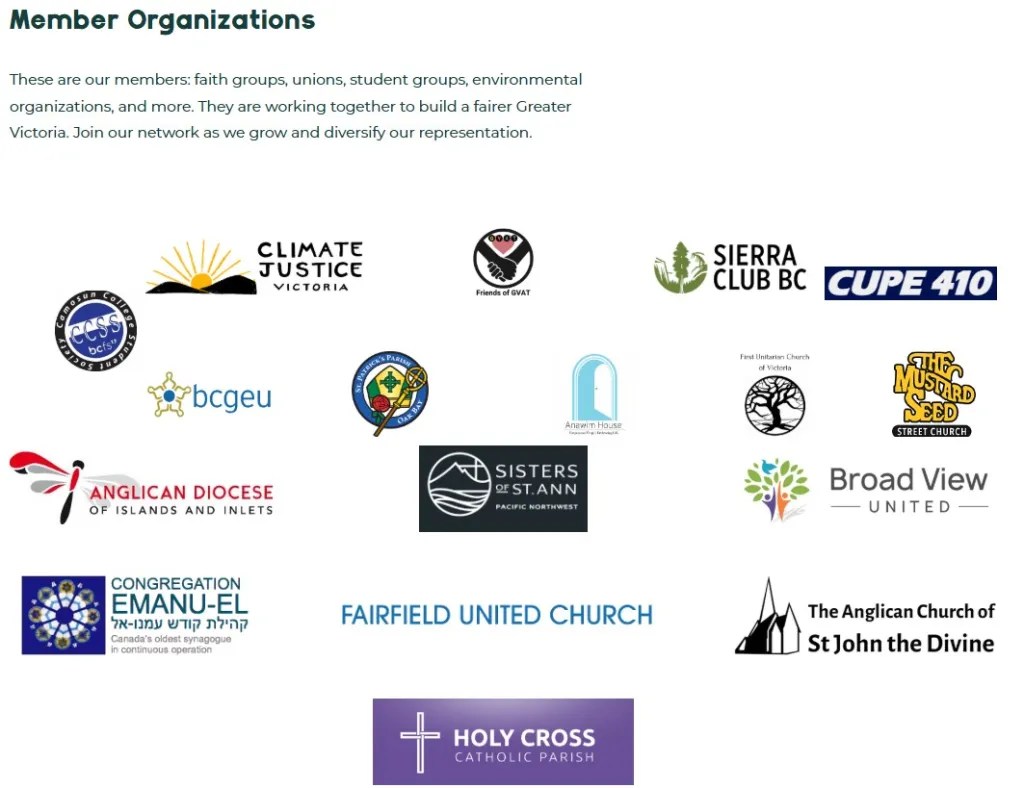
These are the member organizations at the time of writing, note that unions CUPE and the bcgeu are members. The transition from Faith In Action, to GVAT represented the merger of church organizations with union/traditionally NDP leaning organizations under one banner, as part of GVAT’s organizing in the style of the Industrial Areas Foundation.
—————————————————————————————————
Conclusion:
The transition of Faith in Action to the Greater Victoria Acting Society, represents the merger of union and church organizing, which has as a result placed it close to those involved with the BC NDP and with a number of those who have been elected to Victoria City Council from 2018 onward, something I covered in this previous article:
Greater Victoria Acting Together (GVAT) appears to be run by a member of the political pressure group Homes For Living. – CRD Watch Homepage
As I have covered in other CRD Watch articles including this one, the BC NDP, which has adopted an approach of business unionism, took money directly from the UDI development lobby in 2011 and in 2017:
How the Development and Real Estate Lobby Pressed Mandatory Housing Targets, Mass Upzoning, Captured Official Community Plans, and Made the Shutting Down of Public Hearings the Norm in British Columbia Under the NDP Government – CRD Watch Homepage
The transition of Faith In Action (FIA) to GVAT places the organization within an international framework of affiliation with the Industrial Areas Foundation, and the IAF affiliates both in Canada and in the pacific northwest appear to have played a key role in the formation and structure of GVAT and its organizing.
This begs the question of international data harvesting, international manipulation, and potential foreign interference in local elections from our neighbour down south.
GVAT is part of the Livable CRD coalition, which will be grading candidates for the 2026 General Local Government election on Southern Vancouver Island. Another GVAT member is Strong Towns Victoria, which is tied to the Strong Towns movement, which is based in the United States and advances a development oriented agenda internationally. The authorized Principle and spokesperson for Livable CRD, Michael Bassili co-founded Strong Towns Nanaimo, a regional branch of Strong Towns which is based in the United States.
Livable CRD is not transparent, and Strong Towns Victoria does not have a website at the time of writing.
‘Livable CRD’: Grading candidate answers – what are the names? It’s a secret! – CRD Watch Homepage
Emails with Livable CRD and partner organizations, show a pattern of evasiveness as to the identity of those involved who will be grading candidates for the 2026 election. – CRD Watch Homepage
As the Iaf Pacific, which is registered across the border in Washington State, and to which GVAT is an affiliate has stated: “our Alliances have also challenges ‘NIMBY’ red-tape that have restricted development of housing, opposed policies that entrench government dependence and worked to build prosperity through home ownership and support for small businesses.”
“The nonpartisan posture helps the network build unusual coalitions – for example, uniting faith-based groups with labor unions and small businesses – and also lends credibility when lobbying policymakers (since they can’t be easily dismissed as an arm of one party).”
The merger of organizations under a single banner GVAT, which has affiliations with IAF organizations in the United States, has given the organization influence with 10s of thousands of Greater Victoria residents, something that can swing elections.
As mentioned GVAT’s only listed member of staff, appears to be involved with a political pressure group, Home For Living, which is also part of Livable CRD, and is seeking to influence the 2026 election, as it did in 2022, in which it saw majorities of candidates it supported elected to Victoria, Saanich and Oak Bay Councils, which makes up the majority of Greater Victoria both in regards to population and area.
According to the Iaf Pacific: “The training curriculum emphasizes an analysis of power (“the world as it is”) and the need for ordinary people to organize to create “the world as it should be”.
However, “the world as it should be” like many of the nebulous statements from the IAF and its members, and church groups under their umbrella is widely vague and open to interpretation, seldom if ever, do they include the word ecology.
GVAT and Homes For Living have advanced a housing first agenda, but a housing first agenda and one effectively ignoring urban ecology, is simply the advancement of urbanization over urban ecology. The result for the ecology on a place like Southern Vancouver Island of prioritizing one so far above the other can only be catastrophic for the ecology.
The Industrial Areas Foundation, is aptly named…
————————————————————————————————–
A subsequent article will focus on the organizing techniques that have been adopted by the organization.
————————————————————————————————–
See also:
Index of articles and other resources regarding the organization: ‘Livable CRD’ and its coalition partners. – CRD Watch Homepage
Index of Articles and other Media Coverage about Homes For Living – CRD Watch Homepage
List of articles and other resources on corporate regionalism. – CRD Watch Homepage
Front organization – Wikipedia
Business unionism – Wikipedia
Index of articles revealing major lobbying influence on B.C. Provincial Housing Bills and Housing Targets. – CRD Watch Homepage
—————————————————————————————————
Appendix 1: Screenshots of the IAF Pacific landing page at the time of August 8, 2026:


————————————————————————————————–


Leave a comment