‘Livable CRD’, and its alliance of astroturfing organizations, seeking to influence the outcome of the 2026 local government election.
The organization which officially launched according to a press release dated July 23, 2026 – lists no people who are involved in the organization on their website, including no board of directors.
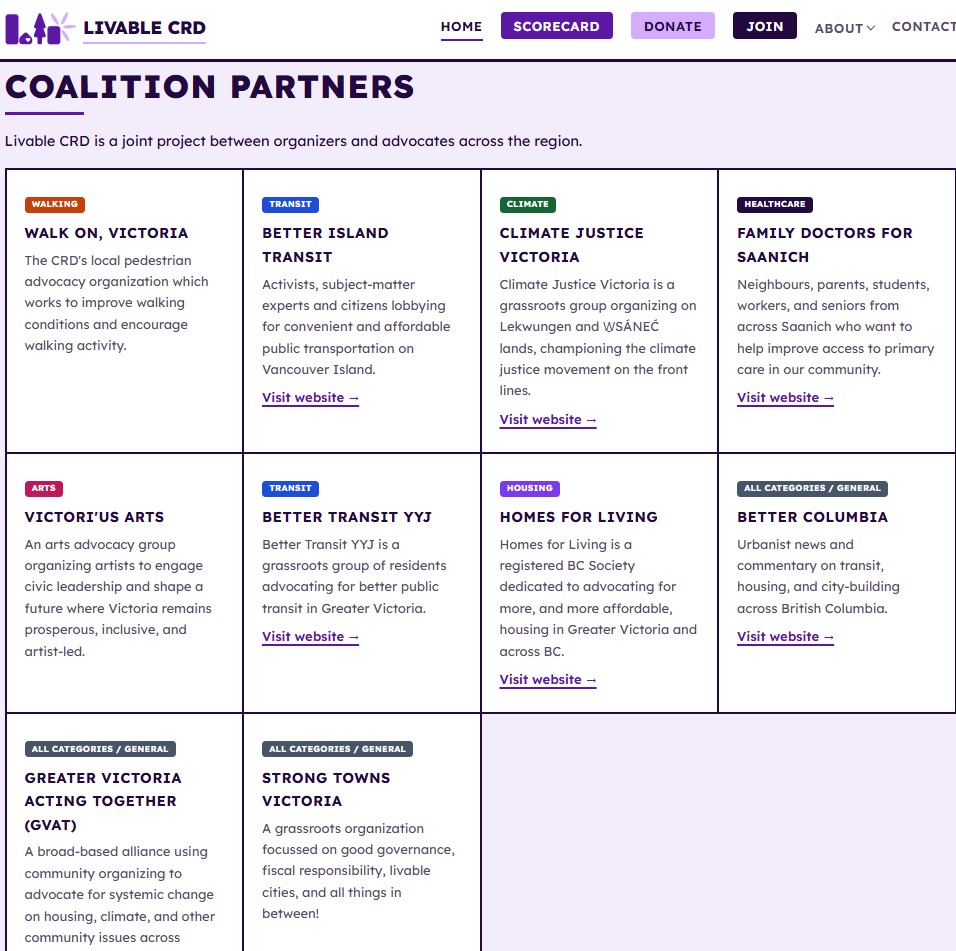
Its list of coalition partner organizations serves as a who’s who list of the usual suspects of local government influence-makers advancing a development agenda on Southern Vancouver Island under the guise of environmentalism and improved transit.
The term “Astroturfing” refers to the use of phony grassroots organizations that push an agenda.
At least 2 of the organizations that are part of the coalition are based in or have a parent organization based in the United States.
One of those US-based organizations is Strong Towns. According to a document from Elections BC, the Authorized Principal for Livable CRD is Michael Bassili, a co-founder according to his website, of Strong Towns Nanaimo. Strong Towns Nanaimo was an early and strong supporter of BC Bill M216, which would if it had been passed (thankfully it failed) have allowed the overriding of municipal government decisions by “outside professionals”.
By Sasha Izard
July 25, 2026
—————————————————————————————————
While many in the public might think that local government elections in British Columbia, are simple contests of independents running for municipal office, or for schoolboard positions – the Provincial Government of B.C. has, created numerous opportunities in the election for the meddling of outside organizations.
The most commonly allowed form of election meddling by outside organizations is the use of Third Party Election Advertising Sponsors. These organizations, which are effectively political pressure groups, typically create score charts that rank candidates according to the political agenda of the organization, and then they advertise accordingly for the preferred candidates of the organization, often after asking the candidates to fill out a survey in advance to see how much they align to the organization’s vision.
Another form of outside organizational influence on election campaigns, are Third Party Elector Organizations. Third Party Elector Organizations run a slate of candidates, and place their organizational name next to their endorsed candidates on the ballot. They are also known as Civic Political Parties, because they are political parties seeking to get their candidates in power during the general local government election.
Another form of outside organizational influence in election campaigns is for an organization to host an election debate between candidates. For example, Greater Victoria Acting Together (GVAT), held mayoral debates in the 2022 general local government election, where practically the sole subject of debate was pushing housing.
See also: Greater Victoria Acting Together (GVAT) appears to be run by a member of the political pressure group Homes For Living. – CRD Watch Homepage
Yet another form of organizational influence is to have members of an organization presented by the media as experts, e.g. how the media repeatedly interviewed members of Homes For Living as “housing experts”, while downplaying the fact that they are a political pressure group.
—————————————————————————————————
One of the most successful Third Party Election Advertising organizations last election was the political pressure group Homes For Living.
2 Sentence Constitution of the Homes For Living Foundation removes any doubt that Homes For Living (HFL) is a purpose-built pressure group designed to influence municipal politicians. – CRD Watch Homepage
Homes For Living, which is development industry aligned, helped get majorities of their preferred candidates on several councils in the Greater Victoria region in the general local government election of 2022. HFL endorsed majorities that were elected in 2022, including on the City of Victoria Council, the District of Oak Bay Council, and on the District of Saanich Council. (See Appendix 1. at the end of this article).
Homes For Living is a coalition partner of Livable CRD according to the Livable CRD website at the time of writing on the website’s homepage.
—————————————————————————————————
A Coalition of Usual Suspects:
The following is the list of Livable CRD’s Coalition Partners:
I will have a look at each of these in more detail. As with covering FOI documents, I tend to start with the end and work my way up, as the more relevant information tends to be at the end of the FOI response as opposed to the beginning where people are more likely to look…
Strong Towns
Strong Towns Victoria does not have a website at the time of writing, making the organization utterly untransparent.
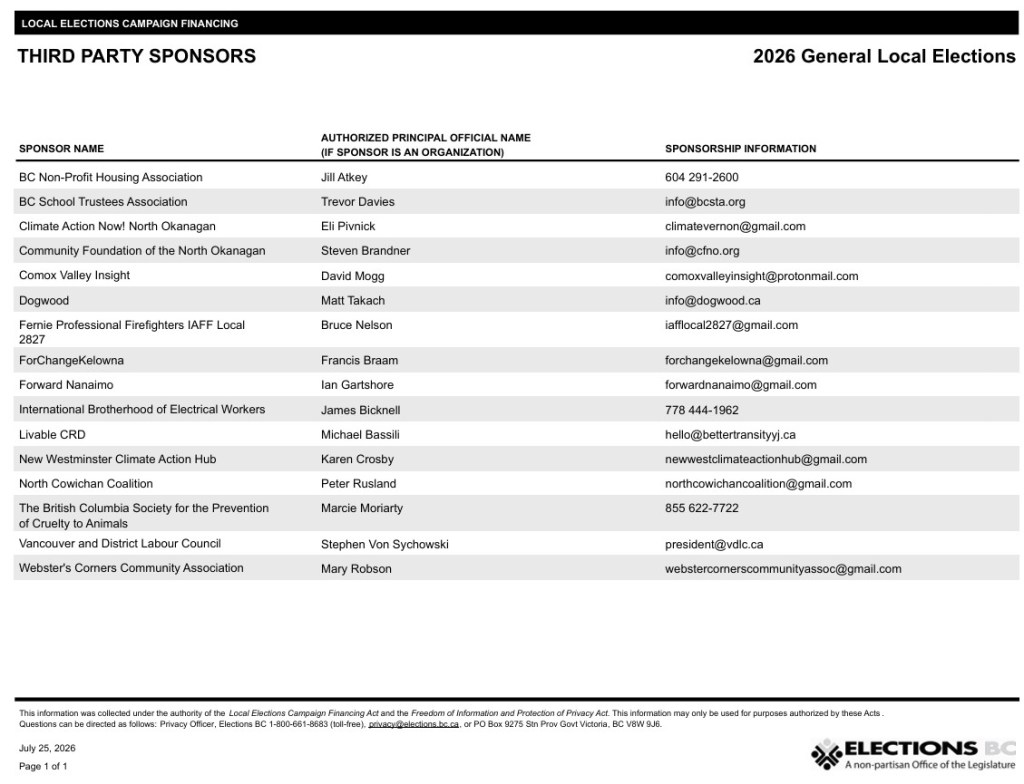
A list of Third Party Sponsors of the 2026 Election dated to July 25, 2026 from Elections BC – contains the following entry (See full document in Appendix 2 at the end of the article):

The name of the Authorized Principal for the sponsor organization Livable CRD is Michael Bassili. The email contact provided is hello@bettertransityyj.ca (Better Transit is a coalition partner of Livable CRD).
The following appears to be Michael Bassili’s website. Here is an Archived snapshot of it:
About Me – Michael Bassili
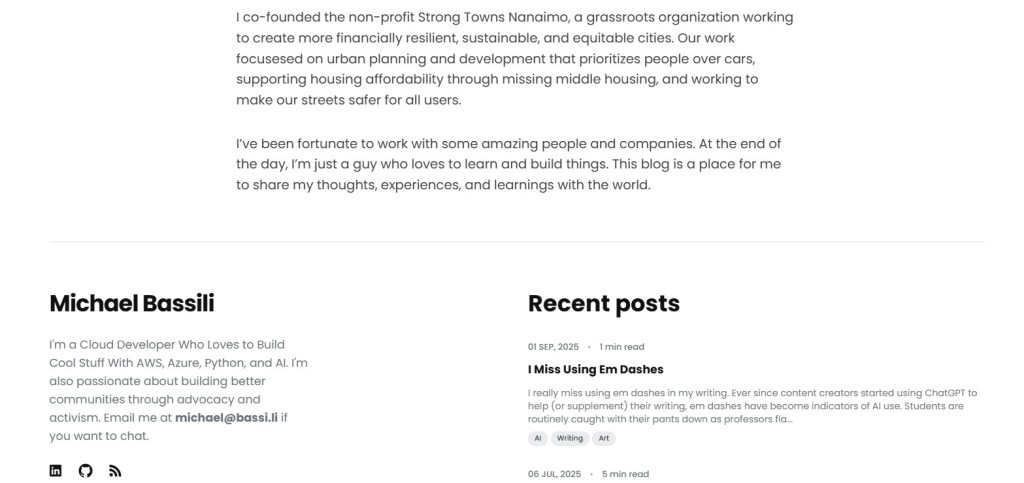
“I co-founded the non-profit Strong Towns Nanaimo, a grassroots organization working to create more financially resilient, sustainable, and equitable cities. Our work focusesed on urban planning and development that prioritizes people over cars, supporting housing affordability through missing middle housing, and working to make our streets safer for all users.
I’ve been fortunate to work with some amazing people and companies. At the end of the day, I’m just a guy who loves to learn and build things. This blog is a place for me to share my thoughts, experiences, and learnings with the world.”
—————————————————————————————————
I have to hone in on what I see as an Orwellian comment: “supporting housing affordability through missing middle housing,”.
In 2022, the Chair of the UDI development and real estate lobby at the time, Adam Stuart Cooper posted on Facebook a comment that Missing Middle is not intended to deliver affordable housing, just as the lobby was doing everything it could to advance it through multiple levels of government. Homes For Living advanced it and its endorsed politicians for Victoria Council which received a majority of seats after the election, soon after passed the Missing Middle Housing Initiative (MMHI).
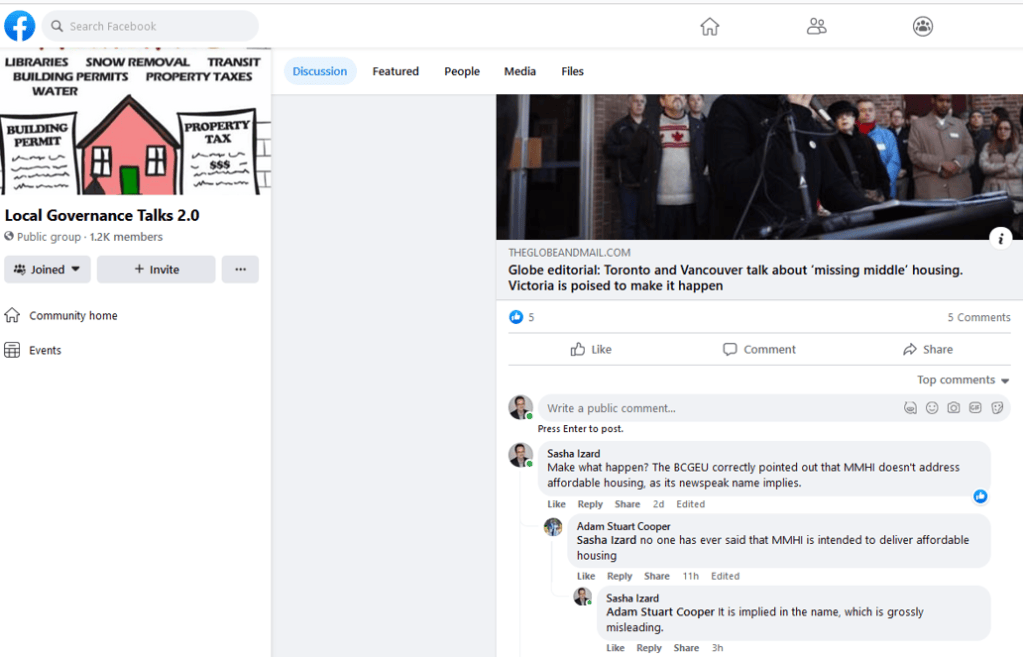
Above: Screenshot of my dialogue with Adam Stuart Cooper in 2022. Cooper wrote: Sasha Izard no one has ever said that MMHI is intended to deliver affordable housing.
So fast forward 4 years to the next election in 2026. The Co-founder of Strong Nanaimo Towns is advancing the myth of missing middle housing as affordable, when that has long since been discredited, upon being put into practice. He is the Authorized Principal of Livable CRD according to Elections BC, and the email contact provided for Livable CRD is hello@bettertransityyj. The Chair of Better Transit YYJ is Sam Holland, who was a Director of Homes For Living, and quite likely still is.
Strong Towns Nanaimo was an early and strong supporter of BC Bill M216 (AKA the Professional Reliance Act, which would if it had been passed (thankfully it failed) have allowed the overriding of municipal government decisions by “outside professionals”.
Bill M216 was supported by Homes For Living and other not surprisingly, YIMBY-oriented pressure groups.
Strong Towns is a US-based organization that pushes a development agenda.
Previously, I wrote about Strong Towns in the following articles:
Stop Bill M216 Before Local Democracy is Dismantled on Nov 17, 2025 – CRD Watch Homepage
The Usual Suspects: Big Business including aligned groups such as The Greater Vancouver Board of Trade, the UDI lobby, and YIMBY pressure group Homes For Living, are pushing Bill M216 in British Columbia, which would override municipal sovereignty and the public voice, if passed. – CRD Watch Homepage
In the first article, I wrote a section:
Strong Towns, A national movement from the US, flush with sponsorship money.
Excerpts from the US-based Strong Towns Sponsor Guide
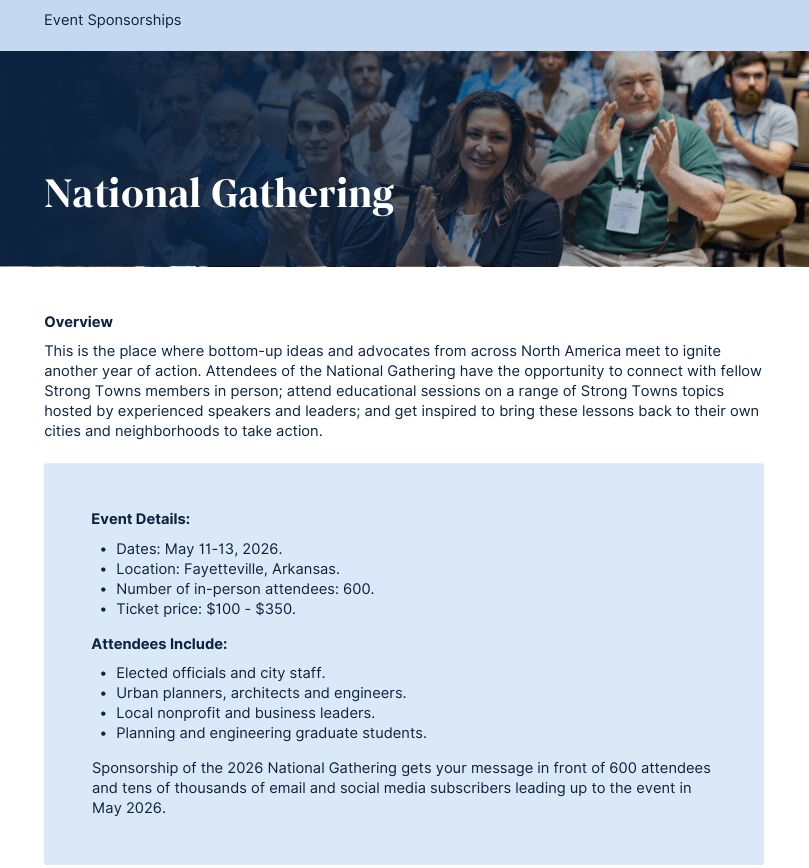
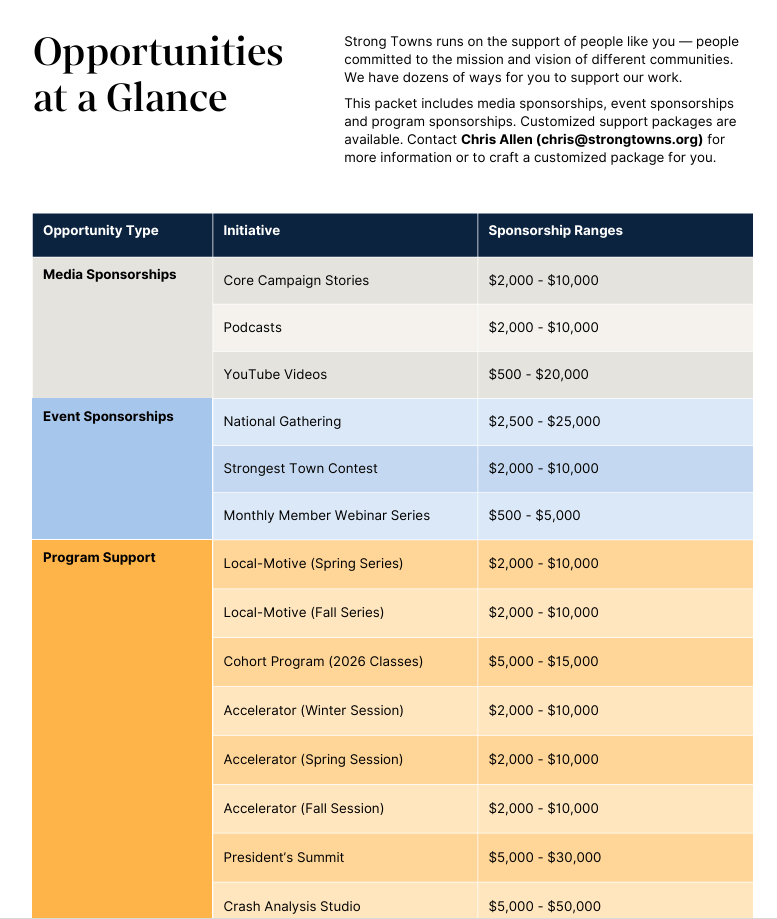
Its Canadian (51st state) branches appear to be closely associated with local industry-aligned YIMBY activist organizations, which lobby for more housing supply at the cost of everything else.
Strong Towns was founded by Charles Marohn, a former engineer and city planner, headquartered in his home town of Brainerd, Minnesota. According to Wikipedia, proponents of Strong Towns describe its philosophy as “a conservative vision for community,” while critics describe it as anti-government, business-libertarian economics and politics cloaked in “progressive” clothing.
It seems that in recent years, the Canadian branches of the organization (Nanaimo, Delta, Vancouver, Langley, etc.) are rebranding to avoid the “Strong Towns” connotations. The post by Beautiful Nanaimo goes into much greater detail praising Bill M216.
—————————————————————————————————
Greater Victoria Acting Together (GVAT)
As in the case of Strong Towns, GVAT has organizational connections in the United States.
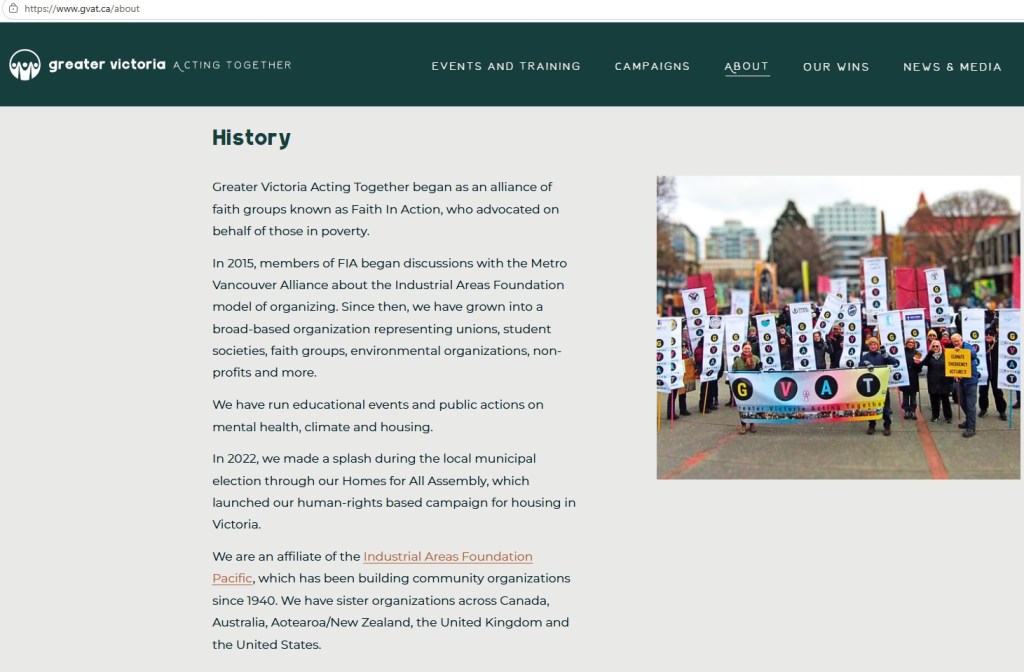
Archived version: Greater Victoria Acting Together / GVAT – About
Under the ‘About’ section on its website, is the following:
“History
Greater Victoria Acting Together began as an alliance of faith groups known as Faith In Action, who advocated on behalf of those in poverty.
In 2015, members of FIA began discussions with the Metro Vancouver Alliance about the Industrial Areas Foundation model of organizing. Since then, we have grown into a broad-based organization representing unions, student societies, faith groups, environmental organizations, non-profits and more.
We have run educational events and public actions on mental health, climate and housing.
In 2022, we made a splash during the local municipal election through our Homes for All Assembly, which launched our human-rights based campaign for housing in Victoria.
We are an affiliate of the Industrial Areas Foundation Pacific, which has been building community organizations since 1940. We have sister organizations across Canada, Australia, Aotearoa/New Zealand, the United Kingdom and the United States.
—————————————————————————————————
At the bottom of the website is the Industrial Areas Foundation logo:

This is the website of the Industrial Areas Foundation Pacific:
Home | Iaf Pacific
At the time of writing their website states:
“IAF Pacific affiliates address local needs like affordable housing, sustainability, and civic engagement, empowering residents to participate in decision-making. sets IAF Pacific apart is the collaborative regional network formed through training and community-building, where leaders enhance their skills and share innovative ideas. This interconnectedness fosters “Type Two Diplomacy,” emphasizing relationships and collaboration to strengthen democracy. By building ties communities, IAF Pacific affiliates bolster social justice movements, nurture emerging leaders, promote mutual understanding, and reinforce democratic legitimacy, transforming democracy into a collaborative and lived experience.
Coming soon: How working together is building our ability to imagine, collaborate and act…“
—————————————————————————————————
The IAF Pacific mirrors a concept I’ve been covering, corporate regionalism:
List of articles and other resources on corporate regionalism. – CRD Watch Homepage
—————————————————————————————————
So what is the parent organization, the Industrial Areas Foundation?
This is what it says on its website at the time of writing:
History – Industrial Areas Foundation
“History
The Industrial Areas Foundation was established in 1940 by Saul David Alinsky and a Board of Directors that included business man Marshal Field, Roman Catholic Bishop Sheil and Kathryn Lewis, daughter of John L Lewis, President of the United Mine Workers. The mission of the new endeavor was to build from Alinsky’s experience developing the Back of the Yards Neighborhood Council into other communities in the greater Chicago area and beyond.
The Back of the Yards Neighborhood Council was the first “community organization” in the nation and a groundbreaking venture that brought ordinary families a voice in the decisions impacting their lives. As a social entrepreneur Alinsky managed to bridge divisions of ethnicity, religion and political philosophy in the interest of community improvement. As a consequence, BYNC achieved a level of power, local accountability and impact unheard of in Metropolitan Chicago of that time.
Subsequent successes with farm workers in California, in the Woodlawn area of Chicago, in Rochester, New York and Buffalo, New York commanded a national media audience and growing respect on both the left and right of the political spectrum. William F Buckley, Jr, a leading voice of thoughtful conservatism at the time, elevated Alinsky and the IAF to further prominence as he described IAF practice as “organizational near genius”.
The modern IAF began after Alinsky died an untimely death at 63 in 1972. Ed Chambers assumed primary responsibility for the IAF along with Richard Harmon. Under their leadership IAF moved to professionalize the role of organizer, aggressively pursue multiple leadership training formats including 10 day National Training, and initiate a policy of sustained relationships with a growing network of organizations under the IAF umbrella.
Early experiments in this regard included the Campaign Against Pollution in Chicago organized by Peter Martinez of the IAF, COPS in San Antonio organized by Ernesto Cortes, Jr., the Queens Citizens Organization, organized by Dick Harmon and Frank Pierson in New York City and following in quick succession, BUILD in Baltimore, organized by Arnie Graf, East Brooklyn Congregations, organized by Michael Gecan, UNO in East Los Angeles, organized by Ernesto Cortes, Jr. and TMO, organized by Cortes and Sr Christine Stephens in Houston.”
—————————————————————————————————
Let’s look at this comment: “William F Buckley, Jr, a leading voice of thoughtful conservatism at the time, elevated Alinsky and the IAF to further prominence as he described IAF practice as “organizational near genius”.”
This is the Wikipedia bio of William F. Buckley Jr.:
William F. Buckley Jr. – Wikipedia
Reading his bio, one might even think of William F. Buckley Jr. and Alinsky, as models for J.R. Bob Dobbs; and the Industrial Areas Foundation, as an inspiration for the Church of the SubGenius.

Did William F. Buckley Jr.,
serve as an Inspiration
for the character J.R. Bob Dobbs (above)?
J. R. “Bob” Dobbs – Wikipedia
Could the Industrial Areas Foundation,
which holds countless churches under its influence in more than one country,
have served as an inspiration itself, for the Church of the SubGenius?
Church of the SubGenius – Wikipedia
—————————————————————————————————
The members of GVAT, whose parent organization is the Industrial Areas Foundation (IAF), which is based in the United States; include the following organizations in the Greater Victoria area:
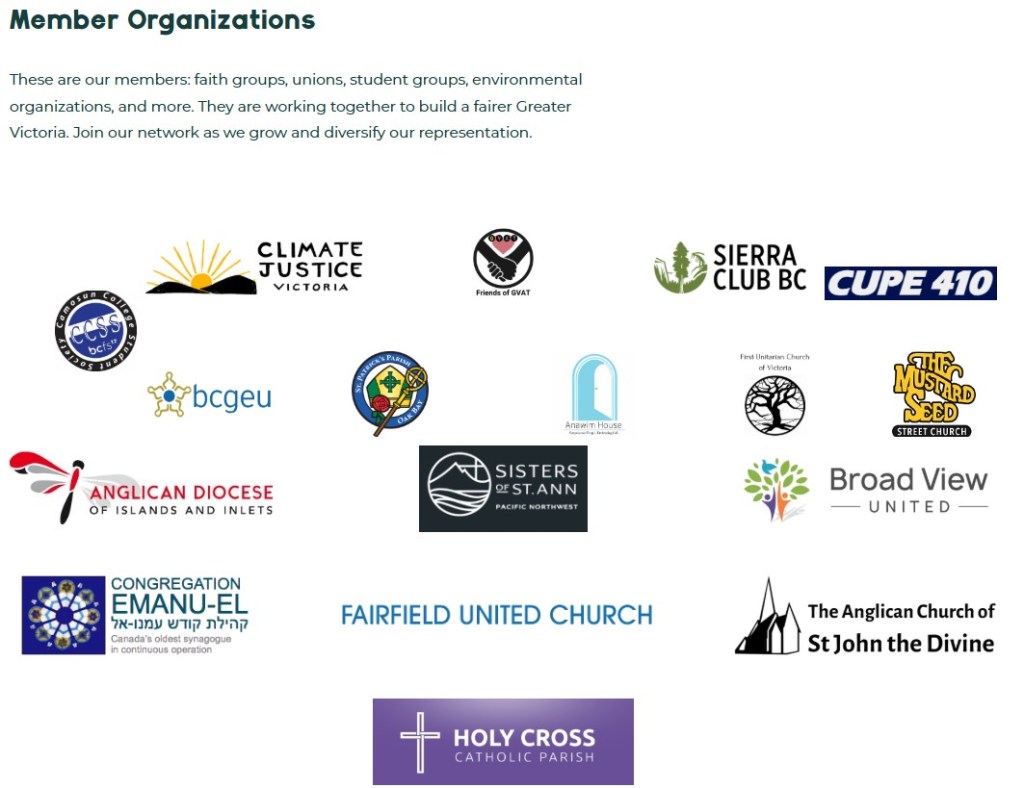
Note, the union presence, and where the unions are present, the NDP typically are not far behind.
Both the separation of lobby and state and still the separation of church and state are important issues in the 21st century.
To state my view plainly, I think that the organizations involved, have very good well meaning and well intentioned members, but when it comes to pushing a housing supply agenda, rather than an agenda which is not explicitly one of specifically affordable housing – these organizations and their members appear that they are being used under the guise of humanitarianism to advance a development/real estate agenda that is industry’s profit-driven agenda, instead of achieving real affordability when it comes to housing. This approach is self defeating. The harm this approach causes is one of ecological/environmental damage, and the type of increasing gentrification of neighbourhoods, that they probably think that they are opposing, instead of helping to facilitate, by taking this type of approach.
To act local, it is better to think local, rather than operating like Canadian branches of the Strong Towns movement, by being tied to organizational strings in the United States.
See also: Greater Victoria Acting Together (GVAT) appears to be run by a member of the political pressure group Homes For Living. – CRD Watch Homepage
The formation of Greater Victoria Acting Together (GVAT), and its relation to the Industrial Areas Foundation in the US – CRD Watch Homepage
—————————————————————————————————
Better Columbia
Better Columbia is hardly more transparent than Livable CRD, but it is slightly more transparent. It does have some names attached to it, or at least attached to its articles. No names are provided for who is running the organization.
Archived website: Home – Better Columbia
It does say on the website’s About section:
“We are a not-for-profit, volunteer-run, urbanism-focused publication with news, commentary and analysis on urban affairs, sustainability, development, and transportation in British Columbia. Inspirations include The Urbanist (Seattle), Urban Toronto (Toronto), and Greater Greater Washington (DC).”
About Us – Better Columbia
The most prolific writer of articles for its website, appears to be Sam Holland. Holland was and perhaps still is a Director of Home For Living. He is also the Chair of Better Transit YYJ. Both HFL and Better Transit YYJ are Livable CRD coalition partners.
Another writer for Better Columbia is Jack Sandor, who was Homes For Living’s recent Vice President and is now running for election to Victoria Council.
Feb 2025 Dialogue with Jack Sandor of Homes for Living provides a fascinating window onto Homes for Living and described lobbying activities to MLAs. No Entry for the organization appears when searched on on the BC Lobbyists Registry. – CRD Watch Homepage
At the time of writing Sandor’s article: Who Should Pay For Growth is the only article from this year on the Better Columbia website.
Who should pay for growth? – Better Columbia (Archived version of his article).
Sandor concludes the article, posing with a Columbus-like stance, of a future world without Developer Cost Charges (DCCs):
“At the very least, we need to stop making the housing crisis worse by increasing DCCs, and start to chart a course to a world without them.” – Jack Sandor recent Vice President of Homes For Living
—————————————————————————————————
Homes For Living
Having already written about HFL in this article and in others, it is not necessary to repeat what has already been written. HFL was created as a political pressure group, something evinced by its Constitution from the very beginning. It was created just in time for the 2022 local government election on Southern Vancouver Island.
It played a perhaps pivotal role in getting endorsed majorities of development oriented candidates elected on several councils in the Greater Victoria region in that year.
Since then, however, it has taken a bit of a brand hit since the 2022 election, having been exposed significantly since then, and since the “missing middle housing” that it promoted failed to deliver housing affordability since being implemented.
Has Homes For Living effectively rebranded as Livable CRD as a third party election influencer for the 2026 election? Given the many connections between those involved with Livable CRD and its coalition partners (which includes Homes For Living), this is an important question to ask.
You can read more about Homes For Living at the following link:
Index of Articles and other Media Coverage about Homes For Living – CRD Watch Homepage
—————————————————————————————————
Better Transit YYJ
The Chair of Better Transit YYJ, as mentioned recently is Sam Holland, a Director of fellow coalition member Homes For Living, and probably still is.
Sam Holland was a strong proponent of the original transportation typologies of the Quadra McKenzie Plan Draft, including single auto and vehicular lane typologies on either sides of the main transport arteries.
Sam Holland was noted for his aggressive presentation at the podium at one of the first Saanich Council meetings on the Quadra McKenzie Plan draft.
—————————————————————————————————
VICTORI’US ARTS
This is actually the first time that I’ve heard of this organization.
They don’t appear to have much of a web presence.
They do seem to have a Facebook page, which at the time of writing has a whopping 7 followers.
Written on the Facebook page at the time of writing is:
Victori’Us Arts YYJ is an emerging arts advocacy group organizing artists to engage civic leadership and shape a future where Victoria remains prosperous, inclusive, and artist-led. The journey is just beginning!
The organization is described on the page as a Non-Governmental Organization (NGO). There is also a Gmail address provided for it, victoriusarts@gmail.com
A Facebook post from February of 2026, mentions that they just had their 2nd meetup.
An online web form that they link to states: “Victori’Us Arts – Stay Connected
Victori’Us Arts (YYJ) is organizing artists, cultural workers, and arts-adjacent community members to shape civic priorities, influence policy, and support arts-aligned leadership in Victoria.”
The name also might have been inspired by Victorius Voices – #VICVOICES | Victoria Poetry Project, a poetry organization founded by former Together Victoria Council member Jeremy Loveday.
—————————————————————————————————
Family Doctors for Saanich.
With their iconic pink shirts with stethoscope and a seeming fanbase for Dr. of political science and self-declared sea cucumber expert, Councillor Teale Phelps-Bondaroff, the organization just might be a front for the BC NDP in time for the election of 2026. Of course, the BC NDP Provincial government would be happy to download costs for its healthcare responsibilities onto local governments, rather than pay for those itself, wouldn’t it?
Teale Phelps-Bondaroff was endorsed by Homes For Living in 2022.
Family Doctors for Saanich | About Us
Under their About Us Section at the time of writing is not surprisingly, not just one but two pictures of Teale-Phelps Bondaroff:
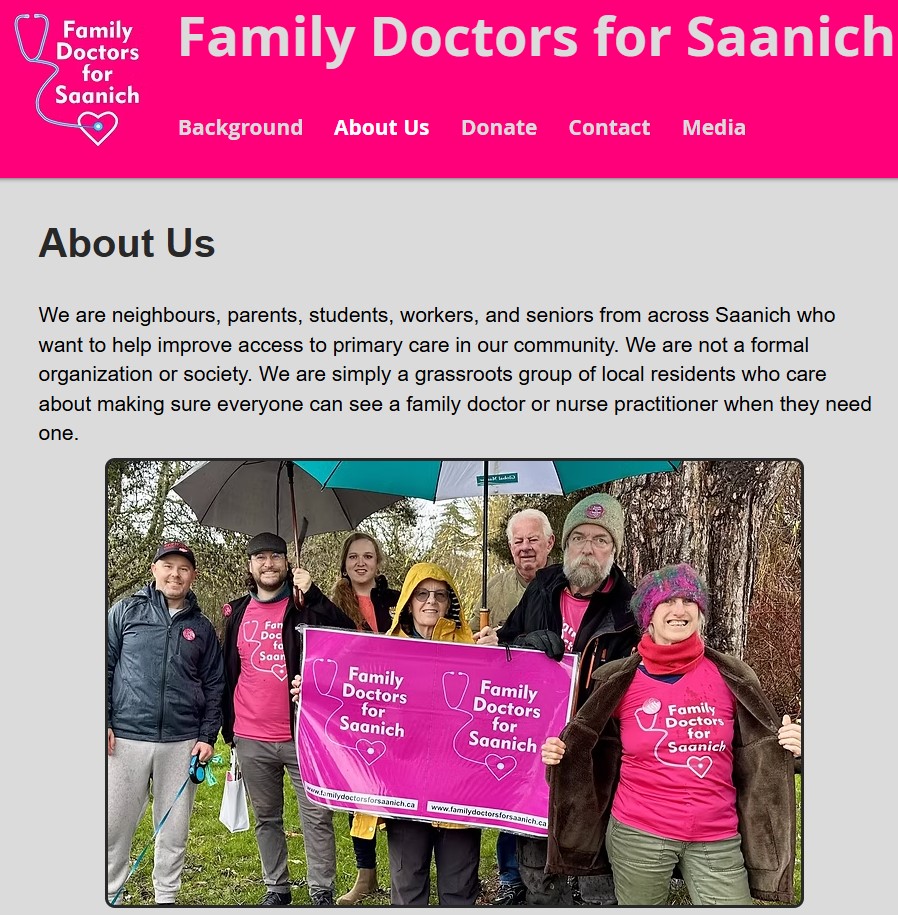
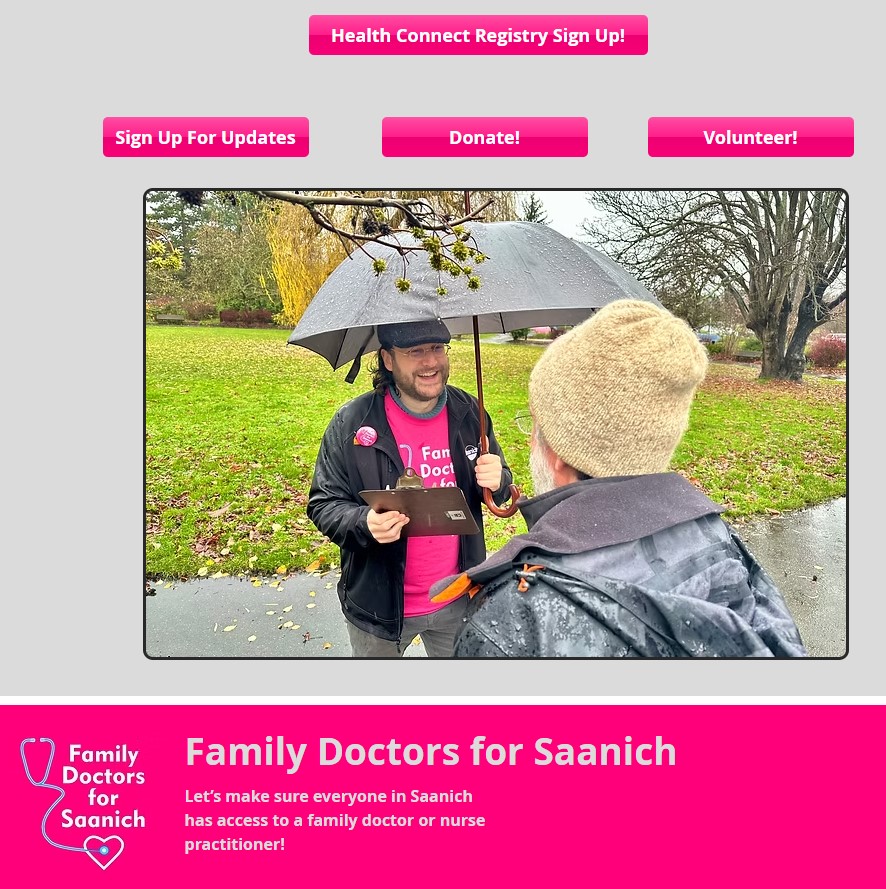
Prior to running for Saanich Council, Phelps-Bondaroff ran for the Alberta NDP Provincially.
Voter Information Service – Past results
—————————————————————————————————
Climate Justice Victoria
Another group, that practically appeared out of nowhere in time for the 2026 election. They speak about climate justice, but I can’t find an ounce of criticism for the BC NDP government’s dependence on LNG, development, and old growth logging on their website.
The About Page for the organization contains pretty much no useful information. Not one person involved with the organization appears listed on the website.
The address provided at bottom for it looks highly doubtful.
About – Join – Climate Justice Victoria
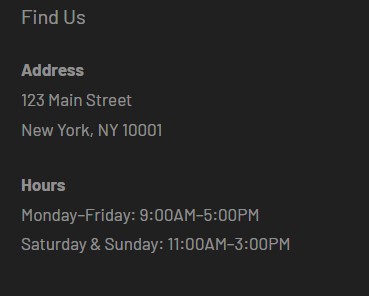
I looked up the address. The address is fictitious, however the closest related result that pops up in a google search was the following:
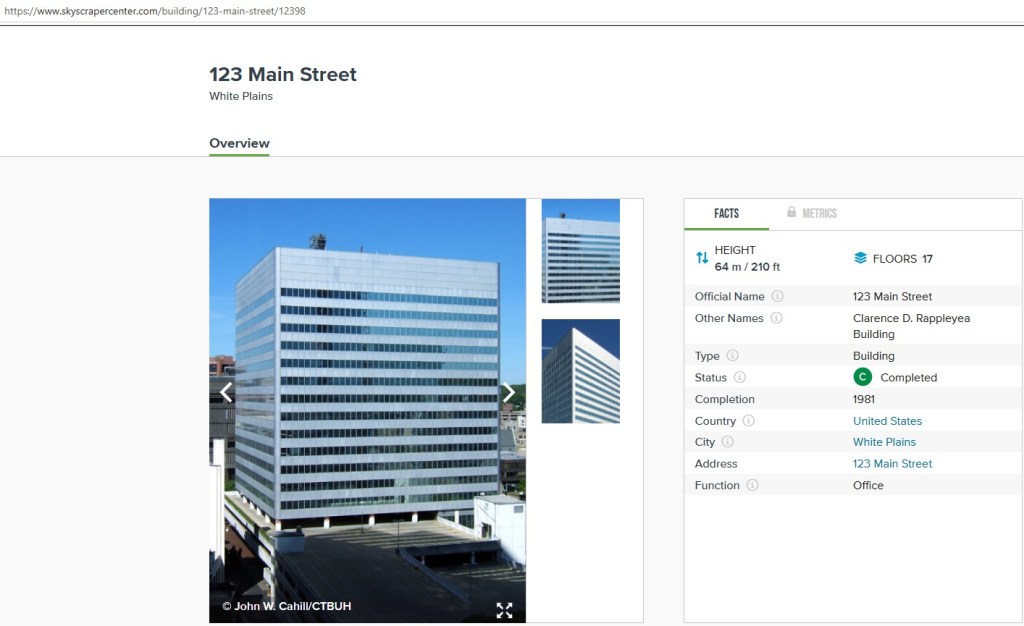
123 Main Street – The Skyscraper Center
Which is something rather poetic. It would fit with a number of these organizations having parental bases in the US, and it does fit with the urban density/skyscraper fanbase of many of these organizations. However, this is not the address of Climate Justice Victoria.
Nonetheless, it is the closest fit provided for, what looks like to be a hastily prepared website with a fictitious address just in time for the 2026 election.
—————————————————————————————————
The website does have a page though that shows a Youtube video regarding “Wheelchair users that moved to Victoria for the bike lanes.”
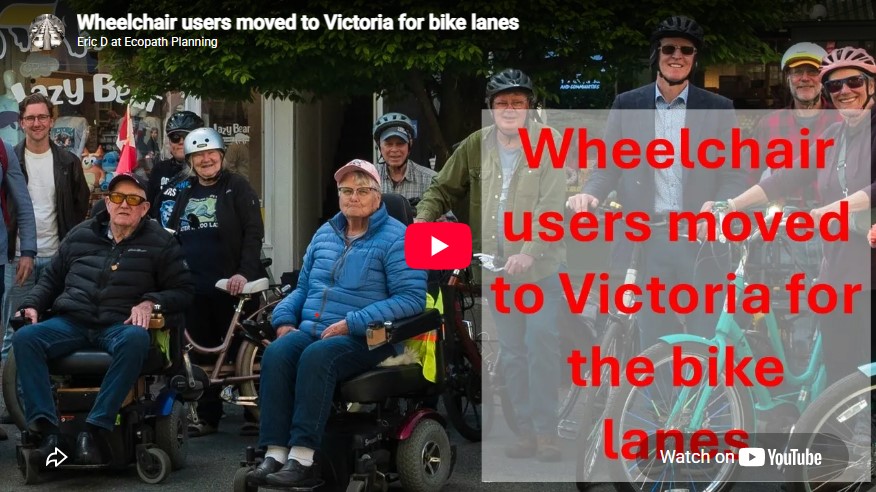
Hey look top left, is that Waldo? No, it’s Jack Sandor again.
The Facebook page of Climate Justice Victoria is actually much better than their website though and they do criticize with good criticisms the BC NDP’s failure to adopt environmental governance, while in power:
Facebook
There is some hope for this organization, but they sure need a much better website, a correct address, and an ounce of transparency at least.
—————————————————————————————————
Better Island Transit
Wow, does this sound like a clone of Better Transit YYJ, or vice versa?
The only person mentioned in its About Page at the time of writing is Todd Litman. Litman for many years has been a proponent for increasing urbanisation/increased housing density, along with more public transit.
Better Island Transit – Connecting Vancouver Island With Frequent and Affordable Transit
As the website states: “In 2023, Todd Litman appeared on CBC to present his study on improving bus service over the Malahat between Victoria and Duncan. Soon after, our group formed to support these proposed improvements, and to support convenient and affordable bus service throughout Vancouver Island. The group name, Better Island Transit, was chosen and work began in earnest.”
Needless to say, it’s pretty likely that this organization is essentially a front created by Litman himself.
Both Litman (Better Island Transit) and Sam Holland (Better Transit YYJ/Homes For Living) were mentioned in the following article 4 months ago:
Future of Victoria transit will get discussion rolling at new speaker series | Victoria News
“The event will feature Todd Litman representing the Victoria Transport Policy Institute. Litman is an internationally recognized expert on equitable transportation planning. Sam Holland from Better Transit YYJ will offer an on-the-ground perspective on bus service and rider experience.”
—————————————————————————————————
Update: I found the Members section for the Better Island Transit site, which wasn’t apparent on first view.
Todd Litman is not surprisingly the President.
Below is a snapshot of his bio on the members page on the website:
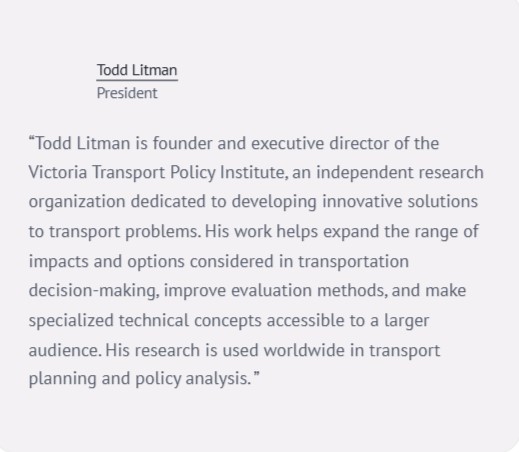
There are a number of other bios on the page. There are 2 more notable bios in regard to this article:
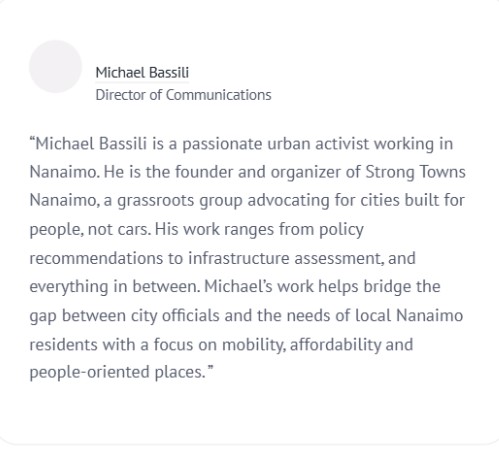
Michael Bassili
Director of Communications
“Michael Bassili is a passionate urban activist working in Nanaimo. H is the founder and organizer of Strong Towns Nanaimo, a grassroots group advocating for cities built for people, not cars. His work ranges from policy recommendations to infrastructure assessment, and everything in between. Michael’s work helps bridge the gap between city officials and the needs of local Nanaimo residents with a focus on mobility, affordability and people-oriented places.”
—————————————————————————————————
Note: it says Bassili is working in Nanaimo, but he is currently the Authorized principal and spokesperson for LivableCRD. The term bridge the gap, is one used commonly in development parlance. This is something that I have written about in previous articles e.g.:
Stop Bill M216 Before Local Democracy is Dismantled on Nov 17, 2025 – CRD Watch Homepage
Registered Organization on the BC Lobbyists Registry: Urban Development Institute (UDI) Board Directors Officiate Over ‘University of Victoria’ (“UVic”) “Student Group” – CRD Watch Homepage
—————————————————————————————————
Eric Diller is another Better Island Transit member.
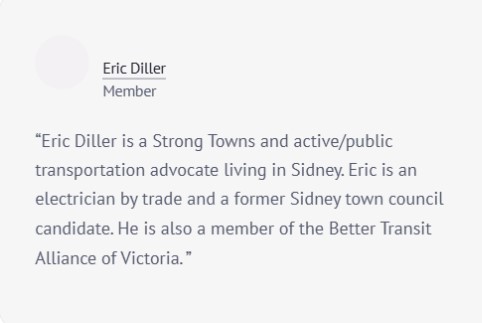
Diller’s bio on the website states:
Eric Diller
Member
“Eric Diller is a Strong Towns and active/public transportation advocate living in Sidney. Eric is an electrician by trade and a former Sidney town council candidate. he is also a member of the Better Transit Alliance of Victoria.”
—————————————————————————————————
What is notable in regards to this article is that Diller is also a member of Strong Towns like Bassili.
—————————————————————————————————
Walk On, Victoria
Walk On, Victoria is yet another coalition member that is utterly lacking in transparency. It seems that it hasn’t had a website in the last 2 years.
Walk On, Victoria is effectively a political pressure group that advances concrete-based side walks, and one of its main annoyances is trees, which are often an obstacle to sidewalks, or at the very least, an impediment to ease of passage along sidewalks. Every now and then there is an article in the paper where they are cited, using their invented term janky or jankiest to describe sidewalks that are difficult to traverse, and often the difficulty involves the presence of trees, most particularly it seems, Bylaw protected Garry Oaks.
Note: The development industry isn’t fond of trees along side walks, as they are often an impediment to massive development (think the Shelbourne trees, much of them removed in 2022 to facilitate road/bike lane/sewer/sidewalk expansion.)
On September 2, 2023 – I wrote the following email to: walkonvictoria@gmail.com
Hello Walk On Victoria,
Is it possible to view the list of donors that finance the organization?
Thank you,
Sasha Izard
—————————————————————————————————
The organization never replied.
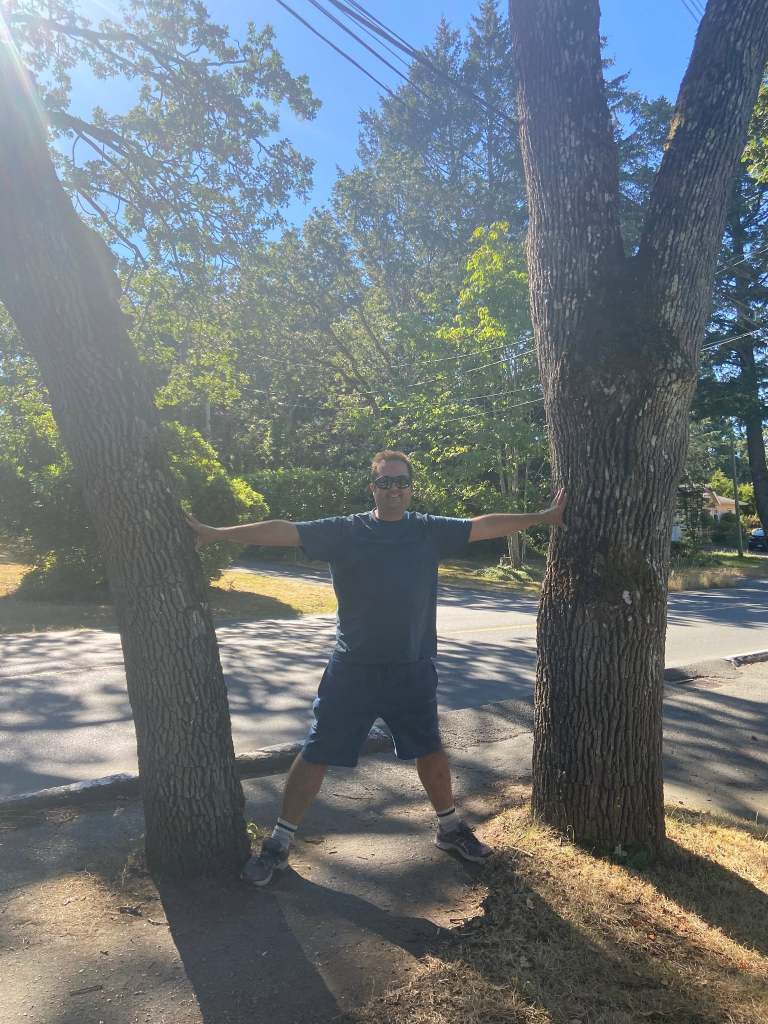
In 2022, I countered a Times Colonist article that featured Walk On, Victoria in regard to a photo, the angle of which, I considered to be misleading; as it implied that a passage was far narrower than it actually was, due to the presence of mature oak trees.
Greater Victoria’s ‘worst sidewalk’ has tree in the middle of it – Victoria Times Colonist
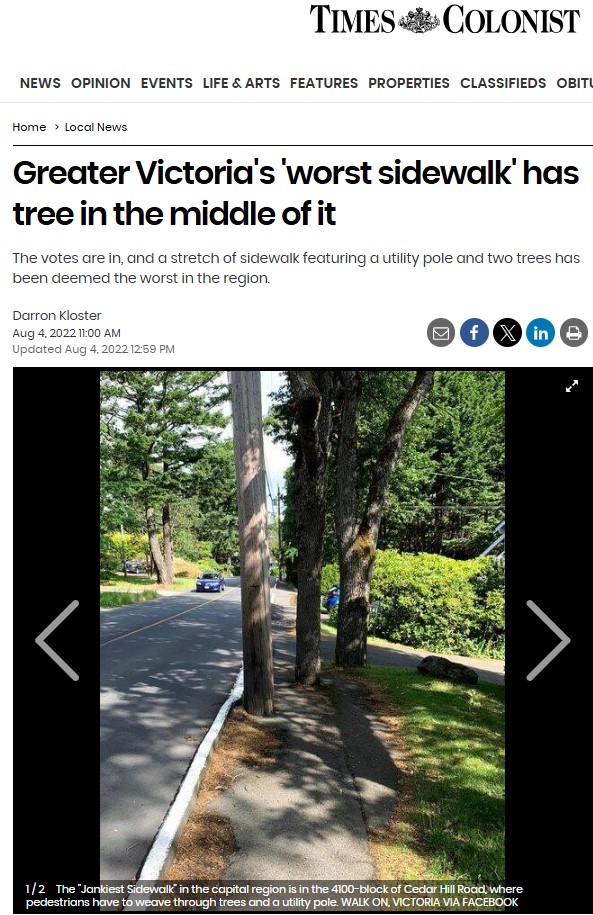
The shadows in the photo actually make the condition of the concrete area look far worse than it actually is. Also the angle of the photo makes it look like the distance between the trees is almost untraversable.
This is myself in 2022, revealing how misleading that photo from Walk On, Victoria – published in the Times Colonist, actually was:
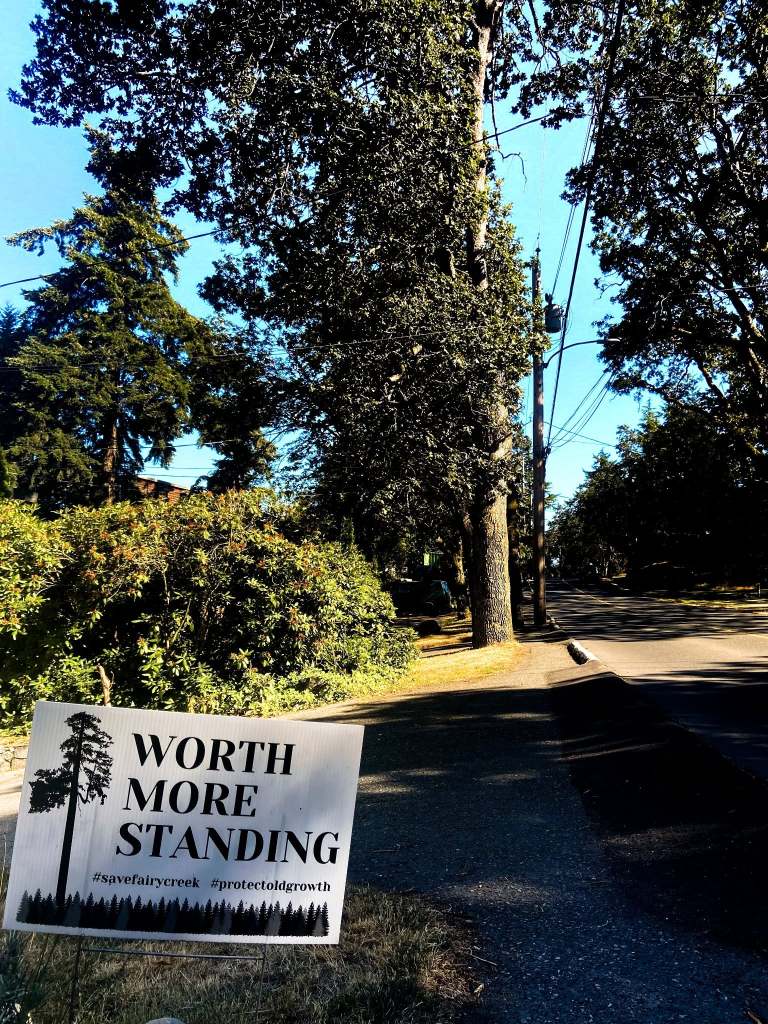
Poetically speaking, a photo of that same section, from the opposite angle to the photo taken by the Times Colonist:
—————————————————————————————————
A proliferation of Third Party Election Advertisers, an easy backdoor for laundering the source of campaign donations.
Is US-Style politics with its CPACs, SuperPACs, and Strong Towns, entering with much smaller versions, Canadian local politics?
Why is all this outside influence necessary for local council runs?
Can’t the political candidates stand alone without all this outside and untransparent backing?
Disguising the Source of Campaign Donations
A vast sea of money notoriously flows into campaigns of local government candidates during elections, from those involved in the development and real estate sectors.
List of campaign donations made by those involved in development and real estate to the campaigns of those who were elected to Saanich council in the 2022 election. – CRD Watch Homepage
Money still skewing local elections – Focus Magazine March/April 2019 – Focus on Victoria
However, what if those connected to these industries don’t want their monetary influence seen?
We already saw when Victoria Councillor Matt Dell failed to include the name of the current CEO of Abstract Developments on his campaign contributions filing to Elections BC, which was as it turned out an “infraction” as Elections BC put it.
Who is Tavish? Victoria City Councillor Matt Dell reported to Elections BC, a Tavish as having provided $500 for his 2022 election campaign, yet Dell did not provide a last name for him to Elections BC. – CRD Watch Homepage
Elections BC allows Matt Dell to get away with impunity for not disclosing the last name of campaign donor [an Abstract Executive] during the 2022 election campaign for Victoria Council. – CRD Watch Homepage
Elections BC allows Matt Dell to get away with impunity for not disclosing the last name of campaign donor [an Abstract Executive] during the 2022 election campaign for Victoria Council. – CRD Watch Homepage
Matt Dell was endorsed by Homes For Living in the 2022 election. He was one of only 2 politicians on Vancouver Island to vote to keep their local government a paying member of the Urban Development Institute development/real estate lobby.
Matt Dell at a council meeting said, “We are in the pocket of trying to build more housing in the city”.
Letter to Councillor Dell in regard to your comments during the deliberations regarding the City’s membership in the Urban Development Institute at the City of Victoria Sept 4 Committee of the Whole – CRD Watch Homepage
—————————————————————————————————
What ways can those involved in development and real estate use to disguise their campaign donations?
The names of campaign donors that donate below $100 to a candidate in a local government election are not published, meaning that they can donate anonymously.
What happens then, if they donate $99 to the candidate, and $99 to each organization that backs the candidate? I don’t know the answer, but I’m asking the question.
It seems to me highly likely that there could easily be backdoors within the third party advertising system of legally or illegally, laundering the source of campaign donations in the form of a vast sea of anonymous donations to third party election advertisers.
Over 93% of the donors to the 3rd Party Election Advertising Sponsor Homes For Living during the 2022 Local Government Election, donated anonymously. Serious questions need to be raised with the Province over the lack of transparency surrounding local government election campaign financing. – CRD Watch Homepage
Quite frankly, I think that anonymous donations should be prohibited entirely, and that 3rd party election advertising organizations should not exist.
Party orientation or influence:
The optics of overt party influence in municipal politics is often not good, and often the optics of political slates running for local government seats has not been good.
There is a good reason for this, because there are obvious conflicts of interest that come with party influence of levels of government seeking to influence other levels of government, when the levels at least in theory, should be independent from each other.
As a result, it appears to me and to many others, that most party influence in local government elections is covert, as opposed to overt influence.
Many members of the public can point to various councillors or mayors and tell you where their political affiliations are, but how many can prove it?
The use of third party organizations can be an easy way to muddy the waters around party influence, or even to launder it.
—————————————————————————————————
Many people will tell you that the BC NDP have the most aligned councillors on their councils, and often, but not always, there is an overlap with developer-backed candidates. Prove the relation, and you’ll likely have more difficulty.
Recently, the BC Conservatives announced that they would be running candidates for local government across various ridings in British Columbia.
B.C. Conservatives register new municipal party – Victoria Times Colonist
Say what you will, but at least they were being overt. However, are they and their influence always overt?
Grassroots or Astroturfing? A comparison of the Save Our Saanich EO Code of Conduct, and that of the BC Conservatives. – CRD Watch Homepage
One of the stranger episodes of the election cycle so far, is what I refer to as astroturfing recursion, when what may be an astroturf, is itself astroturfed.
It also concerns Save Our Saanich, an organization that I wrote about in this article:
How did Save Our Saanich turn from an organization of concerned neighbours, into a Political Slate with 2/3rds of its candidates having worked or continuing to work in real estate or development – in only one year? – CRD Watch Homepage
Save Our Saanich was itself astroturfed in a major way:
Pullman-gate: Government employee Edward Pullman is behind a series of spoof sites of Save Our Saanich. – CRD Watch Homepage
Pullman has also been close to Homes For Living and Capital Bike, two very influential organizations in Greater Victoria politics.
Conclusion:
The organization Livable CRD is highly untransparent, like many of the organizations that it is coalition partners with, as they seek to influence the outcome of the 2026 local government election.
3 of the coalition partners don’t even have a website at the time of writing, yet they are supposed to be the organizations the public trust to come up with a candidate questionnaire by category for the public as an election voting guide?
Where coalition partner websites do exist, their information about themselves is usually very scant. One has a fictitious address based in New York at the time of writing. Some others where they do have websites at time of writing, have no posted information as to who is running the organization or involved with it e.g. Climate Justice Victoria, and Victori’us Arts, and Livable CRD itself. Walk On, Victoria has no website at present, and neither does Strong Towns Victoria.
Where such organizations exist, often the NDP-Union-Developer-Bicycle complex is not far away, but what about the Conservative-Developer complex? That too is vying for influence in the 2026 election.
Whether covert or overt, there’s plenty of influence, advertising and money to go around for campaigns, anonymous or otherwise.
The exact nature of this new organization Livable CRD is not known. Is this an umbrella organization? Is it a central nexus to coordinate this coalition of organizations?
Outlaw biker gangs have come to operate with a corporate structure, whereby there will be an organization at the top, and smaller organizations below it, who are not directly, but are indirectly affiliated and answerable to the organization at top; thus distancing the real commanding power from them in terms of optics, and thus providing for plausible deniability about the chain of command.
Is it possible for legal bicycle groups, political parties, and lobbying organizations – to operate with a similar structure, perhaps pushing a development agenda in tangent with a transportation agenda, under the guise of environmentalism?
When have any of these ostensibly environmental leaning organizations, ever spoken about issues of urban ecology/urban tree canopy, and natural habitat loss due to construction for the purposes of profit-driven densification? I haven’t seen any of them do so. Why not? Would they be stepping on the wrong toes, if they did so?
Has Homes For Living upon being exposed after the 2022 general local government election, rebranded as Livable CRD, ready to advance the same style of election scorecard and accompanying advertising that they used to propel their development oriented candidates to majorities in several councils in Greater Victoria?
These are questions that need to be asked. Let’s hope it’s not after the election this time, that the answers turn up.
—————————————————————————————————
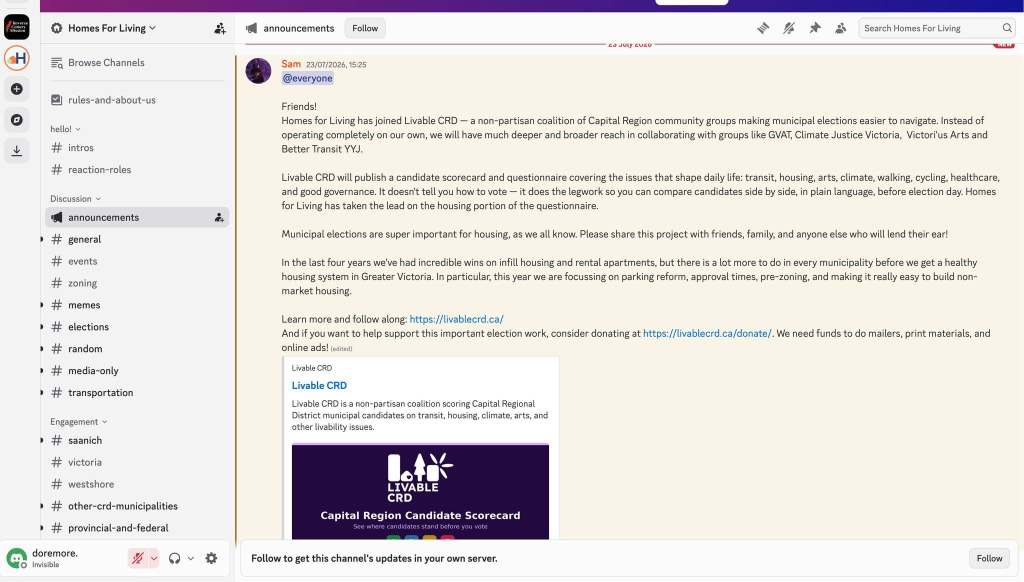
Update: The day after, I published this article, the poster Sam posted the following, sending it to all members of the Homes For Living online Discord channel:
“Friends! Homes for Living has joined Livable CRD – a non-partisan coalition of Capital Region community groups making municipal elections easier to navigate, instead of operating completely on our own, we will have much deeper and broader reach in collaborating with groups like GVAT, Climate Justice Victoria, Victori’us Arts and Better Transit YYJ.
Livable CRD will publish a candidate scorecard and questionnaire covering the issues that shape daily life: transit, housing, arts, climate, walking, cycling, healthcare and good governance. It doesn’t tell you how to vote – it does the legwork so you can compare candidates side by side, in plain language, before election day. Homes For Living has taken the lead on the housing portion of the questionnaire.
Municipal elections are super important for housing, as we all know. Please share this project with friends, family, and anyone else who will lend their ear!
In the last four years, we’ve had incredible wins on infill housing and rental apartments, but there is a lot more to do in every municipality before we get a healthy housing system in Greater Victoria. In particular, this year we are focussing on parking reform, approval times, pre-zoning, and making it really easy to build non-market housing.
Learn more and follow along: https://livablecrd.ca
And if you want to help support this important election work, consider donating at liveablecrd.ca/donate/. We need funds to do mailers, print materials and online ads!”
—————————————————————————————————
See also:
Index of articles and other resources regarding the organization: ‘Livable CRD’ and its coalition partners. – CRD Watch Homepage
‘Livable CRD’: Grading candidate answers – what are the names? It’s a secret! – CRD Watch Homepage
Emails with Livable CRD and partner organizations, show a pattern of evasiveness as to the identity of those involved who will be grading candidates for the 2026 election. – CRD Watch Homepage
Greater Victoria Acting Together (GVAT) appears to be run by a member of the political pressure group Homes For Living. – CRD Watch Homepage
The formation of Greater Victoria Acting Together (GVAT), and its relation to the Industrial Areas Foundation in the US – CRD Watch Homepage
Press release: Livable CRD coalition to launch candidate scorecard for Capital Region municipal elections | Livable CRD
Index of Articles and other Media Coverage about Homes For Living – CRD Watch Homepage
Index of documentation covering the UVic Real Estate Club and development industry influence over it. – CRD Watch Homepage
How an industry-spawned Vancouver-centric ‘YIMBY’ narrative has severely twisted B.C. NDP housing ideology and massive legislation changes (Bills 44, 46 and 47) | CityHallWatch: Tools to engage in Vancouver city decisions
LETTER: Local governments should distance themselves from lobbyists | Saanich News
Front organization – Wikipedia
Astroturfing – Wikipedia
Deliberative Polling: Part of the toolbox of democracy, or part of the ever growing toolbox against democracy? – CRD Watch Homepage
Local Third Party Advertising Rules | Elections BC
Propaganda – Wikipedia
Stop Bill M216 Before Local Democracy is Dismantled on Nov 17, 2025 – CRD Watch Homepage
Index of articles regarding Law and Bylaw – CRD Watch Homepage
Index of articles revealing major lobbying influence on B.C. Provincial Housing Bills and Housing Targets. – CRD Watch Homepage
Index of articles about lobbying influence on the City of Victoria and deliberations regarding it. – CRD Watch Homepage
—————————————————————————————————
Appendix 1: Homes For Living Candidate Endorsements in 2022.
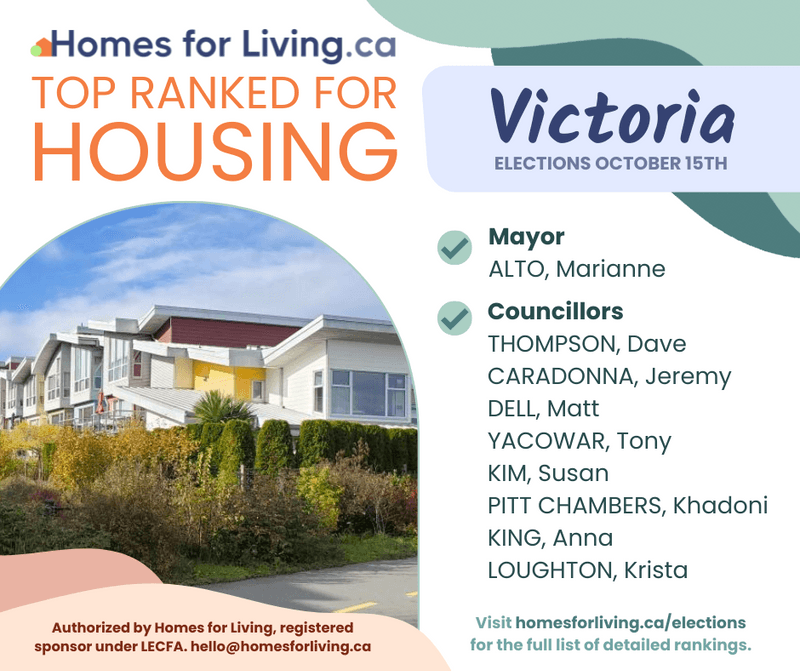
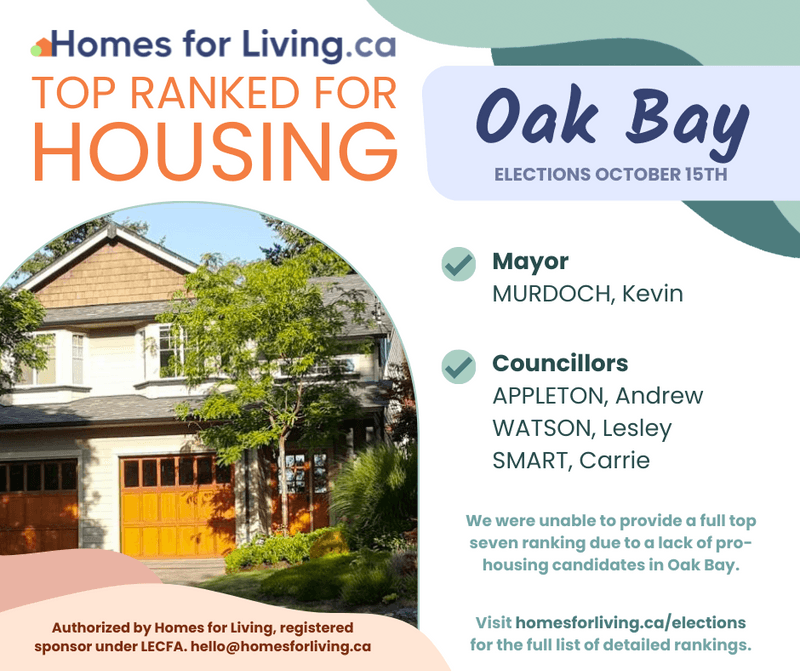
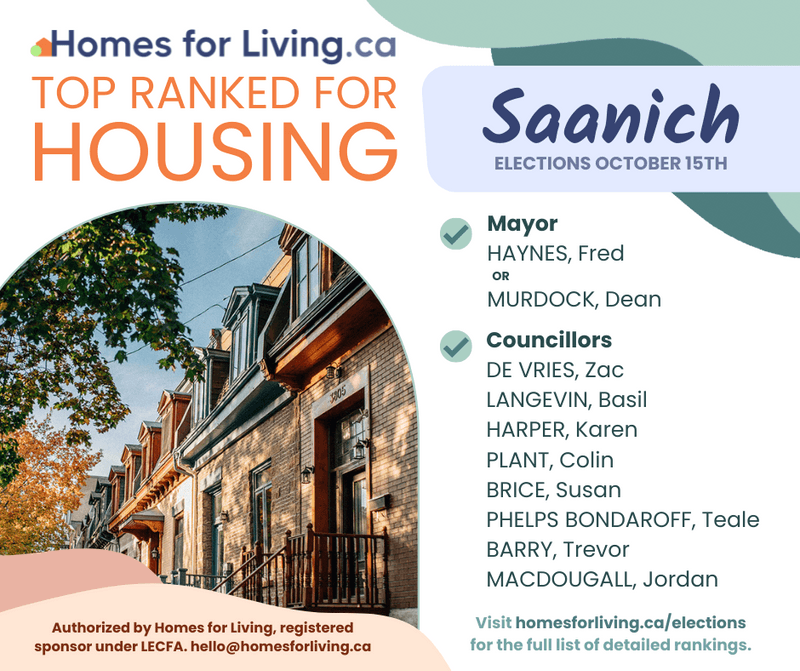
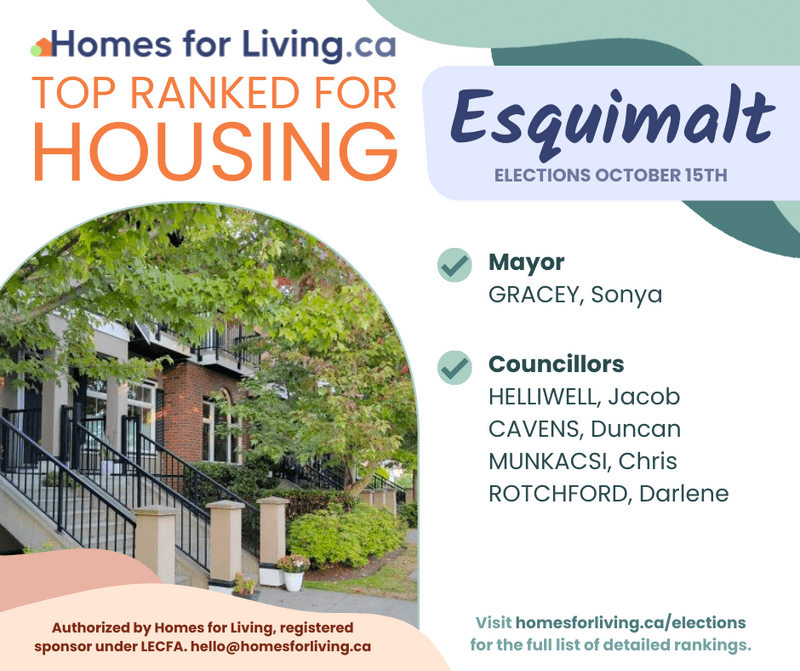
Archived snapshot:
Ranking Victoria candidates on housing
—————————————————————————————————
Appendix 2: Third Party Sponsors list for the 2026 General Local Elections from Elections BC, July 25 2026.


Leave a Reply