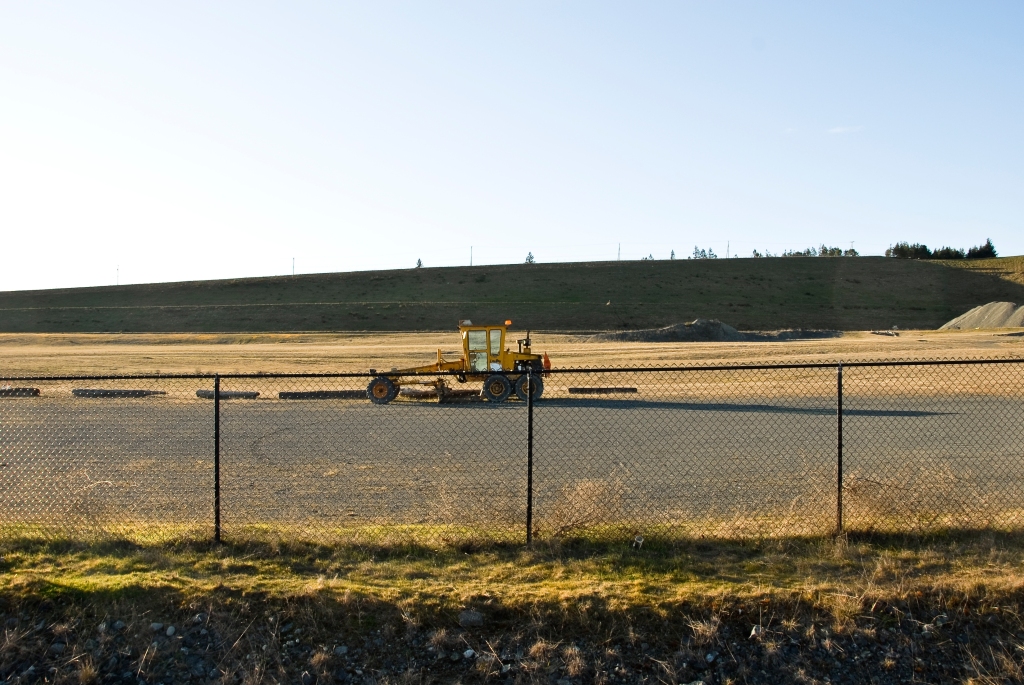
From Civic Square to Splash Park – Part 1
The History of Victoria’s Centennial Square and How Its Current Municipal Government Nearly Destroyed It
Part 1 of a two-part series
by Mary Fowles
Sept 9, 2026
—————————————————————————————————
The writer Gertrude Stein once infamously said upon returning to her hometown of Oakland, California, after 45 years away: “Whenever you get there, there is no there there.” In one line, she described a dysphoric sense of urban drift defined by nondescript development instead of belonging. This line has come into my head several times over the years as I’ve thought about how Victoria’s Centennial Square was nearly erased by our current municipal government, and what the consequences would have been if they’d succeeded.
A civic square – one that is built at the site of a city’s municipal government – can be said to represent the fulcrum of civic life. On a good day, it symbolizes the hope and optimism that defines the public good; where an oath of public office joins the spirit of transparent discourse, decisions, and plans. That place where the people and its elected government intersect.
In Victoria’s civic square, something additionally magical grew over the years. A towering Giant Sequoia—unceremoniously planted on a cold, late-winter day in the early 1980s by three men from the city’s horticultural crew—is today healthy, alive, strong, and beautiful. It seems to want to prove, as if by metaphor, that all the things which are good about civic governance can still declare their rightful place in the world.
And yet, it too was nearly destroyed. One single vote in council chambers on July 4, 2024, to adopt plans drawn up for a “Centennial Square Revitalization Project” included dismantling not only much of the historical architectural elements of the square, but also cutting down the sequoia tree. Six of our nine current municipal leaders, including the city’s own Mayor, voted in favour. This decision has since been paused indefinitely – but the threat that the plans might one day be picked up again still looms.
The Story of Centennial Square and What We Nearly Lost
The story of Centennial Square begins with Victoria’s one-hundredth birthday which took place on Aug. 16, 1962.
One century earlier, in 1862, Victoria had been incorporated as a city, enfranchised with the legal right to form its first municipal government. This marked the vital moment of transition from the corporate colonial rule of the Hudson’s Bay Company, which had established “Fort Victoria” for the purposes of fur trading, into one of an established municipal democracy. Victoria’s City Hall was built about 15 years later.
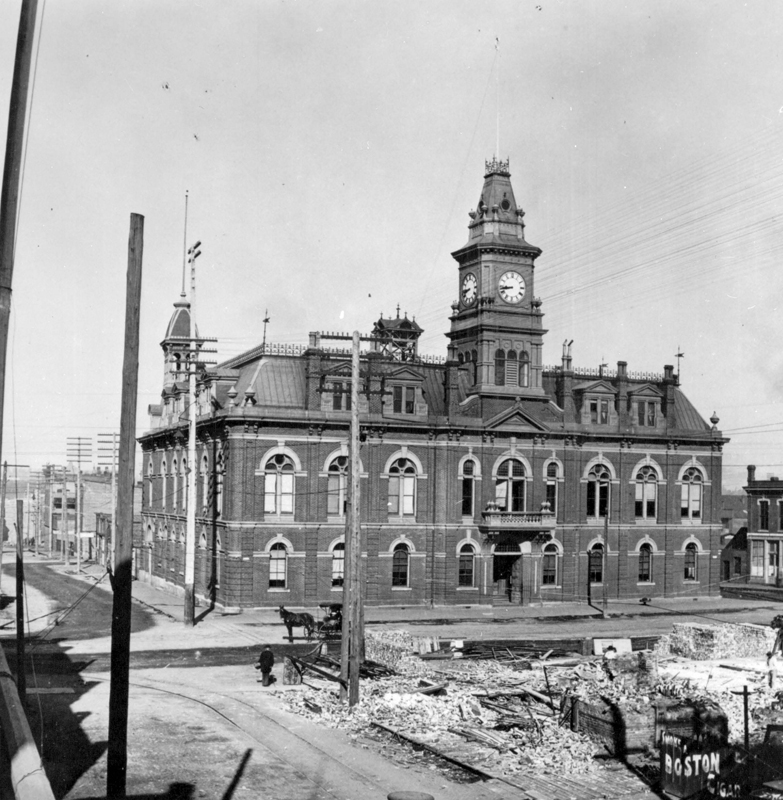
Reviewing archival newspaper articles published in the ‘60s, one discovers it was Victoria’s Mayor Richard ‘Dick’ Biggerstaff Wilson who sought to seize the opportunity before him. Because the 100th anniversary of the city coincided with his tenure, he saw this as the perfect chance for a ‘rebirth’ of Victoria. There would have been no square at all if it had not been for Mayor Wilson’s vision.
Wilson wanted a centennial project that would become a “worthy permanent memorial” of the 100th anniversary of the city’s incorporation. He envisioned a four-acre landscaped civic plaza to punctuate the new and exciting times – it was the ‘60s, after all. A civic square would “attract people to come alive” and be “a new heart to throb new life” into the downtown. Moreover, it would signify the city’s pride in being BC’s capital.
The announcement for this ambitious centennial project took place during the week of the landmark Centenarian celebrations. A time capsule filled with 1962 artifacts, including letters that the mayor and council penned to their unborn successors, was buried underground, to be dug up in 100 years.
A money bylaw vote took place on “one of the most imaginative plans ever presented for local approval.” The plans received a “magnificent endorsement” from property owners who voted in December 1962. Then the project got underway.
A Centennial Square Committee formed, chaired by A.W. Toone. It was composed of “the city’s best designing and architectural brains.” The design team would develop the plans for the square and have veto power over the final decisions.
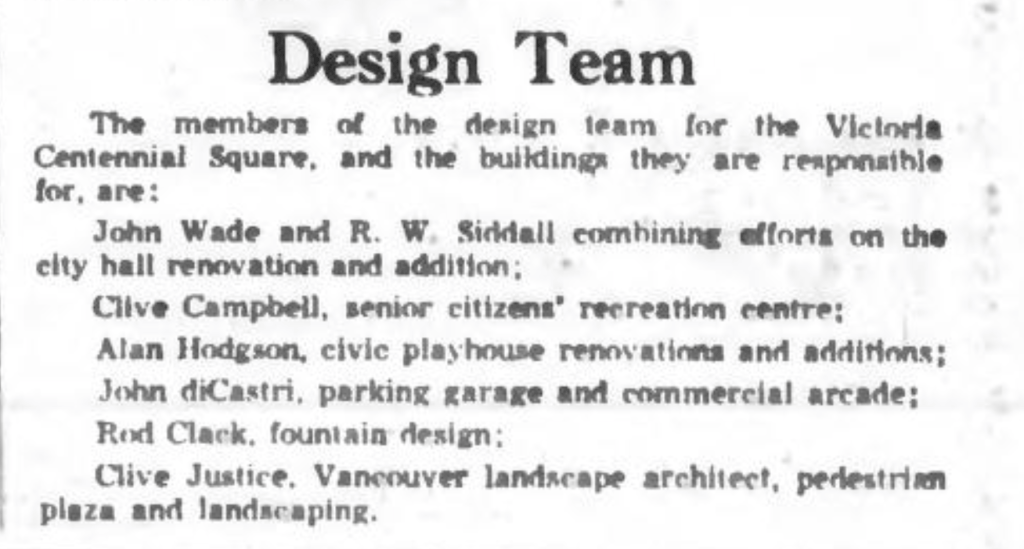
“City council insisted that the project should have the participation of as many Victoria architects as possible of the first rank,” reported The Colonist, “to make the square a community endeavour.”
The city sold off some of its land to find the $1,655,000 that was needed for the project. A 300-car parking building was planned with the understanding that the income it generated would pay for itself in the years to come.
When the preliminary architectural plans for the civic plaza were unveiled in August 1963, Mayor Wilson declared the designs “perfectly delightful” and “pretty near perfect.”
The square would be an “urban pedestrian park” that unified the cultural and social institutions that sat on its periphery. “A great deal of study was given to the movement of people through the square and the effect of this on the placement of buildings,” reported The Daily Colonist.
The historic City Hall would remain, but would be completely refurbished. New council chambers and office spaces would be built for the growing civic staff. A civic Playhouse refurbished from what was then called Pantages Theatre would now be named the McPherson Playhouse and have a new foyer opening out onto the square; the theatre would have convention facilities and a theatre restaurant fronting the square. A drop-in activity centre for “oldtimers” would provide a hot meal every day. A police station would be tucked into one side. And the new parking building would be designed by local modernist architect John A Di Castri. A shopping arcade, also overseen by Di Castri, would draw people to six new specialty shops. This would start a “chain reaction” to inspire private enterprise in the surrounding commercial areas. The new square would “bespeak confidence in the economic future of the town” and transform the otherwise “run down” and “deteriorating area”. It also promised to boost residential property values – particularly important.
At the centre of it all would stand the square’s real marvel. Early renderings in August 1962 depicted a circular centennial fountain – still in concept phase. The fountain was crucial to the design because of how it would “unify all the buildings that make up the square and provide a focal point for the surface design consisting of concentric circles.” It served as a magnet pulling the disparate elements of the square into one cohesive whole.
The “ornamental fountain” would be a Centennial gift to the city from its three neighbours, the municipalities of Saanich, Oak Bay and Esquimalt who each agreed to split the $30,000 costs.
“Ceramic letters eight inches high will be placed on the surface of the square around the pool commemorating the gift,” The Colonist reported.
This centrepiece was envisioned to be “a lively centre of community life and the focal point of civic pride and amity.”
It was unanimous that the “new, open breathing space for the city” would have an architectural character that conveyed none other than “a dignified and gracious environment for this facet of civic government.”
Victoria’s 85-year old City hall was at the time flanked on every side by paved city streets. Thus, creating the 4-acre civic precinct first required a massive demolition job.
“Broad Street between Pandora and Cormorant, and Cormorant Street between Douglas and Government, had to be wiped out,” wrote a reporter in November 1963.
Over the next several months, the streets that were in the way were levelled into a “blasted heath,” with the promise that the rubble pile would soon “blossom into Centennial Square.” During construction, the city’s office workers temporarily moved into an old courthouse in Bastion Square, where rent was obtained at “bargain rates.”
During the demolition, the city enjoyed an unexpected “quiet boom” as the unearthed historic bricks could be sold off to US markets for decorative purposes.
The natural 10-foot downward slope that occurred in the terrain from Douglas to Government street would be resolved by terracing the plaza, thus inspiring a design that had a circular motif, conceptualized by consultant landscape architect Clive Justice.
Construction on the Centennial Square Civic Plaza was completed in several stages with most contracts going out to tender in the early part of 1964.
To kick off construction, in August 1963 the Lord Mayor of London, Sir Ralph Perring, was invited to plant the first tree, a sapling, in the downtown centennial square landmark. Of the gardens that were planned for the square, he is reported to have said: “It will give us the kind of oasis any city with pride in its bones like to plant in the midst of its hurly-burly.
“This will be a permanent lung for the town to breathe through.”
Columnist Tom Taylor remarked poetically–perhaps eerily foreshadowing the future of the square and its towering Sequoia–“It takes some years before a tree can dominate the scene and cast its shade over those who like to sit under it. Seats there will no doubt be for loiterers to whom the square will come like a blessing from heaven.”
Architect and City Planner Roderick Clack designed the fountain’s white circular tiara, made of pre-cast concrete. The tiara – sitting like a crown– surrounded a 40-ft diameter reflecting pool which, Clack said, sought to complement the feeling of an important civic square with an architectural form “designed to have an enduring appearance rather than being way out and risk becoming dated.”
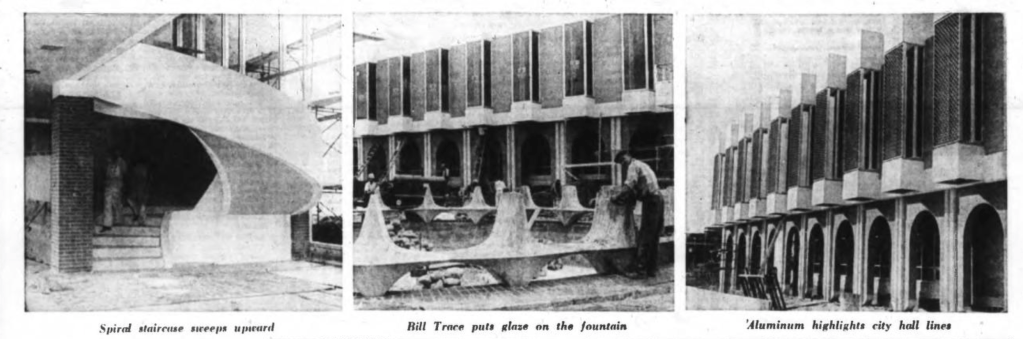
“There is a simple strength in the design,” one writer said, “that promises the fountain will not be looked upon in the future as an example of transient modernity.
“It provides for the most attractive use of cascading water and night lighting, and it contains a wealth of symbolism.”
The committee commissioned local artist Jack C.S. Wilkinson to create the three mosaic-studded monoliths onto which he designed their mystical and mysterious motifs.
Wilkinson had studied painting, sculpture and design in England, and then under Czech-born modern/abstract artist Jan Zach who had lived in Victoria in the ‘50s.
He was also a staff artist with the provincial government department of public works, architects branch, and was later the provincial coordinator of art, overseeing the pieces that would hang in the foyers and on the walls of provincial buildings. In his time, he procured over 600 pieces of public art for the provincial government.
“Imagine how it changes the image of how people see bureaucracy and government, and how bureaucracy sees itself,” he said later, in 1972, speaking of the impact of good art in public areas of government buildings.
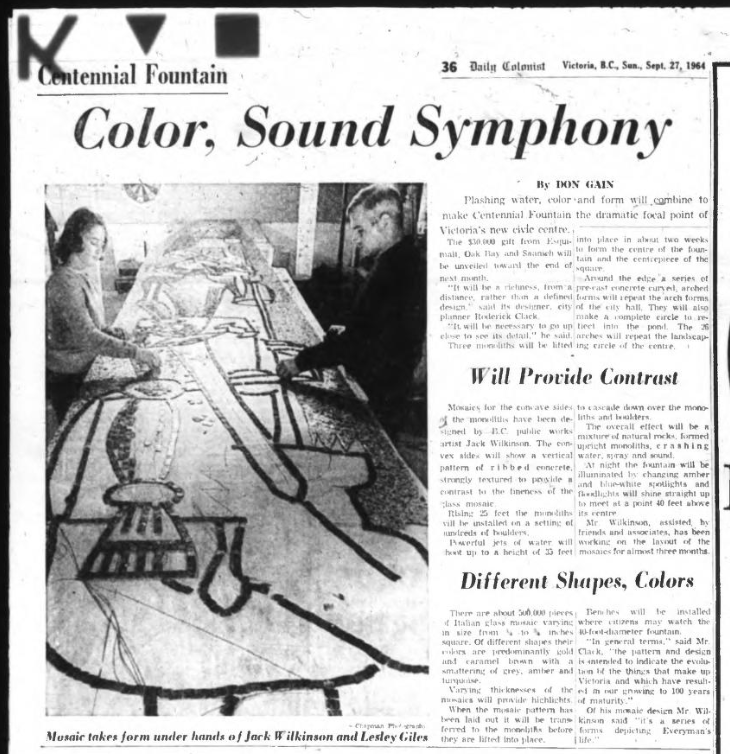
Each monolith, finished in shimmering gold, nodded and gleamed toward one of the neighboring municipalities that had gifted the fountain. “A triple jet of water gushing more than 30 feet in the air,” The Colonist reported, would “cascade over the three monoliths” that rose 21, 24, and 29 feet high. On a hot day, wrote Tom Taylor, “it will refresh the spirit.”
It should be recorded, wrote one commentator, that “the boulder floor of the pond represents the rocky coast; that the gold glass mosaic surface on the monoliths is a reminder of Victoria’s gold rush history, and that the ring of pre-cast concrete forms around the pool, like a crown, stands for royalty in the person of the Queen after whom the city was named.”
After dark, a ring of soft amber light beaming from the edges of the tiara, would meet at 50-feet above the fountain and “cast a diffused glow on the monoliths.”
The gardens were another feat.
The Centennial Square Committee was bombarded with offers of tree and shrub donations, including roses gifted from the Victoria Horticultural Society to create a rose garden in the square. Native Garry Oak and Arbutus trees were to be planted in several areas of the square, to adorn the place as “sculptural elements.”
A sunken European-style “knot garden” planted near the theatre restaurant and “specifically oriented for the sun,” would be planted with flowers that changed with the season. The flowers “will bloom in intricate formal patterns,” wrote one reporter, and “for best effect should be viewed from above.”
Since the garden was sunken, “one comes upon it as a surprise in the square,” said Justice.
Clack recommended mature trees be transferred to the square during the fall and winter of 1965–66 to achieve “immediate spectacular effects in plans for the revitalization of the downtown area.”
In November 1964 the refurbished historical City Hall opened in a ceremony presided over by Mayor Wilson, Toone, and Lieutenant Governor of British Columbia, George Pearkes. They cut a ribbon to the new “dignified civic headquarters”, and Toone was handed the keys.
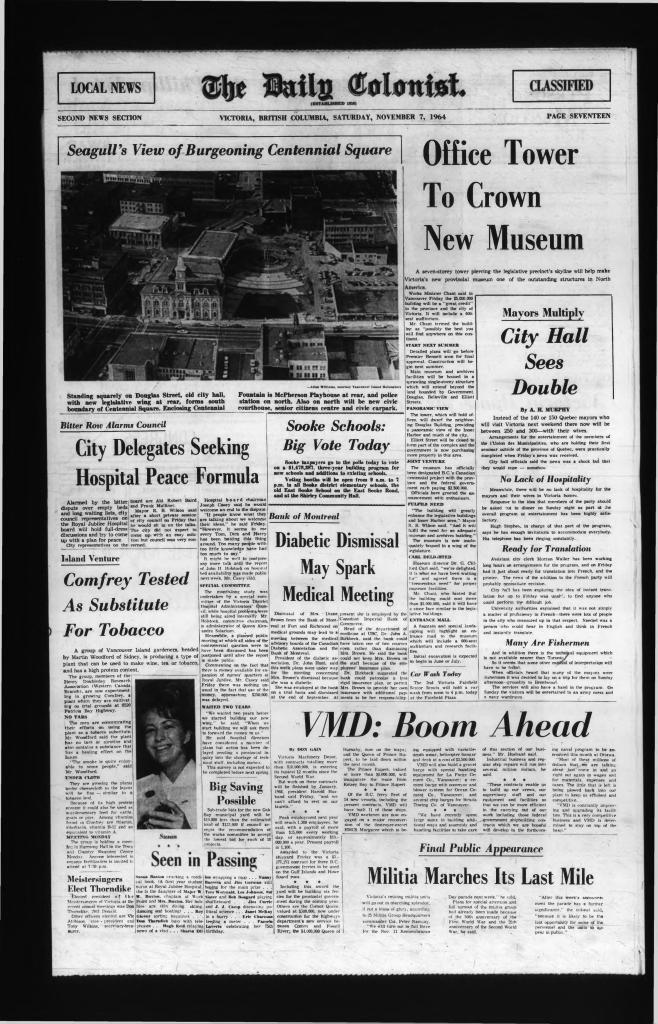
Next, a ceremony to open the fountain took place, with the reeves of the three municipalities that had gifted it to Victoria switching on the fountain’s coloured lights for the first time.
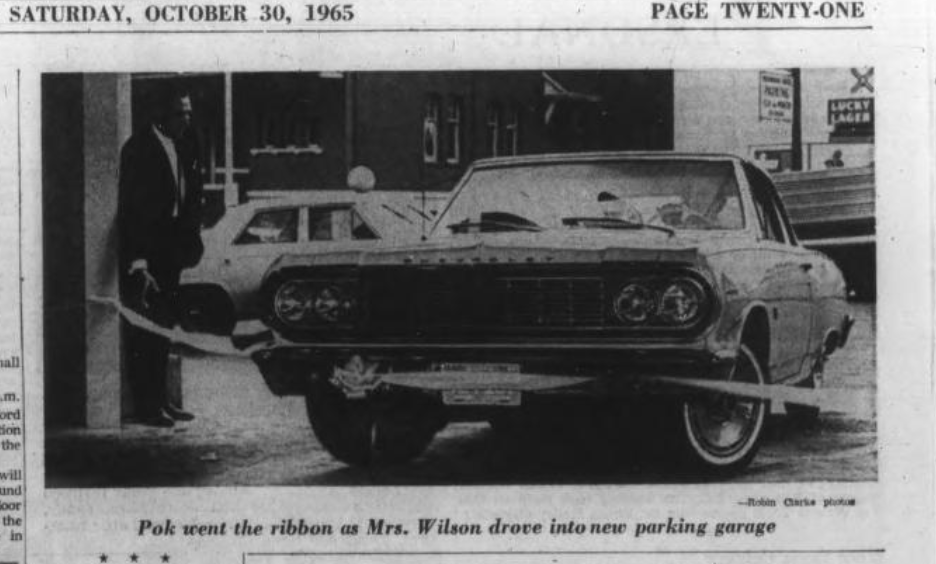
Finally, in October 1965 Mayor Wilson’s wife “snipped” a silken ribbon to the Di Castri car park by slowly driving through it in her car.
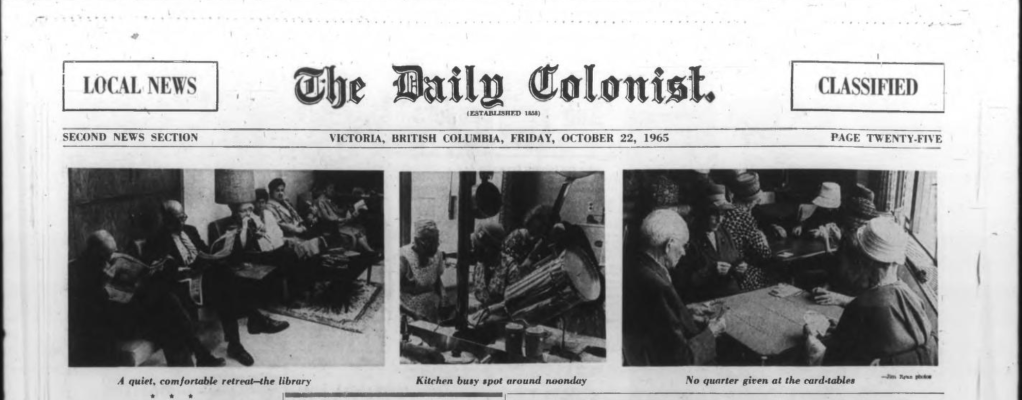
When the seniors’ centre opened, 300 seniors registered, and it was “jumping from the start.” Here, they could get a “hot noonday meal” for only 50 cents. “Many only have a hotplate at home and that means they subsist on a diet of tea and toast,” reported The Colonist. At the centre, they could play cards or do leatherwork, ceramics, painting, weaving, sewing, or just read the paper in an easy chair, then in the afternoon head home on foot, “the stronger helping the weaker,” before rush-hour traffic.
The Centennial square project was considered “the most desirable local improvement ever taken,” and “Victoria’s most ambitious beautification project yet.”
On June 4, 1965, Wilson and Clack were invited to Ottawa as guest speakers at a national seminar attended by city planners from across Canada. Victoria’s beautification program had garnered nation-wide recognition, and was hailed as a model at a time when civic projects were being executed across the country to commemorate Canada’s 1967 centennial year.
When Eileen Learoyd, a journalist for The Daily Colonist visited the new square after its completion, she described the experience as a miracle. “Words nearly fail me,” she wrote, spellbound. “It is beautiful, poetic, and quite fit for the soft footsteps of Hamlet and Ophelia.”
“Mayor Wilson is a man who plants trees,” she said, “encourages the growth of the kind of beauty that will make Victoria fair.
“He has provided the leadership, and inspiration and imagination to see such projects created as we have never seen before.”
If only Victorians today could be so lucky.
In Part 2 of this two-part series “From Civic Square to Splash Pad” Mary Fowles explains how our current municipal government nearly erased the heart of Victoria’s civic history with one vote.
—————————————————————————————————
See selected archives here: Newspaper Clippings
—————————————————————————————————
See also:
From Civic Square to Splash Park – Part 2 – CRD Watch Homepage
Index of documentation related to Centennial Square and the Sequoia – CRD Watch Homepage
Index of CRD Watch articles concerning the environment/ecology. – CRD Watch Homepage


Leave a Reply