Gordon Head Is Losing 60% of Its Social Housing — And the Speakers Who Said So Were Shut Down
By Kyla Berry,
CRHC Tenant, Gordon Head, Saanich
June 24, 2026
—————————————————————————————————
On June 16, 2026, Saanich Council adopted the Quadra–McKenzie Plan. Three people who tried to raise the subject of the non-market housing crisis unfolding in the plan corridor were stopped mid-address by the presiding Mayor. All three are on the meeting recording. Here is what they were trying to say — and why it matters.
—————————————————————————————————
What Happened on June 16
The Quadra–McKenzie Plan (QMP) public hearing on June 16, 2026, was the last formal democratic forum at which community members could raise concerns about the non-market housing crisis in the McKenzie corridor. By that point, every earlier mechanism for doing so had already been closed off by a chain of policy decisions. The QMP hearing was not a planning formality. For the tenants facing displacement through the Rosewood-Willowdene development permit, it was the only podium left.
Three people used it. All three were stopped mid-address by Mayor Murdock. Only one faced a formal parliamentary ruling.
First: Donna Van Dyke, Vice-President of Save Our Saanich Neighbourhood Society, was stopped mid-address from the gallery by Mayor Murdock and directed to refrain from speaking on land use decisions.
Second: Kyla Berry — a blind, sixteen-year resident of Rosewood Apartments — was stopped mid-address at the podium and directed to refrain from speaking on land use decisions and from referencing the “Nothing About Us Without Us” Notice of Motion that had been before Council the previous evening.
Third: Councillor Natalie Chambers was the only participant to have formal parliamentary procedure used against her — a point of order raised at the Council table while she was advocating for Indigenous partners and disabled residents. Addressing the Mayor directly, she expressed intimidation and could not finish her questions to staff before the vote.
The QMP was adopted that same evening (six for, two opposed), pending the third bylaw reading. The Rosewood-Willowdene development permit — which will displace the tenants who tried to speak — was already twenty-six days into a decision-maker’s review at the District of Saanich. The plan was adopted. The speakers were silenced. The permit continued advancing. All on the same night.
—————————————————————————————————
What Community Advocates Were Trying to Warn Council About: The 60% Loss of Nonmarket Housing
Gordon Head historically had 119 units of non-market housing across four Capital Region Housing Corporation (CRHC) properties. Here is where that housing stands today:
Campus View (2249 McCoy Road) — 12 units. Already demolished in October 2025. Replacement not expected until 2027–2028.
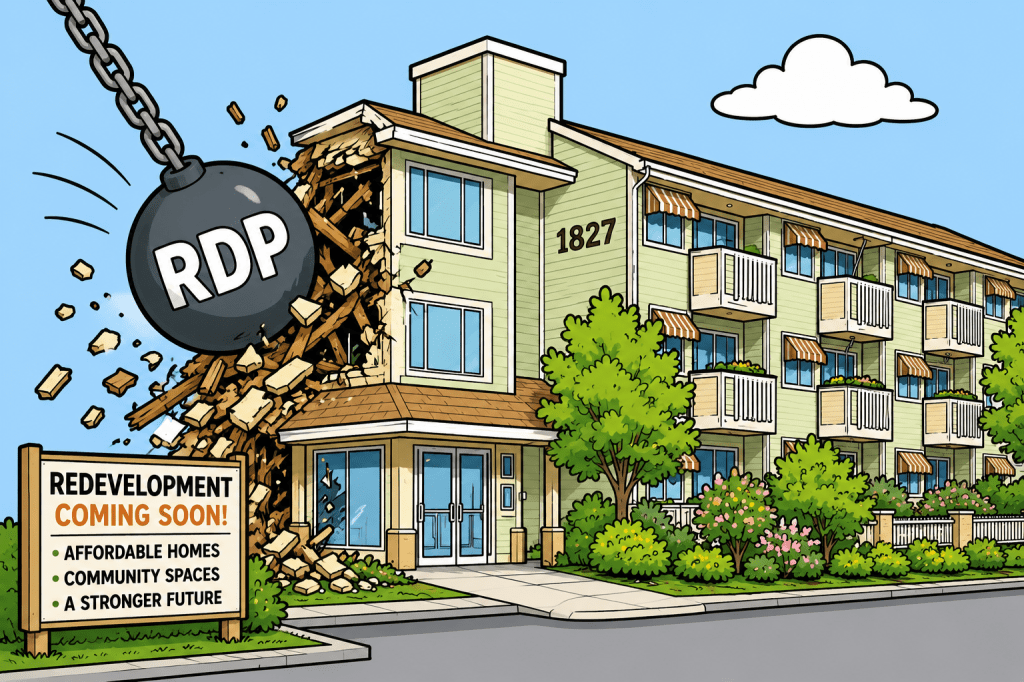
Rosewood Apartments (1827 McKenzie Ave) — 44 units. A demolition and redevelopment permit is in active review at the District of Saanich. Demolition is conditional on permit approval.
Willowdene (1821 McKenzie Ave) — 15 units. Part of the same permit application as Rosewood.
Beechwood Park — 48 units. The only Gordon Head CRHC property not facing a current demolition permit. All 48 units are occupied. Zero vacancies.
If the Rosewood-Willowdene permit is approved and demolition proceeds on the current timeline — as early as late 2026 — Gordon Head will be losing a total of 71 units: the 12 already demolished at Campus View, plus 59 more at Rosewood and Willowdene. Only 48 units at Beechwood Park will remain for approximately three to four years, until the replacement building at 1800 McKenzie is ready. That building is not expected to be habitable until approximately mid-2030.
That is a reduction of nearly 60% of Gordon Head’s non-market housing capacity — for three to four years. This is what the three speakers on June 16 were attempting to put on the record before they were stopped.
Replacement Is Not New Supply
The 259 units proposed at 1800 McKenzie are not completely new affordable housing. They replace the 59 units being demolished at the same address. Gordon Head is not gaining 259 units. It is losing 59 now and getting 259 back — in a mixed-income format — approximately four years from now.
Under the Community Housing Fund’s mixed-income model, roughly half the new units will be rent-geared-to-income; the remainder will be near-market or market-rate. That means fewer deeply subsidized units in a building four times larger.
The only project in the Gordon Head pipeline that represents a genuine net addition to non-market housing is the Cedar Hill Library development: approximately 210 units on a former municipal library site, with no existing social housing demolished to build it. It will not be ready until 2030. Until then, Gordon Head’s social housing capacity is contracting, not expanding.
Beechwood Park Is Not a Safety Valve
The obvious question: can displaced Rosewood and Willowdene residents transfer to Beechwood Park while construction proceeds? No. All 48 units are occupied. There is no room next door.
This is especially acute for power wheelchair users in Rosewood’s four designated accessible suites, which have been continuously occupied by long-term power wheelchair users for over two decades. All relocation offers made to date have been outside Gordon Head (and outside greater Saanich). There is no equivalent wheelchair-accessible social housing available in the neighbourhood during the construction gap.
Beechwood Park contains only one wheelchair-accessible suite — and it is itself occupied.
Anthony Hanna, a thirty-year Rosewood tenant and power wheelchair user, has described the choice he and his neighbours have been given no one should have to choose between a fully accessible unit in an unsafe location, or an accessible neighbourhood without an accessible unit. Those are not two versions of an acceptable outcome. They are two versions of the same harm. Anthony has consented to be contacted by journalists through Kyla Berry.
The Sequencing Asymmetry: One Zoning Change, Two Different Outcomes
Here is something that does not appear in any CRHC communication about the Rosewood redevelopment: Beechwood Park sits under the same rezoning framework that set this process in motion. On February 26, 2024, a rezoning hearing took place at Saanich Municipal Chambers — with no advance notice to Rosewood or Willowdene tenants, who learned about it from a newspaper article two days later. That rezoning covered the broader McKenzie corridor, under which Beechwood Park also falls. If CRHC seeks a development permit for Beechwood Park in the future, it will proceed under the same zoning that is now being used to advance the Rosewood-Willowdene permit.
What will be different is what exists in the neighbourhood when that permit is sought. By the time Beechwood Park might face redevelopment, three projects will be completed and accepting residents: the rebuilt 1800 McKenzie development (259 units), the rebuilt Campus View (119 units), and the Cedar Hill Library affordable housing development (approximately 210 units). Beechwood Park tenants will have in-neighbourhood relocation options. They will be able to move within Gordon Head while their building is reconstructed.
Rosewood and Willowdene tenants have none of those options. They are being displaced now, while all three replacement projects are simultaneously under construction. There are no in-neighbourhood CRHC vacancies. The neighbourhood options that a properly sequenced timeline would have preserved simply do not exist for the tenants displaced first.
This is not a difference in policy. CRHC’s internal relocation policy applies equally to all its Gordon Head tenants. The difference is purely the order in which permits were advanced. The only reason the sequence cannot simply be adjusted is funding: the Community Housing Fund financing model ties construction to capital commitment schedules that do not pause to wait for in-neighbourhood vacancies to exist. That constraint is real — but it is not a natural fact. It is the product of decisions made at CRHC’s capital planning stage in December 2021, before any tenant was notified, before the Tenant Advisory Committee was reconstituted, and before anyone asked what advancing three concurrent demolitions in the same neighbourhood would mean for the people being displaced. The funding timeline was locked in when tenants had no voice. Invoking it now as the reason harm cannot be avoided does not make the harm less real. It means the harm was built into the plan before the people bearing it had any say.
The Policy Gap Behind the Numbers
Saanich’s Tenant Protection Bylaw came into force in 2025. It created enforceable rights for tenants facing demolition: mandatory Tenant Assistance Plans subject to District approval, a legally binding right of first refusal, rent compensation scaled to tenancy length, three alternate unit options with at least one in the tenant’s own neighbourhood, moving expense coverage, and fines of up to $50,000 per day for non-compliance.
These protections apply to private landlords and market rental units managed by for-profit property management companies. They do not apply to CRHC.
Section 4 of the bylaw exempts non-market housing providers from the in-neighbourhood relocation requirement. CRHC does produce a Tenant Assistance Plan under its own Policy 2.48, which provides individualized relocation plans, up to three housing offers, and moving assistance. But that plan contains no commitment to in-neighbourhood relocation — this is a complete absence, not an under-delivery. And because it operates under an internal policy rather than the Bylaw, there is no external review and no enforcement.
The sequencing asymmetry makes this exemption’s impact concrete: the in-neighbourhood protection is being removed from the tenants for whom it is least achievable and most needed — and will be available in practice for future Beechwood Park tenants, for whom it would have been easiest to deliver.
The Supreme Court of Canada held in Eldridge v. British Columbia [1997] 3 SCR 624 that governments must ensure equality of access, not merely formal availability of services. Equal policy applied to an unequal sequencing decision produces unequal outcomes. That is what has happened here.
The Funding Question
In February 2026, the BC government’s budget curtailed the Community Housing Fund — the principal provincial capital funding stream for non-market housing, responsible for more than 13,000 affordable rental homes — reallocating $1.4 billion from its housing strategy and cancelling the current CHF intake. Roughly 100 project proposals across BC may be stranded.
The replacement housing Gordon Head residents are waiting for — the rebuilt Campus View (119 units, estimated 2027–2028) and the Cedar Hill Library development (approximately 210 units, estimated 2030) — now sits within this demonstrably unstable funding environment. Demolishing a total of 71 units of non-market housing on a fixed schedule before replacement capital is confirmed compounds the risk that the three-to-four-year gap widens or becomes permanent.
Councillor de Vries is Chair of the CRHC Board. He co-authored the Saanich–UBCM resolution calling on the province to reinstate the CHF and acknowledge stable capital funding for non-market housing. He has never met with Rosewood or Willowdene tenants in his capacity as CRHC Board Chair.
What Saanich Residents Can Do
Write to Saanich Mayor and Council or directly to CRHC Board Chair Councillor de Vries and ask Saanich to take three specific steps to protect the tenants remaining at Rosewood and Willowdene:
Require an independent reviewer — not CRHC itself — to assess whether the housing options offered to disabled tenants are genuinely safe and navigable in the community, not just accessible inside the unit.
Repeal Section 4 of the Saanich Tenant Protection Bylaw No. 10195 — the clause that exempts CRHC and other non-market housing providers from the bylaw’s legally binding protections. Every private landlord and for-profit property manager in Saanich must meet these standards. CRHC should not be exempt.
Ask the District of Saanich to expedite the permitting process for the Cedar Hill Library development. The Cedar Hill project is the only pipeline project that represents a genuine net addition to Gordon Head’s non-market housing supply. Every month of delay in its permitting extends the period in which Gordon Head operates at 60% below its historical non-market housing capacity.
—————————————————————————————————
Write to full Saanich Council: council@saanich.ca
Write to Councillor de Vries (CRHC Board Chair): zac.devries@saanich.ca
Contact Kyla Berry directly: kaberry@shaw.ca or (250) 888–2673.
Six months ago, Kyla Berry was interviewed by Capital Region Watch On Community Television about the Gordon Head housing crisis. That interview can be watched at: youtu.be/O0ZOT0yVFAg.
—————————————————————————————————
Kyla Berry is a blind, long-term CRHC tenant at Rosewood Apartments, 202–1827 McKenzie Avenue, Gordon Head, Saanich. She has been raising concerns about the Rosewood–Willowdene redevelopment with Saanich Council since September 2025.
—————————————————————————————————
See also: Letter to Mayor Murdock regarding your Chairing at the Feb 11, 2025 Saanich Special Council Meeting – CRD Watch Homepage
Index of articles regarding Law and Bylaw – CRD Watch Homepage
How is it that BC Housing’s Provincial Director of Redevelopment has simultaneously been the Director of a branch of BC’s most powerful lobbying organization for real estate and development interests? And why were they made administrator of BC Housing’s paid membership in that same branch of that same lobbying organization? – CRD Watch Homepage


Leave a comment