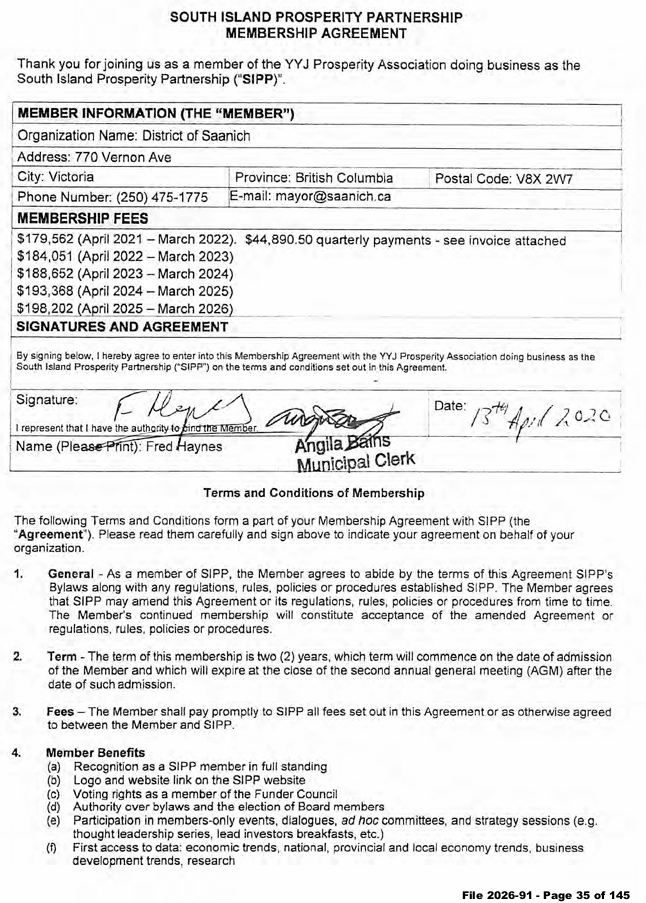
In 2020, Saanich made a 5 year membership agreement for close to a million dollars to the South Island Prosperity Partnership (SIPP). This is what it was to get in return.
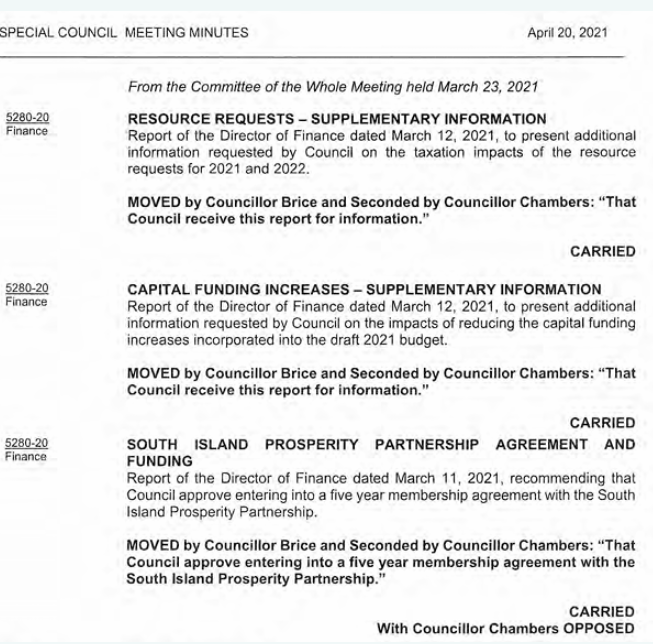
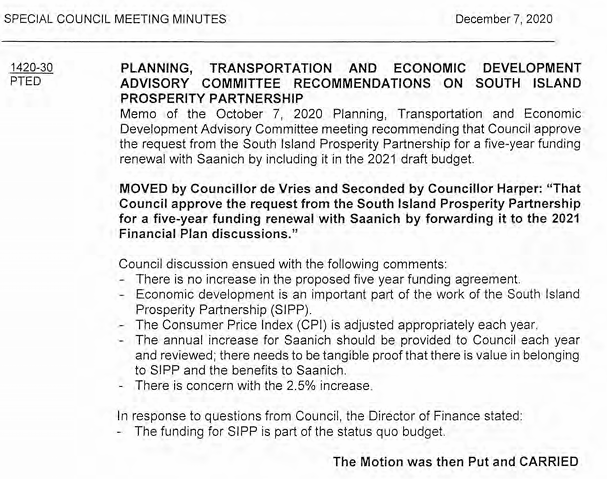
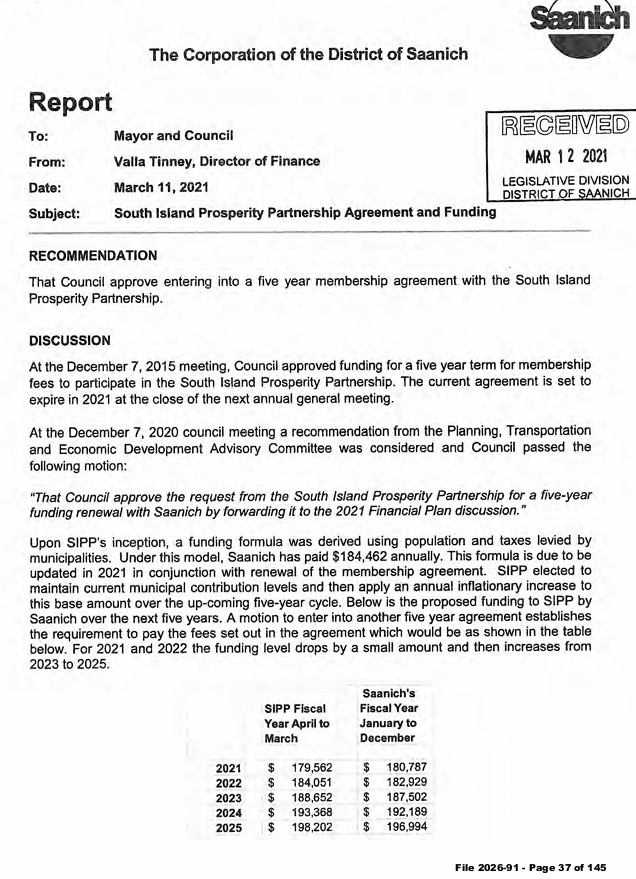
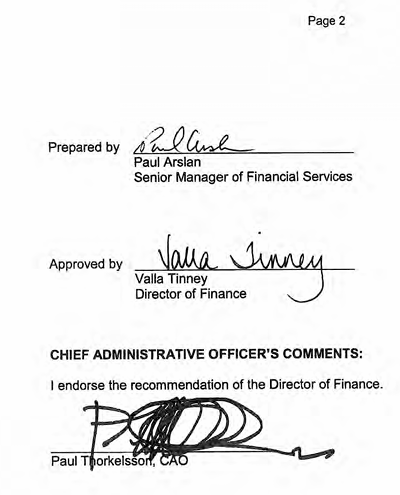
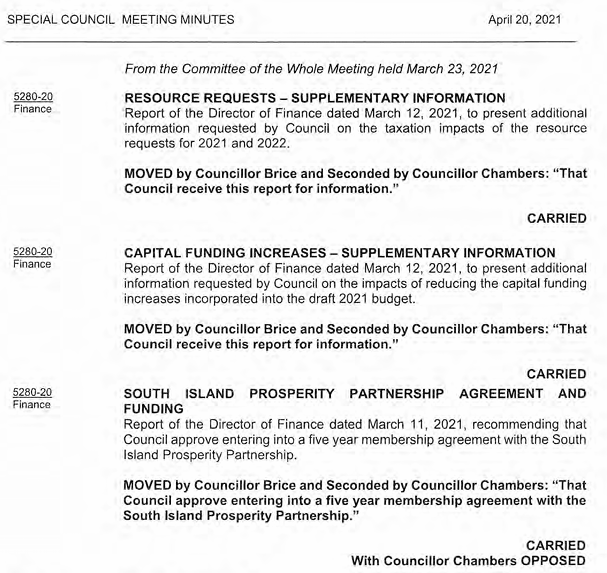
Despite that the membership agreement which provided 5 years of membership fees, was signed by Saanich’s former Mayor in 2020, it doesn’t appear that the “5 year membership” was approved by council until over a year later (the 2nd document below).
SIPP considers overreliance on the public sector to be a pressing issue, with no sense of irony, given that the organization has received millions of dollars from the same public sector with amounts making even the major public subsidization of its shared member the UDI lobby, look minor in comparison.
By Sasha Izard
May 22, 2026
————————————————————————————————–
[2026] Saanich subtly hands over vast amounts of public money to a private organization:
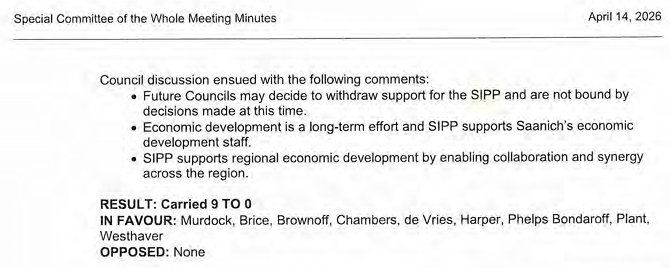
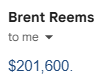
On April 14, 2026 Saanich Council subtly approved spending over $200,000 for the year on the South Island Prosperity Partnership, an outside organization, whose main goal, albeit a vague one, is to increase economic development in the region.
The approval was done very subtly. The previous day on April 13, an agenda item regarding a staff report recommending a 3-year membership/partnership agreement that would cost the District $624,000 to the organization had been put on the Consent Agenda, meaning that unless objected to by a councillor, the item would be approved without deliberation.
Myself and others spoke out against this. In particular, I brought up the issue that an endorsement of the staff recommendation, would be binding the hand of the next council for at least a couple years, forking over vast sums of public money to an outside organization during that time. The item was pulled from the Consent agenda, but rather than deciding on the issue that evening, council moved to postpone it to the financial planning session the following day.
The next day on April 14, they did so towards the end of the evening, but if one looks at the agenda for that day, they won’t find the item, as it was effectively folded into another agenda item regarding budget confirmation. The deliberations and decision on the issue were made in a very vague and ambiguous manner, but seeing through a glass darkly, as the old proverb goes, the council agreed to include this year’s SIPP funding in the budget, which was ultimately approved on May 12, 2026. Staff could sort out the details later about the next 2 years of SIPP funding. Everything was set for SIPP to still receive well over $600,000 over the next 3 years, unless balked by supposedly a new vague clause to be in the works by Saanich Staff that would give the next council an out from continuing to pay the organization, through a 6 month termination notice; something of a difficult, slow and awkward opt-out process.
This subtle approval of handing out vast amounts of public money to the private organization that advances business interests, a non-profit that survives on a mix of major public and private funding – was nothing new for the organization. This had been going on for about a decade, although the numbers have been steadily increasing.
————————————————————————————————–
A 145 page FOI response.
On April 22, 2026 I wrote the following email to Saanich’s Freedom of Information department:
Hello,
I am submitting an FOI request for copies of Saanich’s 5 year, and 3 year sponsorships and/or partnership agreements with the South island Prosperity Partnership. Please include all documentation of what is included with the sponsorships and or partnerships that Saanich has with SIPP.
Date range: Jan 1, 2016 to April 22, 2026
Thank you,
Sasha Izard
————————————————————————————————–
On May 19, 2026 I received the FOI response from the District, which included 145 pages, without any redaction. Credit should be given, where credit is due.
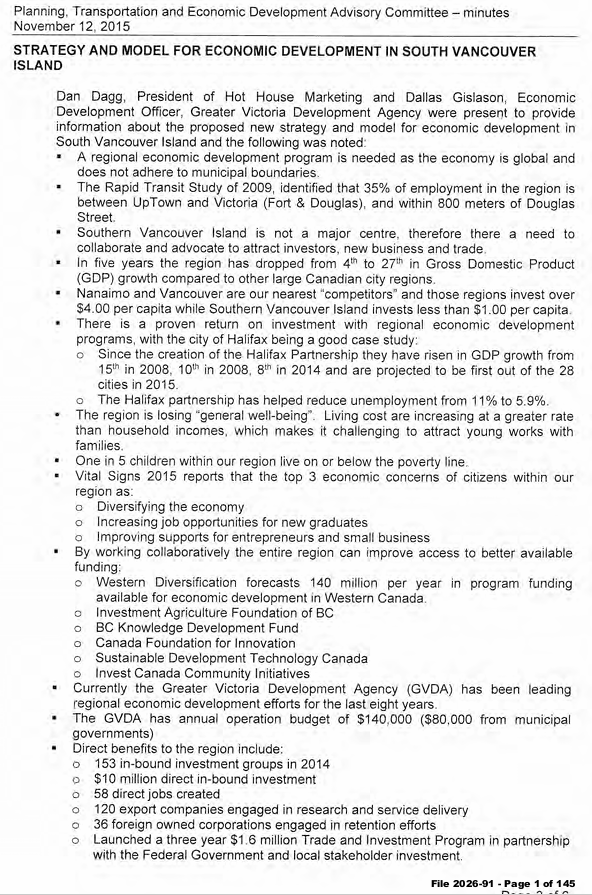
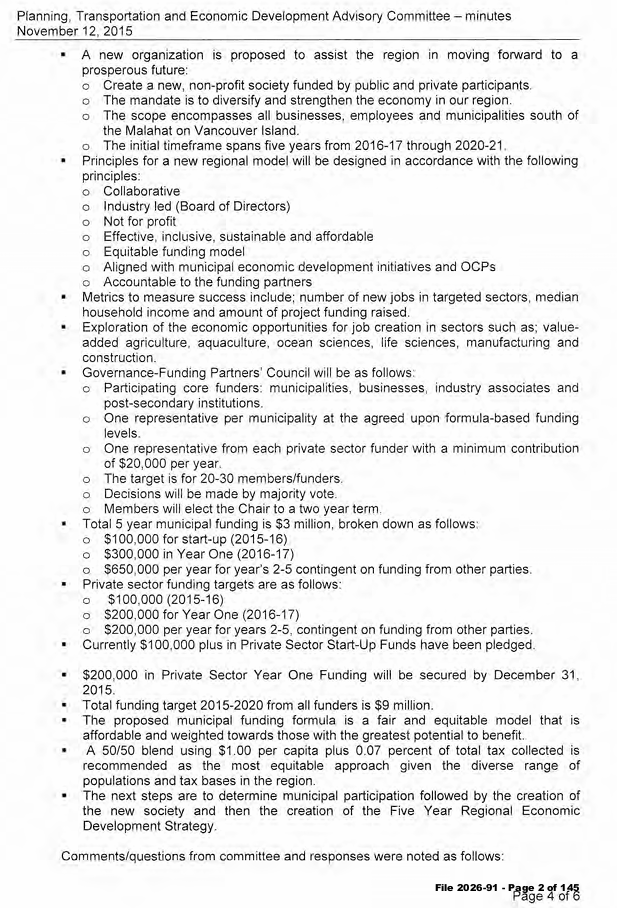
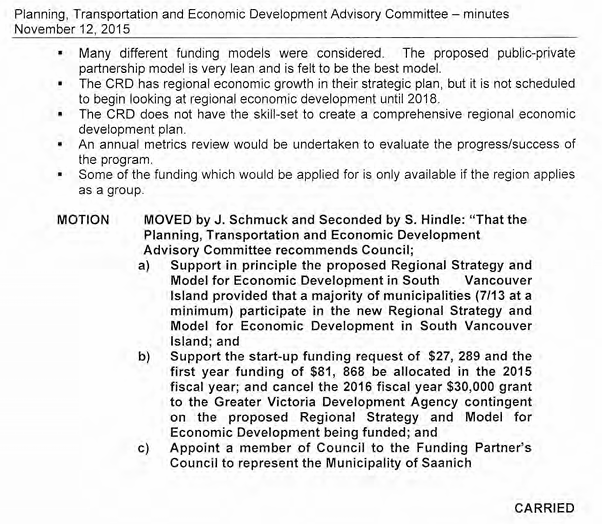
The FOI response started chronologically from the beginning of the history with the following document from Saanich’s Planning Transportation and Economic Development (PTED) Advisory Committee (Nov 12, 2015):
“Industry led”.
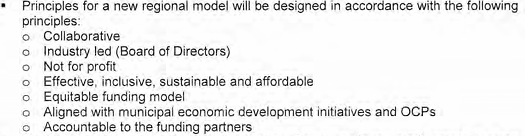
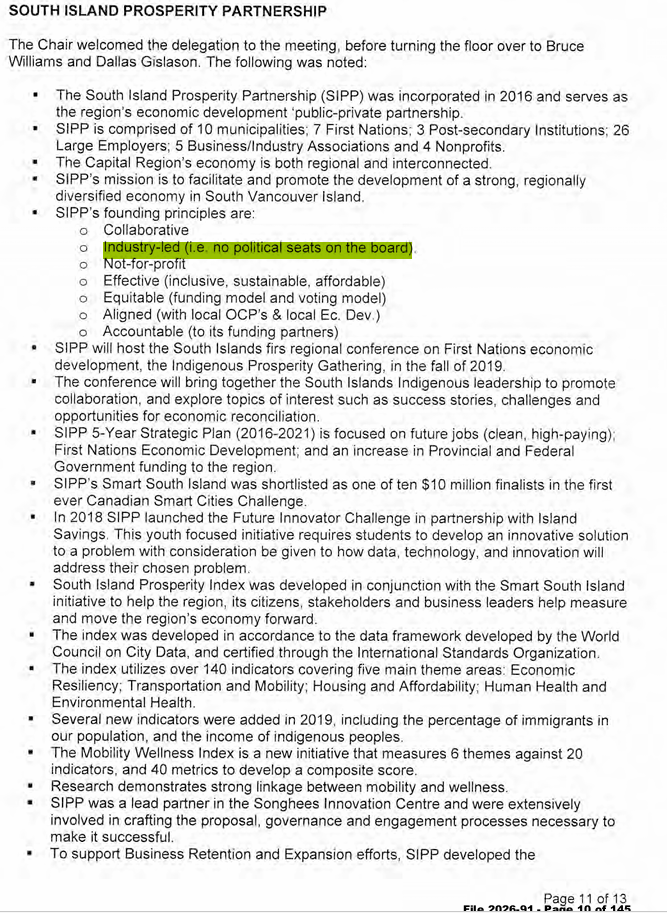
What jumped out at me from the document was that the organization’s board of directors were to be “Industry-led” under the subheading “Principles for a new regional model”.
From the get-go for being an industry-led organization, they were certainly asking for a lot of public money, several million dollars over 5 years cumulatively from municipalities on Southern Vancouver Island, and $9 million from all sources over that time. $20,000 a year for example would get a private sector funder a representative a seat on the Governance-Funding Partners’ Council, effectively paying for influence with the organization $20,000 at a time.
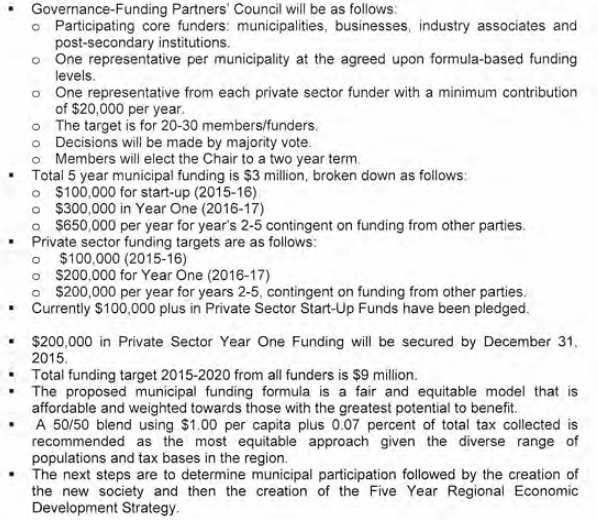
The money asked from the municipalities was certainly not modest: “0.07 percent of total tax collected”. At least they didn’t ask for the money to be paid in tithes.
Saanich’s PTED advisory committee, didn’t seem to have a lot of issues, with the proposal, – after viewing the item they went ahead and recommended it.
The item then came before Saanich Council on December 7, 2015 and was effectively approved:
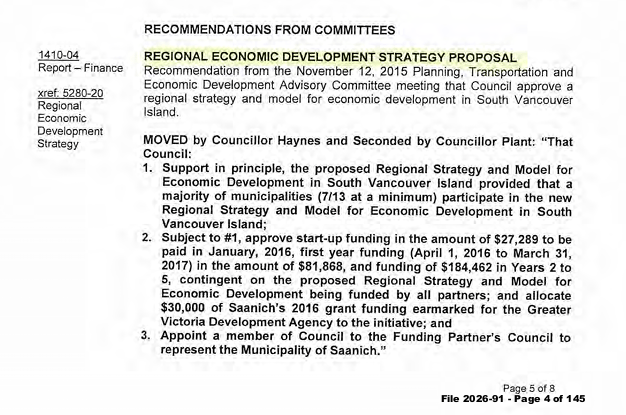
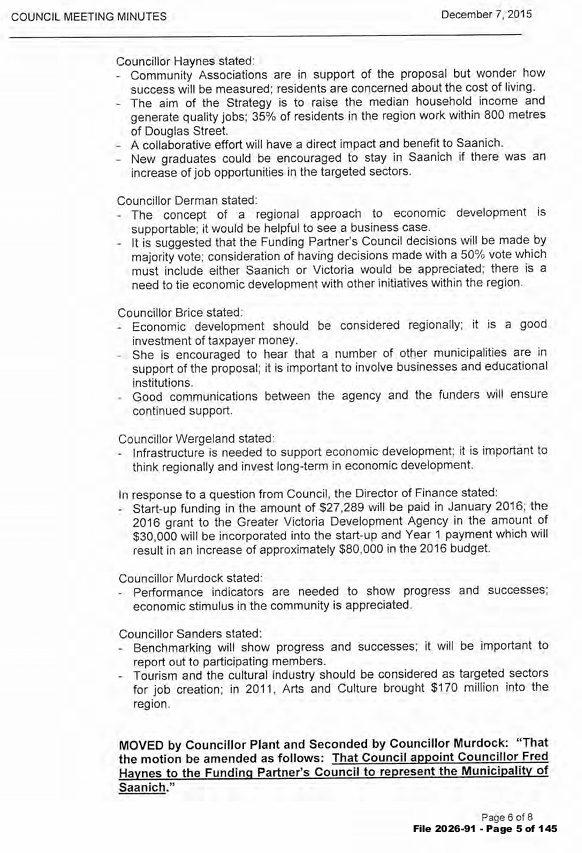
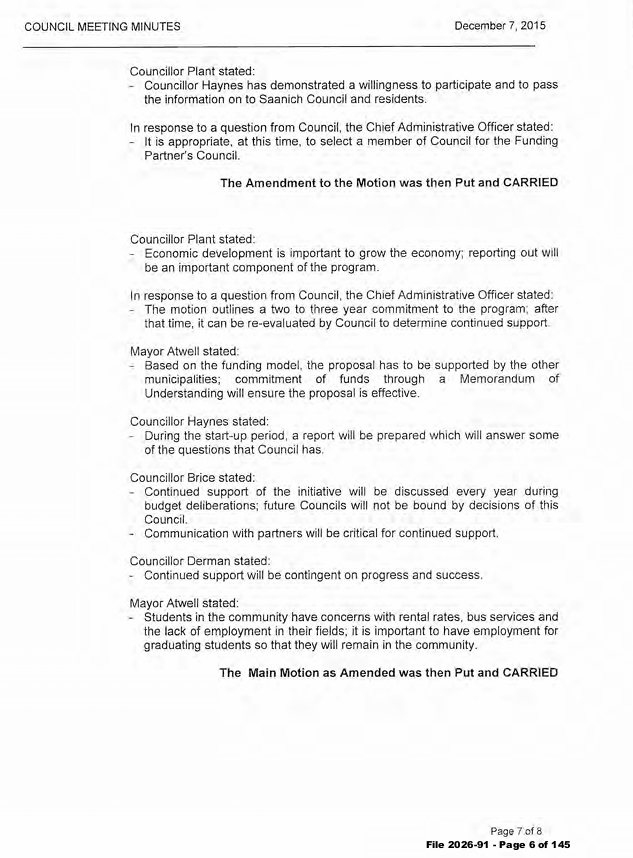
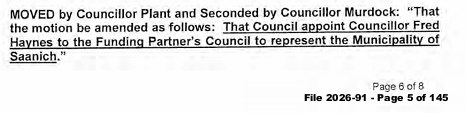
I had to chuckle at the amended motion, which was in the FOI. Prior to being Mayor, both Haynes and Murdock had been councillors. In the 2022 local government election campaign Murdock and Haynes faced off for the Mayoral seat with Haynes, seeking re-election. Murdock portrayed himself during the campaign as the more trustworthy of the candidates for Mayor. Murdock won by a narrow 152 votes.
Going back in the time capsule Murdock while councillor had seconded an amendment to a motion as follows: “That Council appoint Councillor Fred Haynes to the Funding Partner’s Council to represent the municipality of Saanich.”
Clearly Murdock must have considered Haynes most trustworthy to represent the municipality of Saanich at SIPP’s table.
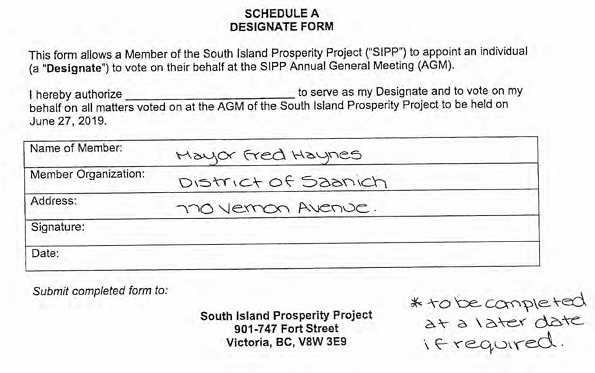
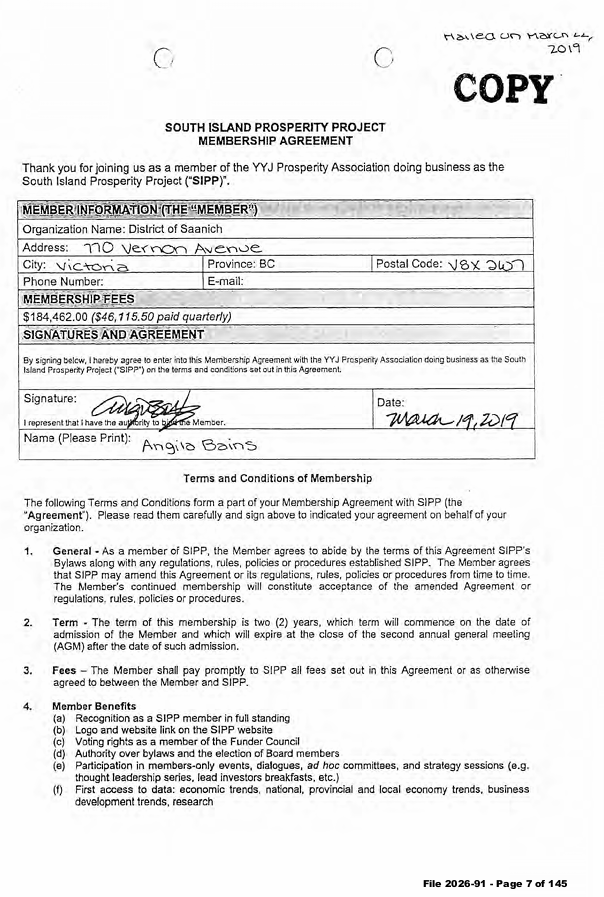
The following is the earliest membership agreement that appears in the FOI. It is dated to March 19, 2019. There may have been an earlier one prior to the date range that I included in the FOI request which started on Jan 1, 2016.
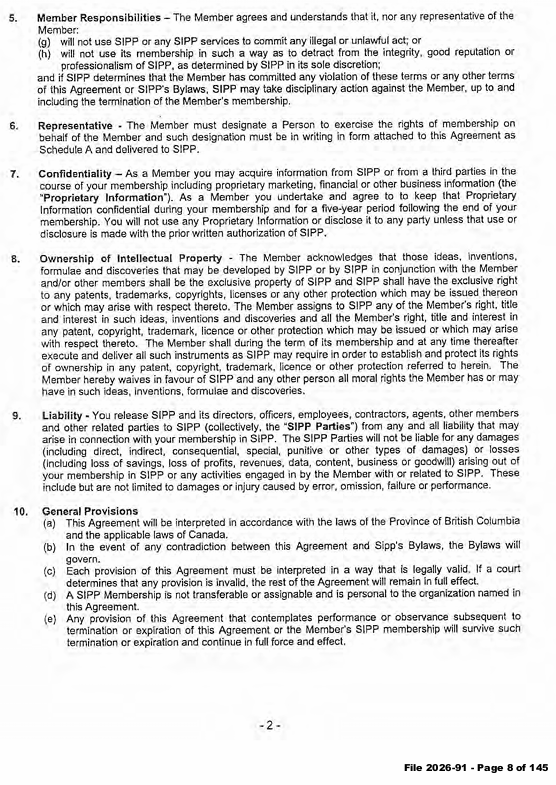
Sections 8. stated: “Ownership of Intellectual Property – The Member acknowledges that those ideas, inventions, formulae and discoveries that may be developed by SIPP or by SIPP in conjunction with the Member and/or other members shall be the exclusive property of ISPP and SIPP shall have the exclusive right to any patents, trademarks, copyrights, licenses or any other protection which may be issued thereon or which may arise with respect thereto. The Member assigns to SIPP any of the Member’s right, title and interest in such ideas, inventions and discoveries and all the Member’s right, title and interest in any patent, copyright, trademark, license or other protection which may be issued or which may arise with respect thereto. The Member shall during the term of its membership and at any time thereafter execute and deliver all such instruments as SIPP may require in order to establish and protect its rights of ownership in any patent, copyright, trademark, license or other protection referred to herein. The Member hereby waives in favour of SIPP and any other person all moral rights the Member has or may have in such ideas, inventions, formulae and discoveries.”
This section, I find quite significant, because it allows SIPP despite having a lifeline from local government funding, to have all patents and intellectual rights to any inventions or innovations from its activities. In this regards it is not exactly an investment that will provide returns from the perspective of the public institutions funding it. If it the public institutions instead had funded their own branches of innovation and research, instead they would be entitled to any patents and intellectual property derived from the investment, and the public could in that scenario continue to benefit from any royalties derived, not the case in this scenario, where the benefits would accrue to SIPP, whereby the benefits could go to its staff salaries.
Simply put: while SIPP drained the public coffers, it could also potentially build up a pool of royalties for itself, something which it could achieve with the public money provided to it, with no conditions attached that it would have to return money back to the public provider for all its help in achieving such a potential state.
Section 9. Liability was also considerably one sided: “Liability – You release SIPP and its directors, officers, employees, contractors, agents, or other members and other related parties to SIPP (collectively the ‘SIPP Parties”) from any and all liability that may arise in connection with your membership in SIPP. The SIPP Parties will not be liable for any damages (including direct, indirect, consequential, special, punitive or other tpyes of damages) or losses (including loss of savings, loss of profits, revenues, data, content, business or goodwill) arising out of your membership in SIPP or any activities engaged in by the Member with or related to SIPP. These include but are not limited to damages or injury caused by error, or omission, failure or performance.”
Try to find an advantage in terms of liability in the membership for the local government. I don’t think you will find one in the above section.
So what were the “Membership Benefits” for close to $184,462.00 of initial public funding to SIPP from the District of Saanich?
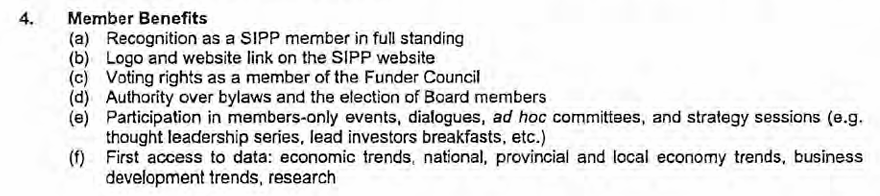
“Member Benefits
(a) Recognition as a SIPP member in full standing
(b) Logo and website link on the SIPP website
(c) Voting rights as a member of the Funder Council
(d) Authority over bylaws and the election of Board members
(e) Participation in members-only events, dialogues, ad hoc committees, and strategy sessions (e.g. thought leadership series, lead investors breakfasts etc.)
(f) First access to data: economic trends, national provincial and local economy trends, business developments trends, research”
As creepy as elected officials attending a thought leadership series and lead investors breakfasts on the public dime, this all had a very UDIesque ring to it. SIPP has been a member of the UDI and vice versa.
Public Release of the Urban Development Institute (UDI)’s hidden members directory dated to the beginning of 2024. The directory contains dozens of government branches that are hiding their memberships in the registered lobbying organization for development and real estate interests from the public. – CRD Watch Homepage
The reader may recall this article that I wrote some months ago:
$10,000 a pop, and VIP Tables included: how BC Housing has been funnelling taxpayer money ($62,500 in less than 5 years) into the UDI, a registered lobbying organization for development and real estate, through $10K sponsorship agreements. – CRD Watch Homepage
In that article, I showed similar sponsorship agreements between BC Housing and the UDI, whereby the UDI agreed to financing the UDI for $10,000 annually renewing on April Fool’s day (seriously), and receiving ludicrous things in advance like VIP tables at UDI breakfast seminars.
In comparison though, what BC Housing was forking over to the UDI, despite adding up to approaching $100,000 in only a few years – was even modest compared to what SIPP has been getting from government, which has added up to millions since foundation.
BC Housing’s out of control spending spree: $82,249 spent in only 3 and a half years, on costs related to a single lobby for real estate and development. – CRD Watch Homepage
2019 and still Industry-led
On June 13 2026, SIPP was before the Saanich PTED Committee. Recall that its predecessor had come before the PTED Committee in November of 2015, and it was the PTED Committee that approved the plan that led to SIPP’s creation, including its industry-led component. One of those who were on the PTED Committee during those years was Travis Lee, who had previously been president of the UDI’s Vancouver Island chapter starting in 2009. Lee wasn’t present at the Nov 2015 PTED meeting, but he was at the June 13, 2016 meeting when SIPP made their presentation.
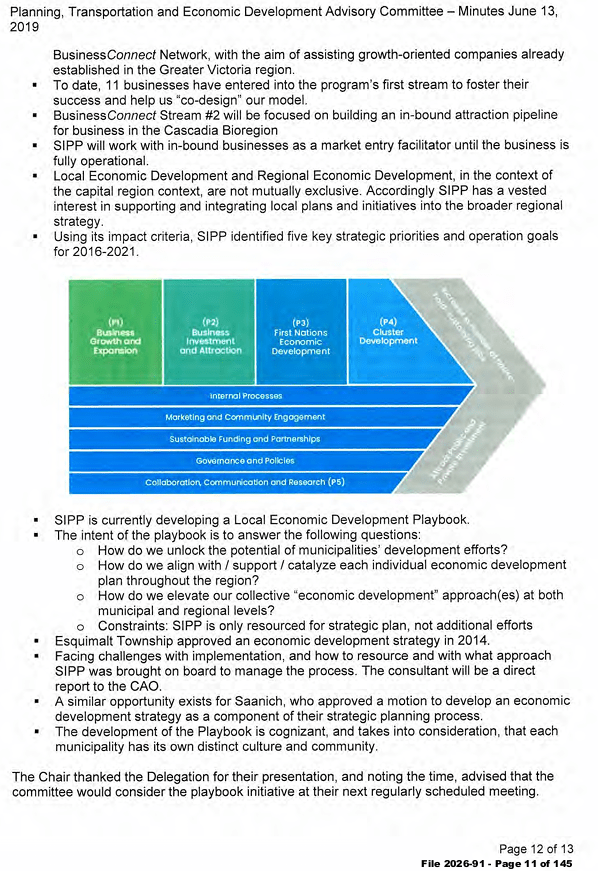
Like the UDI came to be, SIPP despite being propped up by hundreds of thousands of government funds, was intended to be industry-led. I highlighted below the words “industry-led (i.e. no political seats on the board)” from the minutes of SIPP’s presentation to the PTED Committee on June 13, 2016
Wayback Machine
The following also appeared in the FOI.
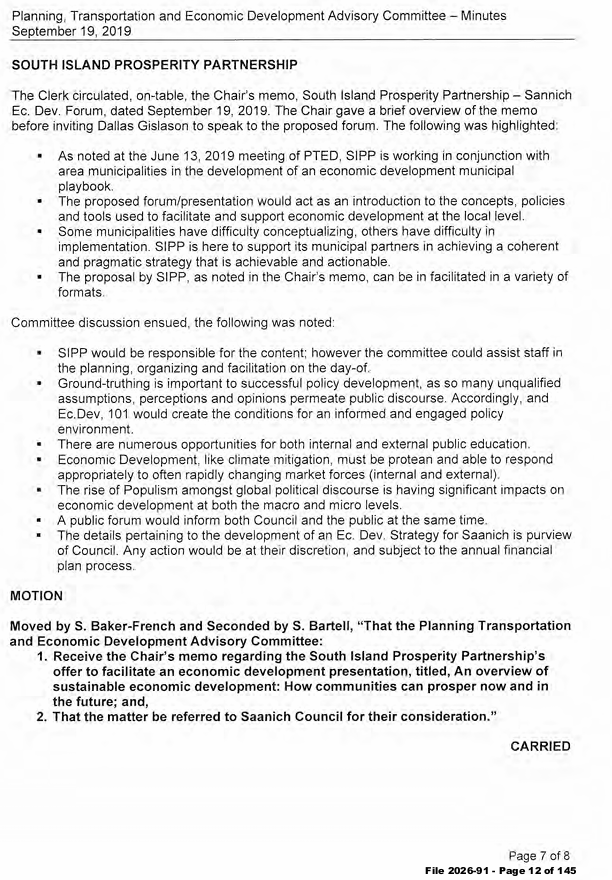
Strangely, despite being included in the FOI I can’t find the above document in the PTED Committee Minutes for that day posted on the Saanich website.
—————————————————————————————————
The next year was the following document, the subject of this article:
In 2020,the District of Saanich made a membership agreement with payments over 5 years set out for close to a million dollars cumulatively, to the South Island Prosperity Partnership (SIPP). What it was to get in return is included under subheading 4. Member Benefits:
Not much benefit for close to a million dollars of public funds over half a decade.
The document reads to me as contradicting itself. The term of the membership is stated under subheading 2., as being “two (2) years”; yet under subheading 3. It states that the “The Member shall pay promptly to SIPP all fees set out in this Agreement or as otherwise agreed to between the Member and SIPP”.
There are 5 years of payments in the agreement, yet the membership according to the same document lasts only 2 years, or perhaps to interpret the wording creatively, 2 sets of two years. How could this be with 5 years of payments laid out in the document? Whether the membership is 2 years or 2 sets of two years, either 2, or 2 + 2 does not make 5, so why were 5 years of payments listed?.
If the agreed upon fees really were for 5 years, signing the document affirming that all fees would be paid, would tie the hand of not only that council for the rest of its term, but in addition it would tie the hand of a subsequent council for almost its entire 4 year term. How could one mayor’s signature achieve such a thing?
The document also states: “The Member agrees that SIPP may amend this Agreement or its regulations, rules, polices or procedures from time to time.” What then would stop SIPP from simply changing its membership fees mid-way?
It seems amazing to me, that such an agreement would even be allowed by the municipal administration.
The document was signed by the mayor of Saanich at the time with the text: “I represent that I have the authority to bind the Member.”
I cannot see how that is the case however. I’m open to being explained to how this could be the case, and I am happy to publish the explanation as an appendix to this article.
How could the Mayor have sole authority to bind the municipality as the Member without the approval of council? As far as I can tell from the FOI, the approval came after. See documents below:

———————————————————————————-
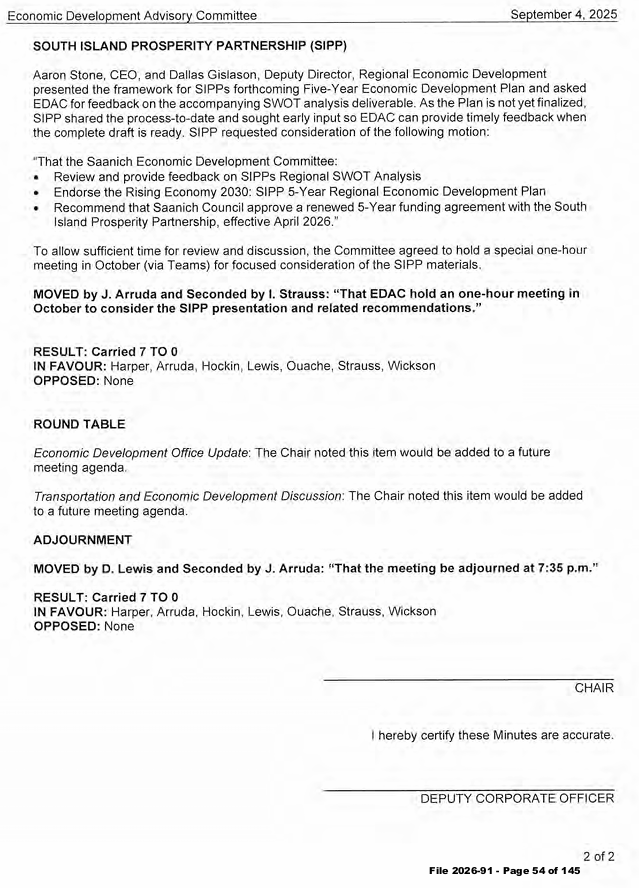
Zooming ahead toward the end of the 5 year agreement:
The following also appeared subsequently in the FOI:

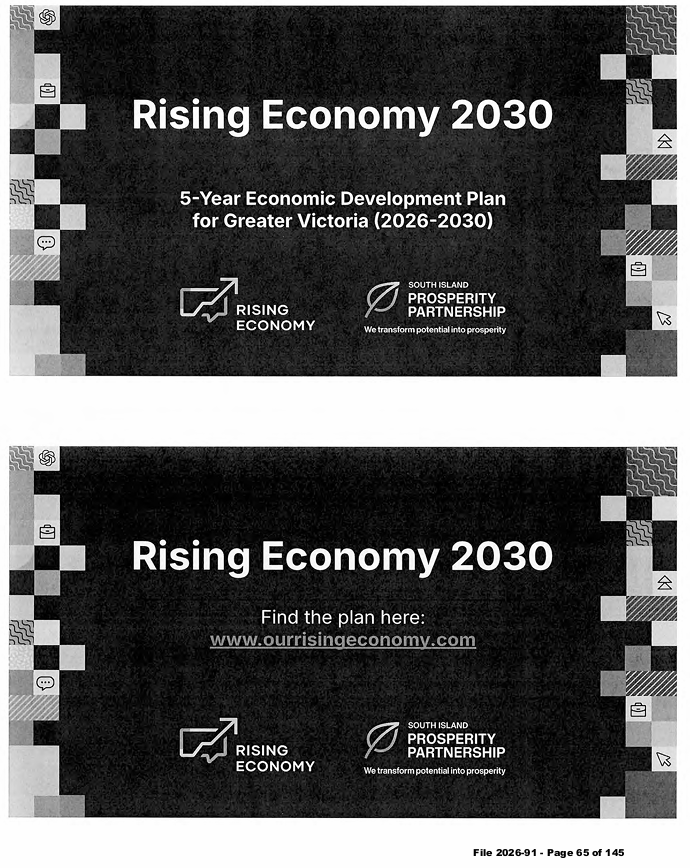
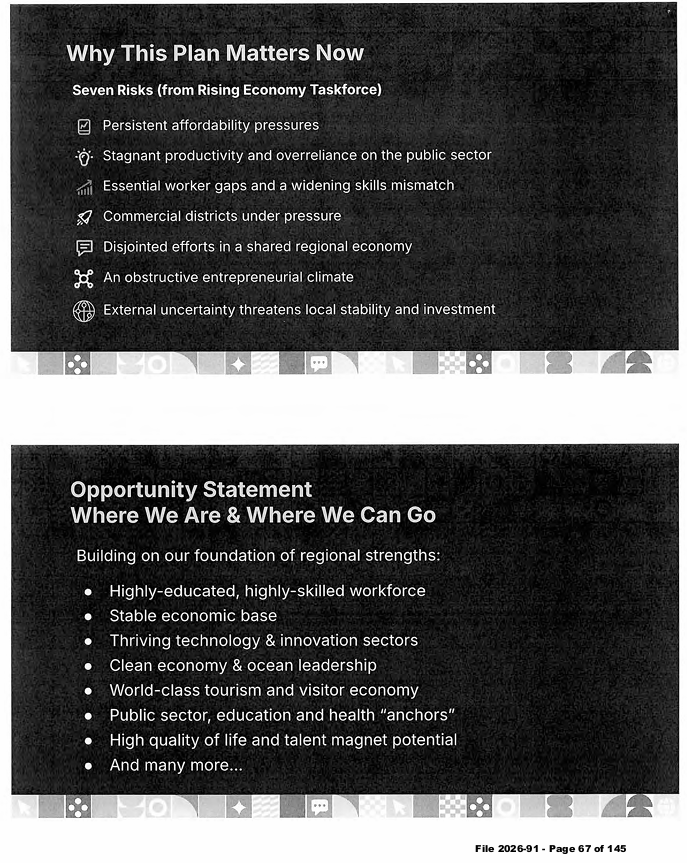
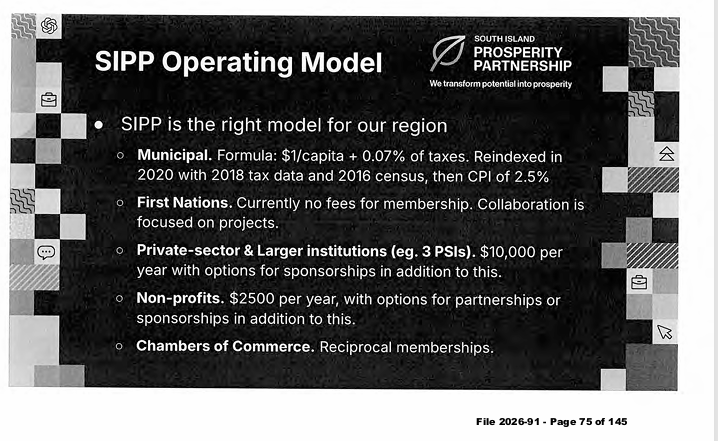
Let’s look at the following excerpt more closely:
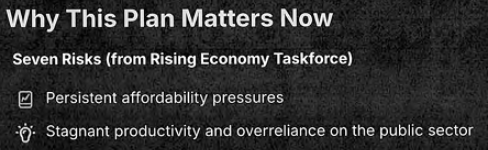
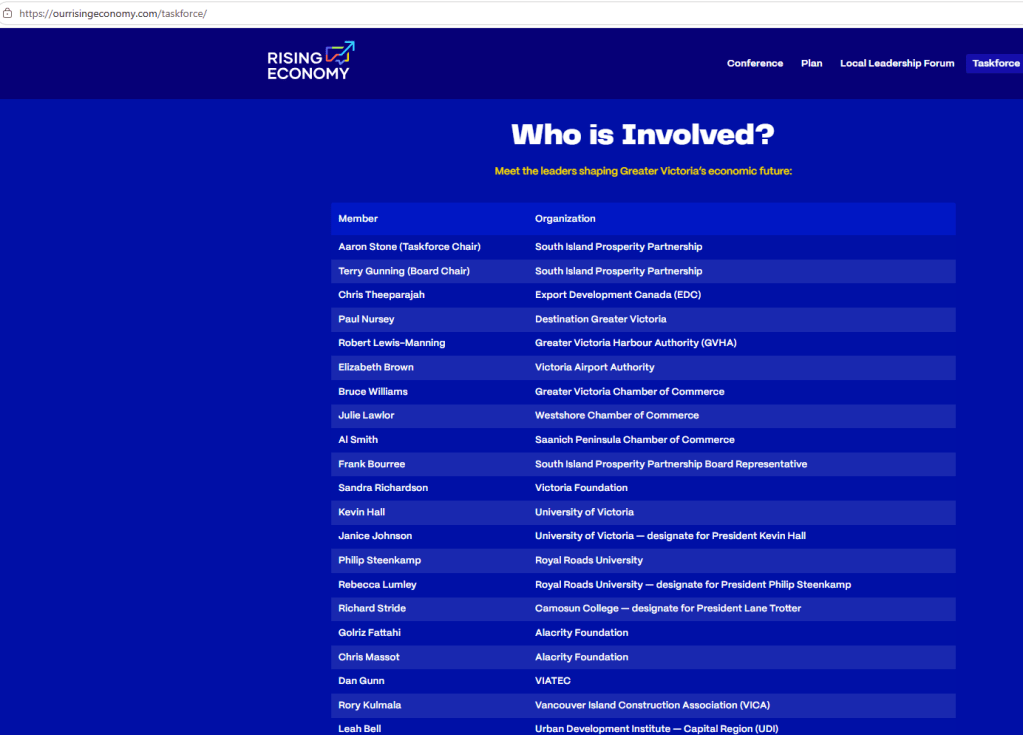
In particular, item 2: which includes “overreliance on the public sector” as a risk according to SIPP’s Rising Economy Taskforce (The UDI Capital Region’s top staffer Leah Bell, the Regional Director was on the Task Force, see Appendix 2 at the end of this article).
This was mentioned on p.7 of the report: “our over-reliance on the
public sector leaves us vulnerable to external shocks”, as well as on p. 19 and in the section beginning on page 34.
On p.19 Under the headline: “Systemic Risks for Our Region” is the following item:
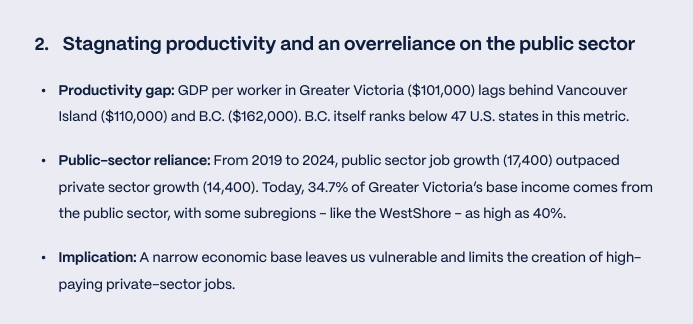
“Public-sector reliance: From 2019 to 2024, public sector job growth (17,400) outpaced private sector growth (14,400). Today, 34.7% of Greater Victoria’s base income comes from the public sector, with some subregions – like the Westshore as high as 40%
Implication: A Narrow economic base leaves us vulnerable and limits the creation of high-paying private sector jobs.”
————————————————————————————————–
Now while I find the above statements somewhat reasonable, what I cannot stand is blatant in your face hypocrisy.
When it comes to overreliance on the public sector, the South Island Prosperity Partnership is a stunning example of exactly what it complains about.
The organization that is so appalled by overreliance on the public sector feels entitled to not only a dollar per southern island resident, but in addition to that 0.07% of all collected municipal taxes on Southern Vancouver Island to go towards the organization and its religion of a need for an ever increasing GDP.
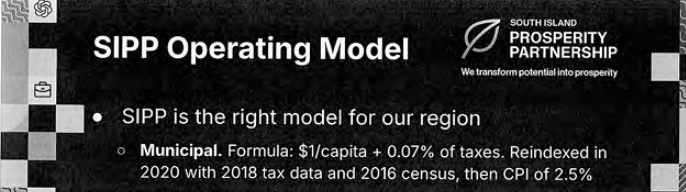
Then they have the gall to turn around and complain about an overreliance on the public sector!!!!
In addition to that, they are taking private sector money at $10,000 a pop and then some, mixing private and public money into the feeding/influence frenzy:

The Transparency Gap in outsourcing public money to outside institutions:
By Saanich transferring money into the non-public organization for industry aligned economic development purposes, the supposed economic development and other activities that this money is used for is not transparent, now that it has been transferred from the public to the private sector.
—————————————————————————————————
Conclusion:
The real danger is publicly subsidized overreliance on the private sector.
SIPP is a perfect example of overreliance on the public sector, the same thing that it claims is a great danger, and that it is here to protect us all from, as it repeats private industry’s mantra to the politicians at its beck and call; while over the years taking millions of dollars of taxpayer funded money out of government and into the organization’s pockets.
As I pointed out previously, in my Open Letter to SIPP:
According to SIPP’s 2022-2023 “Rising to Resilience” report, the salaries and benefits to personnel are: $588,709. Add travel and accommodation ($23,000) to that figure and these combined expenses are more than half of the total Annual Budget for the organization and almost equivalent to the total amount the municipalities of the CRD pay in membership fees to SIPP each year. In 2022 alone this municipal membership fee total amounted to $632,714.
What SIPP represents to me is corporate regionalism, undermining and overriding democratic local governance, while ironically piggybacking on its funding in a major way. It seems no surprise to me that SIPP had a representative presenting to the Victoria-Saanich Citizens’ Assembly. SIPP appears to me to have no problem taking vast amounts of money from local governments, and then turning around and undermining the same local governments/public sector that it relies on to survive.
While industry can sometimes act like sharks, SIPP appears to me to act like a remora.
—————————————————————————————————
See also:
Index of articles and other resources about the South Island Prosperity Partnership (SIPP). – CRD Watch Homepage
The South Island Prosperity Partnership (SIPP) claims “$93.20 per capita annual ROI on SIPP initiatives”, fails to provide evidence for their claim, when asked. – CRD Watch Homepage
List of articles and other resources on corporate regionalism. – CRD Watch Homepage
An Open Letter to the South Island Prosperity Partnership – CRD Watch Homepage
What is the Pacific NorthWest Economic Region? (PNWER) and what are its connections to big oil? – CRD Watch Homepage
Index of Articles and Other Resources on Amalgamation. – CRD Watch Homepage
—————————————————————————————————
Appendix: Documentation of Saanich Council’s subtle, but unanimous approval of continued SIPP spending in the 2026 budget.
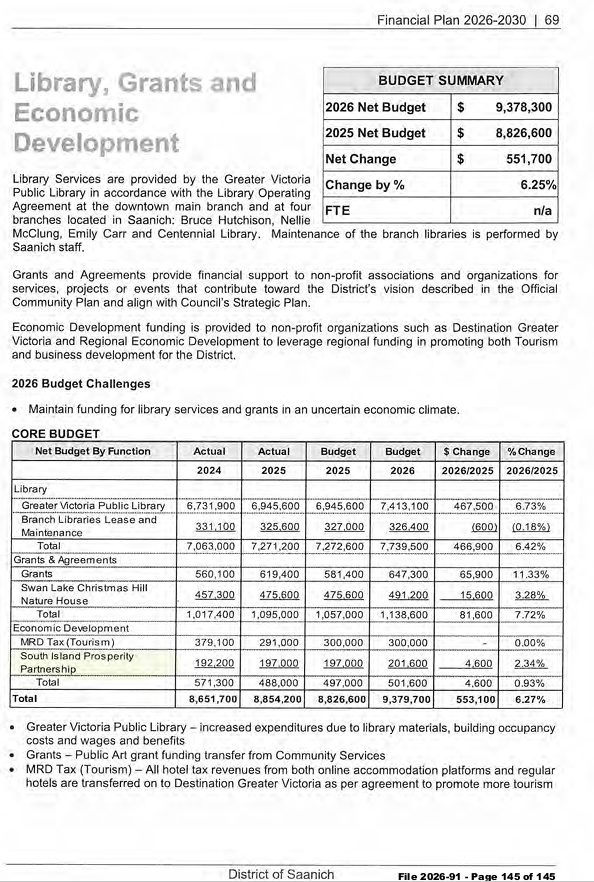
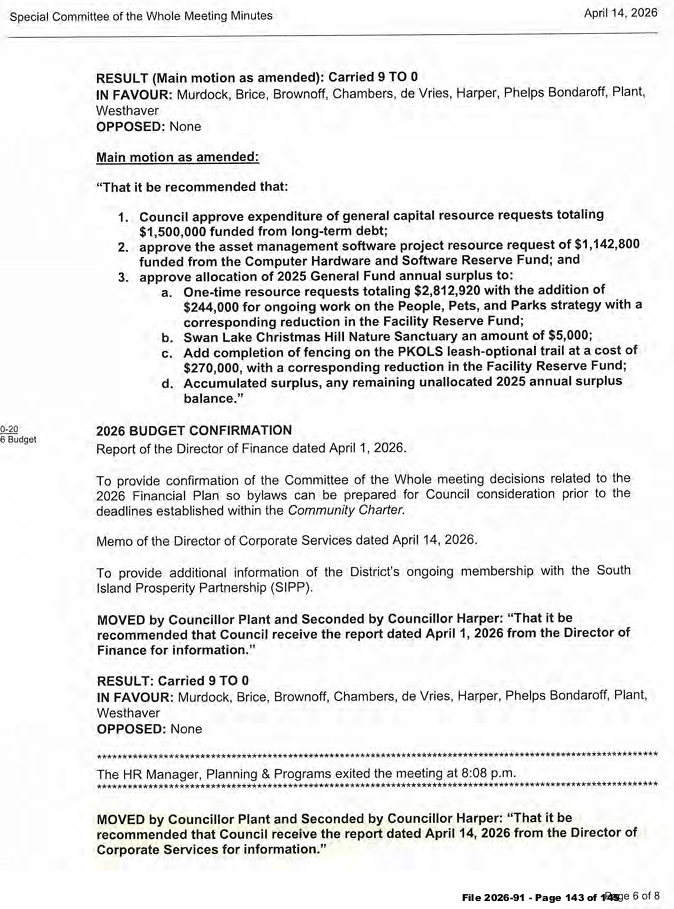
My email dialogue on the subject with Saanich’s CAO:









Reference:
Saanich Bylaw No. 10049


—————————————————————————————————
Appendix 2: The SIPP Rising Economy Task Force
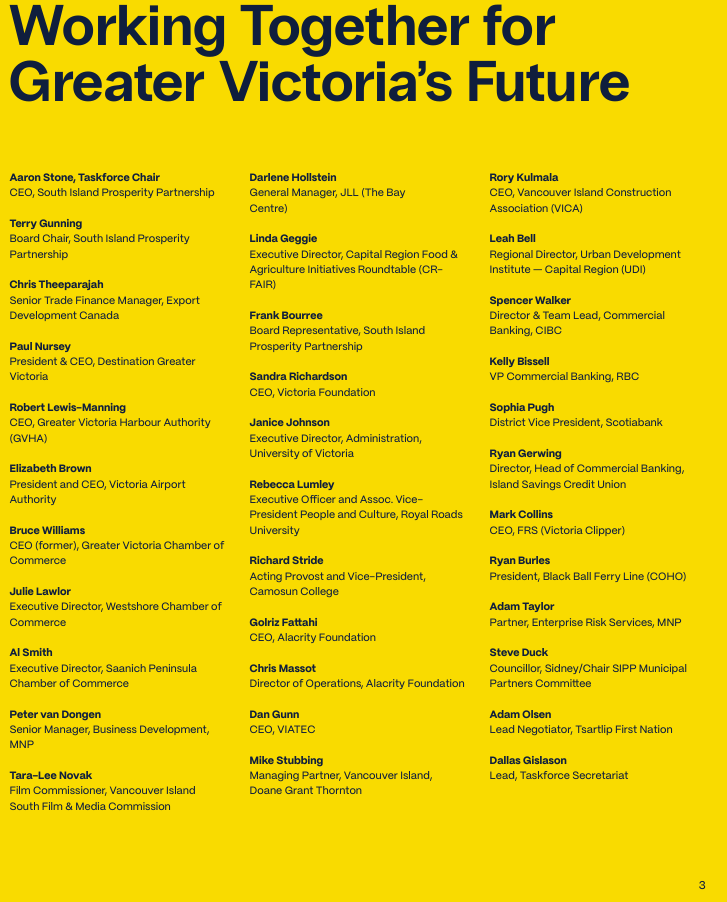
Rising-Economy-Taskforce-Final-Report-September-2025.pdf



Leave a comment