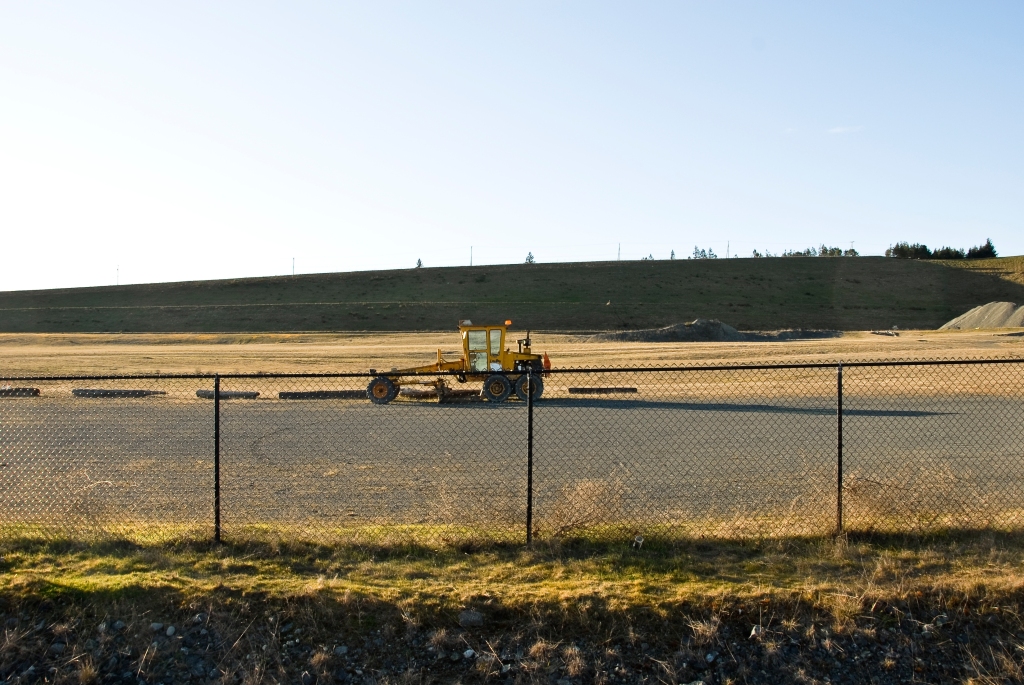
CRD Denies Free Access to Information that is in the Public Interest, regarding felled trees in Elk/Beaver Lake; claims they can pick and choose who can receive such information at lowered cost.
By Sasha Izard
March 25, 2026
Last month, I wrote the following article:
Like wooden tombstones: The latest tree decimation in Elk/Beaver Lake Regional Park. – CRD Watch Homepage
Seeking to find answers, I made a Freedom of Information request to the CRD. The CRD estimated charging me $360, and requested a 50% deposit, unless the information was in the public interest.
The CRD wants to charge me an estimated $360 to find out what trees have been cut down in Elk/Beaver Lake Regional Park during the last 2 years. – CRD Watch Homepage
Clearly the information as to what is happening in regards to trees being felled in a CRD managed park is in the public interest, which I pointed out to the CRD in my response, which you can read in the previous article linked above.
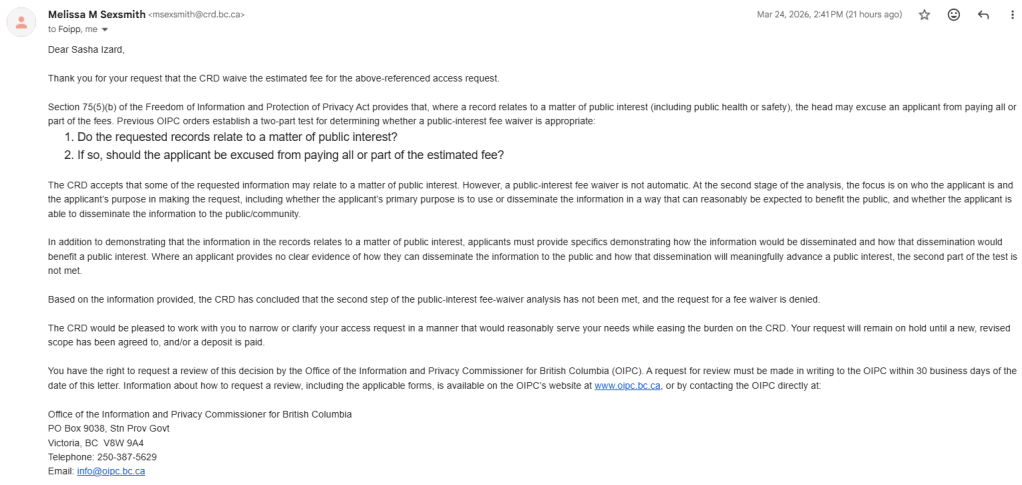
On March 24, 2026 – the CRD responded:
Dear Sasha Izard,
Thank you for your request that the CRD waive the estimated fee for the above‑referenced access request.
Section 75(5)(b) of the Freedom of Information and Protection of Privacy Act provides that, where a record relates to a matter of public interest (including public health or safety), the head may excuse an applicant from paying all or part of the fees. Previous OIPC orders establish a two‑part test for determining whether a public‑interest fee waiver is appropriate:
- Do the requested records relate to a matter of public interest?
- If so, should the applicant be excused from paying all or part of the estimated fee?
The CRD accepts that some of the requested information may relate to a matter of public interest. However, a public‑interest fee waiver is not automatic. At the second stage of the analysis, the focus is on who the applicant is and the applicant’s purpose in making the request, including whether the applicant’s primary purpose is to use or disseminate the information in a way that can reasonably be expected to benefit the public, and whether the applicant is able to disseminate the information to the public/community.
In addition to demonstrating that the information in the records relates to a matter of public interest, applicants must provide specifics demonstrating how the information would be disseminated and how that dissemination would benefit a public interest. Where an applicant provides no clear evidence of how they can disseminate the information to the public and how that dissemination will meaningfully advance a public interest, the second part of the test is not met.
Based on the information provided, the CRD has concluded that the second step of the public‑interest fee‑waiver analysis has not been met, and the request for a fee waiver is denied.
The CRD would be pleased to work with you to narrow or clarify your access request in a manner that would reasonably serve your needs while easing the burden on the CRD. Your request will remain on hold until a new, revised scope has been agreed to, and/or a deposit is paid.
You have the right to request a review of this decision by the Office of the Information and Privacy Commissioner for British Columbia (OIPC). A request for review must be made in writing to the OIPC within 30 business days of the date of this letter. Information about how to request a review, including the applicable forms, is available on the OIPC’s website at www.oipc.bc.ca, or by contacting the OIPC directly at:
Office of the Information and Privacy Commissioner for British Columbia
PO Box 9038, Stn Prov Govt
Victoria, BC V8W 9A4
Telephone: 250‑387‑5629
Email: info@oipc.bc.ca
Kind regards,
—————————————————————————————————
On March 25, 2026 – I replied,
Hello,
“applicants must provide specifics demonstrating how the information would be disseminated and how that dissemination would benefit a public interest. Where an applicant provides no clear evidence of how they can disseminate the information to the public and how that dissemination will meaningfully advance a public interest, the second part of the test is not met.”
Where is your evidence that this is the case? Where is this stated in policy and in FOIPPA?
Thank you,
Sasha
—————————————————————————————————
I also emailed the Office of the Information and Privacy Commissioner OIPC:
Hello OIPC,
I am forwarding this exchange to you, because I do not see the evidence for the CRD’s claim:
” applicants must provide specifics demonstrating how the information would be disseminated and how that dissemination would benefit a public interest. Where an applicant provides no clear evidence of how they can disseminate the information to the public and how that dissemination will meaningfully advance a public interest, the second part of the test is not met.”
Please investigate. The information in this FOI is clearly in the public’s interest. As such I consider that the CRD’s rejection of its release without a fee waiver to be wrongful and against the spirit of transparency of a public institution regarding its actions on public property.
Thank you,
Sasha Izard
—————————————————————————————————
Good afternoon Sasha,
Thanks for your question. I’m pleased to provide some further information to assist you.
As stated in my previous correspondence, the two‑part test for determining whether a public‑interest fee waiver is appropriate is established in orders issued by the Office of the Information and Privacy Commissioner. When there’s a dispute or doubt about how to interpret the Act, the Office of the Information and Privacy Commissioner for British Columbia may investigate, and then issues a binding order. Each order applies the law to a specific set of facts, and clarifies for public bodies and FOI applicants how the Act should be interpreted and applied in practice.
Some such orders, where you can find reference to this test, are:
It may also be useful to note that, under FOIPPA, all fee waivers are discretionary. The two-part public interest test determines whether a fee waiver can be considered; but even if the test is met, the CRD must still decide whether waiving the fee is appropriate. OIPC orders also provide guidance on how to exercise this discretion fairly and consistently.
I hope that all of the above is helpful context.
The CRD remains open to working with you to narrow or clarify your access request in a manner that would reasonably serve your needs while easing the burden on the CRD. Your request will remain on hold until a new, revised scope has been agreed to, and/or a deposit is paid.
Kind regards,
Melissa
—————————————————————————————————
Note: Of the 3 historical Orders from the OIPC that the CRD provided for reference, 1 provided a fee waiver due to an issue being in the public interest (Order F19-09), one provided a 50% fee waiver (Order F26-21), and one provided no fee waiver (Order F21-48).
The one that provided no fee waiver was for a broad FOI request amounting to almost 10,000 pages – that the city was already providing a massive discount in hours of research over, a poor point of reference for the FOI request that I made.
—————————————————————————————————
I replied to the CRD:
Thank you for your response.
Where are the relevant sections of those historical Orders that you provided from the OIPC, that provide substance to your previous claim:
“applicants must provide specifics demonstrating how the information would be disseminated and how that dissemination would benefit a public interest. Where an applicant provides no clear evidence of how they can disseminate the information to the public and how that dissemination will meaningfully advance a public interest, the second part of the test is not met.”
Also note, that the CRD did not inform me in the fee estimate letter that I must provide specifics demonstrating how the information would be disseminated and how that dissemination would benefit a public interest.
How can my not informing the CRD of how the information would be disseminated be grounds for rejection of the fee waiver, when I was not informed by the CRD that there was a requirement for stating how the information would be disseminated?
It is the CRD that has provided the omission by not informing me of this. It is like the game of soccer, with invisible goalposts, that only the CRD knows where they are, or can move them after the fact.
Where is the transparency of process here?
This is supposed to be a democratic institution transparent and accountable before the public that it is supposed to represent.
Thank you again,
Sasha Izard
—————————————————————————————————
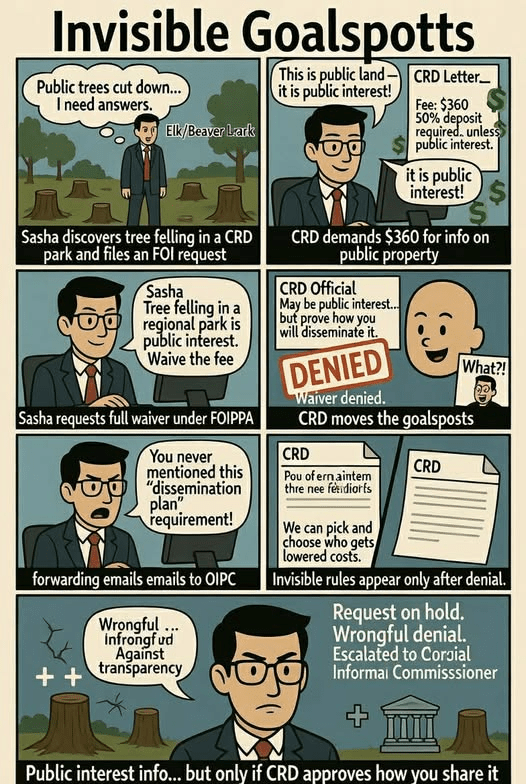
Appendix 1: I asked AI to make a cartoon about this episode with the CRD covered in the article. It seems it got scrambled trying to understand the CRD.
—————————————————————————————————
See also:
NDP set to weaken B.C.’s FOI law and keep public in the dark | Vancouver Sun
Index of Exorbitant Cost Estimates Provided for Freedom of Information in British Columbia – CRD Watch Homepage
I made an FOI to the BC Ministry of Housing and Municipal Affairs regarding proposed Bill M216. The OIPC granted them a half year extension. – CRD Watch Homepage


 CRD Watch Homepage
Leave a reply to Sasha Izard Cancel reply