Parting Mayors: Helps and Murdock pushed for Government Reductions on Development Charges for Purpose-Built Rental Construction, Prior to Leaving Elected Office.
Their advocacy while in elected office for waiving types of such charges on purpose-built rental constructions, mirrors the advocacy of one development lobby in particular.
By Sasha Izard
March 6, 2026
Helping the development industry:
Yesterday, I received an FOI response (Vic-2025-278) from the City of Victoria in regard to an FOI request that I had sent to see the City’s Manager, Intergovernmental & Media Relations regarding the UDI and communications with or regarding it. The 1495 page FOI, contained significant sections which were unreadable (See Appendix 1 at the end of this article for one of many such examples).
One section that was crystal clear however, in the FOI was the following letter from Mayor Helps from Aug 17, 2022 to the Trudeau Government, that she sent about 2 months and a half months prior to leaving office. In 2021 Helps announced that she had decided that she would leave office at the end of her second term.
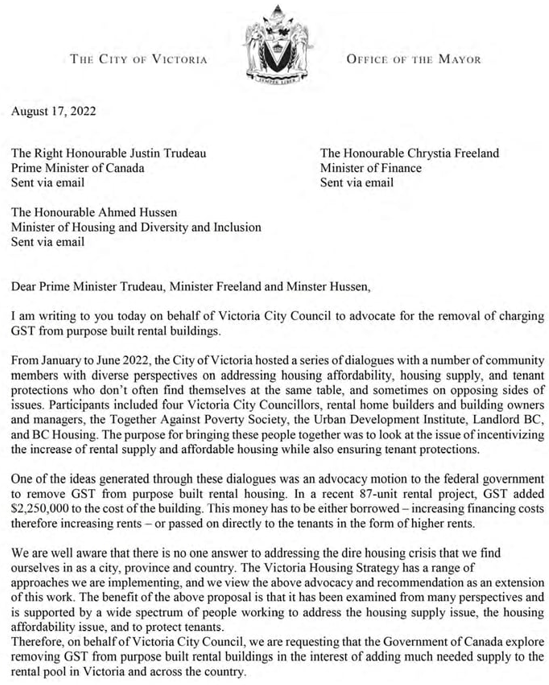
The text of the letter can be seen in Appendix 2 at the end of this article.
Helps using her Mayoral position prior to leaving office, was effectively lobbying the Federal Government for the removal of GST in purpose-built rental buildings – something that the UDI a Provincially registered lobbying organization, representing billions of dollars of corporate interests in development and real estate, that the City of Victoria was a paying member of – has lobbied for, and the government responded accordingly the following year.
Enhanced GST Rental Rebate to build more apartments for renters – Canada.ca
Excerpt:
“On September 14, 2023, the Prime Minister announced that the government will introduce legislation to enhance the Goods and Services Tax (GST) Rental Rebate on new purpose-built rental housing, to incentivize construction of much-needed rental homes for Canadians.
To build more rental housing, the removal of GST will apply to new purpose-built rental housing, such as apartment buildings, student housing, and senior residences built specifically for long-term rental accommodation.
This enhancement increases the GST Rental Rebate from 36 per cent to 100 per cent and removes the existing GST Rental Rebate phase-out thresholds for purpose-built rental housing projects. The enhanced GST Rental Rebate will apply to projects that begin construction on or after September 14, 2023, and on or before December 31, 2030, and complete construction by December 31, 2035.”
https://www.doanegrantthornton.ca/insights/federal-government-relieves-gst-on-new-rental-construction/
In the letter Helps mentioned the UDI was one of her sources of information, as well as Landlord BC, and BC Housing. Helps after being Mayor went on to be the Housing Solutions Advisor to the Premier of British Columbia, and also played a key role in the setting of BC Builds part of BC Housing, which she became lead on.
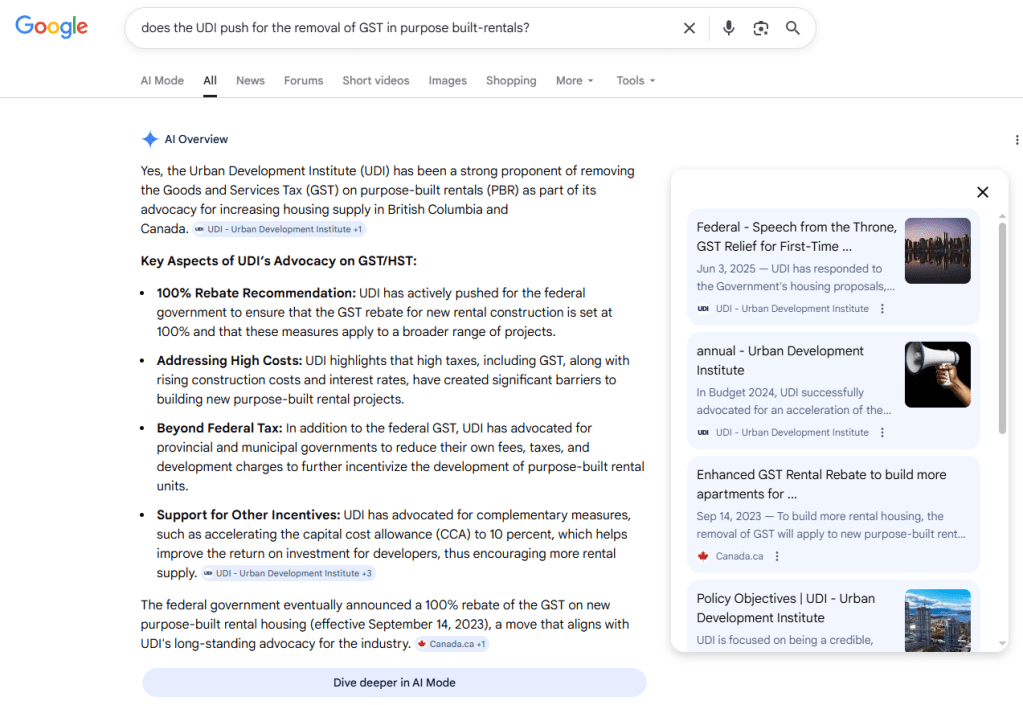
The UDI had been lobbying for a reduction in GST for purpose-built rentals. (See also Appendix 3).
Jon Stovell, who was a Chair at the time of the UDI Pacific region, the main branch of the UDI in BC, donated the maximum to Lisa Helps’ re-election campaign in 2018.

Source: Elections BC FRPC – Local Election Contributions Search Results
Archive (2017 Stovell listed as UDI Chair): Board of Directors – Urban Development Institute
Archive (2023 Stovell listed as UDI Chair): Board of Directors – Urban Development Institute
Helps’ campaign slogan, which could be seen around the city during her re-election campaign, was “Every bit Helps!” reminding of the supermarket giant Tesco’s famous slogan in the UK:
The history of Tesco’s slogan Every Little Helps – Creative Review
————————————————————————————————–
Helps referred to her advocacy in her letter to the Feds, a term the UDI uses as well. The UDI does not register lobbying activity at the federal level.
Federal – Speech from the Throne, GST Relief for First-Time Homebuyers, and UDI Federal Advocacy | UDI – Urban Development Institute
The UDI doesn’t register Federal Lobbying Activity, but it’s own public statements show that it is lobbying the Feds. – CRD Watch Homepage
Helps in her letter was effectively advancing the UDI’s key policy objectives:

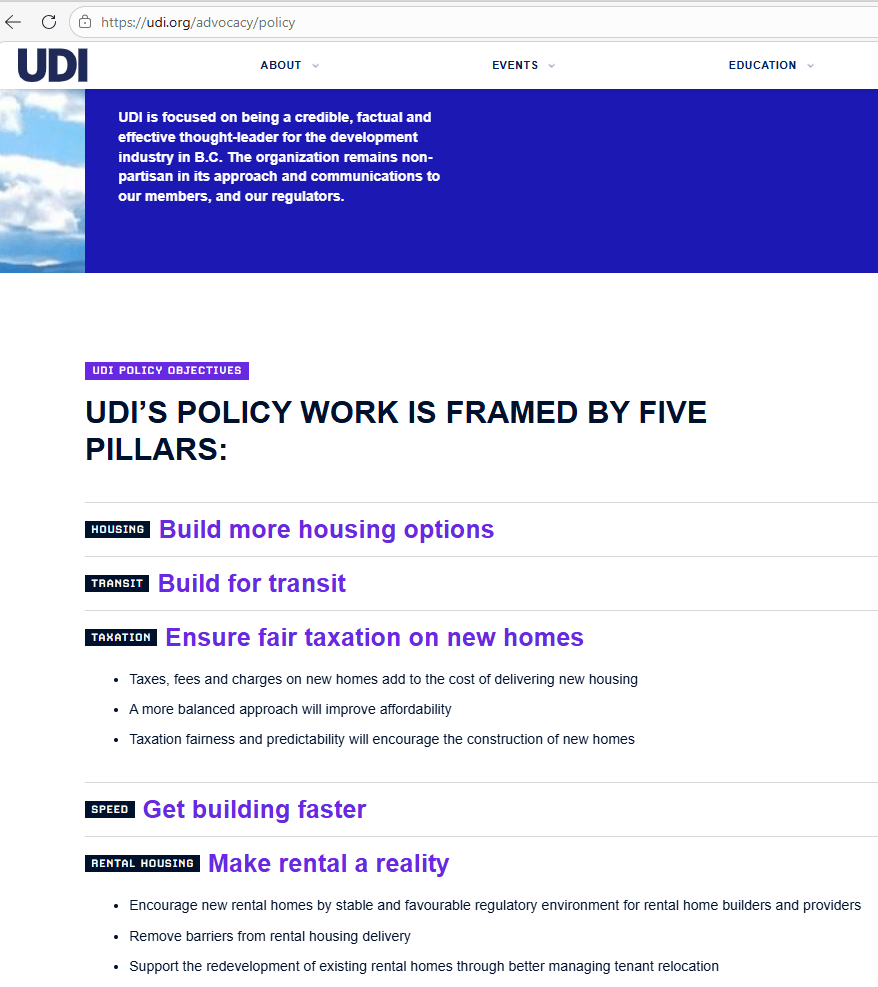

Policy Objectives | UDI – Urban Development Institute
The following is from the UDI’s Annual Report 2023-2024 in which it showed its advocacy (lobbying efforts aimed at the various levels of government), something which it did not include in its 2024-2025 report.

“UDI’s federal engagement continued to grow in 2023 and
2024 with the formation of a new committee focused on
federal advocacy, and a new willingness to listen from the
current Government.
Since the appointment of the Hon. Sean Fraser, as Minister
of Housing, Infrastructure and Communities, we’ve seen
a renewed focus on supply-side measures to accelerate
housing delivery across the country. These included a pivot
in the Federal government’s position on the application
of the GST – effectively removing the tax from new rental
housing – and an exemption for new rental housing from
the excessive interest and financing expenses limitation
(EIFEL) rules in the 2024 Budget. There was also a change
to the Capital Cost Allowance (CCA) rate from 4% to 10%
for new eligible rental projects, which will contribute to
project viability.
All of these changes were longstanding advocacy points
for UDI. Although we still believe that the EIFEL exemption
should apply to the real estate development sector more
broadly, as it does in the United States, we believe that it
represents an incremental gain, and like the removal of the
GST and change to the CCA, will support the development
of new rental housing. Despite these positive changes,
the 2024 Budget also included measures that we will be
watching closely, including the changes to the capital gains tax,
and the potential of a new vacancy tax.
The new direction released by the Federal Government
in April cemented the change in narrative that we had
observed over the past several months. Solving the
Housing Crisis: Canada’s Housing Plan borrows many
of its policies and programs from the B.C. Government’s
own efforts to increase housing development, shining a
spotlight on the generational changes taking place in this
province. While it’s too early to determine the success of
B.C.’s efforts, it’s clear that British Columbians won’t be
the only ones watching with anticipation now.
This Plan includes many positive directions, like tying Federal
funding to commitments by other levels of government to
reduce processing times and improve housing delivery,
particularly around transit. There was an acknowledgment
through the creation of the Canada Housing Infrastructure
Fund, that the Federal Government has a role to play in
supporting growth by making sure that there is funding
available to deliver the necessary infrastructure. While
the actual funding allocation will not be enough to affect
meaningful change, this is a step in the right direction.
UDI is also working collaboratively with other development
organizations across Canada, including other UDI chapters,
the Canadian Home Builders’ Association and BILD GTA.
We believe these collective efforts will continue to deliver
results on behalf of our members.
—————————————————————————————————
Just as the Federal Government and the UDI, used a housing crisis narrative to advance ‘removing barriers to housing supply’ and other policies favourable to industry, the Federal Government was paying hundreds of thousands of dollars in emergency response aid during the pandemic to the UDI.
See also:
“Innovative and Disruptive Thinking”: Impact Canada, a Federal Government Nudge Unit tied to the Prime Minister’s Office, was engaged in a several hundred million dollar program seeking ways to remove barriers to housing supply. – CRD Watch Homepage
Corporate welfare: How the Federal Government of Canada provided one lobby for development and real estate (the Urban Development Institute), hundreds of thousands of dollars in emergency response aid, during the pandemic. – CRD Watch Homepage
—————————————————————————————————
Helps concluded her letter to the Federal government:
Therefore, on behalf of Victoria City Council, we are requesting the Government of Canada to explore removing GST from purpose built rental buildings in the interest of adding much needed supply to the rental pool in Victoria and across the country.
Thank you in advance for your attention to this important matter and for the work that is already underway with respect to the housing crisis. Please do not hesitate to contact me should you have any questions regarding this matter.
Lisa Helps
Victoria Mayor
Helps left office 2 and a half months later. She was made Housing Solutions Advisor to the Premier of British Columbia soon after, and played a key role in setting up the organization BC Builds, becoming after the lead of BC Builds. BC Builds is part of BC Housing. BC Builds offers incentives to developers for increasing types of housing supply.
Helps also wrote in her Aug 17 letter (I’ve highlighted an excerpt):
“From January to June 2022, the City of Victoria hosted a series of dialogues with a number of community members with diverse perspectives on addressing housing affordability, housing supply, and tenant protections who don’t often find themselves at the same table, and sometimes on opposing sides of issues. Participants included four Victoria City Councillors, rental home builders and building owners and managers, the Together Against Poverty Society, the Urban Development Institute, Landlord BC, and BC Housing. The purpose for bringing these people together was to look at the issue of incentivizing the increase of rental supply and affordable housing while also ensuring tenant protections.“
In a recent article I showed how a similar push for incentivizing purpose-built development under the guise of a housing crisis was used in 1981.
Newspaper clippings from the Times Colonist in 1981 reveal that the Housing Crisis scheme has been recycled a generation later. – CRD Watch Homepage
Excerpts from Times Colonist newspaper clippings in 1981:
“Escalation of the housing crisis was inevitable, but the provincial government did nothing to stop it. Some steps would have been relatively easy. The government is sitting on thousands of acres of property in the Highlands, for instance, property which could have been serviced years ago and put on the market at reasonable prices.”
“During those five years, the pressure on the housing market will continue and probably get worse. Either the government takes drastic measures to come to grips with the problem, or things will get worse. A massive infusion of money into the housing market is needed. Government must offer financial incentives to developers, enticing them into building rental accommodation.”
See also: A Quick Glance At Glacier Media’s Real Estate Connections
Petition · Withdraw the Times Colonist from Development Lobby Membership and Media Partnership – Canada · Change.org
—————————————————————————————————
Mayor Dean Murdock of Saanich pushed a recommendation for continued cuts to community amenity contributions charges (CACs) for purpose built-rentals, in a document put forward for the same council meeting that he announced he wouldn’t be running for office again.
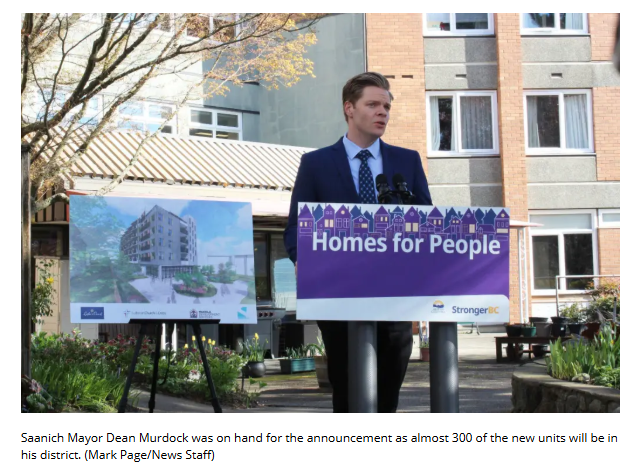
In 2024 Dean Murdock (above) advanced the Province’s Homes For People Plan. See also the photo op taken by the Mayor at Saanich City Hall with Housing Minister Kahlon as the provincial housing targets for Saanich were announced: BC housing initiatives announced twice this week – Island Social Trends
Murdock had been supported in the 2022 local government election by the similarly named organization Homes For Living, a political pressure group that advances a development agenda. Image source In 2026, Murdock announced that he would not be running for Mayor again. During the same council meeting that he announced that he would not be running for mayor again, he advanced cuts for developers on purpose-built rental projects.
—————————————————————————————————
On February 9, 2026 – I attended the Saanich Council meeting that evening.
To the surprise of many (although not entirely surprising given previous statements by the mayor over the previous several months) – Saanich’s Mayor Dean Murdock announced that he would not be running again in the 2026 local government election. In attendance at the meeting, was Federal Liberal MP Will Greaves.
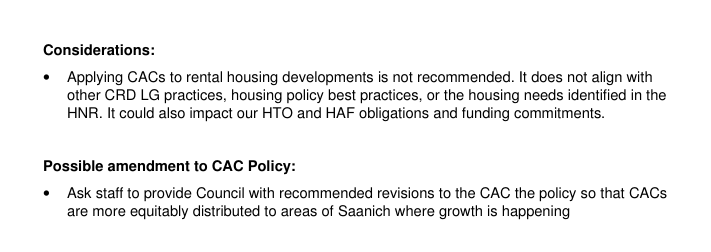
The last item on the agenda that night was the following:
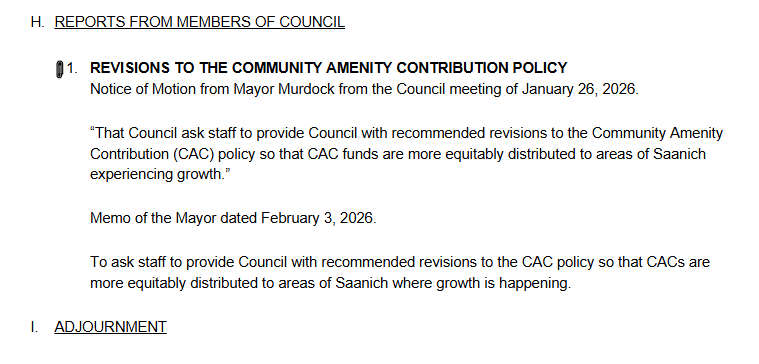
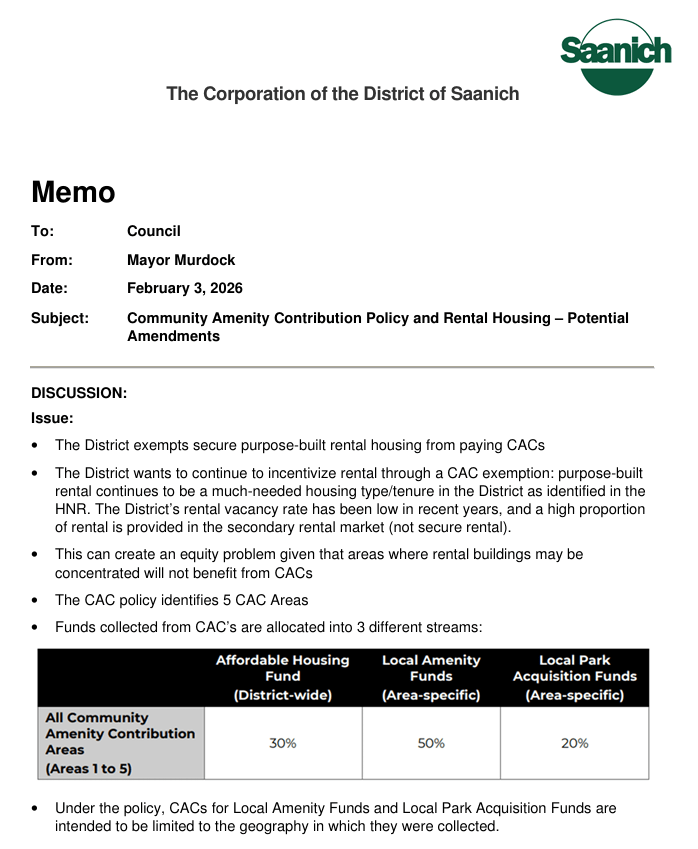
This was the Mayor’s memo attached to the item on the agenda’s page:
I delivered a speech on that item during the public input session of the meeting, which I had prepared in advance:
Item: H.1.: REVISIONS TO THE COMMUNITY AMENITY CONTRIBUTION (CAC) POLICY
From the attached memo, it states: “The District exempts secure purpose-built rental housing from paying CACs”.
Why? Where is the public benefit in this policy? We are looking at market housing, the profits of which go to developers, while added infrastructure requirements are left to be paid for by the public.
In the memo it is also written: “Applying CACs to rental housing developments is not recommended.”
It is not recommended by whom? Where did you get this recommendation from?
According to the Draft Minutes of the Housing Affordable Standing Committee meeting on November 10, 2025: “J. Bourcet stated that many priorities currently lean toward non-market housing and cautioned against losing sight of market housing supply. He noted that adding amenities without nuance may limit developer flexibility and recommended an economic strategy with oversight.”
Mr. J. Bourcet who was appointed to the Committee, is the Chair of the UDI Capital Region, the most powerful lobbying organization for development and real estate interests on the island. It is not surprising that his focus would be on market supply, and that he wanted the district to be cautioned in regard to adding amenities.
At least Mr. Bourcet was calling for a nuanced approach. The approach in the attached document is less nuanced: Again: “Applying CACs to rental housing developments is not recommended.”
Again, who recommended this? We the public deserve to know. Please tell us.
The document continues, [Applying CACs to rental housing developments] “does not align with other CRD Local Government practices, housing policy best practices, or the housing needs identified in the Housing Needs Report. It could also impact our Housing Target Order and Housing Accelerator Fund obligations and funding commitments.”
How does it not align with other CRD Local Government practices? What housing policy best practices are you referring to? Is it material sent to the district by the UDI Capital Region? How does this have anything to do with the Housing Needs Report, which was created by a UDI member company Urban Systems, through its subsidiary Urban Matters? On July 17, 2023 Urban Systems, advised Saanich on policy regarding community amenity contributions (CACs), density bonuses and cash in lieu. They also mentioned that land-lift/upzoning could increase value by 50%. As reported in the Saanich News, council approved a reduction in the CAC rate by 60% that night.
The Mayor’s memo also noted that rental housing development CACs could also impact your Housing Target Order. Well, guess who’s lobbying, the Province was responding to, and who did it consult on their creation? It was again the UDI, top lobbyists of which the Province even had sign Non-Disclosure Agreements during the consultations.
The Premier admitted that the UDI’s advocacy played an important role in the creation of the housing targets at his UDI Luncheon with the so-called Condo King Bob Rennie at the Hyatt in October. He also stated to Rennie at the Luncheon quote: “We have taken big political risks around expanding fast access to density and forcing municipalities that are opposing density to take it.”
This Province and its local governments should start serving their Constituents and stop catering to the UDI’s agenda, against their interests!
Thank you.
—————————————————————————————————
See also:
The House that Mayor Dean Murdock built: Why was a UDI Director/UDI Capital Region Chair, appointed by Saanich’s Mayor, to the Saanich Housing Affordability Standing Committee? – CRD Watch Homepage
The Fox in the Henhouse? Chair of Development/Real Estate lobby Chapter/lobby Director, now reappointed to Saanich Mayor’s Committee, voted in favour of phases 2 and 3 of the District’s Housing Strategy. Council followed suit unanimously. – CRD Watch Homepage
FOI Request to BC Transit yields information about the UDI event: “Pathways to Progress: Uniting Land Use and Transit Strategies for Sustainable Growth” which took place the same day that Saanich adopted its new Official Community Plan and rendered its Local Area Plans legally non-binding. – CRD Watch Homepage
Index of articles regarding lobby events and other meetings between government and lobbyists. – CRD Watch Homepage
—————————————————————————————————
Conclusion:
Prior to leaving office, Mayor Helps of Victoria and Mayor Murdock in Saanich pushed for reductions in government charges for the construction of purpose-built rentals.
Mayor Helps left elected office in 2022. 2 and a half months before she left, she wrote a letter to the Federal government, calling for the removal of GST charges for purpose-built rentals, based on ideas she had received from the UDI lobby and other groups. Removal of GST from purpose-built rentals has been a key policy objective of the UDI.
Helps upon leaving office found new work as the Housing Solutions Advisor to the Premier, whereby she played a key role in the setup of BC Builds, where she became Lead after. BC Builds provides incentives to developers for certain types of projects.
In early 2026, Mayor Murdock announced that he would not be running for Mayor of Saanich again that year. For the same council meeting where his unexpected announcement took place that night, he had advanced a memo recommending continued cuts of Community Amenity Contributions (CACs) charges for purpose-built rentals (rental housing developments).
Several months earlier according to the Draft Minutes of the Housing Affordable Standing Committee meeting, the Chair of the UDI Capital Region, John Bourcet who had been appointed by the Mayor to the committe as a member of the “community at large” had stated:
“that many priorities currently lean toward non-market housing and cautioned against losing sight of market housing supply. He noted that adding amenities without nuance may limit developer flexibility and recommended an economic strategy with oversight.”
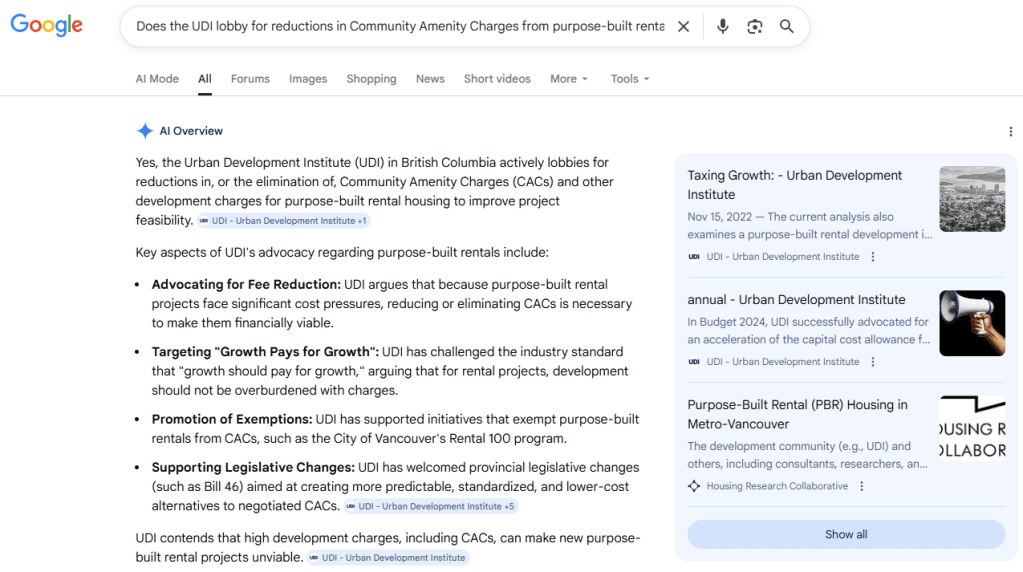
The UDI lobbies for the reduction of CACs on purpose-built rentals. (See Appendix 4).
Will Mayor Murdock follow a similar path to former Helps in his next venture?
—————————————————————————————————
See also:
Snapshot of Deanmurdock.ca in Aug 2020: “Facilitation and engagement specialist”, leads to questions about the focus of Murdock’s consultation business, prior to his becoming the Mayor of Saanich. – CRD Watch Homepage
LETTER: Saanich shouldn’t be providing discounts to developers | Saanich News
—————————————————————————————————
Appendix 1: An example of unreadable content as retrieved through so-called “Freedom of Information”:

—————————————————————————————————
Appendix 2: Text of Aug 17, 2022 Lisa Helps letter to the Trudeau government.
Dear Prime Minister Trudeau, Minister Freeland and Minster [sic] Hussen
I am writing to you today on behalf of Victoria City Council to advocate for the removal of charging GST from purpose built rental buildings.
From January to June 2022, the City of Victoria hosted a series of dialogues with a number of community members with diverse perspectives on addressing housing affordability, housing supply, and tenant protections who don’t often find themselves at the same table, and sometimes on opposing sides of issues. Participants included four Victoria City Councillors, rental home builders and building owners and managers, the Together Against Poverty Society, the Urban Development Institute, Landlord BC, and BC Housing. The purpose for bringing these people together was to look at the issue of incentivizing the increase of rental supply and affordable housing while also ensuring tenant protections.
One of the ideas generated through these dialogues was an advocacy motion to the federal government to remove GST from purpose built rental housing. In a recent 87-unit rental project, GST added $2,250,000 to the cost of the building. This money has to be either borrowed – increasing financial costs therefore increasing rents – or passed on directly to the tenants in the form of higher rents.
We are well aware that there is no answer to addressing the dire housing crisis that we find ourselves in as a city, province and country. The Victoria Housing Strategy has a range of approaches we are implementing, and we view the abov advocacy and reccomendation as an extension of this work. The benefit of the above proposal is that it has been examined from many perspectives and is supported by a wide spectrum of people working to address the housing supply issue, the housing affordability issue, and to protect tenants.
Therefore, on behalf of Victoria City Council, we are requesting the Government of Canada to explore removing GST from purpose built rental buildings in the interest of adding much needed supply to the rental pool in Victoria and across the country.
Thank you in advance for your attention to this important matter and for the work that is already underway with respect to the housing crisis. Please do not hesitate to contact me should you have any questions regarding this matter.
Lisa Helps
Victoria Mayor
—————————————————————————————————
Appendix 3: I asked Google’s AI: Does “the UDI push for the removal of GST in purpose-built rentals?
—————————————————————————————————
Appendix 4: I asked Google AI: Does the UDI lobby for reductions in Community Amenity Charges from purpose-built rentals?
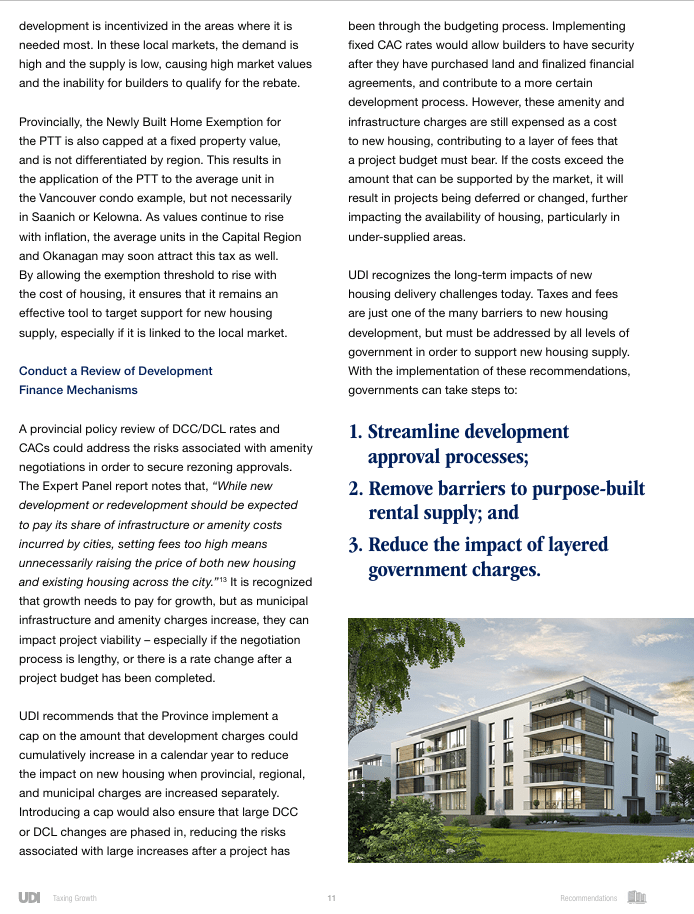
The following is an excerpt from the UDI’s policy document called Taxing Growth:
https://www.hrc.ubc.ca/wp-content/uploads/2025/02/Literature-Review_Housing-Summit-Final.pdf#:~:text=The%20development%20community%20(e.g.%2C%20UDI)%20and%20others%2C,incorporating%20pre%2Dzoning%20into%20Official%20Community%20Plans%20(OCPs).
Archived copy: https://web.archive.org/web/20240101000000*/https://udi.org/pdfs/resource-library/UDI-Taxing-Growth.pdf
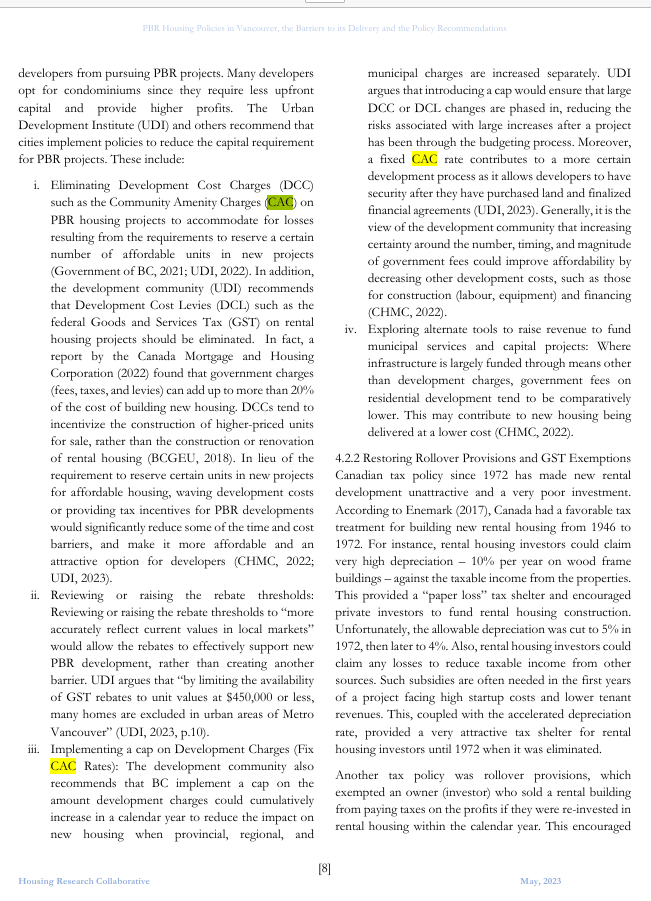
https://www.hrc.ubc.ca/wp-content/uploads/2025/02/Literature-Review_Housing-Summit-Final.pdf
—————————————————————————————————

 CRD Watch Homepage
Leave a comment