
“Innovative and Disruptive Thinking”: Impact Canada, a Federal Government Nudge Unit tied to the Prime Minister’s Office, was engaged in a several hundred million dollar program seeking ways to remove barriers to housing supply.
“Increasing the supply of housing requires innovative and disruptive thinking. The Housing Supply Challenge will bring forward the best new ideas with the funding to turn those ideas into realities that can address housing supply issues in Canada”
– Ahmed Hussen, Minister of Families, Children and Social Development (at the time)


Excerpt from Access to Information Request:
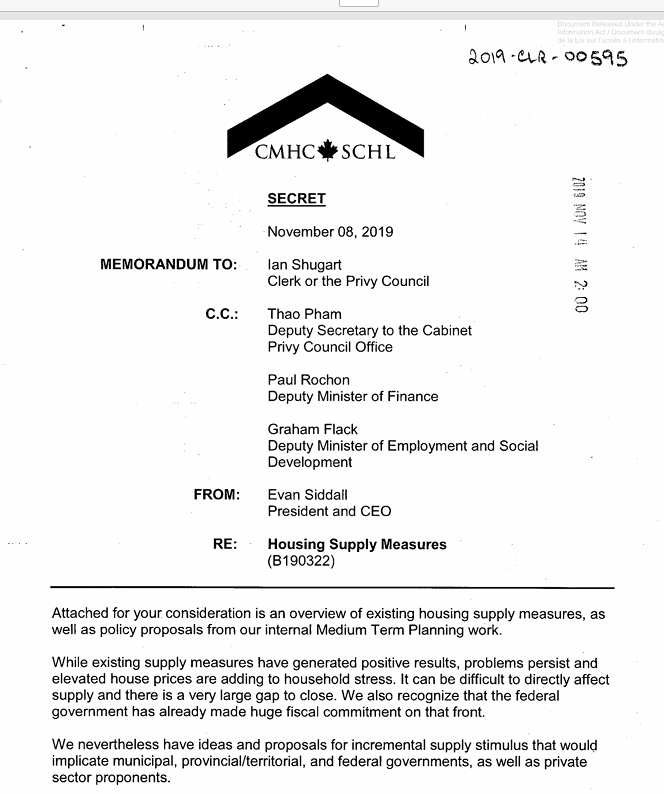
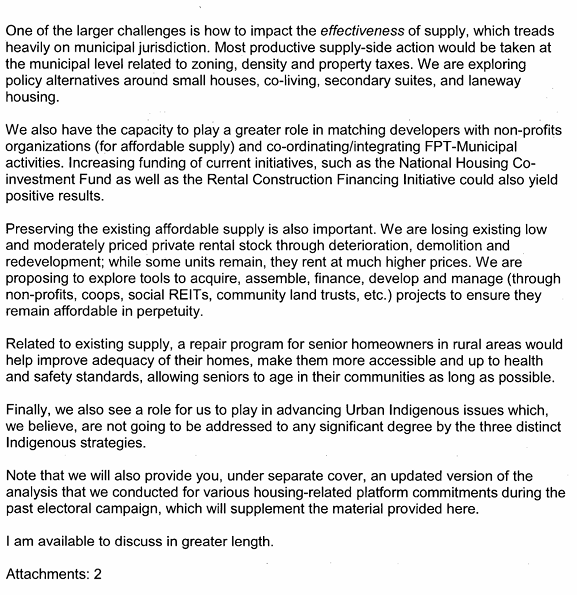
“One of the larger challenges is how to impact the effectiveness of supply, which treads heavily on municipal jurisdiction. Most productive supply-side action would be taken at the municipal level related to zoning, density and property taxes. We are exploring”



By Sasha Izard
Jan 1, 2025
It’s New Years day, and I figured that the best way to start the new year is with some transparency, on how the Government of Canada operates. After all, what could be more important to a great 2026, than transparency towards government! Perhaps they can make it their New Years resolution to be transparent.
In a recent article, I wrote about BC’s Behavioural Insights Group, a nudge unit operating for the Provincial Government:
What is BC’s Behavioural Insights Group, and do they work with META? – CRD Watch Homepage
This article is about Impact Canada, another nudge unit, which operates for the federal government. It is part of the Privy Council Office, which is tied to the Prime Minister’s Office.
—————————————————————————————————
In mid 2023, I decided to ask Impact Canada about its usage of behavioural analytics and “behavioural design”. This resulted in an email dialogue with them.
On June 3, 2023 I wrote to Impact Canada at the obscure and nondescript email address for them that I was able to locate:
iiu-uii@pco-bcp.gc.ca
Hello,
I have a question. Does Impact Canada engage in Behavioural Insights like BC’s Behavioural Insights Group?
Thank you,
Sasha Izard
—————————————————————————————————\
Impact Canada responded:
Hi Sasha,
Thank you for your inquiry. Yes, we are an applied behavioural science team similar to BC BIG; however, we operate at the Federal level.
Please visit our website to learn more about our behavioural science work: https://impact.canada.ca/en/behavioural-science
Best,
Office of the Assistant Secretary to the Cabinet | Bureau du Secrétaire adjoint du Cabinet
Impact & Innovation Unit | Unité de l’impact et de l’innovation
Privy Council Office | Bureau du Conseil privé
Government of Canada | Gouvernement du Canada
@impact_innovEN | @impact_innovFR
https://impact.canada.ca/
—————————————————————————————————
Hello Impact Canada,
Thank you for your response.
How does Impact Canada apply behavioural science?
Thanks again,
Sasha
—————————————————————————————————
Impact Canada replied,
Hi Sasha,
You can find more information on our behavioural science projects
here: https://impact.canada.ca/behavioural-science/projects
Is there anything specific you’re looking for?
————————————————————————————————–
I wrote back:
Hello,
In terms of the actual methodologies used.
What are the methodologies utilized by Impact Canada for applying behavioural science and engaging in “behavioural design”?
Thank you.
————————————————————————————————–
Hi Sasha,
Thank you for clarifying, we can certainly provide more information on our methodology. I’ve CC’d my colleague Amanda Desnoyers, one of our Behavioural Scientists, who can discuss with you the behavioural science methodologies used by Impact Canada.
————————————————————————————————–
Impact Canada’s Senior Behavioural Scientist, Community and Capacity, wrote to me:
Hi Sasha,
Thank you so much your question.
We approach each behavioural challenge by using our identify, understand, design, test, and scale approach and often tailor that according to the needs of the project.
Our team uses a mixed-method approach. Some of our behavioural science work relies on surveys, while other work have more qualitative components (i.e., interviews, focus groups etc.) and some may have both. It truly varies by project and partner.
Does that answer your question?
Follow-up with me if you have any other questions.
Cheers,
Amanda
————————————————————————————————–
I replied,
Thank you very much,
Sasha
I then wrote the following:
Hello Amanda,
Thank you for your response. It tells me roughly how you collect data, but my question is not how you collect data, but how data once studied is applied. What methodologies are used and how is it done and to who is it done?
Step #5 on your website does not explain that.
It says:
“Prepare plans for scaling (e.g. for broad dissemination of results, preparing policy memos, and supporting other key stakeholders to adapt and adopt provides solutions)
Support plan execution”
However, that does not explain the methodologies involved. Preparing a policy memo does not explain how it is implemented. About supporting other key stakeholders, does this mean that the “behavioural design process” is being subcontracted out to organizations other than the government?
If so, how do they implement behavioural design and to who?
To add under 3. Design:
- Ideate solutions for confirmed hypotheses, referencing the behavioural science literature
- Present prototypes of solutions to partners for feedback
- Iterate to refine solutions and prepare priority solutions for testing
What types of solutions are devised/used and how?
Thank you again.
————————————————————————————————–
While Amanda had written “Follow-up with me if you have any other questions.
Cheers,”
That didn’t mean apparently, that if I asked any follow-up questions, that I would get any answers to them. She immediately fell silent.
Why?
If there is nothing to hide, why not be responsive to an inquiry from a member of the public as to how this government nudge unit is operating?
————————————————————————————————–
2 weeks later, I wrote back:
Hello Amanda,
I’m wondering why you were so prompt in responding to my message before and yet you haven’t responded to the questions I’ve asked.
Thank you,
Sasha
————————————————————————————————–
When government stops responding, I know that I’m onto something, and I don’t stop there.
What I found most questionable was Impact Canada’s 300 million dollar housing supply challenge, in partnership with the CMHC, the Canada Mortgage and Housing Corporation.
Up until some point in 2023, the CMHC was a paying member of the Urban Development Institute (UDI), a registered lobbying organization on the BC Lobbyists Registry, representing billions of dollars of corporate interests in real estate and development, that primarily pushes a supply-based approach to housing, which has not led to housing affordability.
Now the CMHC had teamed up with a nudge unit using several hundred million dollars of taxpayer funds to find ways to remove barriers to housing supply. To put it mildly I saw this as a conflict of interest. Perhaps the CMHC finally did as well – as mentioned, they pulled out of the UDI at some point in 2023, which is in some sense too bad, as it brushed that inappropriate government/lobby relationship under the carpet.
On July 5, 2025 I sent an Access to Information Request to the Privy Office, which Impact Canada is under:
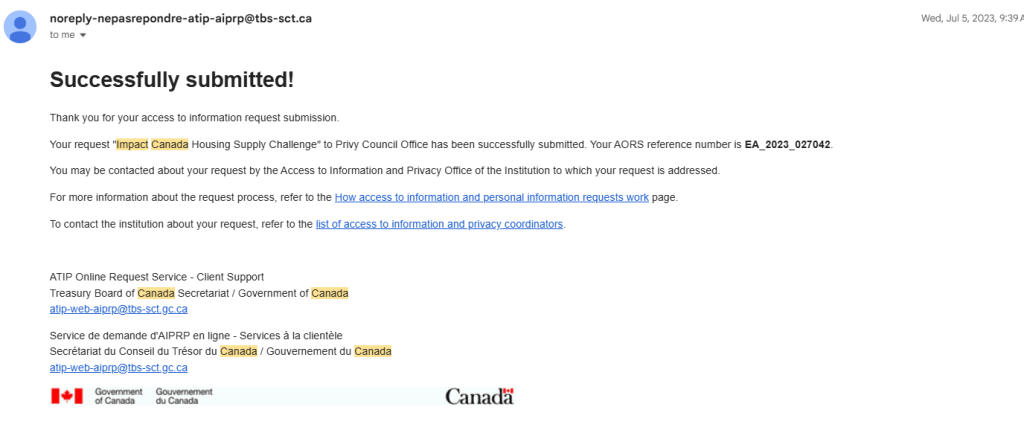
The following was my Access to Information request:
‘’Hello, I would like to know and have documents pertaining to the role of the Privy Council Office in regards to the CMHC’s Housing Supply Challenge. This would include the role of Impact Canada and the Impact and Innovation Unit in the Privy Council Office in the Housing Supply Challenge. I would also like to know why these organizations falling under the Privy Council Office decided to collaborate with the CMHC on this project. Please provide any documentation that shows the reasoning and mandate for this.’’
A representative reached back to me for clarification on the request. I noted that I was looking for:
All emails, briefing notes, memos, consultations, meeting minutes, and internal correspondence, drafts.
In order to make a start date and an end date, I have to know when the process of determining to take part in and engaging in the project began.
Thank you again,
Sasha
—————————————————————————————————
They wrote back:
Good Day Sasha,
Thank you for providing clarifications to our inquiries.
As the initiative was announced in Budget 2019 (announced March 19, 2019), we expect records could go as far back as this, or a bit prior if PCO happened to be involved ahead of the budget announcement. With this in mind, is there a specific timeframe of records you are interested in?
Please note that this request will be put on hold while we await your response.
Thank you kindly,
—————————————————————————————————
I wrote,
Hi,
That makes sense.
Just to be safe, the range can be June 1, 2018 to July 13, 2023
Thank you again for your help,
Sasha
—————————————————————————————————
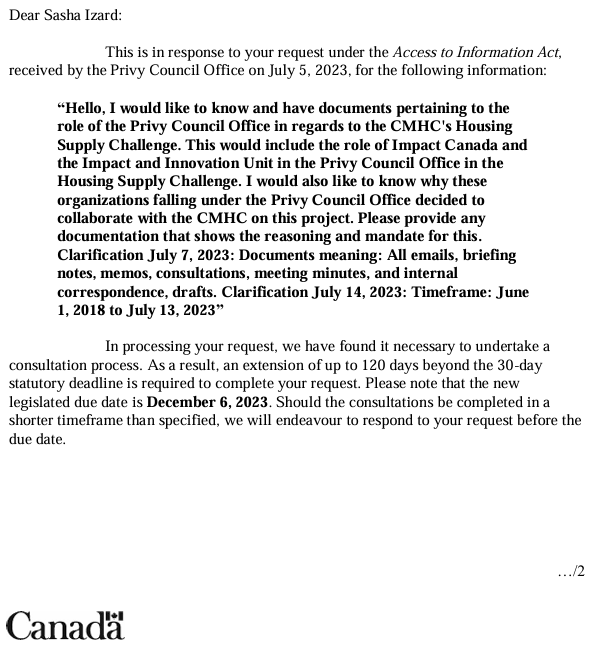
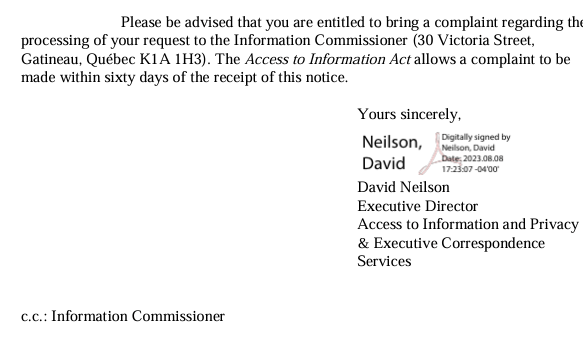
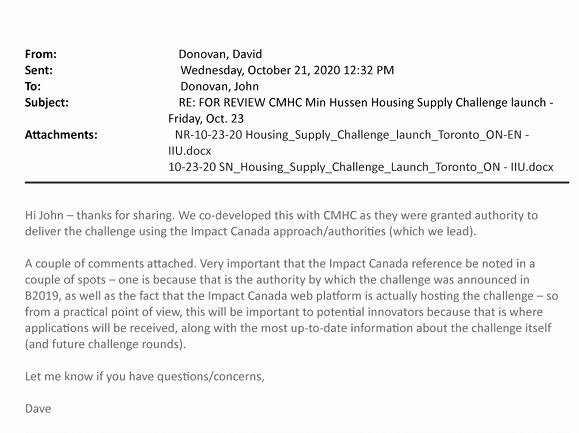
The Government of Canada’s Privy Office wrote back a month later, on Aug 8, 2025.
They took the longest initial extension for an access to information, or freedom of information request, that I have ever seen (120 days beyond the 30 day statutory deadline, which is 150 days):

———————————————————————————–
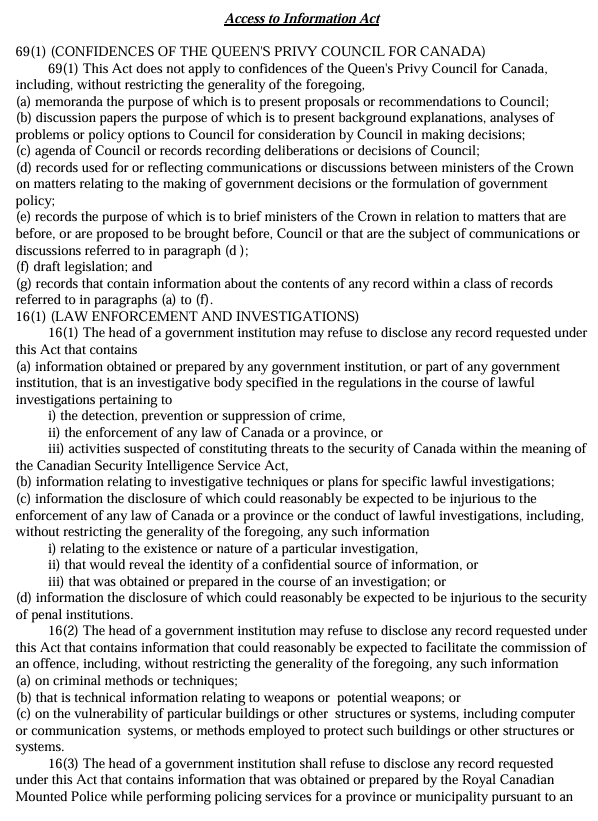
I received the Access to Information response, 2 days after the extended deadline, on Dec 8, 2023, albeit it came with a major amount of fine print about what it may not include:


———————————————————————————–
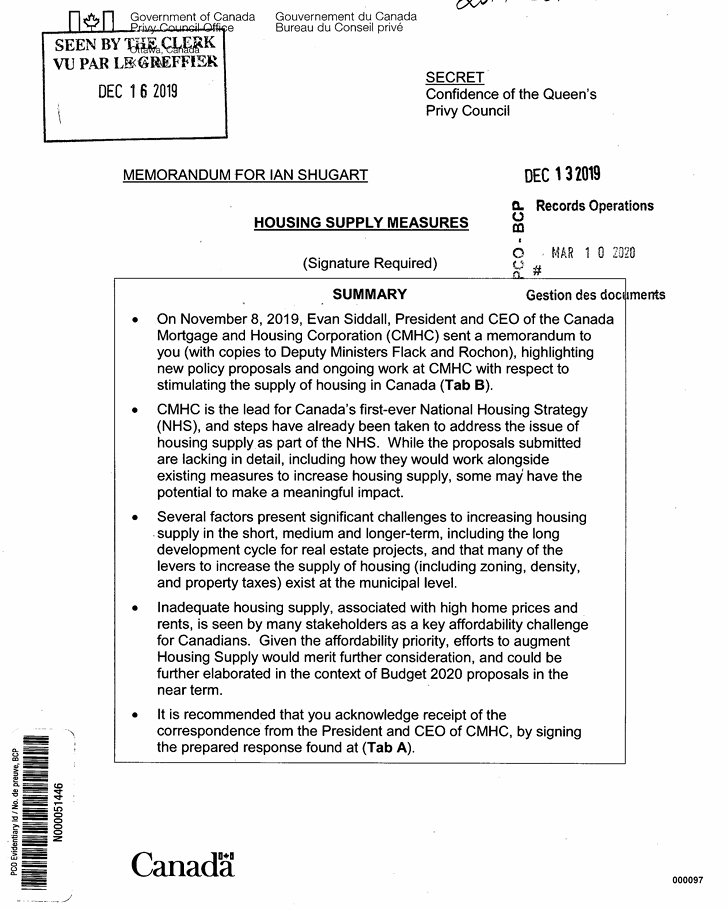
What I received was a mere 56 pages, with heavy redactions. There was not much to enlighten as to why the CMHC teamed up with Impact Canada to engage on the several hundred million dollar Housing Supply challenge, but there were some clues.
The following are some of them:
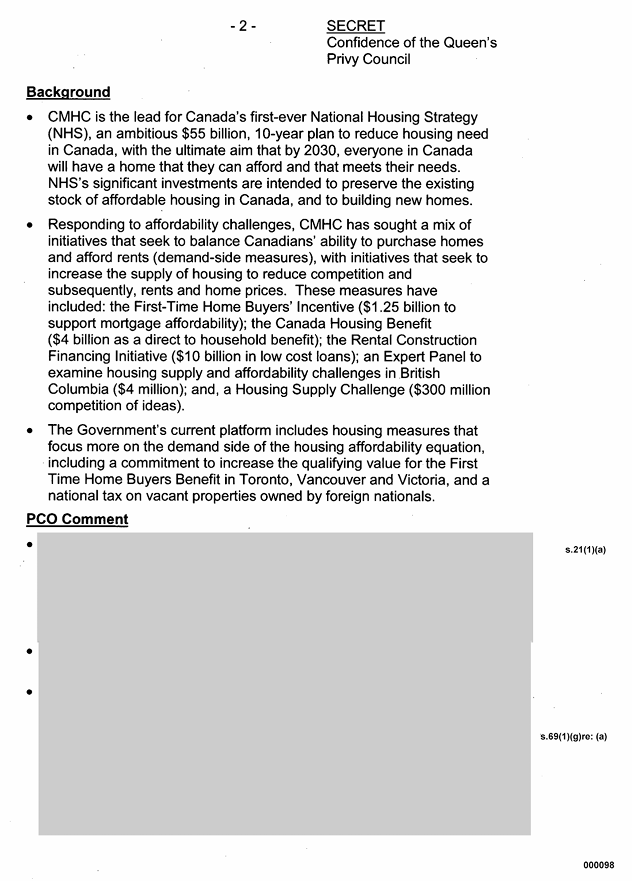
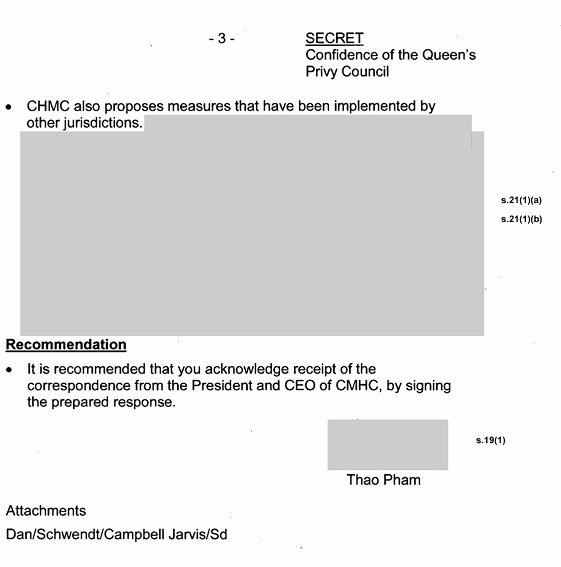
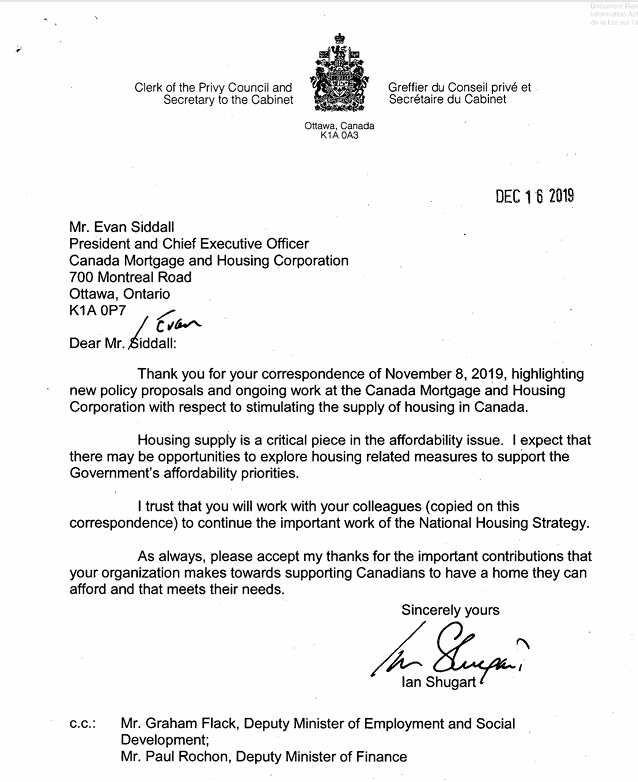
Note: In the beginning of the first page of this above document, it mentioned the CMHC’s intention of stimulating the housing supply.
The CMHC pulled both its UDI lobby memberships in 2023, but was a member for a number of years up to that. The UDI primarily pushes a supply-first narrative, that does not lead to housing affordability.
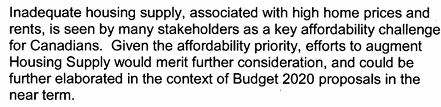
Who were the stakeholders, they mentioned? The UDI and others like it perhaps?
The 2nd page of the above document mentioned the National Housing Strategy (NHS) which at that point was targeted for $55 billion dollars. It has since ballooned to more than twice that, at a projected $115 billion dollars.
Has the strategy led to general affordability in the country? Far from it, but it has represented a vast transfer of public wealth into the pockets of private companies, including through this $300 million taxpayer funded program.
The above document is a critical piece of the puzzle. The CMHC has bought all into a supply narrative, that has not and did not lead to housing affordability. This was part of that strategy.

Why were the above pages blank? Did they not want the public to know what ideas they were considering using, or have implemented to target the populace? That question is rhetorical. It’s obvious that they don’t, hence the word Secret was attached to the document in the top right corner.
Is such a blatant lack of transparency regarding how the government has been dreaming up ways/attempting to manipulate the public, part of democracy? That again was rhetorical.
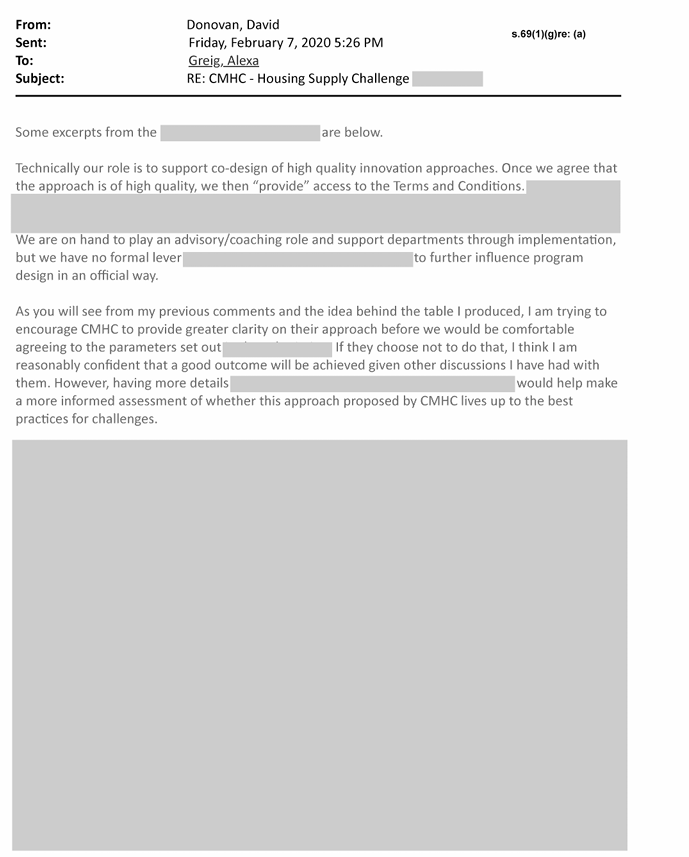

In the above document (2 pages), mostly censored. A person asked for more details to make an informed assessment if what the CMHC was proposing fit best practices.
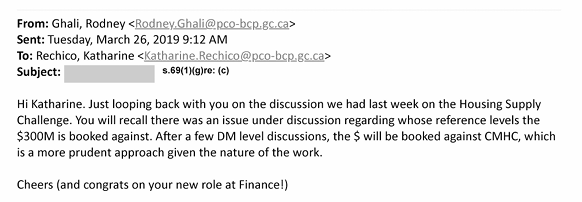
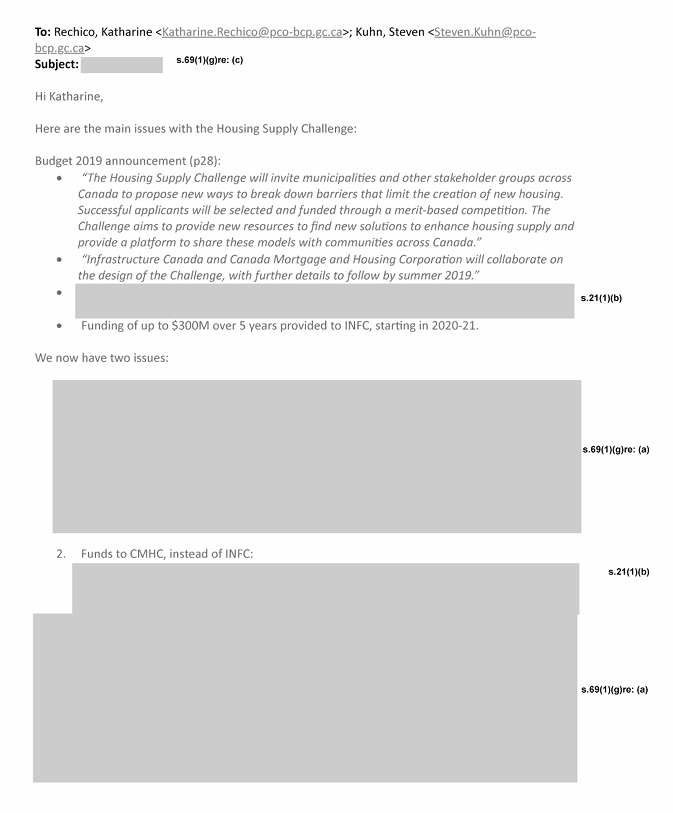
The below document shows that the plan passed a legal analyses:
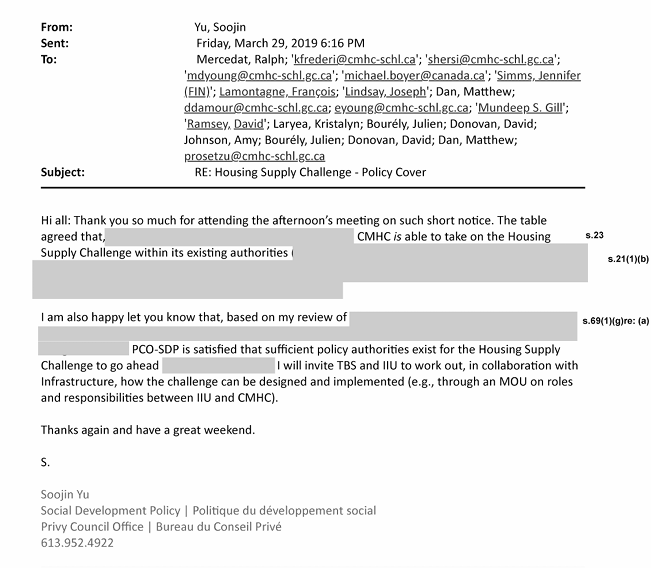
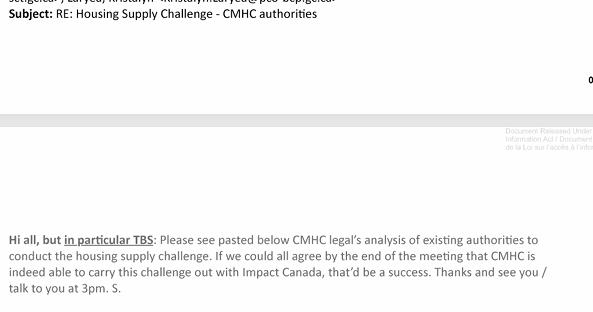

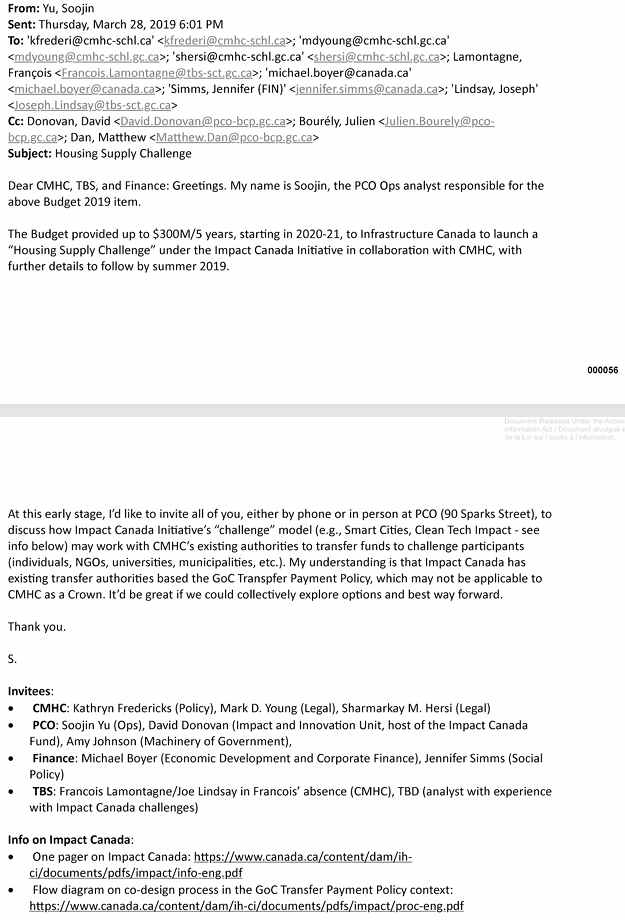
Note, Impact Canada’s involvement with Smart Cities, mentioned above.
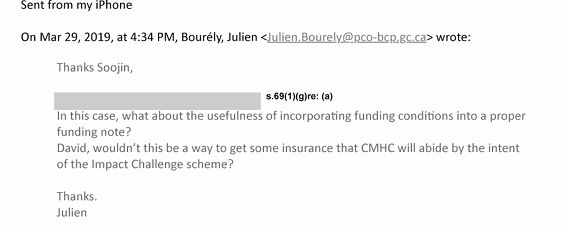


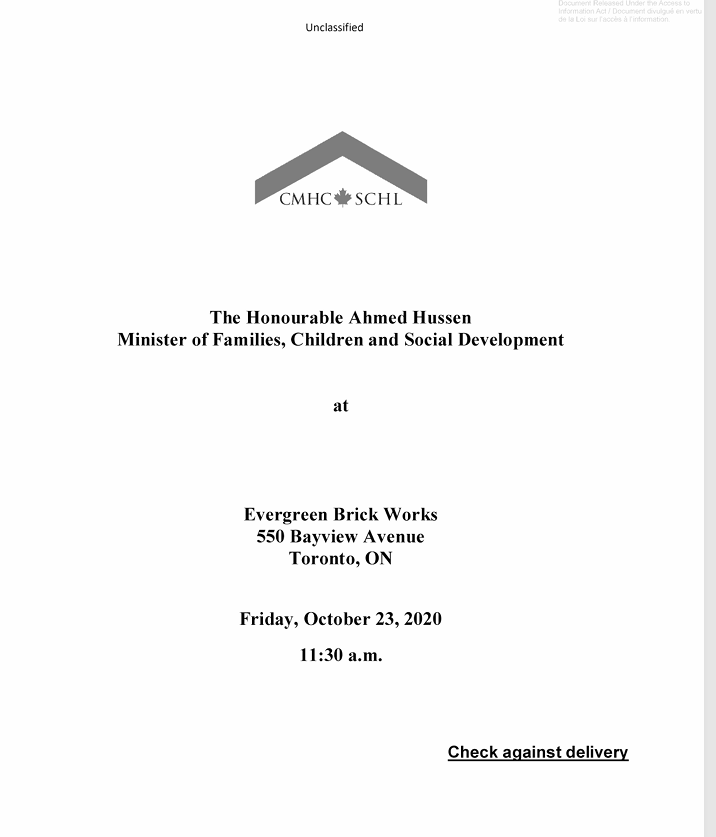



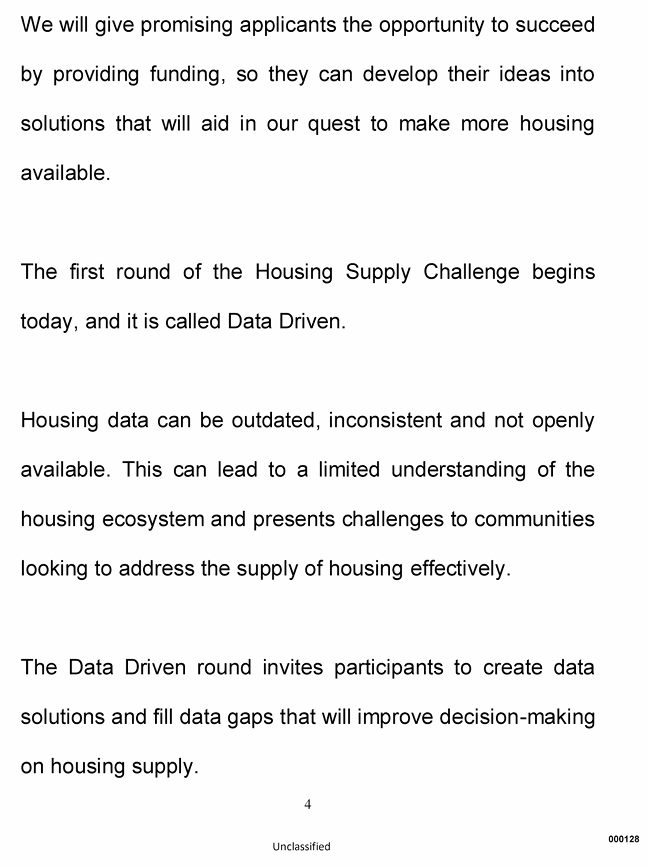
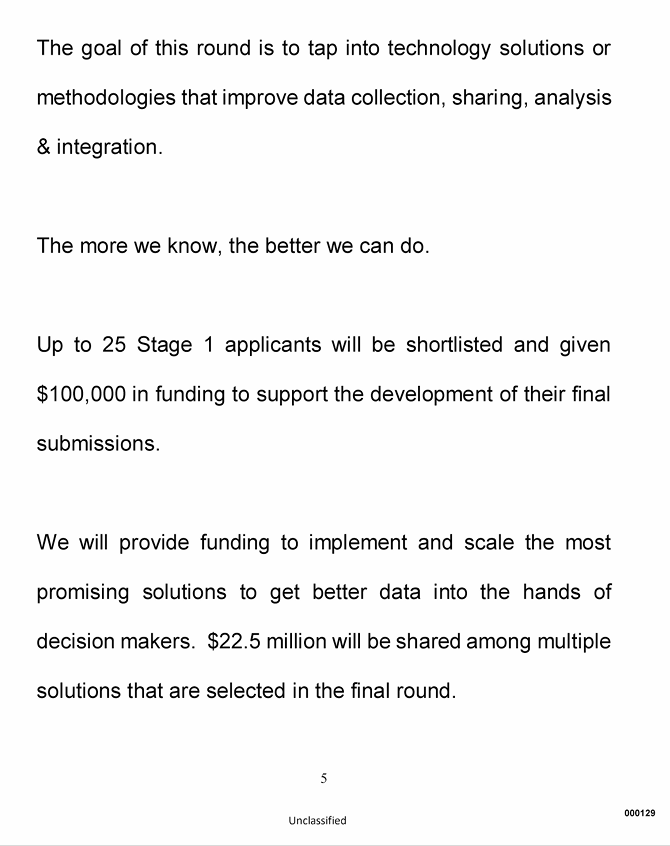


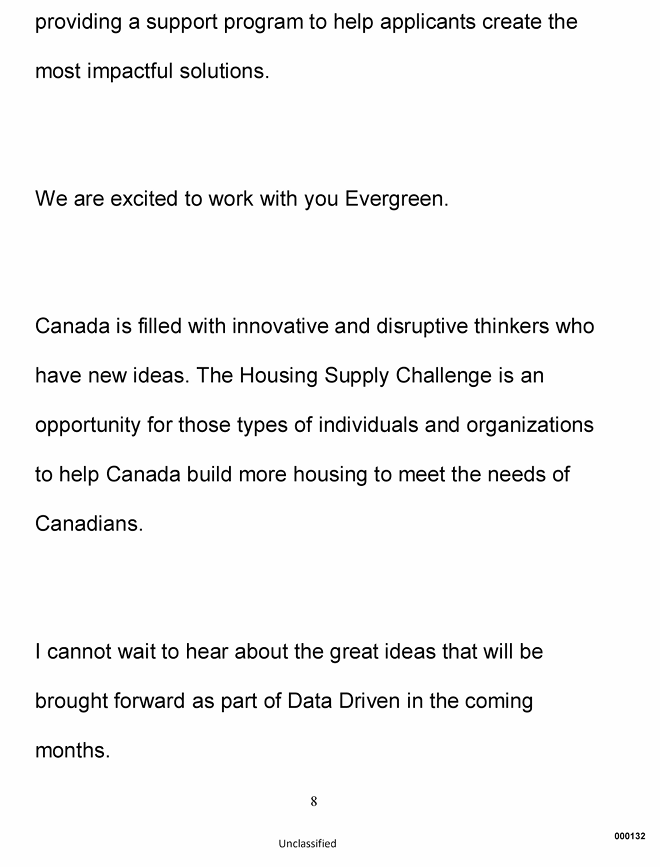

Not surprising, the last document which looks like it was written by the PR department was labeled unclassified, almost as if they wanted me to publish that and nothing else in the Access to Information response. If so, too bad.
This part was particularly eye catching:
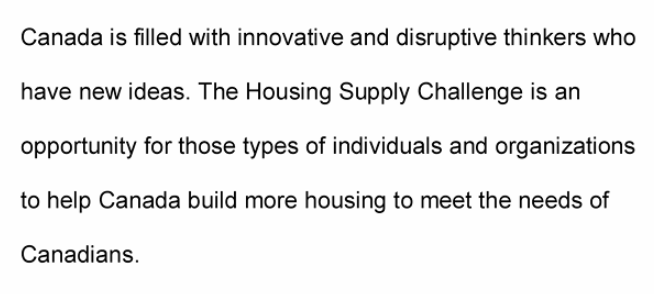
It just happened that the Federal government was offering several hundred million dollars for them…
—————————————————————————————————
What the Supply Myth costs Canadians:

Archived snapshot of Impact Canada’s homepage: Homepage | Impact Canada
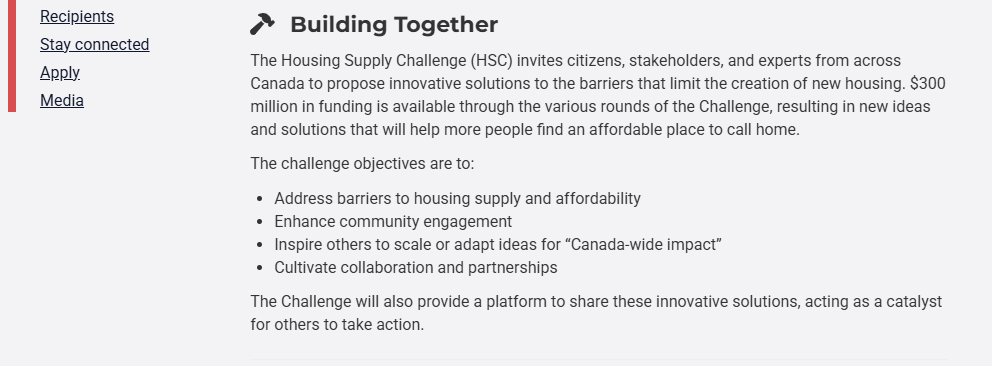
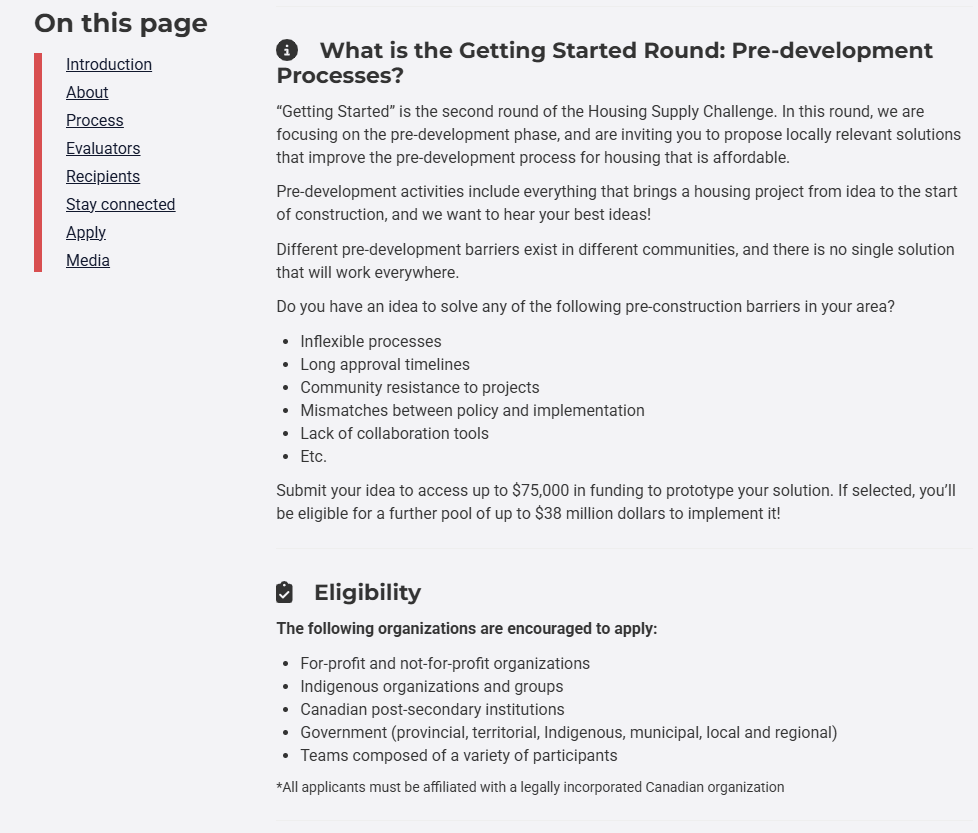
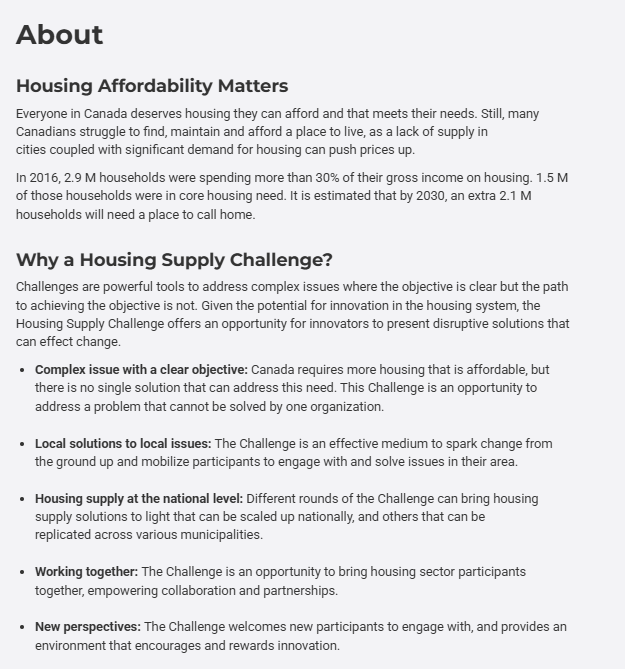
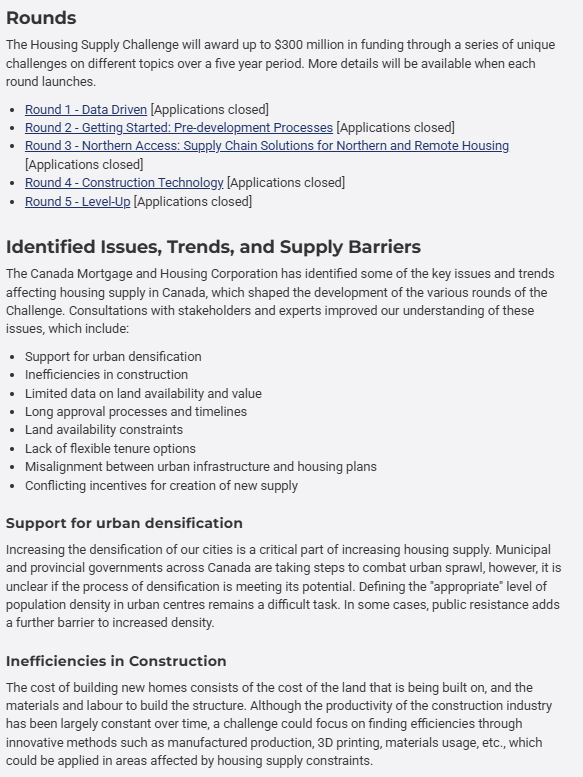
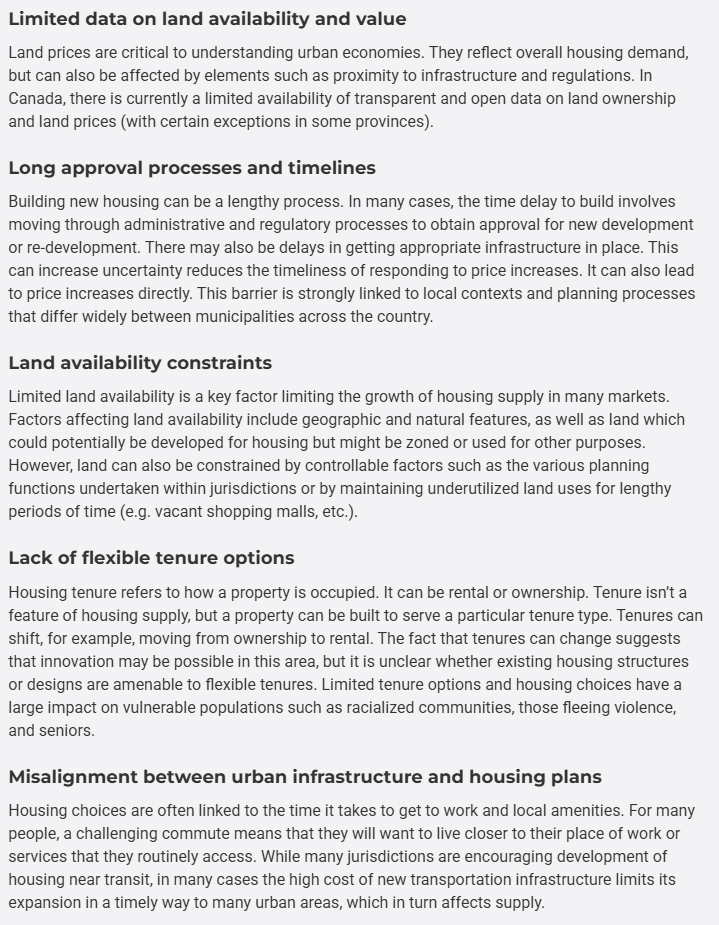
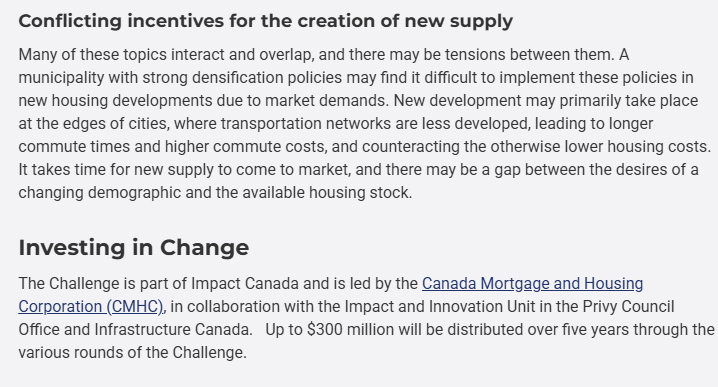
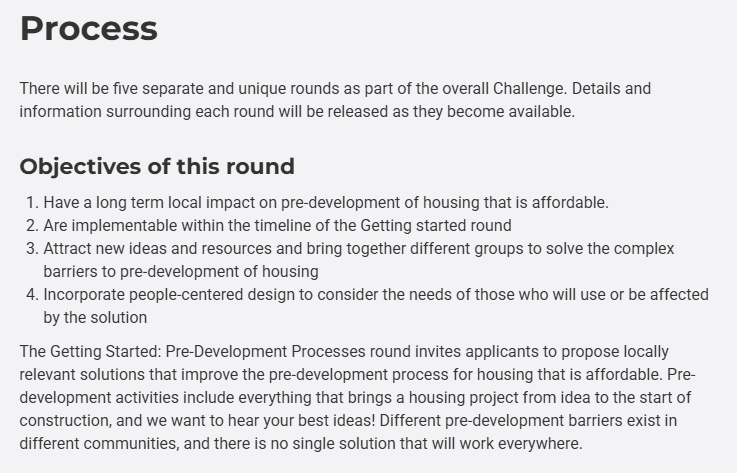
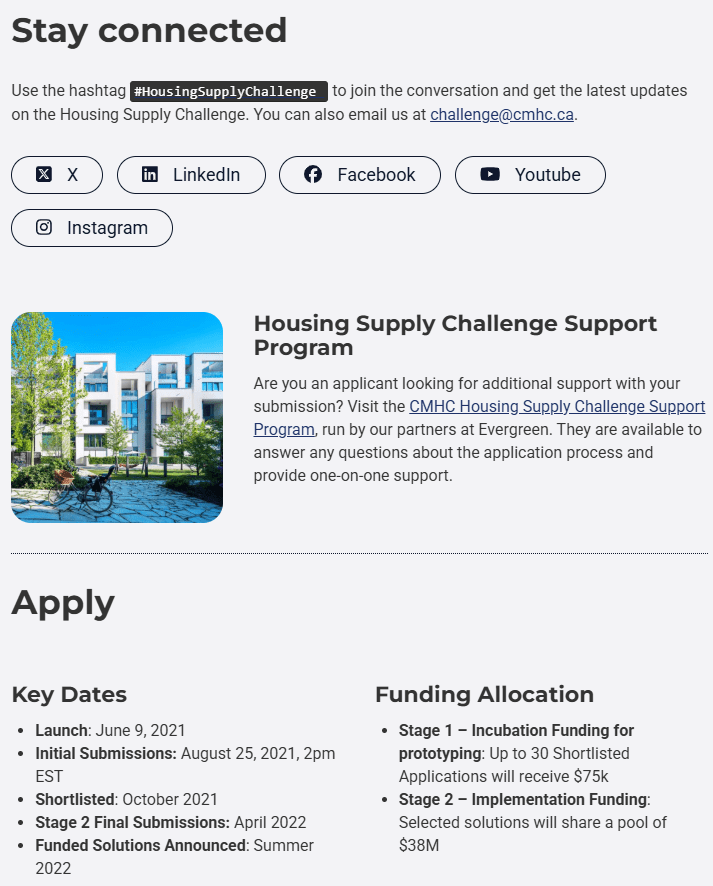
Below are an excerpts from: Housing Supply Challenge: Round 2 – Getting Started | Impact Canada
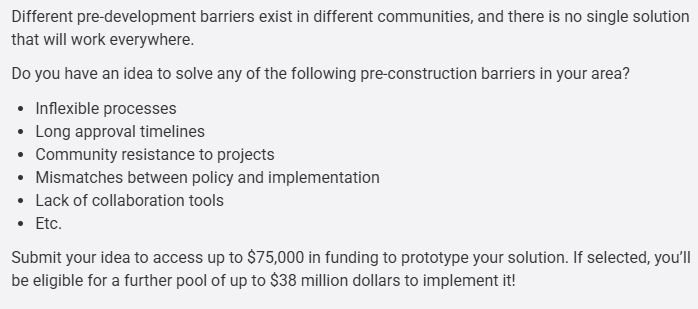
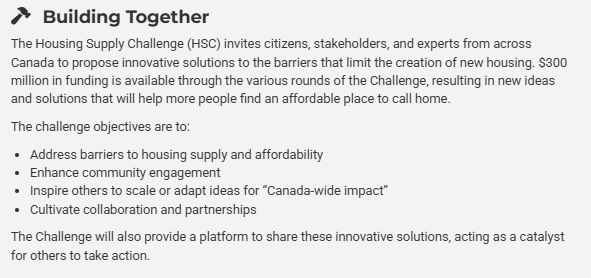
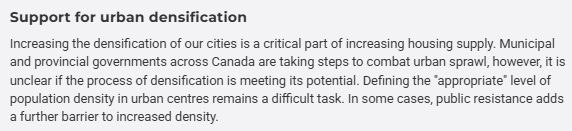
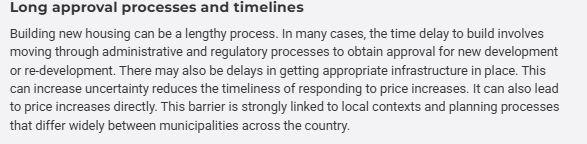
The full section is included in the appendix at the end of this article.
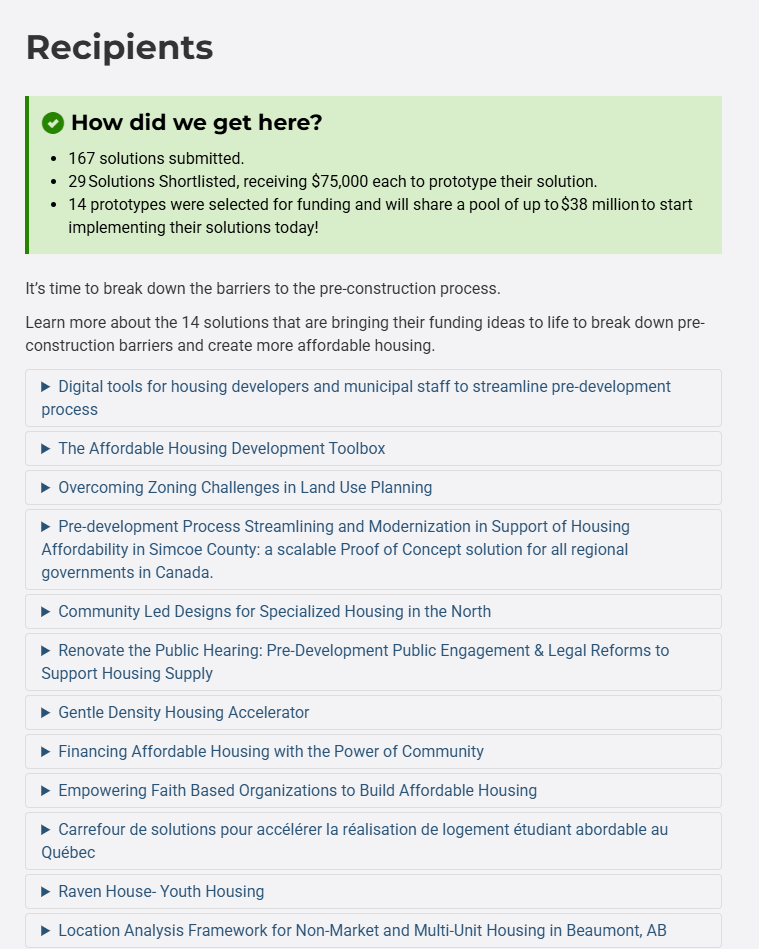
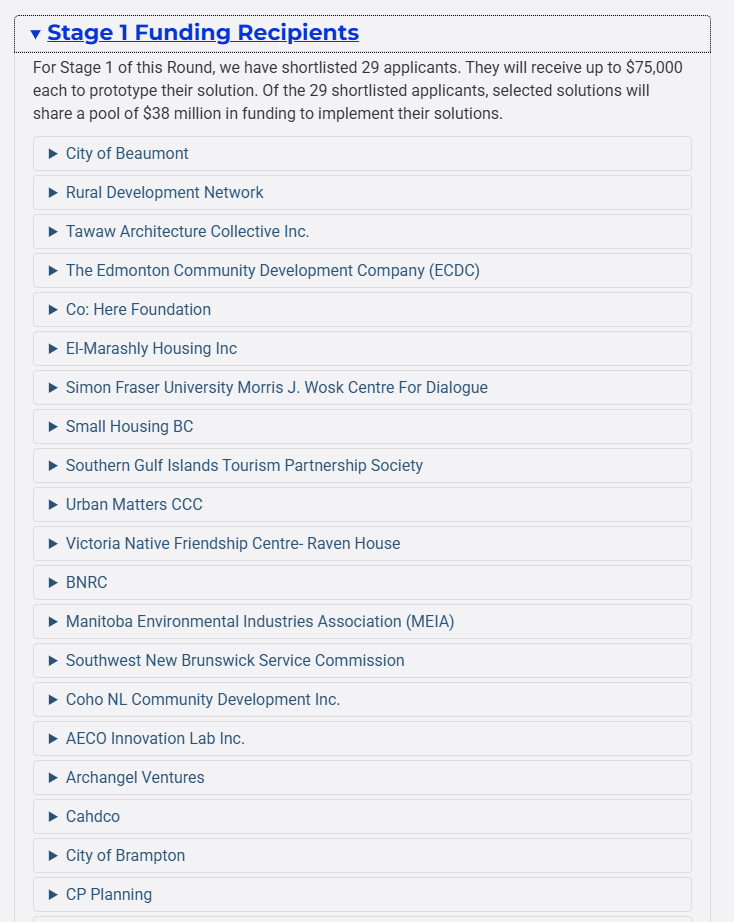
Browsing the full appendix, you might notice some familiar names, some of which are from Southern Vancouver Island.
You might for example, notice UDI member M’akola Development Services.
M’akola was one of those tasked by the BC Housing Ministry, under the direction of the “NIMBY” Task Group to create a guide to fighting nimbyism:
Microsoft Word – NimbyToolkit-vFIN
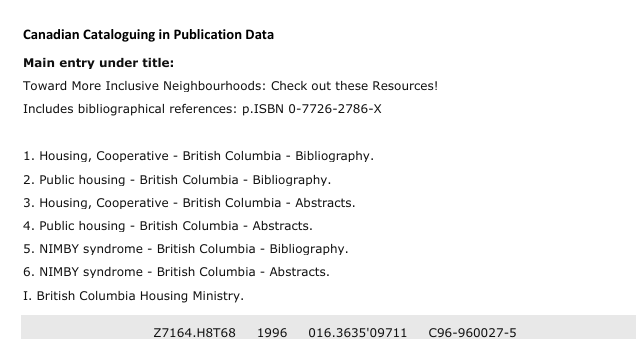
Yes, our housing Ministry, sure is mature isn’t it?
—————————————————————————————————
Or one might notice the name Urban Matters CCC. Urban Matters is a subsidiary of Urban Systems, which disguises that it was UDI member company Urban Systems that has had a virtual monopoly creating Housing Needs Reports (housing targets) for municipalities across much of BC, which has made the company many 10s of thousands of dollars and continues to do so, as they dictate to municipalities how many housing units they have to build.
If the corporate capture of housing policy, and using it to advance the development industry’s interests isn’t too obvious, reading sections of the Impact Canada/CMHC Housing Supply Challenge makes it very obvious.
The 300 million dollar Housing Supply Challenge was part of the 115+ billion dollar National Housing Strategy (NHS) of Canada.
The National Housing Strategy shows how the full embrasure of the development industry’s supply myth, has led to an abject failure in housing policy. Housing has not become affordable, as a result of spending billions of dollars subsidizing the development industry’s big lie that increased supply/density leads to housing affordability. It doesn’t. Conversely, it leads to land-lift, gentrification, and unaffordable housing prices, as has been shown not only be the examples of big cities like Toronto, New York and Vancouver, but by the failure of years of this failed strategy, to deliver housing affordability to Canadians.
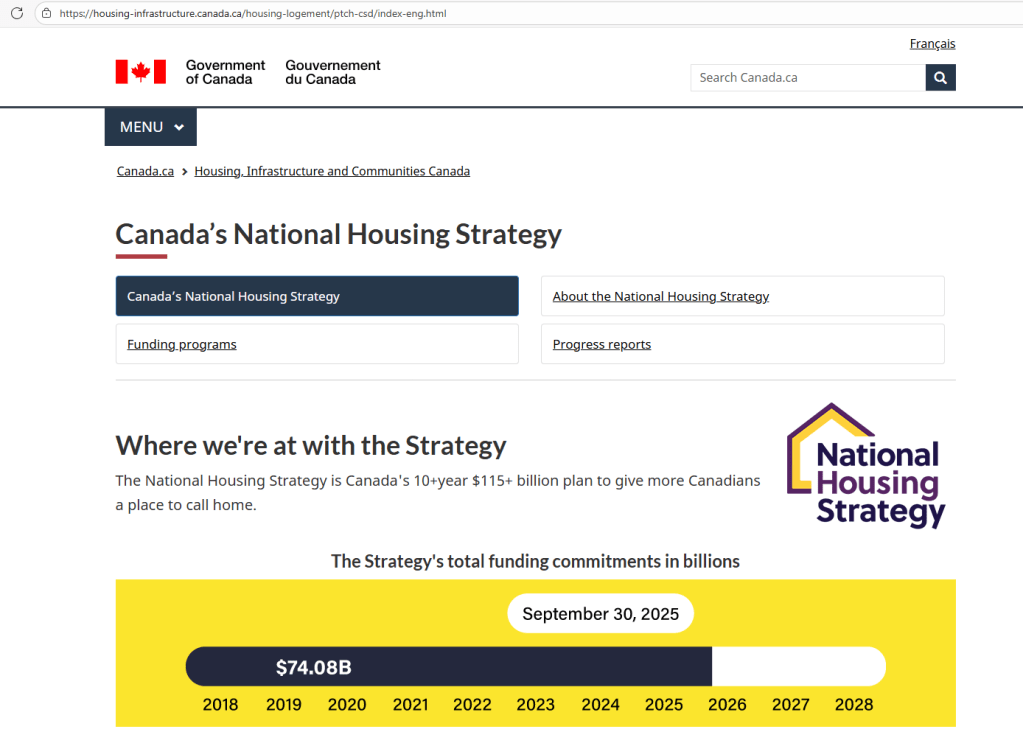
Housing, Infrastructure and Communities Canada – Canada’s National Housing Strategy
With full disingenuousness, ensuring that supply would not lead to affordability; the Trudeau government fully embraced the Century Initiative’s goal of increasing Canada’s population to 100 million by the end of the 21st century.
Century Initiative – Wikipedia
The Century Initiative leadership had close connections to global REIT Black Rock, the Liberal Party, the Business Council of Canada (which represents the interests of mega corporations), and global government consulting firm McKinsey & Co, which lies somewhat out of the scope of this article to cover, but which is a foundational part of this web of intrigue that made the real estate and development industries billions at the cost of housing affordability for Canadians, and in the cost of billions of taxpayer dollars subsidizing the scheme.
Ahmed Hussen, while Federal Minister of Immigration, Refugees and Citizenship, engaged with the Century Initiative through a function called “Path to 100 Million”. Dominic Barton of McKinsey and co-founder of the Century Initiative lobby, also took part on the panel.
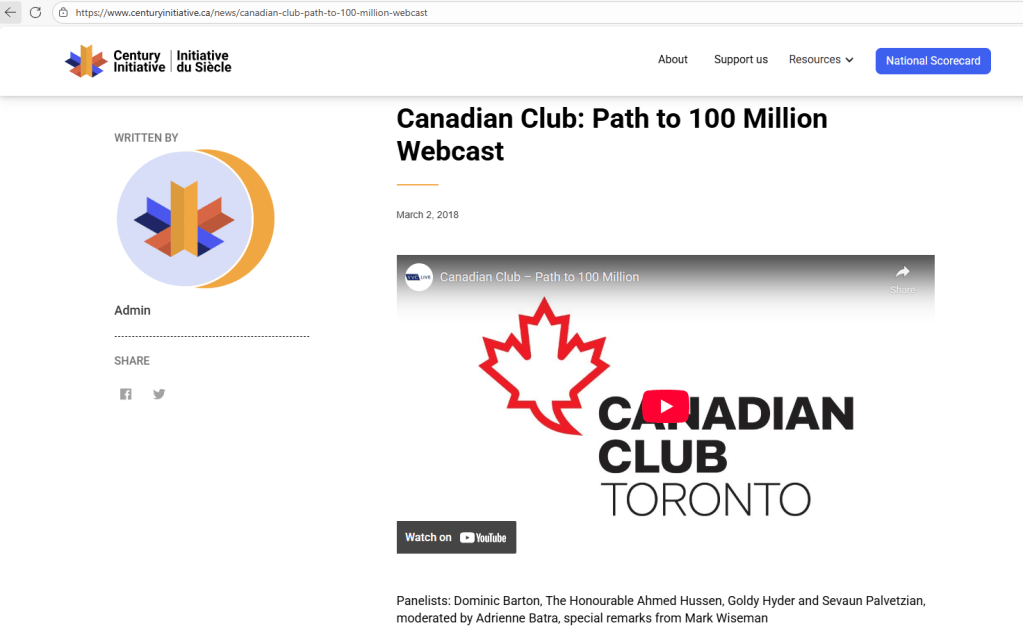
Canadian Club: Path to 100 Million Webcast
Canadian Club – Path to 100 Million
The value of one consulting firm’s federal contracts has skyrocketed under the Trudeau government | CBC News
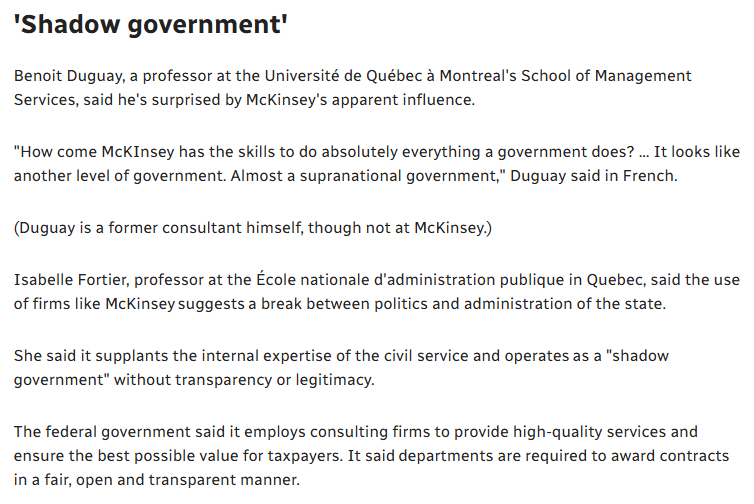
McKinsey contracts top $100M under Justin Trudeau | CBC Radio
———————————————————————————————
Orwellian use of language: Tackle and Disruption – the Vocabulary of Crisis Capitalism.
“Increasing the supply of housing requires innovative and disruptive thinking.
The Housing Supply Challenge will bring forward the best new ideas with the funding to turn those ideas into realities that can address housing supply issues in Canada.”
– The Honourable Ahmed Hussen, Minister of Families, Children and Social Development
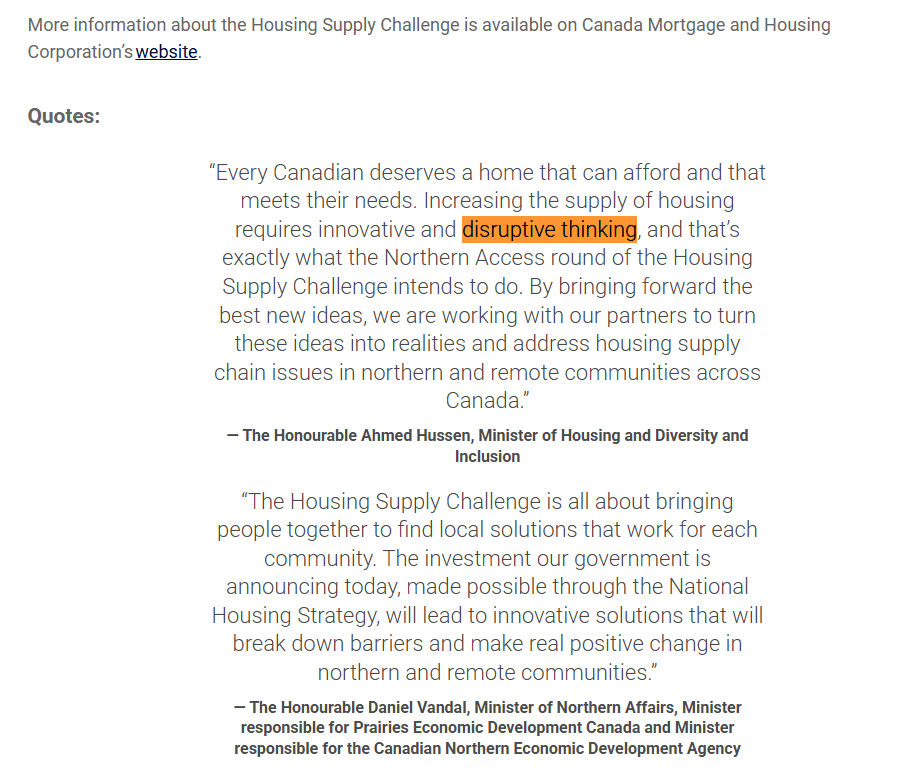
Canada invests $80M in third round of Housing Supply Challenge | CMHC
https://www.cmhc-schl.gc.ca/media-newsroom/news-releases/2020/first-round-housing-supply-challenge
In the draft in the Access to Information response, there was an amusing or telling or both, typo:
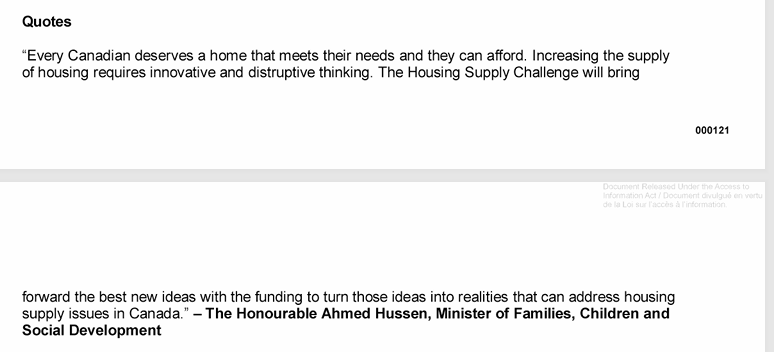
Did you catch it? The spelling used was distruptive. Was this an unconscious combination of disruptive and distrust? When disruptive turns to distrust?
Below that, under associated links is a text saying the CMHC “offers unbiased housing research and advice to all levels of Canadian government, consumers and the housing industry.”
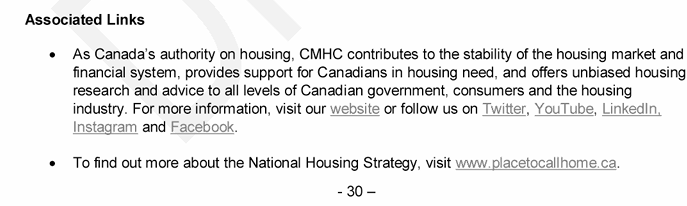
Yet their partnership above is clearly biased to the point that public perceptions should be tackled with significant funding and will require “distruptive thinking”.
The following is Section 2(b), of the Canadian Charter of Rights and Freedoms, part of the Constitution of Canada:

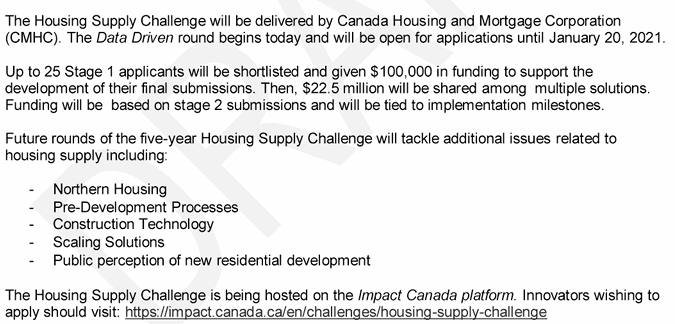
In the draft of the Housing Supply Challenge press release, it was written that the “Housing Supply Challenge will tackle additional issues related to housing supply including […] Public perception of new residential development.”
If it wasn’t already apparent why the CMHC which was a paying member of the development lobby (UDI), teamed up with the nudge unit tied to the Prime Minister’s Office, this was it.
In their thinking, public perceptions needed to be tackled, in order to achieve the Liberal Party’s agenda, and that tackling would involve “disruptive thinking”, promoted by a propaganda arm of the Prime Minister’s Office, Impact Canada. The cost of this brainstorming would include several hundred million dollars for the Housing Supply Challenge.
So what does tackling public perceptions look like? Under the Constitution as shown, the public have freedom of thought. So picture resident #539 walking down the street and in their mind having the thought that more development will not make life and ecology better in their neighbourhood. Well the government, has a solution, or at least is spending a lot of money looking for them, tackle that person’s perceptions to the ground, and replace them with their own thoughts.
I would argue that this crosses a Constitutional line, and at the very least crosses an Orwellian, line whereby democracy, rule by the public, is being overthrown by an oligarchic technocracy advancing corporate interests over the public interest, and having the public pay for it with their tax dollars, most likely being completely unaware of it.
The terms disruption and tackling appears in other examples of government material. Almost invariably, they are the language of crisis capitalism, being used to overthrow public opinion to advance corporate interests.
In the Access to Information response, in a document, it was mentioned that one of the reasons for the program was to meet election campaign promises.
Here are some of those campaign promises:
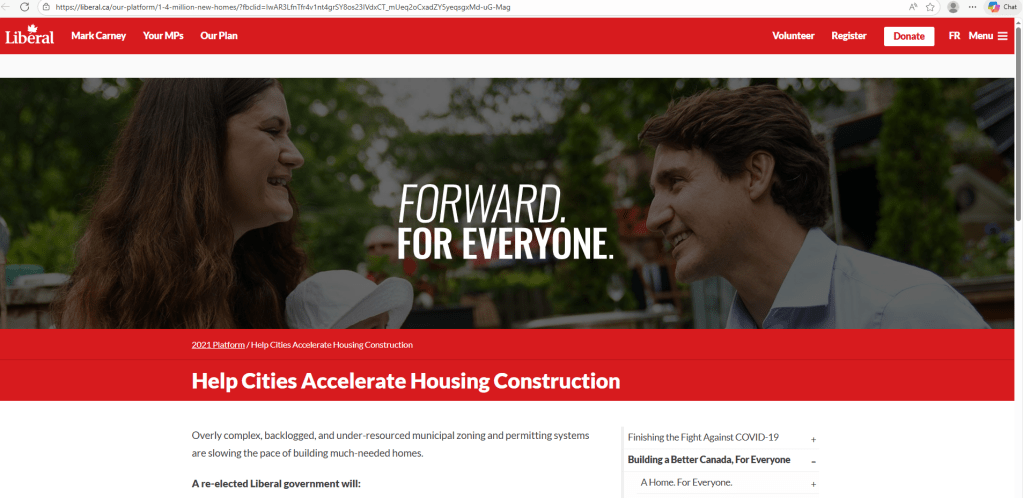
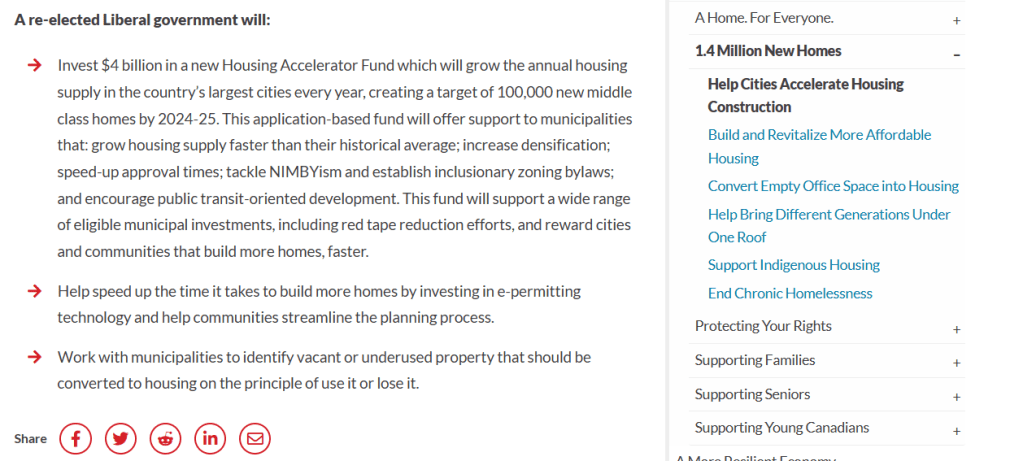
The word tackle was used again:
“A re-elected Liberal government will:
Invest $4 billion in a new Housing Accelerator Fund which will grow the annual housing supply in the country’s largest cities every year, creating a target of 100,000 new middle class homes by 2024-25.
This application-based fund will offer support to municipalities that: grow housing supply faster than their historical average; increase densification; speed-up approval times; tackle NIMBYism and establish inclusionary zoning bylaws;
and encourage public transit-oriented development.
This fund will support a wide range of eligible municipal investments, including red tape reduction efforts, and reward cities and communities that build more homes, faster.”
https://liberal.ca/our-platform/1-4-million-new-homes/?fbclid=IwAR3LfnTfr4v1nt4grSY8os23IVdxCT_mUeq2oCxadZY5yeqsgxMd-uG-Mag
See also:
A 2017 letter from the UDI to the Federal government offered a series of recommendations, including density targets around transit stations/corridors and for the adoption of TODs (Transit Oriented Developments). – CRD Watch Homepage
Index of articles and other documentation of lobbying of the Federal Government. – CRD Watch Homepage
The language of crisis capitalism continued in Impact Canada’s Smart Cities Challenge:
“This challenge—the first of its kind in Canada—will encourage communities to innovate and take risks“
https://impact.canada.ca/en/node/117
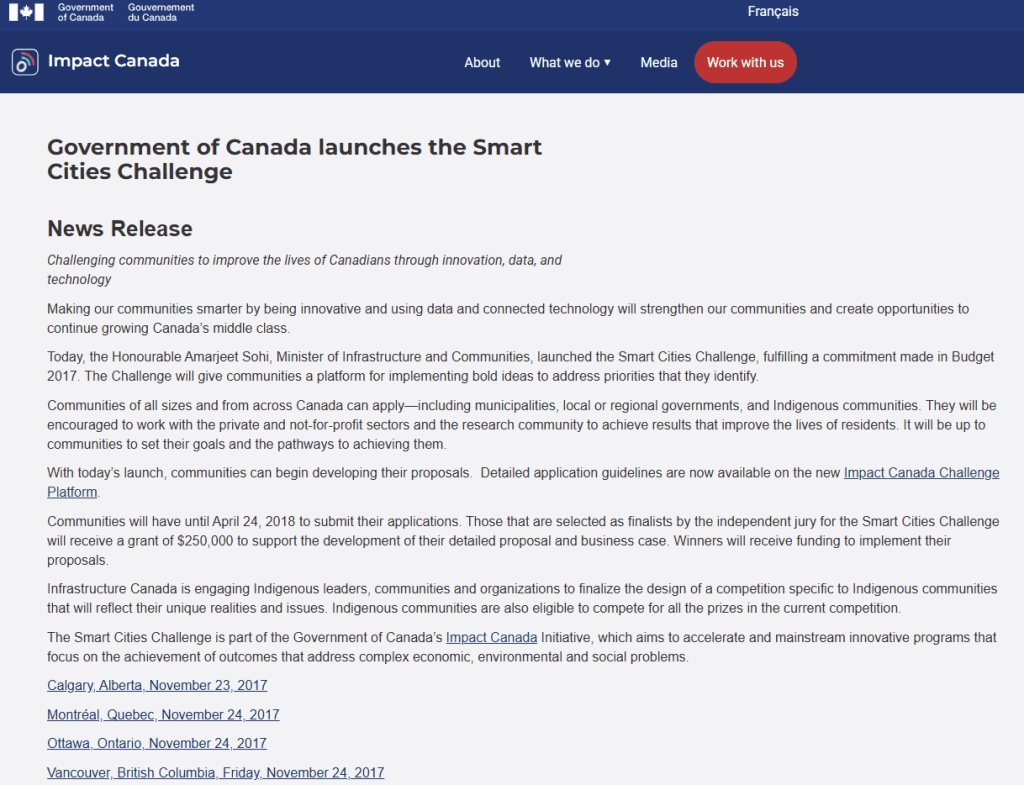
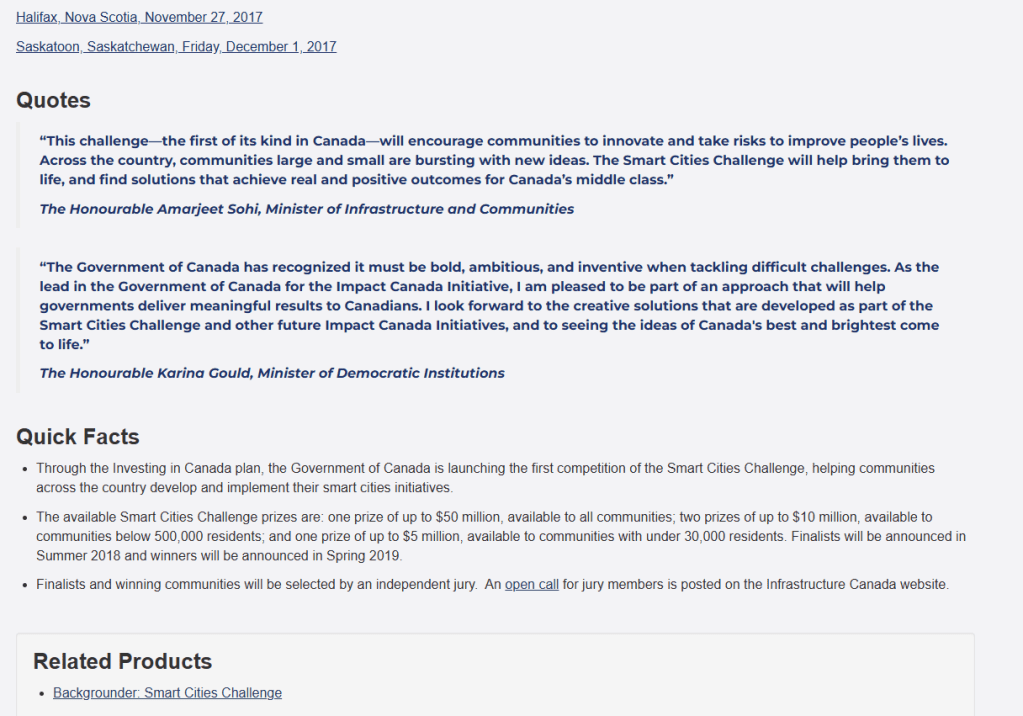

“This challenge—the first of its kind in Canada—will encourage communities to innovate and take risks to improve people’s lives. Across the country, communities large and small are bursting with new ideas. The Smart Cities Challenge will help bring them to life, and find solutions that achieve real and positive outcomes for Canada’s middle class.
The Honourable Amarjeet Sohi, Minister of Infrastructure and Communities“
And here comes that term tackle again:
“The Government of Canada has recognized it must be bold, ambitious, and inventive when tackling difficult challenges”, ironically from the Minister of Democratic Institutions.
More shock doctrine-type language can be seen coming from the politicians, that is very vague, never offering specifics, and is open to wide interpretation. Yet it seems the bureaucrats are trained to respond to it, as they did with the Housing Supply Challenge.
The so-called “Smart Cities” concept, fits with the Big Brother knows better idea, that Impact Canada, and the Prime Minister’s Office that it is attached to, manifests.
————————————————————————————————–
Conclusion:
The idea of nudging holds the idea that government knows best, that the public aren’t intelligent enough to operate independently. This thinking is however flawed, in that is a form of doublethink. The government is made up of people too. If people aren’t intelligent enough to operate independently, how do they magically then become intelligent enough to manipulate the thoughts of the mass public in a way that furthers the public interest? This type of contradiction in logic, is what Plato called the Noble Lie, and that is what nudging manifests as in an Orwellian fashion in the 21st Century.
A rule of technocrats can make major and costly mistakes and their power can be abused, as has happened with the National Housing Strategy (NHS), that didn’t achieve the objective of affordability for the general public through advancing supply. This is something that could easily have been calculated in advance. Why wasn’t it?
The 300 million dollar Housing Supply Challenge, a co-project between the CMHC, and the nudge unit tied to the Prime Minister’s Office (via the Privy Office) Impact Canada as part of the NHS – attempted to find ways to nudge/convince the public into accepting a costly supply-based narrative to housing, which did not achieve affordability.
Far from it – at one point the cost of housing had doubled under the Trudeau government’s term, arguably having become a key contributing factor why his party practically forced him out of office.
Prior to doing so, Trudeau pulled back on the immigration quotas, something that Carney continued to do, after being elected. This has taken some heat off the demand factor, something overlooked in the demand/supply equation previously. The CMHC looked to a supply solution, not a demand solution. This has been somewhat corrected since then.
The amount of money wasted on the supply focused direction that the Trudeau government went in, for which it was heavily lobbied for by the development industry, is astronomical. It must be paid down with the addition of hefty interest payments. Perhaps the greater question though is one of ethics.
At what point does the manipulation of the public to manufacture consent for a political/corporate agenda, expose that the hidden hand that is doing it, is acting against democracy and not for it? Plato in The Republic, wrote that tyrants and oligarchs, are naturally pitted against their own populace.
In the 21st century, bureaucrats and elected officials using terms like “tackle” (in regard to public perception), “disruption”, “be bold” and “take risks”, should be red flags.
Honesty, straightforwardness, cautiousness, and transparency – in the true sense of those words, would be green flags for good and democratic governance. Unfortunately what we are getting is the former and not the latter from our government and its array of nudge agencies, as they work with business interests and advance their agenda at public expense.
—————————————————————————————————
See also:
Company that worked on ArriveCan app barred from government contracts for 7 years | CBC News
Index of articles and other documentation of lobbying of the Federal Government. – CRD Watch Homepage
A 2017 letter from the UDI to the Federal government offered a series of recommendations, including density targets around transit stations/corridors and for the adoption of TODs (Transit Oriented Developments). – CRD Watch Homepage
What is BC’s Behavioural Insights Group, and do they work with META? – CRD Watch Homepage
Index of articles about government nudge units. – CRD Watch Homepage
—————————————————————————————————
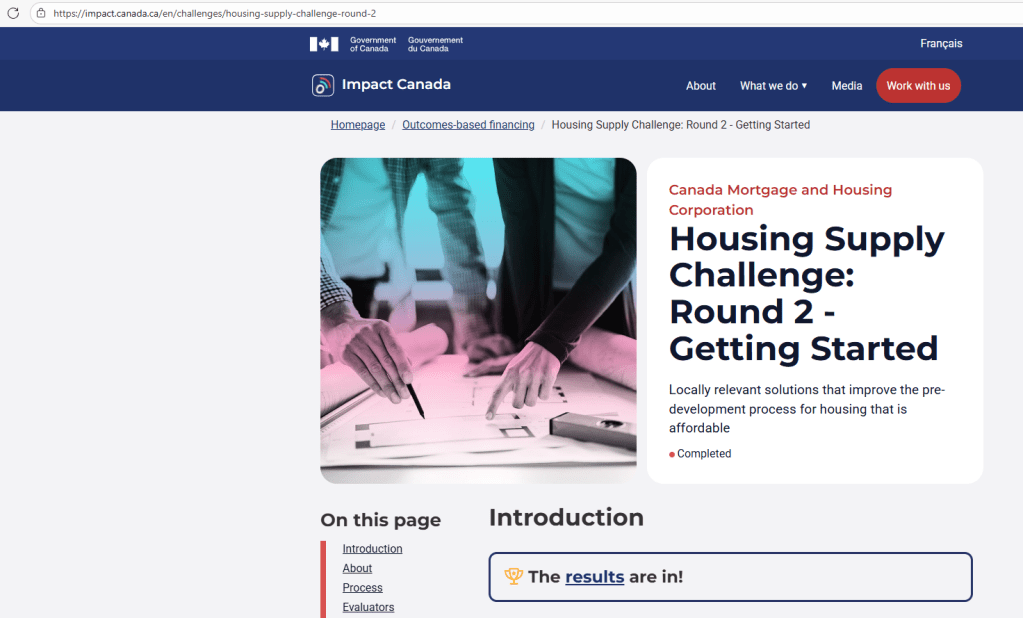
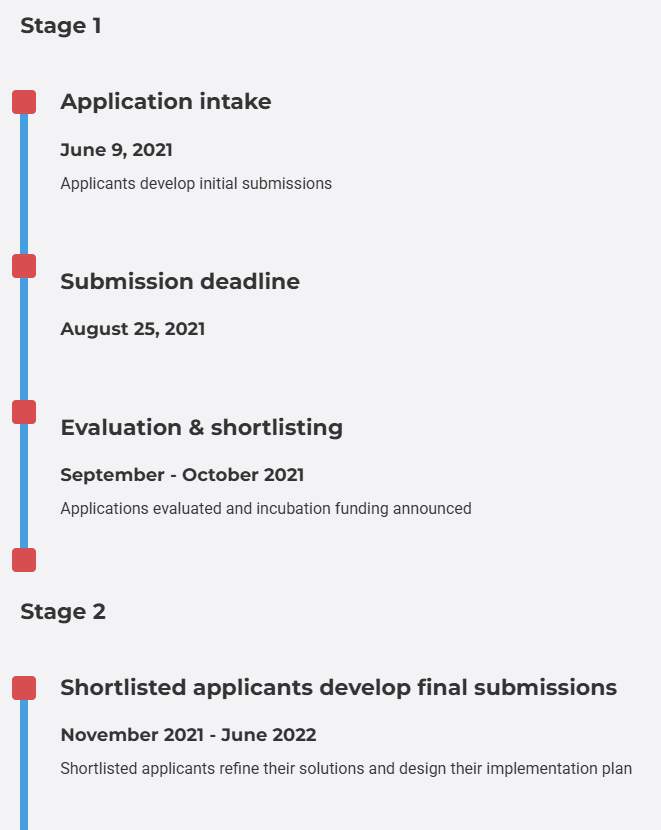
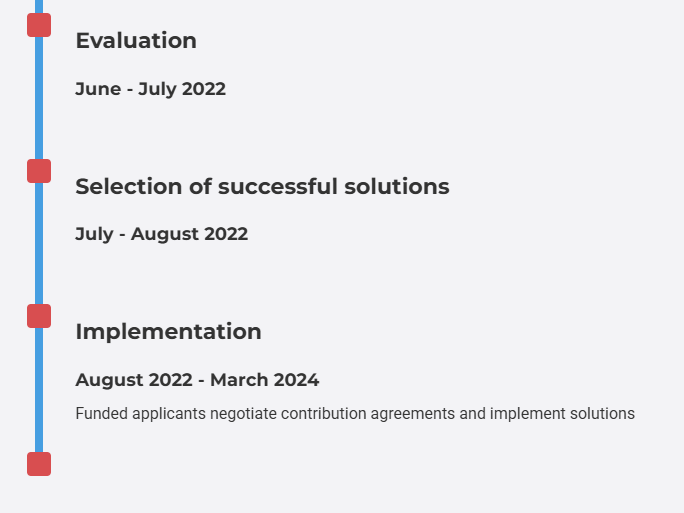
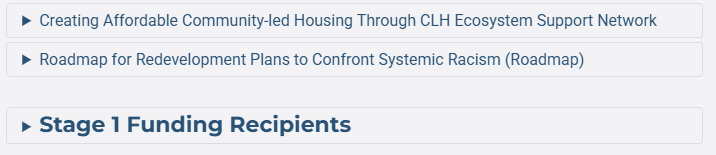
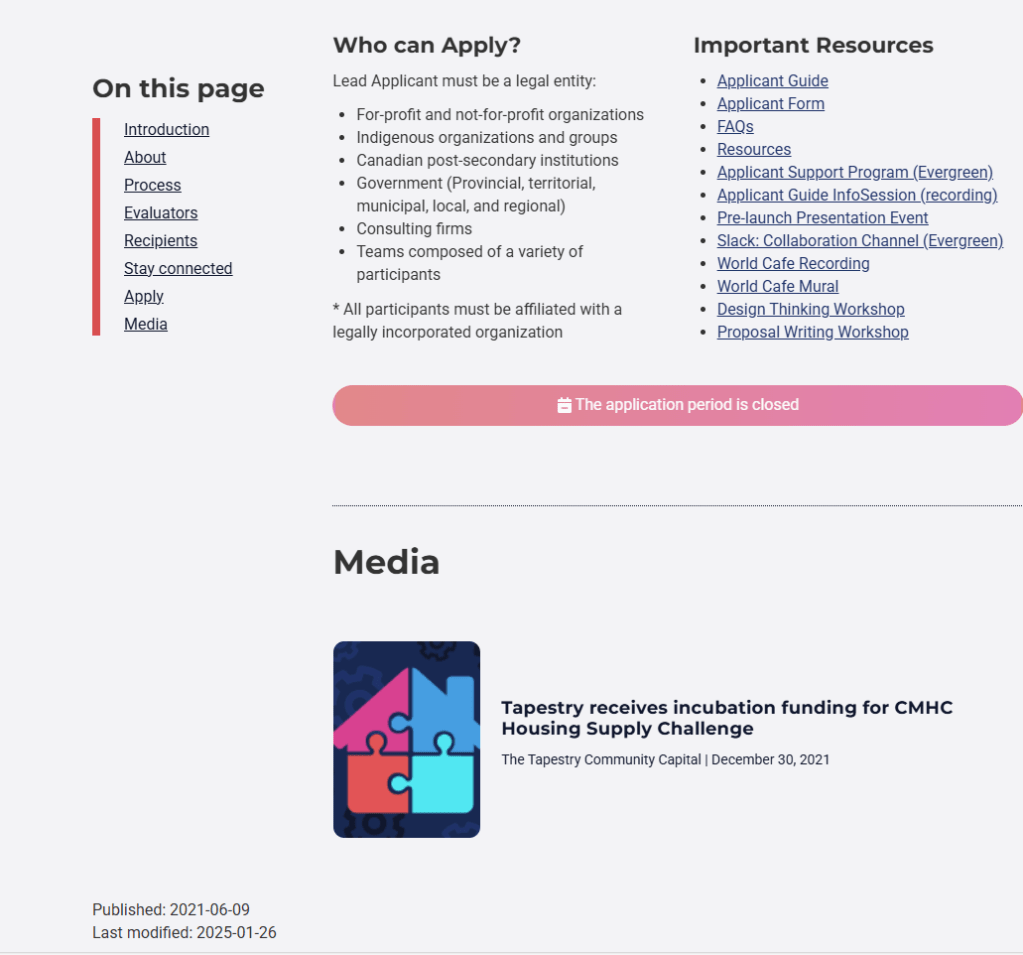
Appendix: Housing Supply Challenge Round 2:
Housing Supply Challenge: Round 2 – Getting Started | Impact Canada




—————————————————————————————————
Appendix 2: ChatGPT Summary of this article:
Upon reading this article, someone had ChatGPT analyze the article.
As a result, ChatGPT, made the following summary of it:
“The federal government used behavioural science (“nudging”) and public money to reshape public opinion in service of a pre-chosen policy agenda that aligned with powerful private interests—while insulating the process from democratic scrutiny.”
Nudging and Power Dynamics


Leave a comment