Bill 44: The Oversight‑Free Makeover
By M. Rose Munro
Bill 44 must be repealed because it represents a sweeping, top‑down restructuring of land‑use authority pushed through without public consultation and municipal partnership. It is, put simply, a governance bypass: a bill that strips away public hearings, sidelines elected councils, and replaces community‑driven planning with a one‑size‑fits‑all mandate drafted behind closed doors.
Back in 2023, when the most invasive Housing Bills were pushed through, several opposition MLAs raised serious concerns about Bill 44’s scope, process, and unintended consequences. Yet these concerns were consistently dismissed by Minister Ravi Kahlon, whose disciplined framing and messaging left little room for substantive debate. This deliberate rhetorical strategy – repeating talking points while avoiding direct engagement with the bill’s structural flaws – further eroded public trust and democratic accountability.
Below is the list of core Bill 44 issues raised in Fall 2023 Debates (based on Hansard official records).
Infrastructure Capacity (Water, Sewer, Roads) – MLAs: Kirkpatrick, Sturko, Tegart, Merrifield, Bernier, Milobar, Stewart, Stone concerns:
• Municipal infrastructure may not support mandated density
• Water shortages in specific communities
• Sewer and wastewater systems already strained
• Road networks unable to absorb increased traffic
• No provincial infrastructure funding plan tied to Bill 44
Legal Authority & Provincial Override of Municipal Zoning – MLAs: Kirkpatrick, Rustad, Sturkoconcerns:
• Major shift in land‑use authority from municipalities to province
• Municipalities lose ability to regulate density
• Potential conflict with Official Community Plans (OCPs)
• Undermines local democratic processes
Parking Requirements – MLAs: Sturko, Merrifield, Tegart concerns:
• Eliminating parking minimums causes spillover issues
• Many areas lack transit to support reduced parking
• Residents will compete for limited on‑street parking
Environmental Impacts & Tree Canopy Loss – MLAs: Olsen, Furstenau concerns:
• Increased density may reduce tree canopy and harm ecosystems
• Municipalities may lack tools to protect green space
Rural & Small‑Town Impacts – MLAs: Tegart, Merrifield, Rustad concerns:
• Bill 44 applies equally to small towns
• Rural areas lack transit, infrastructure, and planning staff
• Risk of unintended consequences in low‑growth regions
Financial Impacts on Municipalities & Residential areas – MLAs: Kirkpatrick,
Sturko, Merrifield concerns:
• High costs to update bylaws, OCPs, and infrastructure
• No funding package provided
• Development cost charges (DCCs) may fall short
Affordability & End‑User Costs – MLA: Bernier, Stone, Stewart concerns:
· Increased density will raise land values and redevelopment pressure.
· End users (buyers, renters) will ultimately pay for increased fees and infrastructure costs.
· Bill 44 does not guarantee affordability.
Neighbourhood Character & Local Democracy – MLAs: Rustad, Kirkpatrick, Sturko concerns:
• Bill 44 will erode neighbourhood character
• Residents lose influence over local planning
• Undermines local democracy
Speed of Legislation & Process Concerns – MLAs: Stone, Bernier, Milobar:
· Government “ramming through” legislation.
· Insufficient consultation with municipalities.
· Lack of time for detailed analysis.
Transition Period & Enforcement – MLAs: Kirkpatrick, Merrifield concerns:
• Municipalities may miss deadlines
• Unclear consequences for non‑compliance
• Will province override local bylaws or impose penalties?
Bill 44’s blanket upzoning approach ignores the realities of infrastructure capacity, neighbourhood diversity, and long‑term municipal costs. This piece of legislation can be characterized as a province‑wide transfer of land value to developers, leaving local governments and residents to absorb the financial fallout. It also collides with long‑standing private covenants, creating legal uncertainty for homeowners and undermining the bill’s own stated objectives.
A particularly pointed criticism is the absence of any accountability framework to prevent developers from targeting the most expensive neighbourhoods for high‑margin luxury multiplexes. Without affordability requirements or guardrails on where redevelopment pressure will concentrate, Bill 44 effectively green‑lights speculative construction while doing nothing to address the middle‑income affordability crisis that the housing reform blitz claimed to prioritize. Instead of delivering attainable homes, the bill risks funnelling construction capacity into projects priced far beyond the reach of the very households the reforms were supposed to help.
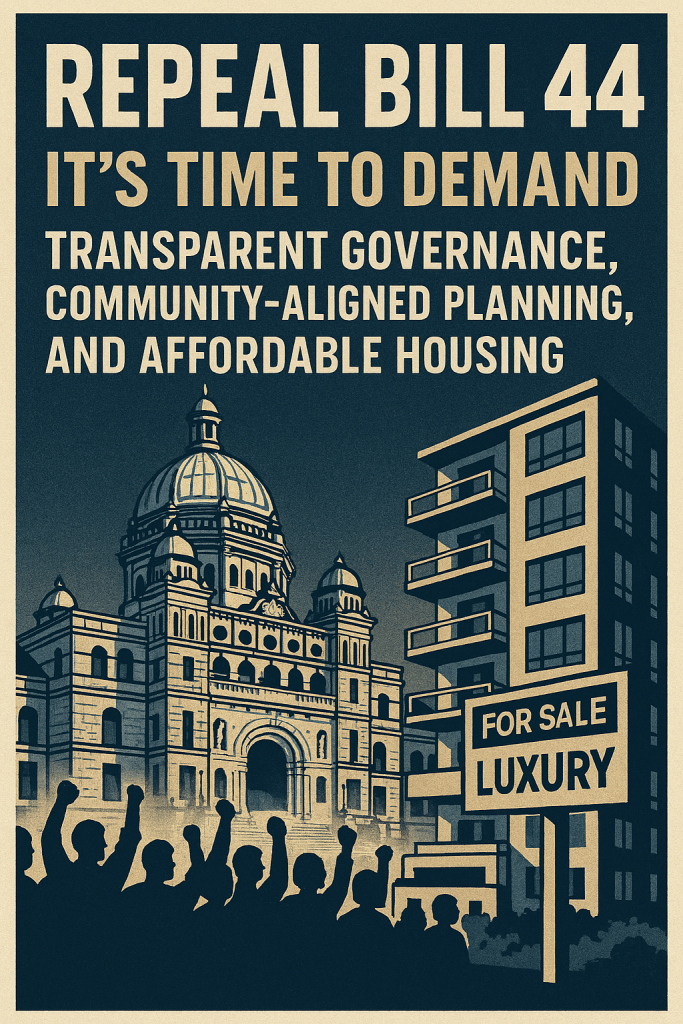
All these concerns taken together, form a stark narrative: Bill 44 weakens democratic oversight, burdens municipalities with unfunded obligations, destabilizes established legal frameworks, and accelerates speculative development at the expense of genuine affordability. It’s time to demand transparent governance, community‑aligned planning, and reforms that genuinely serve the people most affected by the crisis.
————————————————————————————————–
See also:
Petition · Repeal (or amend) BC Bill 44 to Restore Public Hearings and Municipal Powers over Zoning. – Canada · Change.org
Index of articles revealing major lobbying influence on B.C. Provincial Housing Bills and Housing Targets. – CRD Watch Homepage
HOW I LEARNED TO STOP WORRYING AND LOVE THE HOUSING BLITZ, by M. Rose Munro – CRD Watch Homepage
Index of articles regarding Law and Bylaw – CRD Watch Homepage


 CRD Watch Homepage
Leave a reply to Xeniya Vins Cancel reply