Re: Bill M216, View Royal Mayor Calls Out Pattern of Legislation Reshaping Local Governance Without Consultation
The letter, which strongly critiques the proposed legislation, also calls out and questions the role and influence of the UDI’s lobbying on Provincial housing legislation.
CRD Watch
Nov 27, 2025
On Nov 27, 2025 – On behalf of the Township, View Royal’s Mayor made a submission to the Select Standing Committee on Private Bills and Private Members’ Bills c/o Parliamentary Committees Office, in regard to the proposed Bill M216.
The following is the letter:
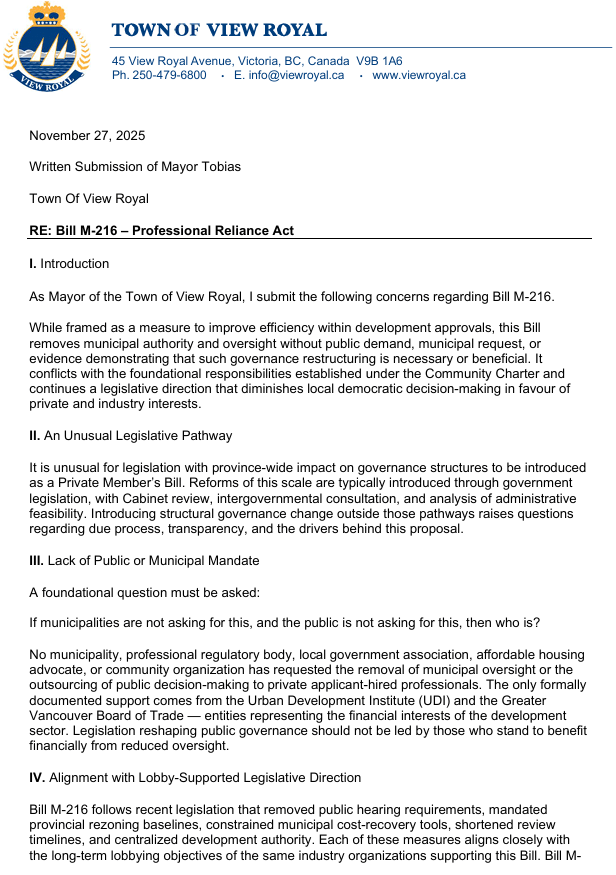
November 27, 2025
Written Submission of Mayor Tobias
Town Of View Royal
RE: Bill M-216 – Professional Reliance Act
—————————————————————————————————
I. Introduction
As Mayor of the Town of View Royal, I submit the following concerns regarding Bill M-216.
While framed as a measure to improve efficiency within development approvals, this Bill removes municipal authority and oversight without public demand, municipal request, or evidence demonstrating that such governance restructuring is necessary or beneficial.
It conflicts with the foundational responsibilities established under the Community Charter and continues a legislative direction that diminishes local democratic decision-making in favour of private and industry interests.
II. An Unusual Legislative Pathway
It is unusual for legislation with province-wide impact on governance structures to be introduced as a Private Member’s Bill. Reforms of this scale are typically introduced through government legislation, with Cabinet review, intergovernmental consultation, and analysis of administrative feasibility. Introducing structural governance change outside those pathways raises questions regarding due process, transparency, and the drivers behind this proposal.
III. Lack of Public or Municipal Mandate
A foundational question must be asked:
If municipalities are not asking for this, and the public is not asking for this, then who is?
No municipality, professional regulatory body, local government association, affordable housing advocate, or community organization has requested the removal of municipal oversight or the outsourcing of public decision-making to private applicant-hired professionals. The only formally documented support comes from the Urban Development Institute (UDI) and the Greater Vancouver Board of Trade — entities representing the financial interests of the development sector.
Legislation reshaping public governance should not be led by those who stand to benefit financially from reduced oversight.
IV. Alignment with Lobby-Supported Legislative Direction
Bill M-216 follows recent legislation that removed public hearing requirements, mandated provincial rezoning baselines, constrained municipal cost-recovery tools, shortened review timelines, and centralized development authority. Each of these measures aligns closely with the long-term lobbying objectives of the same industry organizations supporting this Bill.
Bill M-216 appears not as an isolated reform, but as the next step in a coordinated agenda that reduces local authority and expands private-sector influence over public decisions.
V. Conflict with the Community Charter
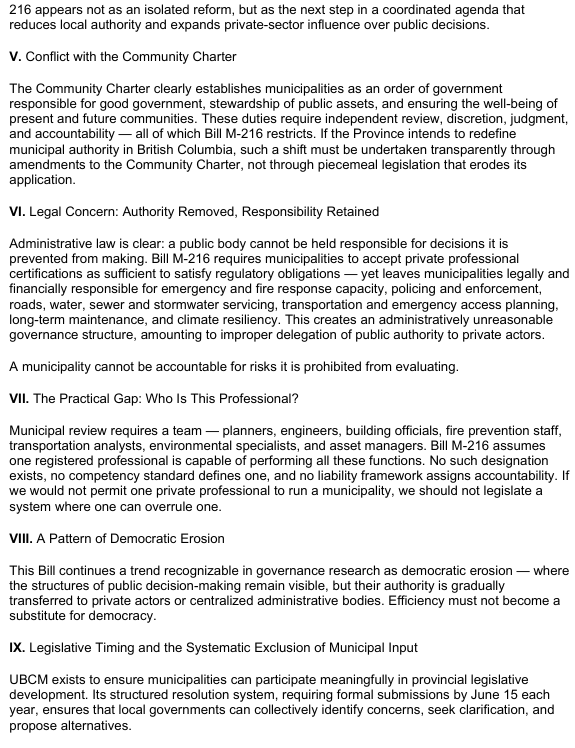
The Community Charter clearly establishes municipalities as an order of government responsible for good government, stewardship of public assets, and ensuring the well-being of present and future communities. These duties require independent review, discretion, judgment, and accountability — all of which Bill M-216 restricts. If the Province intends to redefine municipal authority in British Columbia, such a shift must be undertaken transparently through amendments to the Community Charter, not through piecemeal legislation that erodes its
application.
VI. Legal Concern: Authority Removed, Responsibility Retained
Administrative law is clear: a public body cannot be held responsible for decisions it is prevented from making. Bill M-216 requires municipalities to accept private professional certifications as sufficient to satisfy regulatory obligations — yet leaves municipalities legally and financially responsible for emergency and fire response capacity, policing and enforcement, roads, water, sewer and stormwater servicing, transportation and emergency access planning, long-term maintenance, and climate resiliency. This creates an administratively unreasonable governance structure, amounting to improper delegation of public authority to private actors.
A municipality cannot be accountable for risks it is prohibited from evaluating.
VII. The Practical Gap: Who Is This Professional?
Municipal review requires a team — planners, engineers, building officials, fire prevention staff, transportation analysts, environmental specialists, and asset managers. Bill M-216 assumes one registered professional is capable of performing all these functions. No such designation exists, no competency standard defines one, and no liability framework assigns accountability. If we would not permit one private professional to run a municipality, we should not legislate a system where one can overrule one.
VIII. A Pattern of Democratic Erosion
This Bill continues a trend recognizable in governance research as democratic erosion — where the structures of public decision-making remain visible, but their authority is gradually transferred to private actors or centralized administrative bodies. Efficiency must not become a substitute for democracy.
IX. Legislative Timing and the Systematic Exclusion of Municipal Input
UBCM exists to ensure municipalities can participate meaningfully in provincial legislative development. Its structured resolution system, requiring formal submissions by June 15 each year, ensures that local governments can collectively identify concerns, seek clarification, and propose alternatives.
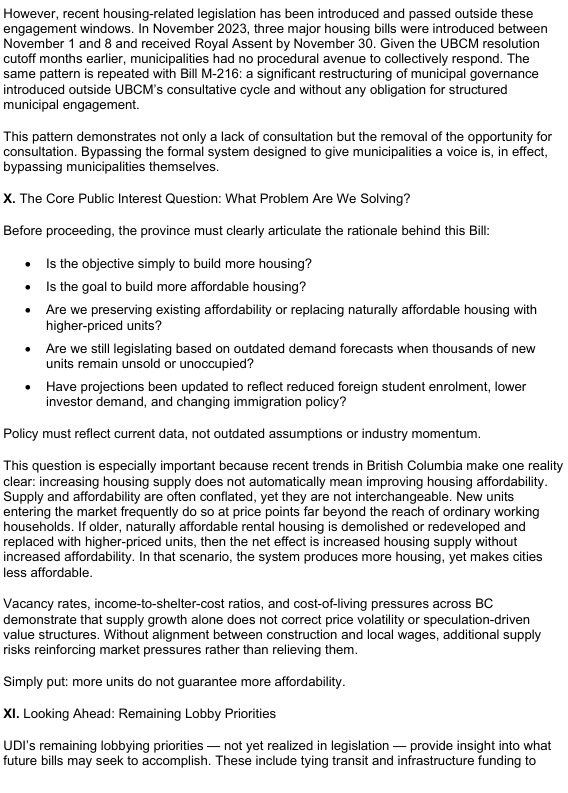
However, recent housing-related legislation has been introduced and passed outside these engagement windows. In November 2023, three major housing bills were introduced between November 1 and 8 and received Royal Assent by November 30. Given the UBCM resolution cutoff months earlier, municipalities had no procedural avenue to collectively respond. The same pattern is repeated with Bill M-216: a significant restructuring of municipal governance introduced outside UBCM’s consultative cycle and without any obligation for structured municipal engagement.
This pattern demonstrates not only a lack of consultation but the removal of the opportunity for consultation. Bypassing the formal system designed to give municipalities a voice is, in effect, bypassing municipalities themselves.
X. The Core Public Interest Question: What Problem Are We Solving?
Before proceeding, the province must clearly articulate the rationale behind this Bill:
Is the objective simply to build more housing?
Is the goal to build more affordable housing?
Are we preserving existing affordability or replacing naturally affordable housing with higher-priced units?
Are we still legislating based on outdated demand forecasts when thousands of new units remain unsold or unoccupied?
Have projections been updated to reflect reduced foreign student enrolment, lower
investor demand, and changing immigration policy?
Policy must reflect current data, not outdated assumptions or industry momentum.
This question is especially important because recent trends in British Columbia make one reality clear: increasing housing supply does not automatically mean improving housing affordability.
Supply and affordability are often conflated, yet they are not interchangeable. New units entering the market frequently do so at price points far beyond the reach of ordinary working households. If older, naturally affordable rental housing is demolished or redeveloped and replaced with higher-priced units, then the net effect is increased housing supply without increased affordability. In that scenario, the system produces more housing, yet makes cities less affordable.
Vacancy rates, income-to-shelter-cost ratios, and cost-of-living pressures across BC
demonstrate that supply growth alone does not correct price volatility or speculation-driven value structures. Without alignment between construction and local wages, additional supply risks reinforcing market pressures rather than relieving them.
Simply put: more units do not guarantee more affordability.
XI. Looking Ahead: Remaining Lobby Priorities
UDI’s remaining lobbying priorities — not yet realized in legislation — provide insight into what future bills may seek to accomplish. These include tying transit and infrastructure funding to and Amenity Contributions, further shortening or eliminating public participation mechanisms, establishing provincial oversight positions empowered to intervene in municipal approvals, expanding blanket upzoning areas beyond those already mandated, and redefining affordable
housing in ways that allow market-priced units to qualify. Municipalities must therefore anticipate continued attempts to reduce local autonomy, oversight capacity, and democratic accountability.
XII. Growth and Taxation Evidence
Across British Columbia, a clear pattern has emerged: the fastest-growing municipalities are experiencing some of the highest increases in taxation. This trend reflects a simple reality — growth demands immediate investment in infrastructure and public services, while revenue from development arrives slowly, unevenly, or in constrained forms when cost-recovery tools are limited. This pattern is visible across the West Shore, Surrey, Kelowna, Sooke, and other rapidly expanding communities.
Growth does not pay for growth under the current model — existing taxpayers do.
Removing municipal authority while increasing growth pressure exacerbates this imbalance.
XIII. Final Reflection
British Columbians expect decisions affecting their communities, safety, infrastructure, and future to be made by accountable democratic institutions — not delegated to private consultants. If the sponsoring MLA’s genuine objective is to strengthen democracy, uphold the responsibilities of the Community Charter, and preserve the integrity of public governance in British Columbia, then the responsible action is clear:
Bill M-216 should be withdrawn.
Withdrawal would not end the conversation — it would place it back on the proper foundation: evidence, transparency, consultation, and alignment with the public interest.
Respectfully submitted,
Mayor Sid Tobias
Town of View Royal
—————————————————————————————————
————————————————————————–
See also:
Index of Articles Related to BC Bill M216 – CRD Watch Homepage


 CRD Watch Homepage
Leave a reply to loudlyebc8e95892 Cancel reply