
Letter to Councillor Loughton in regard to your comments during the deliberations regarding the City’s membership in the Urban Development Institute at the City of Victoria Sept 4 Committee of the Whole
By Sasha Izard
Sept 17, 2025
Hello Councillor Loughton,
You will recall that recently on Sept 1, 2025 I sent you and the other City of Victoria Councillors, the following letter in regard to the Sept 4 Councillor Member Motion that the City of Victoria end its membership with the Urban Development Institute:
Letter sent to Victoria’s Mayor and Council and City Manager’s office, regarding the City’s potential withdrawal from the UDI development/real estate lobby. – CRD Watch Homepage
I did not, however, get the impression that you read that letter based on your deliberations at Council. I suggest that you review it closely so that you are informed on the subject of development industry lobbying in the City of Victoria, and not merely speculating about it during important council deliberations on the issue.
I observed closely the deliberations on the subject, and transcribed the content so as to analyze the discussions involved.
This can be helpful to you as well moving forward.
The transcription of your deliberations, I’ve added as an appendix at the end of this letter.
I will add my own commentary to your comments below, so that you are more fully informed on this issue and that you are under no illusions as to the UDI and the City’s relationship to it, as you proceed forward on the issue of lobbying in the municipality, which will appear again in the near future, as the UDI withdrawal motion was temporarily postponed to be deliberated on soon after the issue of a potential municipal lobbyist registry is discussed by council, as it has been.
—————————————————————————————————
You began your deliberation on this subject with a question to the Mayor, that was then referred to a staff director:
Cllr. Loughton: “Thanks, and through you Mayor.
I just want to ask a question just for just um myself, so I have full understanding of this, that staff, if we if we weren’t a member anymore, that they would still have access to the research and reports and all of the forecasts on housing and economic trends, all of that information.
Mayor Alto: Director, is that correct?
The membership does not have an impact on your availability of, you’re working with them are accessing their research and resources?
Staffer: Thank you Mayor.
No.
It has no impact on that.”
—————————————————————————————————
I am going to pause right here, because it is clear from your comments after that exchange, that either you did not understand what the staffer said, or you didn’t want to understand it, and moved on as if you didn’t hear it.
The staff was making it very clear, that withdrawing from the UDI would make no impact on their ability to access the UDI’s research and resources.
This has been shown time and again including in the District of Saanich, which withdrew from the UDI and still received the UDI’s material in droves, just as before, while the District’s staff continued to collaborate with the UDI behind closed doors.
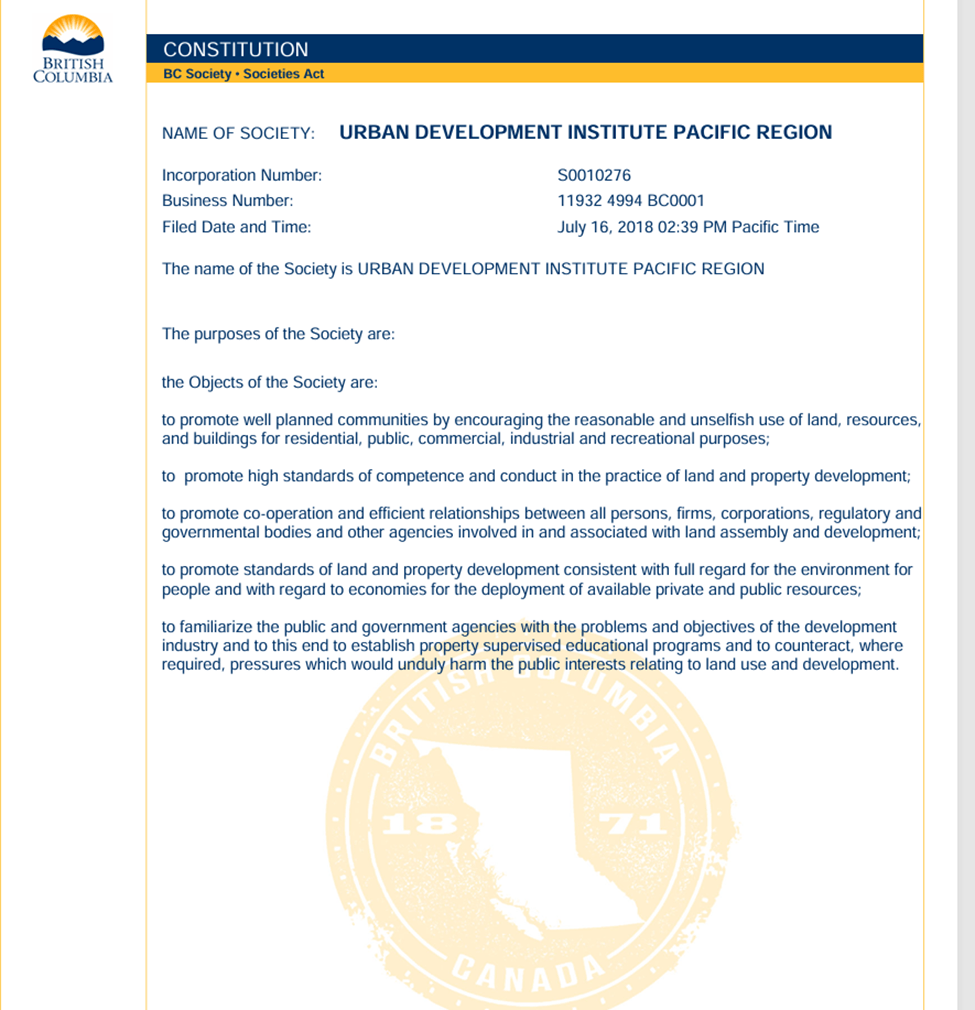
The lobbying group has every incentive to provide government material, and as a lobbying group representing billions of dollars of private interests in their corporate membership, they should be offering their material free of cost to government, not on the taxpayer dime. They approach government and offer branches of government material for free either way. That is what lobbies do. Why should the taxpayer subsidize this activity? To provide government bodies material and to work with them, is in their very constitution, which states:
“to promote co-operation and efficient relationships between all persons, firms, corporations, regulatory and government bodies and other agencies involved in and associated with land assembly and development”
“to familiarize the public and government agencies with the problems and objectives of the development industry and to establish property supervised educational programs”
Yes, make no mistake about it, this lobby acting as a supposed educational institute, did write “property” in their very Constitution in that sentence above. I’ve added the UDI’s Constitution as a second appendix to this letter.
When asked, if staff’s access to the UDI’s research and resources was affected by having a membership in the UDI or not, the staff stated:
“It has no impact on that.”
You Councillor Loughton then responded:
“So just the only impact is that we would potentially pay more.”
My comment: Yes, you will pay more by having a membership in the UDI, with no difference in the ‘service’ provided. That is it. By paying money to the organization, the City gets nothing it couldn’t otherwise get. Sounds like a good deal for the City and taxpayer, right?
You continued, with the following non-sequitur:
“So a membership gives some savings and certain things.”
A non-sequitur means that the train of thought, ‘does not follow’ logically, from what was previously stated.
You erroneously concluded: “That a membership provides savings”, from the staff’s opposite statement: “It has no impact on that.” (referring to staff’s access to the UDI’s research and resources)
A UDI membership does not provide savings. I debunked this thoroughly in my letter to Councillor Coleman, which you received:
Letter to Councillor Coleman in regard to your comments during the deliberations regarding the City’s membership in the Urban Development Institute at the City of Victoria Sept 4 Committee of the Whole – CRD Watch Homepage
“the councillors do get a minor membership discount for attending UDI events, as do staff using taxpayer dollars – something like a 15 or 20% discount, sort of like a discount sticker in a supermarket.
To attend the events now from what I’ve seen, it often takes around $100 per staff member or elected official to attend a UDI lobby event e.g. a luncheon, which operates in such instances much as a taxpayer subsidized lobby fundraising lunch, while they are able to indoctrinate elected officials and unelected staffers according to their agenda, which is focused on bringing as much profits to the industry as possible, and in gaining favourable zoning and other policies from government. This will keep their private corporate member organizations happy, who they are selling political influence to in the form of their paid memberships, which are much more expensive than government memberships.”
“As I mentioned previously, the supposed ‘fee benefits’ of attending such events are not born out in reality. The City of Victoria’s membership in the UDI is over $1500 annually. The reduced costs for elected officials and staff to attend lobby events, is generally in the ballpark of around 15-20%.
There is no way, that the City will ever come out as a net cost saver in this scenario. The cost savings are an illusion and nothing else. This is merely a convenient excuse for the UDI to provide a thin veneer of justification for local governments to be spending taxpayer dollars on their influence events, where they are able to network with elected officials and staff in an untransparent manner.
Just one meeting with City of Victoria staff and the UDI, cost almost $800 in a venue rental”
—————————————————————————————————
You continued in your deliberation:
Councillor Loughton:
“Okay.
So I’m I’m looking I sort of missed I made a list of the pros and cons of membership and it and it seems to me that the cons really are optics and a perceived conflict of interest, and a focus on private sector interests.”
The first con that you pointed out is optics. As the saying goes, ‘there’s no smoke without fire’.
Why are the optics bad? Is it a mere coincidence? It is not. The optics are bad for many reasons, some of which you yourself have stated in your list above.
This is not merely a question of bad optics. This is a serious issue of integrity, of ethics, of major at the very least ethical conflict of interest issues that have far reaching repercussions.
As you, yourself noted, there is a perceived conflict of interest in regard to the UDI membership, and the issue of conflict of interest with municipal UDI membership is something that has also been discussed in the deliberations in the neighbouring District of Saanich, that led to a unanimous council decision to end the District’s membership with the UDI, something featured in a Times Colonist article about it:
Saanich bails on membership in developers’ organization – Victoria Times Colonist
As you, yourself noted that there is a perceived conflict of interest with the City of Victoria’s UDI membership, so it is your duty as an elected official in a democracy acting in the public interest, to end that perceived conflict of interest. Perceived conflict of interest should also be grounds for council recusal on development applications, including on UDI member company applications, as you have noted that a perceived conflict of interest exists.
This is what it states in the City of Victoria Code of Conduct for Council Members Bylaw:
“A [council] member must respect that it is the role of employees to provide neutral and objective information without undue influence and interference.”
Code of Conduct (00127005.DOCX;10)
The UDI is not a neutral organization. Their own material makes that clear. The UDI has an agenda. Their agenda is included in their Constitution. The statements on their websites have also made clear that they have an agenda of providing political influence for their paying member organizations.
The following is quoted from the UDI Capital Region’s homepage before it was pulled down along with its members directory in November of 2023:
“Your voice in the Capital Region’s development industry
Join the team of industry leaders and professionals who are influencing the issues that affect your bottom line.”
“PRIMARY AREAS OF FOCUS
Government Relations
We are the public voice for Capital Region’s development industry, liaising with local governments and the media”
It is clear that the UDI is not neutral, that it has an agenda, is a lobbying organization (it is registered as such on the BC Lobbyists Registry), and as such, its material cannot be considered objective, nor inherently neutral. It is clear from the UDI’s material that the UDI seeks political influence, and its Constitution and statements from the UDI Capital Region’s former Executive Director, show that the UDI has created a role for itself of officiating with all branches and levels of government involving development, real estate, zoning policy, and policy on public input to government in regard to these, that it can get access to; and that the UDI considers its self-designated role to be generating, and helping to implement and align such policies for all levels of government according to its agenda. As you yourself correctly noted, the UDI has “a focus on private sector interests”.
I repeat what it states in the City of Victoria Code of Conduct for Council Members Bylaw:
“A [council] member must respect that it is the role of employees to provide neutral and objective information without undue influence and interference.”
- This is what Transparency International, writes about undue influence:
“There are several ways through which interest groups, such as companies, professional groups or public interests groups, try to influence the decision-making process. Interest group influence, commonly known as lobbying, encompasses “any direct or indirect communication with public officials, political decision-makers or representatives for the purposes of influencing public decision-making carried out by or on behalf of any organised group[1]”. - Interest group influence is not a corrupt or illegitimate activity per se, but when opaque and disproportionate it may lead to undue influence, corruption and even state capture. Undue influence is a more subtle form of corruption as interest groups often make use of legal mechanisms to influence the decision-making process[2]. For instance, they may legally contribute to electoral campaigns; provide research and host receptions but expecting favourable decisions in exchange. Undue influence may also be achieved by promising decision-makers well-paid future jobs in exchange for support[3].
- In certain contexts, disproportionate and unregulated influence by interest groups may also lead to state capture, which occurs when corruption is so systemic and infiltrated within the institutions of the state that private interests substitute themselves to the common good as main drivers of policy and regulation.”
Transparency International Knowledge Hub | Knowledge Hub
—————————————————————————————————
After providing a list of “cons” as you put it, you also wrote, what you perceive to be the pros of paid government membership in the lobbying organization:
“but the pros are resource sharing and cost savings, access to industry expert expertise and trends, support for housing and economic development goals, advocacy and policy influence, which is important because it helps us engage with senior levels of government on these issues that affect all levels of government.”
Yet again you are repeating what is contrary to staff’s statement in the deliberation.
You said: “but the pros are resource sharing and cost savings, access to industry expert expertise and trends,”
Yet asked, if staff’s access to the UDI’s research and resources was affected by having a membership in the UDI or not, the staff stated:
“It has no impact on that.”
In the video of the deliberations, it does not appear that you expected staff’s response in that regard, and yet when you heard that response from staff, you continued on to the contrary, as if you didn’t hear it from them.
Staff debunked the first section of your list of pros, as have I. In regard to cost, there is no cost savings with UDI membership. You can review that yourself with staff to help you. You can compare the slightly discounted sticker price and the non-resulting cost ‘saved’ with the taxpayer paying for elected officials and unelected staff to attend UDI lobby events i.e. luncheons, and there is no way, it will come close to the annual cost of membership from the organization.
Why would the UDI charge a membership fee, which provides token discounts for government employees to attend their lobby events, and expect to come out a net monetary loser in the process? There is no reason for them to do so. There are no cost savings, and no evidence for cost savings has been presented by you. So, how have you come to the conclusion that there is a cost savings with the membership?
There are absolutely no cost savings with the membership. Real cost savings would be for the elected officials and unelected City bureaucrats to pay out of their own pockets if they want to attend lobby events i.e. luncheons, seminars, panels etc. They do not need to be using taxpayer funds to attend them. There is nothing stopping government employees from using their own money to attend these events.
That would at least show integrity, but they only want to attend these events on the public chequebook. Why? Why should the taxpayer pay for this? Why should the taxpayer pay for lobby access to government officials, especially access that is untransparent and unrecorded?
The only cost savings and it would be 100% cost savings for the City, would be that government employees attend lobby events with their own money, instead of the City’s.
Any and all money spent on the lobby with taxpayer dollars, is a cost loss to the government and to the public. It is misleading to suggest the reverse – that this is a cost savings. It is simply not true, and you know it. Logic instead of marketing, demonstrates that to be the case.
You continued with your list of supposed pros of the membership:
“And professional development and training.” – Cllr. Loughton
Why should staff be trained/indoctrinated using public funds by a lobbying organization for real estate and development interests?
Wouldn’t it be in good-faith, for them to be trained instead by appropriate post-secondary institutions?
“support for housing and economic development goals,” – Cllr. Loughton
How does government paying a membership in a lobbying organization for development and real estate interests support housing?
You are said to be an advocacy for affordable housing Councillor Loughton.
Did you know that the UDI recently lobbied the B.C. Minister of Housing and Municipal Affairs to allow landlords including corporate landlords to keep rents unaffordable, and even increase the cost margin of allowable rent increases to well above the rate of inflation annually?
2025-07-30-UDI-Letter-Ministry-of-Housing-and-Municipal-Affairs-2026-Annual-Allowable-Rent-Increase.pdf
As it states in the lobbying letter: “UDI asks that the Province restore the AARI formula to CPI +2% for 2026.”
AARI stands for Annual Allowable Rent Increase. CPI, stands for the Consumer Price Index, a commonly used gauge of inflation.
As for your claim that the UDI supports economic development goals, what are you basing this on? The UDI pushes an agenda of maximizing the profits for developers and realtors of primarily increasing unaffordable market-rate housing. Since when do they push for economic diversification? You cannot build an economy simply based on unaffordable housing, that is a bubble simply waiting to collapse back in on itself.
As the UDI Capital Region had stated on their website before pulling the site down:
“Join the team of industry leaders and professionals who are influencing the issues that affect your bottom line.”
Whose bottom line are they furthering? The bottom line of their numerous private corporate member organizations involved in development and real estate that they are hiding from the public?
Public Release of the Urban Development Institute (UDI)’s hidden members directory dated to the beginning of 2024. The directory contains dozens of government branches that are hiding their memberships in the registered lobbying organization for development and real estate interests from the public. – CRD Watch Homepage
Your brief list of pros involved with the membership continued:
“advocacy and policy influence”
Is it a pro that the UDI is lobbying your government entity, and influencing your policies using taxpayer dollars to do so?
How on earth is that a pro that is provided by the City’s membership in the organization? They will lobby you either way. Nothing is gained in this regard by having a membership, unless “perceived conflict of interest” as you put it previously, can be considered something ‘gained’ here.
“which is important because it helps us engage with senior levels of government on these issues that affect all levels of government.”
Since when does the government of Canada at all levels, need an industry lobbying group to lobby the other levels of government for them?
Is the UDI, the government’s corporate equivalent of the Romand deity Mercury, as it passes important messages back and forth between different government branches and levels?
The government of Canada should be able to communicate with its various levels securely in good-faith, on its own accord, without an outside intercessor with a stated corporate agenda, acting as lobbyist between them, providing influence, undue or otherwise, in the process.
Why do you need a lobbying organization to help you engage with senior levels of government?
What is stopping the City from engaging with senior levels of government directly?
The City of Victoria for example, has a Head of Intergovernmental Relations. Isn’t this their function? Why would they need help from the UDI? Incidentally, the City’s Head of Intergovernmental Relations is a former spouse of the UDI Capital Region’s Chair. Again, why does a branch of government need an outside lobby group representing billions of dollars of corporate interests to facilitate its communications with other levels of government?
“which is important because it helps us engage with senior levels of government on these issues that affect all levels of government.”
What lobbying does the UDI provide to the senior level of government? The UDI does not register any lobbying at the federal level of government, at least it hasn’t in about 2 decades since it last registered lobbying activity about fish habitat, ‘fishy’ as that might seem.
The UDI successfully lobbied the government against environmental streamside protection regulation. – CRD Watch Homepage
That said, the UDI does lobby the federal government. A UDI lobbying letter can even be viewed on the House of Commons’ own website:
URBAN DEVELOPMENT INSTITUTE – PACIFIC REGION
A 2017 letter from the UDI to the Federal government offered a series of recommendations, including density targets around transit stations/corridors and for the adoption of TODs (Transit Oriented Developments). – CRD Watch Homepage
There are many examples of the UDI lobbying the federal government, many of which I have submitted to the Federal Commissioner of Lobbying of Canada, yet the UDI arguably the most influential and powerful lobbying organization for real estate and development in BC does not have to file lobbying registrations at the federal level.
How can this be? It is simple, the Federal Government of Canada is intentionally, not transparent in regard to its dealings with lobbyists.
It has set the bar so almost unattainably high in requirements for lobbying registration, that the “PREMIER VOICE OF THE BC REAL ESTATE DEVELOPMENT INDUSTRY” does not even have to register when it lobbies it.

Above snapshot from the UDI Pacific Region’s website, prior to its having been pulled down in November 2023:
Home – Urban Development Institute
If the Premier voice of the BC Real Estate Development Industry, does not have to register its lobbying activities with the Federal Government, how is it transparent for the City of Victoria to lobby senior levels of government through the UDI?
Let’s for the sake of discussion though ask the question:
If the UDI is lobbying senior levels of government on behalf of the City of Victoria, then what is it lobbying them on in the City’s behalf?
As an elected official, do you know? As an elected official, how would you know?
The Sooke Council deliberations on their District’s UDI membership were the most interesting in this regard. The elected officials, with the exception of the Mayor who appeared to have had much knowledge of the UDI, after years of meeting with them – wanted to learn what the UDI’s roles were, and to learn what is the nature of the UDI’s lobbying activities and who, or what, were they lobbying. The elected officials by Motion gave the UDI a year to come to them and explain their organization’s roles including lobbying activities publicly.
After over a year, the UDI did not show up. The UDI cancelled two scheduled meetings with the District and finally notified the District that at that time they did not see a meeting date in the foreseeable future.
The elected officials did not find that acceptable and unanimously voted to discontinue their District’s membership with the lobbying organization.
If the UDI itself refuses to publicly explain its nature and activities to elected officials (who did not vote in the first place for their District to join the UDI as a paying member), then how on earth does it stand to reason that the City of Victoria should be a paying member of a lobbying organization that will not publicly explain their lobbying activities and other roles to a municipality when asked?
If this organization will not state to the municipal elected officials publicly, what their organization’s roles and lobbying activities are; then the City has no business being a paying member of such a blatantly untransparent organization.
The UDI Capital Region did previously explain briefly, a number of its roles to the municipality of View Royal, but their Executive Director at the time in that speech claimed that the UDI is “not a lobbying group”, despite being registered on the BC Lobbyists Registry at the time as their in-house lobbyist.
Is this the sort of opaque lobbying that the City of Victoria is condoning through its membership in this organization? The District of Sooke like other branches of government, saw this situation correctly, as untenable.
It is time Councillor Loughton, that the City of Victoria show the integrity to finally end its grossly inappropriate and untenable paid membership in this corporate lobbying organization.
Thank you,
Sasha Izard
————————————————————————————————–
Appendix 1: Transcription of Councillor Loughton’s deliberations at the Sept 4, 2025 Committee of the Whole in regard to the potential withdrawal of the City’s paid membership in the UDI.
Cllr. Loughton: Thanks, and through you Mayor.
I just want to ask a question just for just um myself, so I have full understanding of this, that staff, if we if we weren’t a member anymore, that they would still have access to the research and reports and all of the forecasts on housing and economic trends, all of that information.
Mayor Alto: Director, is that correct?
The membership does not have an impact on your availability of, you’re working with them are accessing their research and resources? Staffer: Thank you Mayor.
No.
It has no impact on that.
Cllr. Loughton:
So just the only impact is that we would potentially pay more.
So a membership gives some savings and certain things.
Okay.
So I’m I’m looking I sort of missed I made a list of the pros and cons of membership and it and it seems to me that the cons really are optics and a perceived conflict of interest, and a focus on private sector interests, but the pros are resource sharing and cost savings, access to industry expert expertise and trends, support for housing and economic development goals, advocacy and policy influence, which is important because it helps us engage with senior levels of government on these issues that affect all levels of government.
And professional development and training.
So and I’m so it seems that there is, our benefit from it outweighs the cons, but I understand too.
We don’t want the public to think that we are, you know, in the pocket of big development.
So it’s a tricky one, but I think I’m I’m not sure how I’m gonna vote on this, but I’m I’m leaning to my my the previous comments before me because I think it is, I agree, it’s a slippery slope if we’re if we’re doing it with with uh this organization then what do we do with all of the other organizations? Where we’re members and we get lobbied.
So, um this is a tough one, but I think that, um I do think that the pros outweigh the cons.
Thanks.
————————————————————————————————–
Appendix 2: The UDI’s Constitution
—————————————————————————————————
See also:
City Councillors Hammond and Gardiner put forward Motion to “Terminate Victoria’s membership in the Urban Development Institute” “effective immediately”. – CRD Watch Homepage
Transcript of City of Victoria Council Deliberation on Motion put forward by Councillors Hammond and Gardiner to “Terminate Victoria’s membership in the Urban Development Institute”. (Sept 4, 2025) – CRD Watch Homepage
Letter to Councillor Thompson in regard to your comments during the deliberations regarding the City’s membership in the Urban Development Institute at the City of Victoria Sept 4, 2025 Committee of the Whole – CRD Watch Homepage
Letter to Councillor Coleman in regard to your comments during the deliberations regarding the City’s membership in the Urban Development Institute at the City of Victoria Sept 4 Committee of the Whole – CRD Watch Homepage
Index of articles regarding lobby events and other meetings between government and lobbyists. – CRD Watch Homepage


 CRD Watch Homepage
Leave a reply to slowlydependablea37a606bc8 Cancel reply