
Ministry of Housing and Municipal Affairs: “conflict of interest rules under the Local Government Act and Community Charter do not apply to local government staff.”
The Local Government Act and the Community Charter were designed to provide legislation for local governments.
By Sasha Izard
Jan 1, 2025
On December 12, 2024, I wrote an article titled: Anarchy for the BC Public Service in Regard to Conflict of Interest Law: “There are no laws per se”. (Link)
I was informed that “there are no laws per se” in this regard, by the Public Sector Employers’ Council Secretariat (PSEC) of the Province of British Columbia.
4 days later, on Dec 16, I wrote to the newly merged: Ministry of Housing and Municipal Affairs:
Hello Ministry of Housing and Municipal Affairs,
I have 2 question regarding municipal affairs:
1. Are there any laws against conflict of interest for elected officials in local government?
2. Are there any laws against conflict of interest for local government employees?
Thank you,
Sasha Izard
————————————————————————————————-
2 days later, on Dec 18, the Ministry responded:
Good afternoon, Sasha Izard:
Thank you for your email of December 16, 2024, to the Honourable Ravi Kahlon, Minister of Housing and Municipal Affairs, and Deputy Minister of Housing and Municipal Affairs, Teri Collins, regarding your questions about conflict of interest. As a Senior Planning Analyst of the Governance and Structure Branch at the Ministry of Housing and Municipal Affairs, I am pleased to respond on their behalf.
The rules related to financial and non-financial conflict of interest for local government elected officials are set out under Part 4, Division 6 of the Community Charter (Charter). In general, the rules provide that elected officials who have a pecuniary (financial) or another interest in a matter must declare their conflict and may not participate in discussions, vote, or exercise influence on the matter. The onus is on the elected official to determine if they must declare themselves as being in a conflict of interest.
If an elected official does not make such a declaration, section 111 of the Charter provides that 10 or more electors may make an application to the court or the applicable governing body (municipal council or regional district board) may make an application to the court for that elected official’s disqualification if this is approved by a resolution adopted by a vote of at least two-thirds of all of council or the regional district board and identifies the grounds for disqualification that they consider apply to the matter.
Whether or not a particular set of circumstances gives rise to an interest that would be considered to be a prohibited financial or other interest is established by common law – in other words, the legislation does not set out the substance of what is or is not a conflict, given that conflict of interest is complex and dependent on the particular facts in every situation. Therefore, whether or not there is a conflict of interest can only be decided by the courts; ultimately the courts have the expertise to apply the law to the facts of a situation and make an impartial and learned judgement. For more information on conflict of interest and locally elected officials, please visit: https://www2.gov.bc.ca/gov/content/governments/local-governments/governance-powers/conduct-of-locally-elected-officials/ethical-standards.
In terms of your second question, it is my understanding that the Charter’s rules for conflict of interest on the part of elected officials do not extend to local government employees; however, a number of local governments in B.C. have established policies and/or codes of conduct that apply to their staff. These policies and codes of conduct generally set out key principles, such as integrity, responsibility and accountability, how local government information is handled, conflict of interest, and how breaches, complaints and the manner in which disciplinary action are managed. If a local government finds that a staff member is in breach of the policy or code of conduct, enforcement measures by the council or regional district board typically consider existing collective agreements, employment law and/or the terms of employment contracts. You may also be interested to know that the Local Government Management Association (LGMA) now requires that all its members – which include local government staff across B.C. – abide by its mandatory Code of Ethics.
Thank you again for writing to the Ministry of Housing and Municipal Affairs. I hope the information above is helpful.
Best,
————————————————————————————————-
I wrote back the following day:
My one question regarding it is,
Is it a conflict of interest for municipal employees to be involved in the advocacy work of a registered lobbying organization that is lobbying the Province, including your Ministry, in regard to development on behalf of its paying corporate member organizations?
Thank you again,
Sasha
————————————————————————————————-
On Dec 31, the Ministry replied (the bolding was added by myself):
Hi Sasha:
From my reading of the legislation, conflict of interest rules under the Local Government Act and Community Charter do not apply to local government staff. Local governments, however, may have their own policies and procedures in place. Please note that our Ministry does not provide legal advice nor does our guidance constitute legal advice.
For greater certainty, you may wish to seek legal counsel.
If you have not already done so, you may wish to reach out directly to your local government and inquire about any internal policies that may apply in the situation you have described. A directory of all local governments in British Columbia is available online at: https://www.civicinfo.bc.ca/directories.
————————————————————————————————-
Their response was not surprising. It was exactly what I was expecting from the beginning.
I subsequently wrote the CAO of Saanich, the municipality that I reside in:
Hello [Saanich CAO],
Would you please provide any of Saanich’s policy, guidelines and/or Bylaw(s) regarding conflict of interest by Saanich staff?
Thank you,
Sasha
————————————————————————————————-
The Ministry of Housing and Municipal Affairs statement: “From my reading of the legislation, conflict of interest rules under the Local Government Act and Community Charter do not apply to local government staff.”, is in my view a failure of the Province in regulating municipalities in regard to conflict of interest involving staff.
The Local Government Act and the Community Charter were designed to provide legislation for local governments. It is the Province’s role to design appropriate legislations for local governments.
Are we really to believe that there is no potential for conflict of interest among staff at the local government level, and that as a result there is none for the Province to put in appropriate legal mechanisms to prevent?
Are the Local Governments simply left to self-regulate in this regard? I ask that the reader provide me a favour. Write to your local governments and ask the same question that I asked my local government CAO:
Would you please provide any [district] policy, guidelines and/or Bylaw(s) regarding conflict of interest by [the municipal] staff?
You might be surprised by the answer.
————————————————————————————————-
Now this might not be an issue for me, if I didn’t have examples in mind.
One of these is in regard to a newsletter sent by the Urban Development Institute, a registered organization on the BC Lobbyists Registry that offers political influence/representation to its paying corporate members involved in real estate and development which includes many of the biggest names in development and real estate, as well as numerous branches of government including local/regional governments, crown corporations and statutory entities, albeit on the UDI’s now hidden members directory.
The following is a section of that newsletter which was sent to the University of Victoria (as obtained by Freedom of Information):
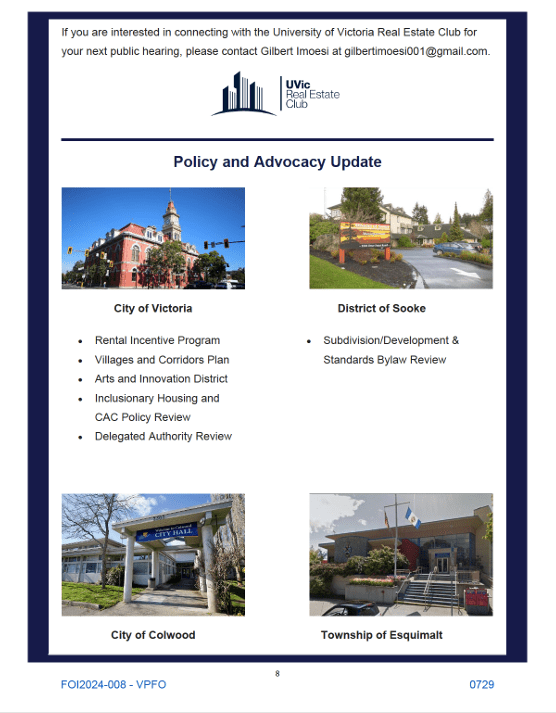

Note the text at the bottom: “If you are working in a municipality listed here and would like to be involved in our advocacy work, please contact” [the UDI Capital Region’s Executive Director] “at UDIVictoria@udi.org“
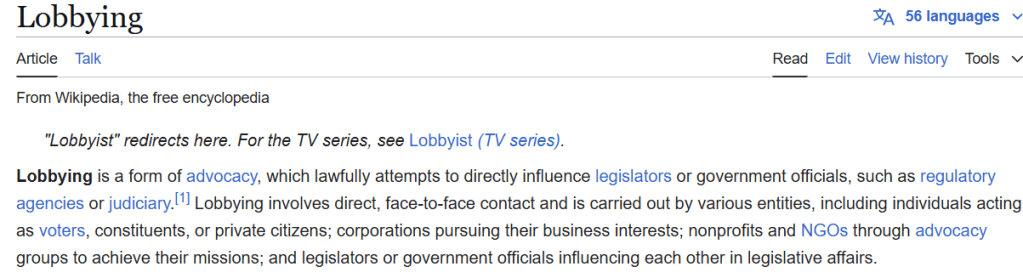
At the time of writing Wikipedia’s entry for its article on lobbying begins:
“Lobbying is a form of advocacy”.
Similarly at the time of writing, Wikipedia’s page on “Advocacy Group” begins with the following:
“Advocacy groups, also known as lobby groups, interest groups, special interest groups, pressure groups, or public associations, use various forms of advocacy or lobbying to influence public opinion and ultimately public policy.[1] “

The UDI’s committees which meet with government are considered advocacy committees:
https://udi.org/knowledge/advocacy/committees
When the UDI registers its lobbying activity to the Province, it does so typically by stating that it is “advocating”:
Urban Development Institute / Anne McMullin, President & CEO – 12-Month Lobbying Summary – Lobbyists Registry – Office of the Registrar or Lobbying of BC
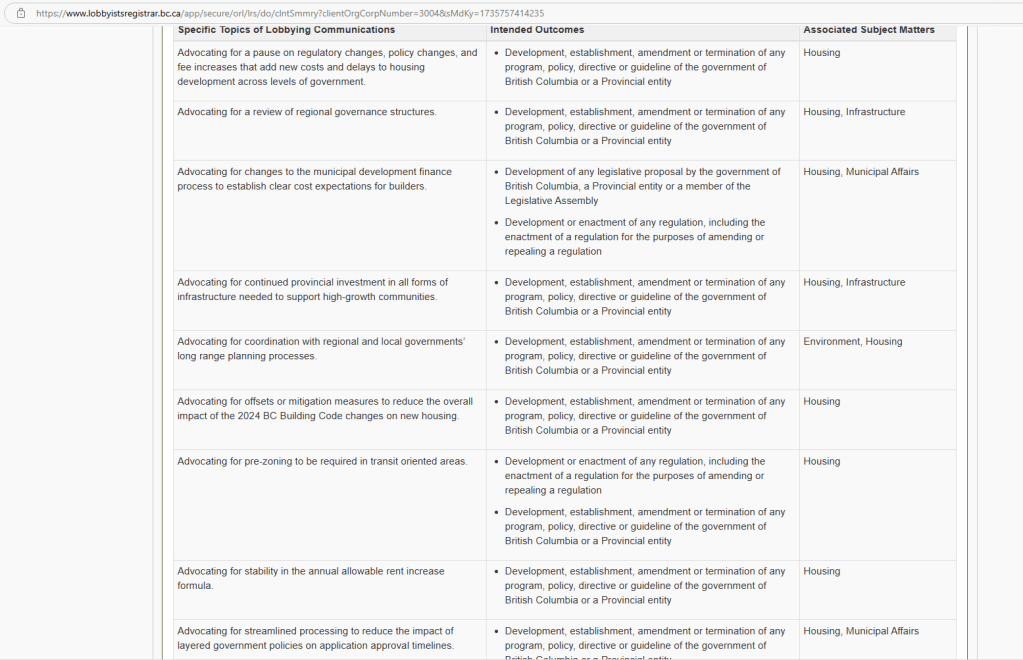
Notice the pattern? OK, advocacy/advocating when used by a registered lobbying organization for registering their lobbying activity to the government is literally synonymous with lobbying. It is not only synonymous with lobbying, it is lobbying as per their registration.
Is advocacy not then lobbying, when the the same lobbying organization including its registered in-house lobbyist (the UDI Capital Region’s Executive Director) then advertises to local government officials:
“If you are working in a municipality listed here and would like to be involved in our advocacy work, please contact” [the UDI Capital Region’s Executive Director] “at UDIVictoria@udi.org“
Applying the logical technique of syllogism to the question, it appears to me that the lobbying organization is asking municipal employees to take part in the organization’s lobbying activities. Advocacy appears to be a mere euphemism for lobbying, but does offer at least the benefit of the doubt, or at least barely plausible deniability: perhaps they didn’t really mean it that way!
Regardless, of which way you take it, I think the reader will agree that municipal officials taking the offer of a registered lobbying organization that advances private corporate interests in development and real estate, to be involved in their advocacy work, when that organization legally registers lobbying as “advocating” is not only inappropriate, it’s a conflict of interest.
The Ministry of Housing and Municipal Affairs statement that: “From my reading of the legislation, conflict of interest rules under the Local Government Act and Community Charter do not apply to local government staff. ” is not only sadly ironic in that the Local Government Act and the Community Charter were designed to provide legislation for local governments, but that the same lobbying organization mentioned, the UDI, actually helped draft the Community Charter, which took on most of the previous role of the Local Government Act:
Registered Lobbying Group for Real Estate and Development Helped Draft the Community Charter of British Columbia. – CRD Watch Homepage
Which finally begs the question:
Is the Province intentionally, or inadvertently under lobbying influence, not legislating conflict of interest laws for local governments, so that conflict of interest is allowed by the Province to exist at the local government level, unless the local governments themselves intervene?
I think a good example of the Province’s double standard when it comes to lobbying and local governments is that while the Province has legislation for a lobbyist registry for the Province, it does not legislate the same to municipalities, despite having the authority to do so, thus allowing lobbying and conflict of interest regarding it to go virtually undetected in the background at the local/regional government level, and yes it does happen, as I have written about in other articles.
The Province and municipal officials like to refer to local governments as the ‘Creature of the Province’, which always seems to remind me of the artist Goya’s depiction of Saturn devouring his son, particularly in regard to the recent Provincial intervention into local government zoning, as was lobbied to it by the UDI.
When it comes to seizing zoning powers from local governments, the province is all gung-ho, it even invoked closure in the Legislature to achieve it in regard to Bill 44, yet, when it comes to preventing conflict of interest by municipal employees, and the registration of lobbying activity, suddenly the municipalities are left to their own devices, although the Province claims that they aren’t for example allowed to have a mandatory lobbyist registry even if they institute a lobbyist registry, because the Province hasn’t provided legislation for them to do so, even if they want to.
I don’t really believe this narrative from the Province and the media though. Municipalities have every right to institute Bylaws, which could include a mandatory lobbyist registry, as far as I can tell.
In other words, these days, it looks the Province only wants to treat municipalities as its creature when its advancing the development/real estate lobby’s agenda, but at the same time, it doesn’t want to regulate them to prevent likely undue influence from the same lobbies in the form of conflict of interest among municipal employees (which frequently use public funds to attend events hosted by the UDI, and sign entire municipalities up to be paying members of it without votes from elected officials) which ends up costing taxpayer dollars.
The Minister of Housing and Municipal Affairs, Ravi Kahlon, had fireside chats with the UDI and the ULI (the Urban Land Institute), over the last couple years, and similarly David Eby, has met and been lobbied with them on a number of occasions, while he was Attorney General/Minister of Housing previously.
Kahlon’s Ministry and the Premier’s Office have been lobbied heavily by the UDI, as revealed by both the BC Lobbyists Registry.


See also: “Sold out” event… – CRD Watch Homepage
On November 11, 2023, I sent an emailed to Kahlon Developments based in Victoria, to ask if one of its employees is a relative of Ravi Kahlon.
They did not respond.
—————————————————————————————————
Conclusion:
The Ministry of Housing and Municipal Affairs statement that: “From my reading of the legislation, conflict of interest rules under the Local Government Act and Community Charter do not apply to local government staff. “, to me reveals a failure of the Province to live up to its (double-faced) act of local governments being the ‘creatures of the Province’.
I was taught that leadership is by example. Conflict of interest, if it is allowed to potentially thrive in lower levels of government, the responsibility for it, starts from the top.
See also:
Anarchy for the BC Public Service in Regard to Conflict of Interest Law: “There are no laws per se”. – CRD Watch Homepage
Freedom of Information reveals that the Province of B.C. was working to implement what the registered lobbying organization, the Urban Development Institute, had been pushing for. This culminated in the recent Housing Bills that override local government authority on zoning. – CRD Watch Homepage
LETTER: Local governments should distance themselves from lobbyists – Saanich News

 CRD Watch Homepage
Leave a comment