The Conference of the Birds at Panama Flats:
A Future Bottleneck for Species Extinction
on Southern Vancouver Island?

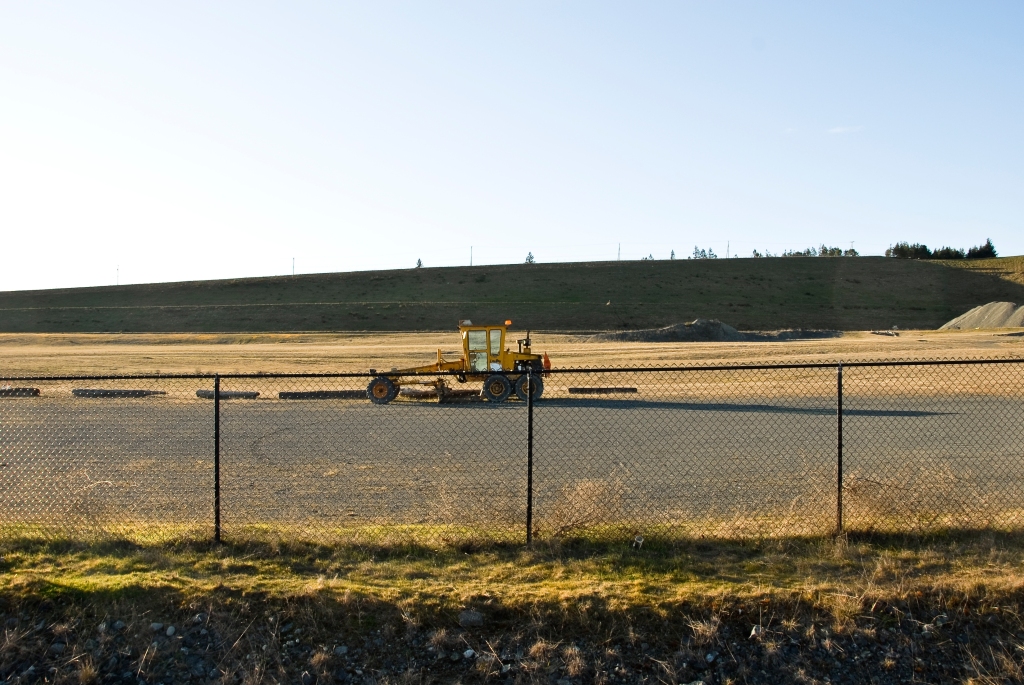
“Detail of cover from a manuscript of Mantiq al-Tayr
(Conference of the Birds)
by en:Attar of Nishapur (Farid
al-Din Attar), Isfahan, Iran, ca. 1610”
Sasha Izard
Sept 15, 2024
The Saanich Council meeting of September 9, 2024 was an eventful one for a number of reasons. The bulk of the deliberations that night were focussed on Saanich’s Urban Forest Strategy Update (item B1.) during the evening – so much so, that other items on the agenda were postponed and public input on them controversially closed, much as public input had been closed on Saanich’s Urban Forest Strategy Update prior to that night.
There was one particular section of dialogue during the deliberations that struck me that evening, for I found the implications brought up during it, to be quite disturbing.
Councillor Chambers, had noted the gross lack of environmental protections in Saanich for trees on private properties, especially in light of BC-Bill 44 (2023), which upzoned much of the Province without ensuring adequate environmental protections are in place – the same for Saanich’s new Official Community Plan, which had been adopted on May 7, 2024 several months previous to this meeting.
Although Chambers did not mention it that evening, areas of the Swan Lake watershed along McKenzie Avenue have been targeted for development, without environmental and hydrological assessments having been made,[i] and in the process putting dozens of mature native trees in the crosshairs of development; thus as a number of people have pointed out: threatening the very survival of the Lake and its eco-system, which serves as a key migratory bird sanctuary.
The following section of dialogue is quoted from the Sept 9, 2024 Saanich Council meeting:
Councillor Chambers: “What I’m referring to is that Saanich is located in the Pacific Flyway, which is a migratory home for 400 migrating birds, and I’m wondering where these birds are supposed to be. We have no replacement habitat with tenants. We have a tenant replacement policy. Where is this biodiversity supposed to go, while these trees are being cut, while the houses are being built. Are they just supposed to go extinct? Where can they go?”
Senior Manager of Parks: “Through the Mayor to Councillor Chambers, we have a number of natural areas that support birds for example. Panama Flats is known as the number 1 birding hotspot in the South Island. And you know, I’m glad to say that a previous Council had the foresight to protect those lands. So, that’s an example where there is some protection for migratory birds.”
Although Councillor Chambers stated “400 migratory birds” during her deliberation, she had meant to say 400 migratory-bird species, as clarified after the meeting, and as evinced by various writings that she had made on the subject in the past. (See reference section at the end.)
The video clip of that section of the deliberation can be viewed here by clicking on this link.
What I found disturbing about the deliberation, was that only one location was provided as an example of a location where 400 bird species could find refuge in Saanich with a rapidly depleting urban forest due to the processes of development, and for many of those species the prospect of extinction is very existential.
What came to my mind were various tragicomic visions of poetry regarding gatherings of birds: from Orpheus lulling animals around him to a calm slumber with his lyre, to medieval poetry, such as the Persian poet Attar’s “The Conference of the Birds”, or Geoffrey Chaucer’s “The Parliament of Fowles”, even the tale of St. Francis speaking the language of the birds in order to preach to them.
In the medieval era and earlier, visions of birds exemplifying a higher society were many; there were romances of birds, and why not?
They certainly had their predecessors in myth, and also in ancient comedy. Just as the gods were so often viewed by the ancients as residing in the sky, the birds were thus seen as their messengers and intercessors between the heavens and the earth.
In Aristophanes’ play The Birds, a man convinces birds to join him in creating an ideal city situated between the Earth and the Heavens called Nephelokokkygia, or “Cloud Cuckoo Land”. Perhaps it was a satire of the Stoic ideal City of the Heavens, and similar thematically to his earlier play “The Clouds”, which poked fun at philosophers including Socrates, who according to ancient tradition watched the play as an audience member. For Aristophanes, the detached ideals and ideas of philosophers and their looking upwards to understand the heavens, often seemed to be thinking more in the clouds, than in useful down to earth reality.
Frankly, I see Saanich’s approach to the environment to be in the clouds, and not in a good way.
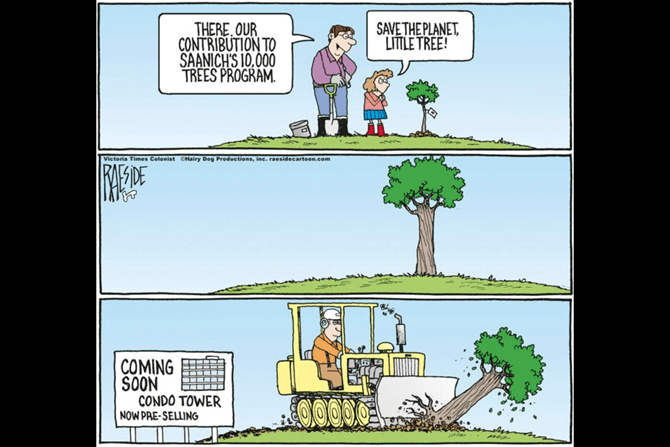
Perhaps exemplifying this best is the Mayor’s goal of planting 10,000 trees, while not adequately protecting mature trees in the District. While, it sounds like a lot of trees on paper, the devil is often in the details. What kind of trees. Are they native trees? Are they monitored? Is there space for them? What happens when they too get bulldozed for the masses of development surely coming down the pipeline?
An illustration in the Times Colonist by artist Adrianne Raeside depicted this paradox well:
———————————————————————————————–
To return to earth: if there are few points of refuge for migrating birds facing lost habitat, the reality is likely not to be utopian. The reality is that we are likely to see forced bottlenecks, where extinction becomes commonplace, as Southern Vancouver Island is turned into dense metropolis; as the former garden city, becomes the next concrete jungle, and as much of the remaining urban forest turns to urban deforestation and desertification.
We need an urban forest, not an urban myth.
Remember the Dodo Bird? It went extinct on an island. What drove it to extinction? Humans.
—————————————————————————————————

Carl Wilhelm de Hamilton – The Parliament of Birds – Parlement of Foules
—————————————————————————————————
Are refugee birds really going to harmoniously gather and mingle on the shores of the Panama Flats, waiting it out for better days in some future era, or will many of them simply go extinct in the process?
Contrary to a great harmony among birds, many birds are highly territorial and will fight over territory and limited food sources. Many birds of prey, prey on you guessed it, other birds. Many birds tend not to cohabit the same areas, e.g. aquatic, and tree-dwelling species.
Aristophanes is said to have died in 388 BCE. Aristotle is considered to have been born 4 years later. Aristotle studied under Plato, who in turn had learned from Socrates.
Plato’s thinking as evinced by his writings in the 4th century BCE, was often much like the thinking previously caricatured in Aristophanes’ birds, as thinking in the clouds; with his ideal republic, lofty ideas and universal forms which although can seem far-fetched was an important predecessor to later physics through attempts to understand underlying physical reality and evolving languages and mathematics/geometry to do so.
Aristotle’s thinking however, became widely divergent from Plato. There are two books that I can’t recommend enough on this:
The Cave and the Light: Plato Versus Aristotle, and the Struggle for the Soul of Western Civilization by Arthur Herman
The Lagoon: How Aristotle Invented Science by Armand Marie Leroi
In the Lagoon, Leroi wrote about how through close observation of lagoon-life Aristotle came to many advancements in thinking about the biology of flora and fauna and the interrelationships between them.
Although making major advances in human thought, portions of Aristotle’s thinking in many ways came to dominate in the Middle Ages, and often in ways that became stagnant and full of dogma.
Despite that, Aristotle’s thinking in many ways set foundations that would lead to the development of modern theories of biology, including to ideas that can be seen as proto-evolutionary, and proto-scientific method.
Aristotle’s ideas however, were not always correct. One of his views of nature, as Leroi pointed out was that some species of animals were essentially in endless combat with one another. Whereas in Aristotle’s view this was a world of a balanced stasis between species, Leroi pointed out that to the contrary, species in the world as it is, will sometimes in actual-fact, drive other species to extinction, even if they are a food source for the predator species that drives one of its own specific food sources to extinction, right down to the last meal composed of that particular prey species.
I think you can see where I am going with this. Rather than Panama Flats as being some kind of ultimate utopian evolutionary refuge for birds, I see that if it gets to the point; where it is the last one of its kind in Saanich, it will be for many species an evolutionary dead end.
I laud Councillor Chambers for pointing out the elephant in the room when it comes to Saanich’s so-called Urban Forest Strategy, or what I refer to as the Urban Deforestation Strategy: “Where is this biodiversity supposed to go, while these trees are being cut, while the houses are being built. Are they just supposed to go extinct? Where can they go?”
—————————————————————————————————
Resources:
Agenda for Saanich Council Meeting: September 9, 2024: Council Meeting (granicus.com)
LETTER: Region’s habitat is a lifeline for more than 400 bird species – Greater Victoria News (vicnews.com) by Nathalie Chambers
Black Press Media [Saanich News]
Oct 8, 2023 6:30 AM
https://nathaliechambers.ca/habitat-nat/fall-2024-update/
B.C. Bill 44 could trigger ‘catastrophic loss’ of urban forests | The Narwhal
LETTER: Urban designation overlooks diverse Saanich habitat – Saanich News
Book: The Cave and the Light: Plato Versus Aristotle, and the Struggle for the Soul of Western Civilization by Arthur Herman
Book: The Lagoon: How Aristotle Invented Science by Armand Marie Leroi
The Lagoon: How Aristotle invented science by Armand Marie Leroi – review | Science and nature books | The Guardian
Birds | Comedy, Ancient Greece, Satire | Britannica
Plato and Aristotle: How Do They Differ? | Britannica
The Conference of the Birds – Wikipedia
Parlement of Foules – Wikipedia
[i] LETTER: Club’s pro-development stance weakens UVic’s reputation – Saanich News by Anthony Britneff Sep 7, 2024 6:46 PM
“I reside in the Swan Lake neighbourhood where Saanich council recently approved two outrageously over-dense projects within the watershed of the Swan Lake Christmas Hill Nature Sanctuary under the flyway of migrating birds and requiring extensive logging of native Garry oak trees on a protected ecosystem – all without environmental and hydrological assessments.”


 CRD Watch Homepage
Leave a comment