Targets Without Terrain: How the Province’s Mandated Housing Model Doesn’t Fit Saanich
By M. Rose Munro
March 19, 2026
The Housing Needs Report (HNR) uses BC Stats’ PEOPLE projections as if they are fixed, inevitable outcomes. Population projections, however, are not guarantees. They are trend‑based scenarios that assume past patterns will continue unchanged. When these projections are converted directly into mandatory housing targets, the province effectively transforms a demographic model into a land‑use requirement, without testing whether the underlying assumptions hold true for Saanich or for Vancouver Island. This is not an example of evidence‑based planning by any measures, but rather a planning by spreadsheet. The provincial methodology treats projections as obligations, not forecasts.
HNR methodology does not account for Saanich’s physical, environmental, or infrastructural constraints, as it does not include variables for:
· Saanich’s limited land base
· Age-related lifestyle (ARL) projections
· Rural and watershed areas
· Steep slopes and wildfire interface
· Finite sewer and water capacity
· Constrained road networks
· Ecologically sensitive areas
· Institutional land holdings (UVic, Camosun, etc.)
In other words, the model assumes Saanich has the same development capacity as a flat, serviced, expandable mainland municipality. And as we all know, this is simply not the case. Saanich is 70% rural, heavily constrained by environmental protections, and located on an island with finite infrastructure. The provincial methodology does not recognize any of this.
HNR methodology inflates Saanich’s housing need through structural double‑counting. The HNR adds together: projected household growth, current core housing need, replacement of aging stock, plus a limited pipeline adjustment. This structure overstates need, especially in municipalities like Saanich that have older rental buildings, have a large student population, have a high proportion of renters, have aging single‑family stock, and have redevelopment pressures in established neighbourhoods. The result is a target that reflects mathematical accumulation, not real‑world feasibility.
The methodology assumes densification is infinitely scalable, implicitly assumes that:
• if land is scarce, build up
• if infrastructure is constrained, expand it
• if neighbourhoods resist, legislate over them
• if the market is slow, it will eventually catch up
These assumptions are not tested in the model. They do not reflect construction labour shortages, financing constraints, market absorption limits, displacement risks, infrastructure bottlenecks, the realities of island supply chains. The model treats densification as a technical switch, not a complex, multi‑decade process.
The methodology does not measure actual buildable capacity in Saanich because the HNR does not analyze:
• how much land is realistically developable
• where infrastructure can support growth
• where environmental constraints prohibit development
• where redevelopment is economically viable
• where displacement risks are highest
• how much new housing the market can absorb
This means the provincial targets may exceed Saanich’s actual physical capacity to deliver them. A housing target that cannot be built is not a plan. It is a number.
The HNR methodology treats Vancouver Island as if it were the Lower Mainland. There is no adjustment for ferry‑dependent supply chains, limited labour pools, constrained transportation corridors, island‑specific cost premiums, regional water and sewer limitations. The model assumes that growth can be accommodated simply by rezoning. But on an island, growth is constrained by infrastructure, geography, and ecology, not just zoning. Saanich cannot densify its way out of physical limits. The result is a target that is mathematically tidy but practically disconnected. The provincial methodology produces a number that: is internally consistent, is easy to compare across municipalities, is politically useful, but is not grounded in Saanich’s physical reality. Said disconnect creates risk:
• over‑promising and under‑delivering
• misallocating infrastructure investment
• displacement in established neighbourhoods
• environmental degradation
• public mistrust
A credible housing strategy must be achievable, not just calculable. Saanich needs a housing plan grounded in reality, not abstraction. Saanich is and has been committed to addressing housing need, but effective planning requires realistic population assumptions, recognition of island constraints, alignment with infrastructure capacity, protection of ecological assets, respect for rural and agricultural lands, and feasible, phased implementation. The current HNR methodology does not provide that foundation.
Housing Needs Report Historic Timeline Overview
2018: The HNR requirement was created through Bill 18 (2018), which amended the Local Government Act to require every municipality and regional district in BC to complete a Housing Needs Report every five years. This was the first time BC mandated a standardized, province‑wide assessment of housing need.
2019: The Ministry of Municipal Affairs released the first HNR guidelines and calculator. Municipalities were required to complete their first HNR by April 2022.
2021 – 2022: The province shifted from reporting to enforcement when it introduced a new legislative package that ‘strengthened’ the HNR methodology, required Interim Housing Needs Reports by 2025, enabled binding provincial housing targets, and tied HNR outputs directly to zoning. This is the moment the system moved from data collection to regulatory control.
2024 – 2025: The Ministry of Housing released the updated HNR calculator, renamed HART (Housing Assessment Resource Tools), which municipalities must use for Interim HNRs (due Jan 1, 2025) and for OCP and zoning updates (due Dec 31, 2025). This new version is far more prescriptive and directly tied to provincial housing targets. Shortly after, the Province adopted the UBC‑developed tool as the standardized, mandatory methodology for all municipalities beginning with the 2024–2025 cycle.
The HART project was led by two UBC researchers: Penny Gurstein and Tsur Sommerville. The project was funded by Canada Mortgage and Housing Corporation (CMHC), BC Ministry of Housing / Municipal Affairs, Federation of Canadian Municipalities (FCM), and UBC Housing Research Collaborative. What’s intriguing is the close alignment with industry advocacy. Urban Development Institute (UDI) and the development industry have long advocated for:
• Standardized zoning
• Pre‑zoning for density
• Reduced municipal discretion
• Faster approvals
• Provincial override powers
• Target‑driven housing supply mandates
The HART/HNR system operationalizes exactly those goals. The policy direction embodied in the HNR aligns closely with industry advocacy. The BC government’s housing bills (2021–2024) rely on: standardized, province‑controlled housing need calculations, targets that municipalities must meet, zoning reforms that remove local discretion, and the HART/HNR tool precisely supports its legislative agenda.
This tool provides the technical justification for these reforms.
Legitimate concerns associated with the HART/HNR tool:
1). Mainland-centric assumptions – this tool was developed at UBC using mainland development patterns, mainland infrastructure assumptions, mainland land-use typologies. It does not reflect island constraints, rural land protections, or Saanich’s geography.
2). No municipal or regional co‑development – Local governments were not co‑authors of the methodology. They are end‑users, not contributors, which is a power imbalance.
3). The tool’s outputs are now tied to binding provincial targets – a research model has become a regulatory instrument, and this raises governance questions.
4). The tool’s assumptions align with industry interests: more density, more pre-zoning, more market supply, fewer municipal barriers, making this tool politically attractive to both the province and the development industry.
5). Lack of transparency and calibration – the methodology is published, but: calibration choices, sensitivity testing, geographic adjustments, validation against real‑world constraints are not publicly documented in detail.
What does this mean for Saanich? Saanich is required to use a tool that:
• Was developed outside the region,
• Does not account for island geography,
• Does not incorporate ALR, watershed, or rural protections,
• Assumes infinite densification capacity,
• Aligns with industry‑preferred planning models,
• Is now tied to binding provincial zoning mandates.
This explains why the numbers feel disconnected from Saanich’s physical reality.
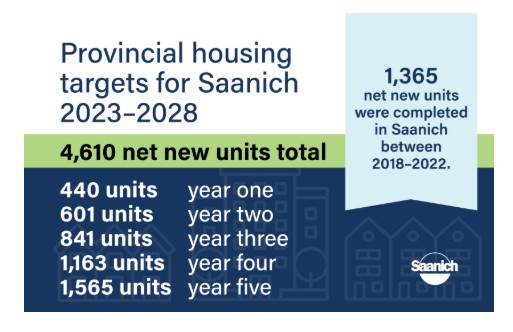
The fact that a motion to challenge the provincial housing targets was defeated, and only surfaced on the eve of an election, highlights a serious disconnect. Saanich council’s duty is to represent the community, not to silently absorb provincial mandates that don’t reflect our geography, infrastructure, or democratic will.
Saanich council works for Saanich residents, not the Province, and silence in the face of flawed provincial targets is not what representation looks like.
————————————————————————————————-
See also:
Saanich Council Ditches Motion to write to the Provincial Government to Remove the Provincially Mandated Housing Target Order for the District. – CRD Watch Homepage
Setting the record straight with the Times Colonist, on Saanich Council’s refusal to write a letter to the Provincial Government asking for the removal of provincially mandated housing targets for the municipality. – CRD Watch Homepage

 CRD Watch Homepage
Leave a comment