Grassroots or Astroturfing? A comparison of the Save Our Saanich EO Code of Conduct, and that of the BC Conservatives.
The comparison of the two documents by AI, reveals that “It is highly likely that one document was based on the other”
Why were the SOS EO membership not consulted on the Constitution before it was written?
The SOS EO membership passed the document by vote, despite that it appears to contain a glaring misrepresentation of Elections BC Requirements. Elections BC does not require that an EO President and Vice President “shall be deemed to be immediately appointed without a vote, and continue for a term of up to one year“, as the Constitution which was passed claims.
By Sasha Izard
Jan 29, 2026
In mid-December of 2025, the leadership of Save Our Saanich had a meeting with two leaders of a Conservative Riding Association, without informing the SOS membership. This was confirmed to me from the list of those present at the meeting, when I asked the President of SOS who had been in attendance at the meeting, after I had learned of it.
To me this was a red flag. As a member of the organization, which was supposedly a grassroots movement to put the interests of the Saanich residents and neighbourhoods first and foremost on the political agenda at the local government level, why were the leadership meeting with leaders in a big party political organization, without informing the members?
My inquiries quickly led to few answers from the leadership, and what seemed to be thinly veiled and less thinly veiled threats of expulsion from the organization, merely for inquiring as to what was the nature of the meeting, and were minutes being taken of the Save Our Saanich Elector Organization Steering Committee meetings.
In January of 2026, the membership of the Save Our Saanich Elector Organization were provided by email a draft of a Constitution to be voted on by the EO membership at a meeting set for the end of the month.
When I asked for an online venue to be setup so that the members could discuss among themselves issues related to the organization, the District of Saanich, and the SOS EO, this was denied by the leadership, although the idea was a popular one among members of the Save Our Saanich Facebook page. Where else could they discuss among themselves about such issues including the EO Constitution? No possibilities had been provided.
When I reviewed the Draft EO Constitution, I noted that it contained a section that seemed dubious:
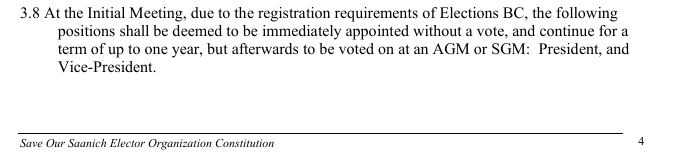
Section 3.8 stated: “At the Initial Meeting, due to the registration requirements of Elections BC, the following positions shall be deemed to be immediately appointed without a vote, and continue for a term of up to one year, but afterwards to be voted on at an AGM or SGM: President, and Vice-President.”
I contacted Elections BC and asked them referring to the above section 3.8: Is the claim in the following paragraph that the following is a registration requirement of Elections BC accurate?
Elections BC promptly replied:
The Local Elections Campaign Financing Act (LECFA) does not use the terms President or Vice-President. Instead, it requires organizations to designate a responsible principal official and an authorized principal official for registration purposes. Neither Elections BC nor LECFA regulates how these principal officials are selected. Decisions about titles, roles, and selection processes are considered matters of internal administration.
Please reach out with any questions.
———————————————————————————————–
It was clear to me from Election BC’s response that Section 3.8 in the SOS EO Constitution draft was not accurate. It is not an Elections BC Requirement that an Elector Organization President and Vice President shall be deemed to be immediately appointed without a vote, and continue for a term of up to one year.
I contacted the two Responsible Principals of the Save Our Saanich Elector Organization about the issue. The first Principal acknowledged that I was correct. The second Principal said that the issue would be brought up at the meeting to vote on the Constitution.
I then noticed that the agenda for the meeting did not have a section for the EO membership to discuss the EO Constitution prior to voting as to whether or not it would be adopted. This raised another red flag to me. I insisted to the leadership that the membership should be able to discuss the Constitution before it was voted on. Although they wavered at first, they ultimately gave in. What could they do, not allow the membership to discuss the Constitution before it was voted on?
They had a Zoom meeting with the EO membership to discuss it. I brought up section 3.8 and how it was inaccurate, but nothing was changed.
On Jan 27, 2026 the EO had a meeting at a room at the Commonwealth Pool. Voting on the proposed Constitution was the first item on the agenda. The proposed Constitution had not been modified, despite various voices having brought up issues with this and other aspects of the Constitution that required scrutiny if not changing it, and 3.8 certainly warranted that in my view.
How could the leadership put forward a proposed Constitution that was in my and other’s view, clearly misleading, in terms of Section 3.8?
The Constitution was voted on, and passed despite that. I immediately left the organization. How could I possibly take part in an organization that had a blatantly misleading Constitution in my view, which had stated claims about Elections BC requirements, which were clearly not based on reality?
As a result of the issues brought up previously, the President and Vice President positions were voted on after all, albeit this had not been intended previously. Their votes were through affirmation, rather by election. There were only two options in such a vote, one person for the President position, and another person for the Vice President position. What was being affirmed however? There had been no one in these roles in the EO previously.
————————————————————————————————-
The Constitution empowered the Executive, which could have a majority of unelected people on it, but it was not empowering to the membership. When one member asked if the membership had the right to observe meetings of the Executive, their questions were not answered. I consider it to be an oligarchical constitution.
I also found highly odious the Code of Conduct, which I viewed as essentially a gag order, having Orwellian implications, e.g. public criticism of the way the structure of the organization, or how it was operating was forbidden and could even be grounds for expulsion by the Executive without appeal.
Not just Orwellian, the process was Kafkaesque. Members were informed prior to the Zoom to discuss the proposed Constitution, that those who attended it were bound by the Code of Conduct in the proposed Constitution, despite that the proposed Constitution and its Code of Conduct had not been voted on yet!
Furthermore, this had been decided on by an Executive that had not been elected. In the Zoom meeting one member asked if this was like a non-disclosure agreement, and the leadership informed the members that just by being a member we were under the equivalent of a non-disclosure agreement.
I brought up Section 2b of the Charter of Rights and Freedoms part, of the Canadian Constitution, which in comparison to the SOS EO Constitution guarantees freedom of expression under all mediums of communication:
Section 2(b) – Freedom of expression
Provision
2. Everyone has the following fundamental freedoms:
freedom of thought, belief, opinion and expression, including freedom of the press and other media of communication.
—————————————————————————————————
The SOS EO Constitution denied many of those same tenets of freedom of expression for the members of the organization, which were in comparison guaranteed in the Canadian Constitution. Notably this is during an election year, which is a key time of democratic participation. One for example, could not criticize publicly the organization or how it was being run according to the Code, or risk expulsion from the organization without appeal.
When I asked the person who drafted the document if he could explain in his own words, how the SOS EO Code of Conduct was not in contravention of the Charter, he refused to do so, saying that he had been told by lawyers that there was no legal issue in this regard, but refrained to say the name of who those lawyers were.
My point wasn’t necessarily that the Code of Conduct is in contravention of the Charter, although questions should be asked of how not only the membership, but candidates in an election, including potentially some elected officials could be gagged on certain subjects by the organization.
The SOS EO is a non-profit, not a government entity. The Charter applies to government entities, but I do consider that the membership deserved an explanation, prior to voting on it.
My broader point was that their Constitution is a much inferior document to the Canadian Constitution. To put it mildly, it might as well have been the Constitution of an authoritarian regime, rather than a democracy. With Saanich we shouldn’t be lowering our standards that we expect from our leadership, we should be aiming to surpass them.
In my view, various interruptions of the members of the public by the current council, during their presentations – to the point of sometimes cutting members of the public off at the mic, prior to the conclusion of their allotted speaking time, does not correspond with the rights and freedoms provided by Section 2b of the Charter and the Canadian Constitution, an issue that has been brought up with previous councils, but was unfortunately never taken to the point of judicial review.
Woman sues Saanich, says she didn’t get allotted time at meeting – Victoria Times Colonist
Mayor Richard Atwell issues public apology as part of settlement with EDPA supporter | Saanich News
Letter to Mayor Murdock regarding your Chairing at the Feb 11, 2025 Saanich Special Council Meeting – CRD Watch Homepage
If leadership is by example, then in my view when it comes to democracy and upholding the values of Charter, SOS will almost certainly do the same or worse, if their demonstrated values are instituted through power.
—————————————————————————————————
A couple days after the Jan 27 SOS EO Meeting, at which the Constitution was adopted, I looked at the code of conduct in the Conservative Party of BC Constitution (Appendix 1.). I noted that it looked too similar to the Code of Conduct in the Save Our Saanich EO Constitution to be coincidence in my view. (Appendix 2.)
I provided the two codes of conduct from the constitutions to AI.
I asked Google’s Deep Dive AI: Is it likely that of the two Constitution documents [the codes of conduct specifically], that one was based on the other?
Here was the response:
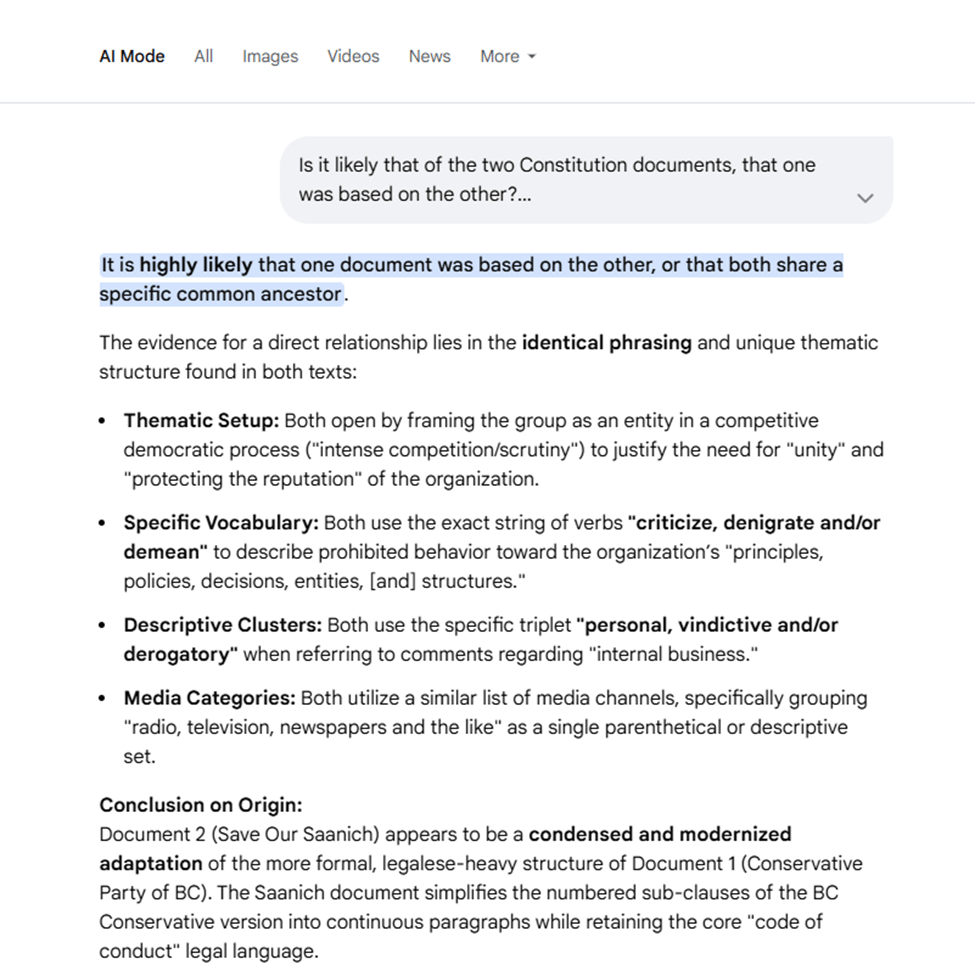
The AI determined that it appears that the Save Our Saanich document had been based on the document of the Conservative Party of BC.
I mentioned this to a friend of mine with a scientific background, who suggested that I compare the data by running through the same comparison with another political party code of conduct.
I asked AI to compare it the code of conduct of the BC Green Party.
This is what it determined:
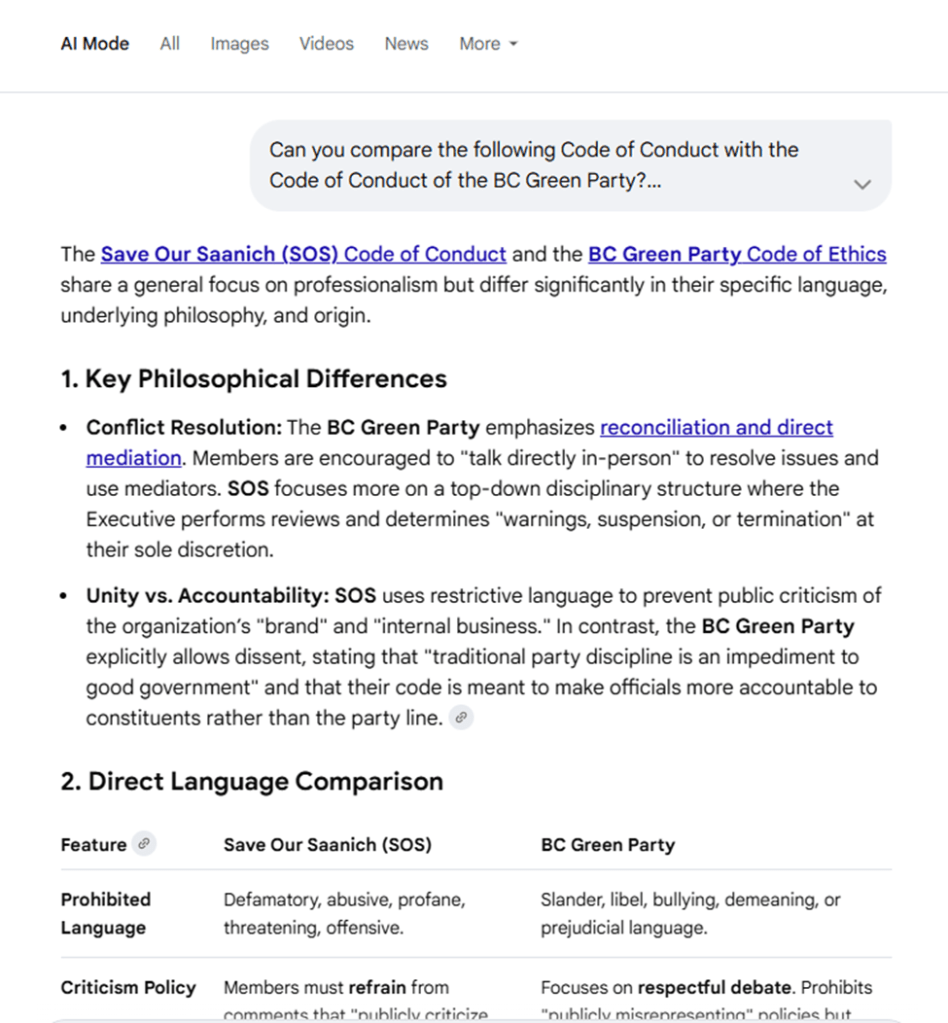
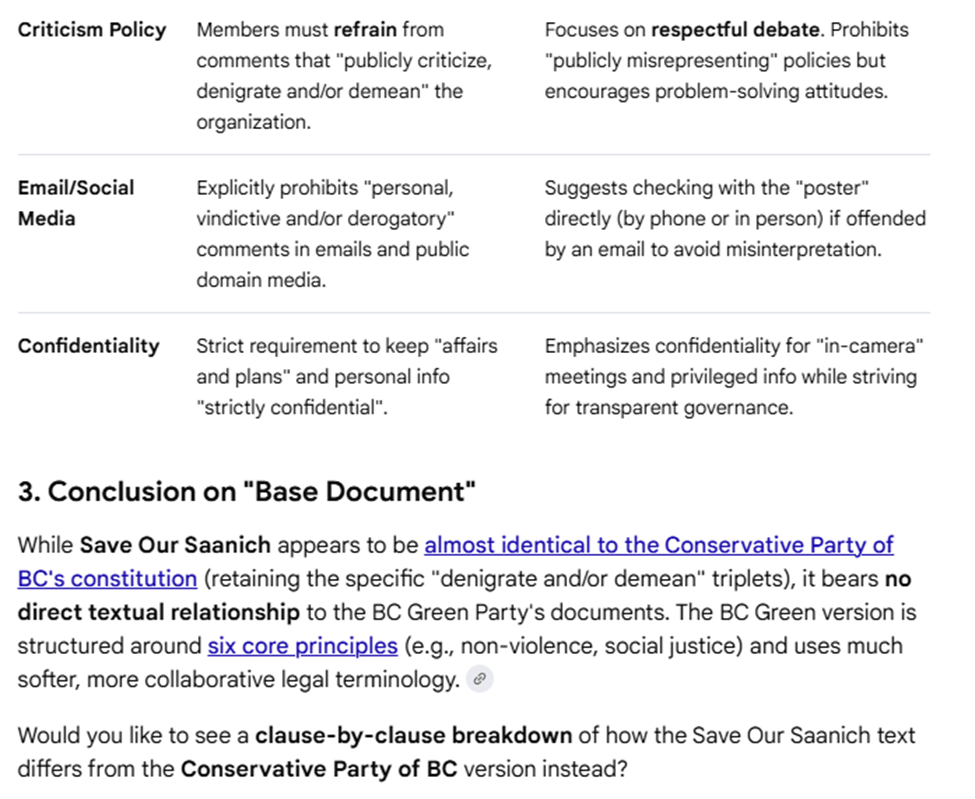
Clearly the AI did not consider the SOS EO document to have much in common textually with the BC Green document; although I didn’t ask in this instance whether it had any relation to the Conservative Party of BC’s constitution, the AI noted: that the Save Our Saanich document “appears to be almost identical to the Conservative Party of BC’s constitution”.
Now to correct the AI a bit, while the Save Our Saanich EO Code of Conduct does bear stark resemblance in many aspects to the Conservative Party code of conduct, stating that it appears almost identical to the Conservative Party of BC’s Constitution (which their code of conduct is a part of) is not entirely accurate either, but clearly AI was noticing some pretty stark patterns.
I took fondly to AI’s comparison of the codes of the different parties:
“1. Key Philosophical Differences
Conflict Resolution: The BC Green Party emphasizes reconciliation and direct mediation. Members are encouraged to “talk directly in-person” to resolve issues and use mediators. SOS focuses more on a top-down disciplinary structure where the Executive performs reviews and determines “warnings, suspension, or termination” at their sole discretion.
Unity vs. Accountability: SOS uses restrictive language to prevent public criticism of the organization’s “brand” and “internal business.” In contrast, the BC Green Party explicitly allows dissent, stating that “traditional party discipline is an impediment to good government” and that their code is meant to make officials more accountable to constituents rather than the party line.”
It’s pretty clear which political organization has the more ‘democratic’ code of conduct.
The two codes did not have too much in common.
————————————————————————————————–
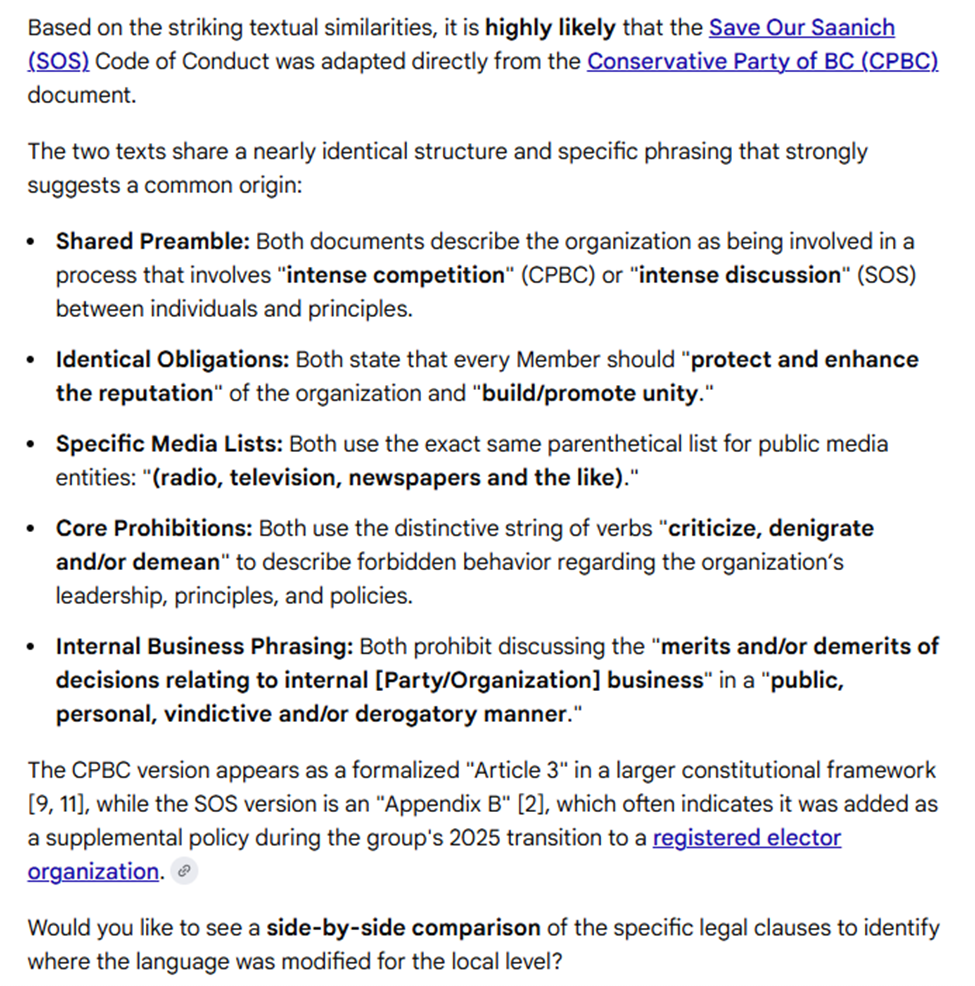
I ran one more comparison through AI of the code of conduct document of the BC Conservatives and that of the Save Our Saanich Elector Organization:
I asked: Is it likely that one of the following 2 Code of Conduct documents was used to create the other?

AI responded: “Based on the striking textual similarities it is highly likely that the Save Our Saanich (SOS) Code of Conduct was adapted directly from the Conservative Party of BC (CPBC) document.”
————————————————————————————————–
Conclusion:
In my view, the setting up of the SOS Elector Organization Constitution, is a perfect textbook example of what not to do if one is to seek a democratic outcome. It is however, a textbook example of an oligarchic (rule by the few) document, which empowers small groups at the expense of the membership as a whole.
The fact that it was passed with what appears to be clearly misleading information, in comparison with actual statements from Elections BC, is in my view shocking. It was passed with hardly any opposition at the actual time of the vote (by a show of hands), despite that such issues had been raised by a number of the membership previously to it.
That AI has found major parallels between the SOS EO Constitution and that of the BC Conservative Party (something I noticed on a quick first glance of it), raises critical questions.
Do big party politics have a place in local government elections, whether overt or less overt?
Is a local grassroots organization, still operating as a grassroots organization, if its leadership drafted a code of conduct based on that of a major political party, without informing its own membership of this?
Was this organization an attempt at saving Saanich as its name purported, or had it become an exercise in saving the Saanich conservatives?
————————————————————————————————–
See also:
Asch conformity experiments – Wikipedia
————————————————————————————————–
Appendix 1: Code of Conduct of the Conservative Party of BC:
ARTICLE 3 – OVERALL BEHAVIOUR, GOOD CONDUCT AND RESPONSIBILITIES OF MEMBERS 3.01
3.01 It is acknowledged that the Party is a “political” entity involved in the legal and democratic process of seeking to serve the people of British Columbia in the fields of public government and administration. Also, it is recognized that such a democratic process often involves intense competition between individuals, concepts, beliefs, ideals, principles and many other issues. Therefore, it is understood and accepted by the Conservative Party of BC Member that every Member should do all possible to protect and enhance the reputation of the Party in the public domain and to build unity in the Party. In furtherance thereof, every Member should:
(a) refrain from making statements to public media entities (radio, television, newspapers and the like) that openly and publicly criticize, denigrate and/or demean the Party, the Party leadership, individual Party Members, the Party principles, policies, decisions, entities, structures and/or associated bodies of the Party or discuss in a public, personal, vindictive and/ or derogatory manner the merits and/or demerits of decisions relating to internal Party business and Administration;
(b) refrain from making or posting any statements on “public domain” entities (such as social media, or other internet sites) that openly and publicly criticize or denigrate and/or demean the Party, the Party leadership, individual Party Members, the Party principles, policies, entities, structures and/or associated bodies of the Party or discuss in a public, personal, vindictive and/or derogatory manner the merits and/or demerits of decisions relating to internal Party business and administration; and
(c) in communicating by e-mail, refrain from making statements that harshly criticize or denigrate and/or demean the Party, the Party leadership, individual Party Members, the Party principles, policies, entities, structures and/or associated bodies of the Party or contain personal attacks, vindictive and/or derogatory statements on the merits and/or demerits of decisions relating to internal Party business and administration and those involved therein.
————————————————————————————————–
Appendix 2: Code of Conduct attached to the Save Our Saanich Elector Organization Constitution
APPENDIX B: SAVE OUR SAANICH ELECTOR ORGANIZATION CODE OF CONDUCT
Save Our Saanich Elector Organization Members will treat everyone fairly and equally and generally refrain from defamatory, abusive, profane, threatening, offensive, or illegal material, language or actions. Such actions will not be tolerated.
The Organization is engaged in a process which may involve intense discussion and scrutiny. It is understood that every Member should protect and enhance the reputation of the Organization, its “brand,” and promote unity.
When representing Save Our Saanich Elector Organization at private or public events, when communicating within the EO membership, or when engaging on the Organization’s website, or on Facebook, other similar “public domain media,” and/or public media (radio, television, newspapers and the like), Members will conduct themselves in accordance with the Code of Conduct.
Members will refrain from comments that openly and publicly criticize, denigrate and/or demean the Organization, other Members, the Organization’s principles, policies, decisions, entities, and structures, or discuss in a public, personal, vindictive and/or derogatory manner decisions relating to internal Organization business. Similarly, Members will refrain from such comments in emails. Members are required to keep the affairs and plans of the Organization confidential, and will keep any personal information respecting Members strictly confidential. Members may not publicly criticize or undermine the Organization, other Members, or the Executive. To the extent any Member has a criticism, such issues should be brought forward privately.
Members will not present themselves in private or public meetings, on social media, or in any other forum, as representing the Organization without formal authority provided, in writing, by the Executive.
If a Member’s or Members’ conduct is deemed to contravene this Code of Conduct, the Member(s) may be subject to a review conducted under authority of the Executive which may result in warnings, suspension, or termination of Save Our Saanich Elector Organization Membership by vote of the Executive. At the sole discretion of the Executive, the Member(s) who are subject to such a review may be given the opportunity to address the Executive prior to any action being determined.

 CRD Watch Homepage
Leave a comment