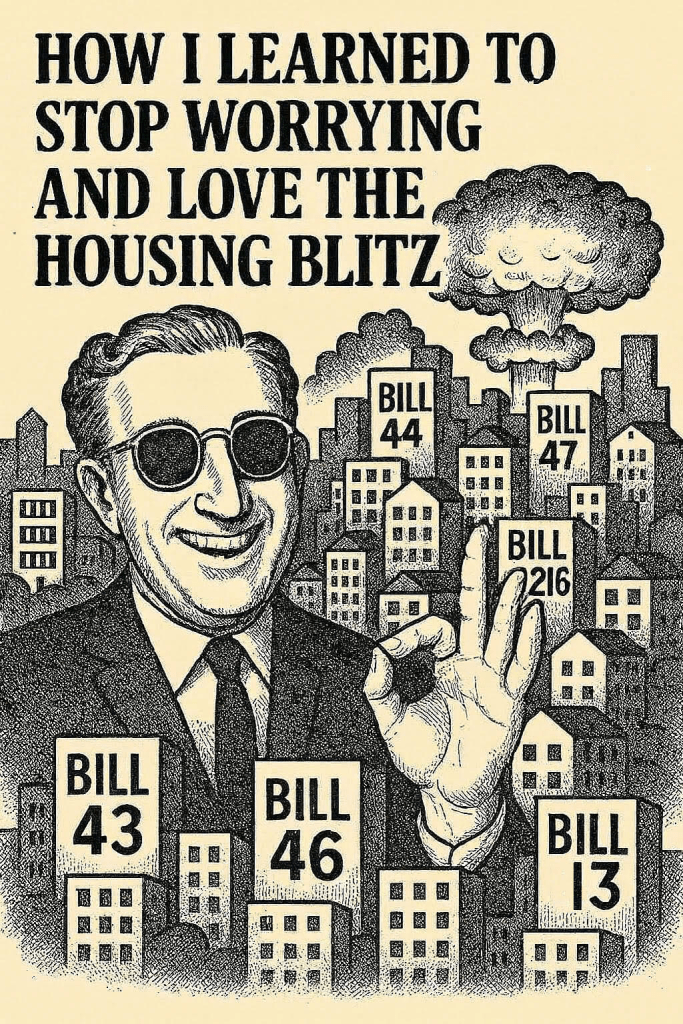
HOW I LEARNED TO STOP WORRYING AND LOVE THE HOUSING BLITZ
M. Rose Munro
Jan 24, 2026
British Columbia’s sweeping housing reforms and land‑use overhaul were introduced and passed months before the Province publicly declared a “middle‑income housing crisis” in February 2024 with the launch of BC Builds. This is when the provincial government formally asserted that “middle‑income housing crisis” required direct state intervention. This means the most aggressive zoning, density, and municipal‑power‑limiting legislation in B.C.’s history was justified after the fact, using a crisis narrative that did not exist when the reforms were drafted or passed.
Between 2021 and 2023, British Columbia’s housing reforms unfolded as a coordinated exercise in speed, timing, selective benefit, and strategic opacity, well before it was formally packaged as a “middle-income housing crisis.” In just a few years, the Province advanced the most consequential land‑use reforms in a generation, precisely during a period when civic participation was at its weakest and access to decision‑making was uneven by design.
What followed was an aggressive blitz of housing legislation pushed through at extraordinary speed. Consultation windows narrowed to the point of exclusion. Decision‑making structures consistently advantaged those with pre‑existing access and influence. Urgency became the governing logic but transparency never caught up. In this system, access was dictated by speed. Participation was constrained by timing. The beneficiaries were entirely predictable. And accountability steadily receded into the background.
This analysis examines how four variables: speed, timing, beneficiary, and transparency interlocked over the course of the timeline to produce a transformation that was never intended to be widely seen, let alone widely debated.
Once you follow the pattern, the housing reform blitz stops looking like a response to “middle-income housing crisis” and starts looking like a coordinated developer lobby enrichment strategy.
The Speed
The B.C. housing legislation blitz did not simply unfold in waves. It was propelled deliberately, with speed functioning as the strategy itself. Bill after bill, the Province redefined zoning, density, development finance, and municipal authority at a pace that outstripped not only public input, but public awareness altogether. A review of the timeline makes the pattern unmistakable. In 2023 alone, the Province introduced and passed three major housing bills in just five months. Bill 44 imposed province‑wide upzoning, overriding local zoning and mandating multi‑unit housing on formerly single‑family lots. Bill 46 overhauled municipal development finance, expanding provincial control over development charges and limiting municipalities’ ability to negotiate amenities or shape projects through financial tools. Bill 47 redefined transit‑oriented areas, mandated minimum heights and densities, removed municipal authority to downzone, eliminated parking minimums, forced Official Community Plans and Local Area Plans into alignment with provincial boundaries, and imposed strict implementation timelines. In effect, Bill 47 compelled high‑density, low‑parking housing near transit hubs by setting provincial minimums and stripping municipalities of the power to limit them.
Together, these three bills reconfigured land‑use authority in British Columbia, concentrating decision‑making at the provincial level and sharply narrowing the space for local governance. But the acceleration did not begin in 2023. In 2022, Bill 43 (the Housing Supply Act) moved from first reading to Royal Assent in a matter of weeks, granting the Minister of Housing & Municipal Affairs sweeping authority to impose binding housing targets and intervene when municipalities fell short. Planning, in practice, became compliance.
This pace was unprecedented. The B.C. government is typically bureaucratic, slow, and procedurally cautious. When a legislative agenda suddenly accelerates this dramatically, speed becomes a sorting mechanism of its own. Large developers and industry groups with staff, capital, and policy capacity, can keep up. Residents, small builders, and municipalities cannot. Speed amplifies existing power differentials: it determines who gains access, who is sidelined, and who ultimately shapes the outcome. In this blitz, speed was not neutral, it was directional.
Let’s examine the timeline:
2021 – 2022
• Province begins multi‑year restructuring of housing policy
• Early signals of centralization and accelerated approvals
• No mention of a “middle‑income crisis”
2023 (Early–Mid)
• Consultation windows narrow
• Municipal authority erodes through policy directives
• Public participation weakens by design
• Still no “middle‑income crisis” framing
2023 (Late) – Bills 44, 46, and 47 passed in 5 month
• Eliminated single‑family zoning province‑wide
• Imposed provincial density, height, and parking rules
• Rewrote municipal financing tools
• Represented the fastest, most sweeping land‑use overhaul in B.C. history
• Contained zero references to a “middle‑income housing crisis”
February 13, 2024 – BC Builds launched
• First appearance of “middle‑income housing crisis” language
• Province asserts middle‑income households are in urgent need
• Crisis framing used to justify accelerated state intervention
• This occurs months after the reforms were drafted and passed
The timeline makes the sequence unmistakable: the reforms preceded the crisis narrative, not the other way around.
The Timing
Timing compounded the effect. If speed determined who could keep up, timing determined who could participate at all. These reforms were advanced during and immediately after the COVID‑19 pandemic, when public engagement was structurally gutted. Hearings were suspended or moved online, neighbourhood meetings evaporated, and public forums became inaccessible. People were isolated, overwhelmed, and focused on survival. The Province did not lift the COVID‑19 emergency order until July 2024, long after the legislative blitz was underway. Unleashing the most extensive land‑use reforms seen in decades during a period of civic paralysis was not incidental. It ensured that only those with institutional resources and continuity remained in the loop. Everyone else fell out of it. Which raises the obvious question: if the public could not participate, who could?
Cui Bono?
Who could participate, indeed. Who benefited? Every policy redistributes power; the only honest question is in whose direction. When the Province centralizes authority, accelerates approvals, and removes public hearings, the beneficiaries are hardly a mystery:
• Large developers gain speed, certainty, and privileged access.
• Residents lose influence, time, and the ability to shape their neighbourhoods.
• Municipalities lose autonomy and bargaining power.
If the Province were confident these reforms served the public interest, scrutiny would be welcomed rather than avoided. Instead, the choreography of speed and timing ensured that only a narrow set of actors could meaningfully engage, and they were precisely the ones best positioned to profit. Compounding this, the Ministry of Housing and Municipal Affairs maintains no central registry that provides even a basic count of developers, large or small, or their active projects on Vancouver Island. Nor does the Ministry disclose developer lobbying activity. This omission is striking, given that the same Ministry operates a detailed short‑term rental registry. When transparency would reveal who stands to benefit from provincial housing reforms, the data simply isn’t there. The absence of such basic public information speaks for itself.
Nothing Says “Public Confidence” Like Missing Process Notes
Which brings us to the final variable: transparency – the factor that determines whether the Province’s approach withstands scrutiny. Transparency is the backbone of legitimacy. It reveals how decisions were made, who was consulted, and what trade‑offs were weighed. Without it, even well‑intentioned policy invites suspicion.
The issue was never just the pace of the reforms, but the pace pursued without daylight. Compressed timelines, minimal consultation, and opaque decision‑making left the public with outcomes but no visible account of why, how, or on whose behalf this policy blitz was carried out. Transparency is what allows communities to distinguish genuine urgency from political opportunism. It helps municipalities understand how provincial directives intersect with local realities. It enables residents to assess whether “middle‑income” affordability claims align with the actual beneficiaries. In the absence of transparency, the public is asked to accept sweeping structural changes on faith alone. And faith is not a governance model.
The new Minister of Housing and Municipal Affairs, Christine Boyle, was appointed in July 2025. And while she may be an upgrade from Ravi Kahlon in terms of academic credentials, her lack of expertise in land‑use planning is hardly surprising given how low the bar for provincial ministers has been set. Boyle holds an undergraduate degree in urban agriculture and First Nations Studies, followed by a Master of Arts in religious leadership for social change. While her background offers little practical relevance to housing policy, it does help explain the moral framing the Minister often brings to land‑use debates, casting disagreement with the Ministry’s densification agenda as a matter of ethics, character, or community virtue, while reducing concerns about infrastructure capacity, environmental impacts, or democratic process to mere “NIMBYism”. This background also helps explain how “middle‑income” families have been strategically positioned in the narrative, pitted against existing residential property owners as if their interests are inherently opposed. The framing suggests that the only barrier to middle‑income stability is neighbourhood resistance, rather than the structural realities of land speculation, financialization, and policy design that overwhelmingly benefit large developers. At the same time, a younger generation locked out of homeownership has been encouraged, often subtly, sometimes explicitly, to act as a mouthpiece for land‑development interests, rallying behind the promise of “affordable housing” that, in practice, is priced far beyond their reach. Their frustration is real but the outlet they’ve been handed is manufactured.
The market outcomes speak for themselves. Despite the rhetoric, these policies have not delivered affordability for middle‑income households. Prices remain out of reach, new units are priced for higher‑income brackets, and the bulk of benefits continue to flow upward to landholders, developers, and financial intermediaries. The policy blitz did not fail middle‑income families by accident. It failed because it was never designed to meaningfully serve them in the first place. The real estate market realities make that unmistakably clear.
If this agenda was truly about middle‑income affordability, we would see the evidence on the ground. Where are the new affordable communities? Where is the rail transit infrastructure? Where is the social housing for young families and seniors? And where are the accountability measures for developers who selectively build in high‑value areas, producing multiplexes that are unaffordable to the very households these policies claim to support?
When transparency thins, accountability becomes optional. And when accountability becomes optional, the public is fully justified in asking whose interests were fast‑tracked, and why they weren’t even allowed in the lobby, let alone the room.
That is how I learned to stop worrying and love the housing policy blitz (not really). Not because the blitz served the public, but because the public was never meant to be part of it. The policies were never designed to help young families; they were engineered to reshape land‑use authority in ways that benefited those already positioned to profit. The housing policy blitz was implemented before any “middle‑income crisis” narrative even existed, because the narrative wasn’t the catalyst. It was the cover.
When speed accelerates, timing suppresses participation, beneficiaries become predictable, and transparency evaporates, the pattern becomes unmistakable. The housing blitz wasn’t simply a rapid succession of bills. It was a consolidation of power that overwhelmingly advantaged the developer lobby. Once you see the pattern, you can’t unsee it.
———————————————————————————————–
References:
1. https://news.gov.bc.ca/releases/2024HOUS0006-000188
2. https://www.cbc.ca/news/canada/british-columbia/b-c-builds-construction-homes-1.7117986
3. https://www.bclaws.gov.bc.ca/civix/document/id/bills/billsprevious/3rd42nd:gov43-1
4. Bill 44 – 2023: Housing Statutes (Residential Development) Amendment Act, 2023
5. Bill 46 – 2023: Housing Statutes (Development Financing) Amendment Act, 2023
6. Bill 47 – 2023: Housing Statutes (Transit-Oriented Areas) Amendment Act, 2023
7. Complexity of Vancouver Island’s housing crisis highlighted at economic summit – VIEA
8. Vancouver Island Real Estate Board | CREA Statistics
9. Affordable housing out of reach everywhere in Canada | Fraser Institute
———————————————————————————————–
See also:
The Trifecta of Control: Stealth. Speed. Complexity. – Spacing Vancouver | Spacing Vancouver


 CRD Watch Homepage
Leave a comment