BC MLAs that are not Ministers, are not subject to Freedom of Information and Protection of Privacy Act (FOIPPA) requirements.
The Offices of BC MLA’s (unless they are a Minister, member of Cabinet, or the Premier) are not subject to Freedom of Information (FOIPPA) Requirements.
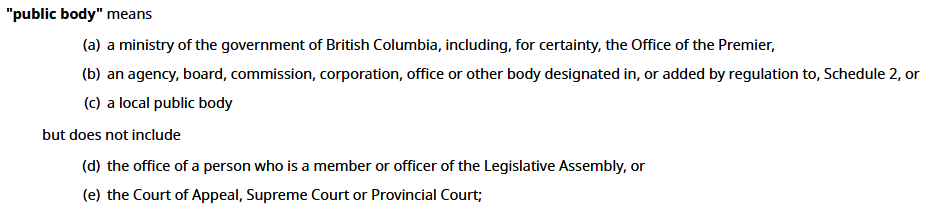
Schedule 1, of the Freedom of Information and Protection of Privacy Act (FOIPPA) under definition of “public body” “does not include (d) the office of a person who is a member or officer of the Legislative Assembly.”
Some content from MLAs and their communications could be FOIable, if their content/communications is held by other ministries etc., but the content held by their offices is not available under FOIPPA.
This glaring transparency gap in regard to non-Ministerial MLAs has important implications in regard to legislative proposals not put forward by a Minister e.g. Bill M 216.
By Sasha Izard
Dec 29, 2025
If you’ve ever made a a Freedom of Information (FOI) request to the Provincial Government of BC recently, you’ve no doubt had to tick off one of the following boxes on the government’s website:
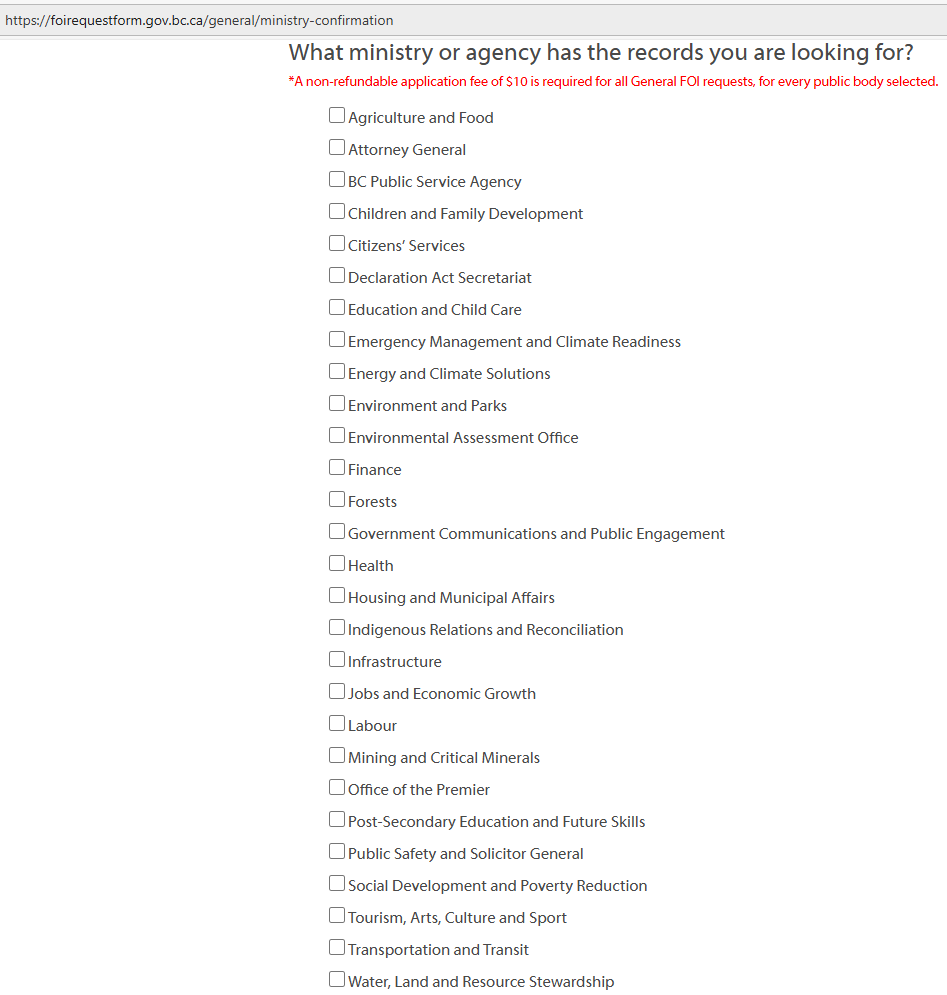
One thing that I noticed, is that there are no boxes for ticking off individual MLAs. Well sure, many of my articles have ‘ticked them off’ no doubt, but there are no Freedom of Information boxes in regards to them that one can tick off on the government form, unless the MLA is a Minister, or the Premier (who I’ve definitely ticked off).
I’m having difficulty finding a box for a member of Cabinet, but either way, members of Cabinet can can apparently avoid Freedom of Information transparency for an eye dropping 15 years.
So what if a backbencher puts forward some dubious legislation like Nanaimo MLA George Anderson did with Bill M216? Legislation that would more appropriately have, been put forward by the Minister of Housing?
See: Index of Articles Related to BC Bill M216 – CRD Watch Homepage
Oops, there’s no way to FOI MLA Anderson. Coincidence? Or is this a convenient way by design to shield non Ministerial MLAs from transparency and public accountability?
If the legislation was put forward by the Ministry of Housing and Municipal Affairs, there would have been an FOI trail. Not so, with a backbencher putting forward potential legislation in this are of concern.
As with many such examples in legislation, I generally hold that this transparency gap, like many others are entirely by design and intentional by the government.
I don’t say “by design” lightly. It is by design. This is not an omission in the legislation, it was something intentionally added to the legislation.
Schedule 1 of the Freedom of Information and Protection of Privacy Act (FOIPPA) defines a public body. It explicitly states that “public body” “does not include (d) the office of a person who is a member or officer of the Legislative Assembly” (an MLA’s office).
“public body” means
(a)a ministry of the government of British Columbia, including, for certainty, the Office of the Premier,
(b)an agency, board, commission, corporation, office or other body designated in, or added by regulation to, Schedule 2, or
(c)a local public body
but does not include
(d)the office of a person who is a member or officer of the Legislative Assembly,
————————————————————————————————–
The result of this intentional elephant in the room transparency gap is profound: The workings of a non-Ministerial MLA’s office, including their communications, and information about those lobbying them e.g. the content of lobbying, cannot be FOI’d from their offices.
Therefore, if a backbencher puts forward legislation, the origin of the legislation, if it is the result of lobbying, can be hidden.
And that perhaps, is entirely the point.
————————————————————————————————–
Appendix: Email exchange with the Ministry of Citizen’s Services.
On Dec 30, 2025 – I sent an email to my MLA Diana Gibson:
Hello Diana Gibson Minister of Citizens Services,
As a Constituent from your riding, I have a question.
Is it possible to make Freedom of Information requests of non-ministerial MLA’s offices?
Thank you,
Sasha Izard
————————————————————————————————–
On Feb 3, 2026 I received a response from her Ministry:
Dear Sasha:
Thank you for writing with the following question: Is it possible to make Freedom of Information (FOI) requests of non-ministerial MLA offices?
The Freedom of Information & Protection of Privacy Act (the Act) applies to records that are in the custody or control of a public body. However, members of the Legislative Assembly are not public bodies under the Act. Therefore, records that relate to MLA functions are not subject to FOI.
For information about requesting records from government, feel free to visit the following website: Request records from government – Province of British Columbia
Sincerely,
Rhianna Begley
Executive Director FOI Operations
Ministry of Citizens’ Services
————————————————————————————————–
On Feb 21, 2026 I wrote back:
Hello,
Thank you for your response.
Is the Legislative Assembly of British Columbia not a public body?
From what I understand, MLAs’ Offices fall under its umbrella.
– Sasha Izard
————————————————————————————————–
The dialogue continued in the following article:
Ministry of Citizens’ Services: “The Legislative Assembly is not a public body under the BC Freedom of Information and Protection of Privacy Act.” – CRD Watch Homepage
————————————————————————————————–
References:
Freedom of Information and Protection of Privacy Act
Index of Articles Related to BC Bill M216 – CRD Watch Homepage
————————————————————————————————–
See also:
Index of articles regarding Law and Bylaw – CRD Watch Homepage
Freedom of Information reveals that the Province of B.C. was working to implement what the registered lobbying organization, the Urban Development Institute, had been pushing for. This culminated in the recent Housing Bills that override local government authority on zoning. – CRD Watch Homepage
————————————————————————————————–
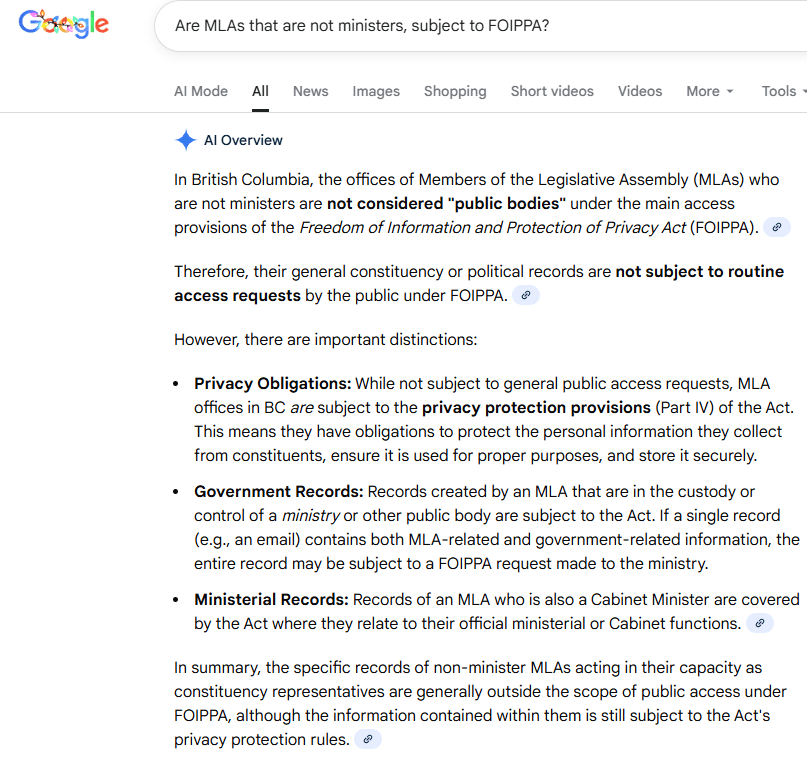
Appendix: Google’s AI response to my inquiry on the issue.
After writing this article, I asked the following question to Google AI, to see what it found on the subject? Not surprisingly, it found the same transparency gap:


 CRD Watch Homepage
Leave a comment