The Housing Crisis Playbook: How BC’s Development Lobby Wrote the Province’s Override Laws
An investigation by Sasha Izard revealed the hidden architecture of British Columbia’s housing reforms: non-disclosure agreements, inside access for lobbyists, delayed FOI releases, and publicly subsidised industry events that gave developers a privileged role in dismantling local democracy.
By Arthur McInnis
Dec 22, 2025
This post is based on the original investigative journalism by Sasha and that has been published on CRD Watch. For the complete exposé, including access to the Freedom of Information documents that underpin this story, see:
Index of articles revealing major lobbying influence on B.C. Provincial Housing Bills and Housing Targets. – CRD Watch Homepage
See also, the article:
The David Eby Confession: Premier Eby talking to the ‘Condo King’ Bob Rennie, finally spilled the beans in front of the camera, on how UDI lobbying played key role in the creation of the Provincial Housing Bills. – CRD Watch Homepage
The FOI materials: emails, slide decks, lobbying letters, and NDA records provide the paper trail that connects industry lobbying to legislative outcomes.
The story that emerges is of a tightly organised alliance between the Urban Development Institute (UDI) and Premier David Eby’s government, in which secrecy tools, public money, and choreographed public events work together to give the development lobby a privileged role in writing British Columbia’s housing laws.
Secrecy infrastructure: NDAs and FOI
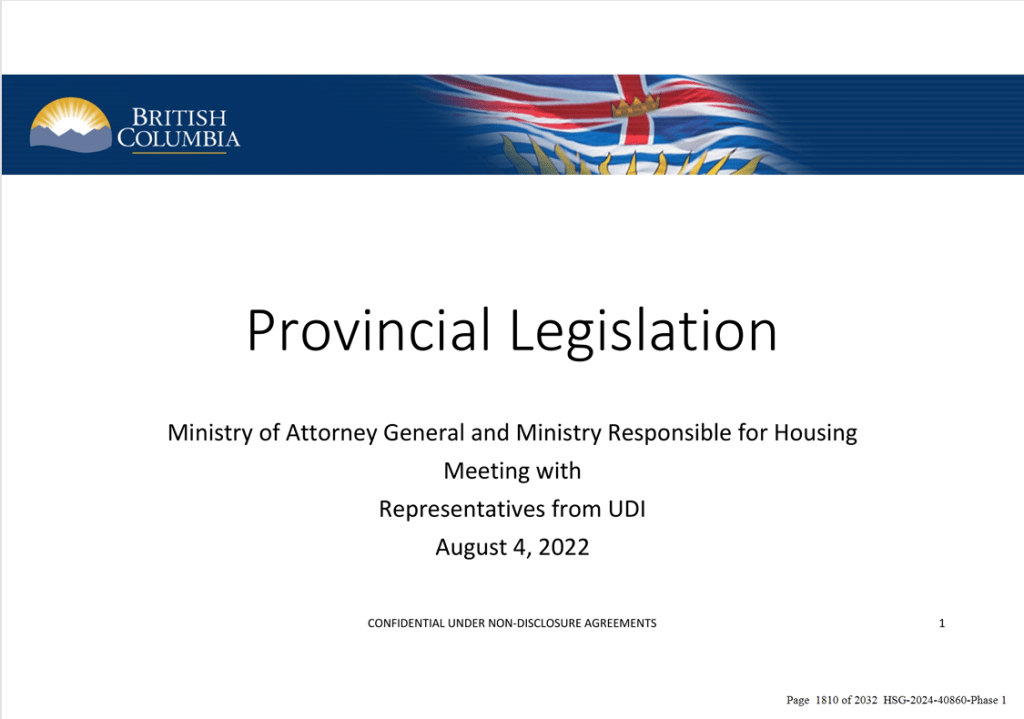
At the core of this alliance are Non‑Disclosure Agreements between senior UDI figures and provincial officials, signed in the context of consultations on housing targets, the Housing Supply Act, and the suite of housing bills that now override municipal planning powers. These NDAs are not incidental; they function as formal secrecy devices, ensuring that lobbyists can help shape binding provincial policy on local zoning and housing supply while their identities, advice, and leverage remain hidden from the public that must live with the consequences.
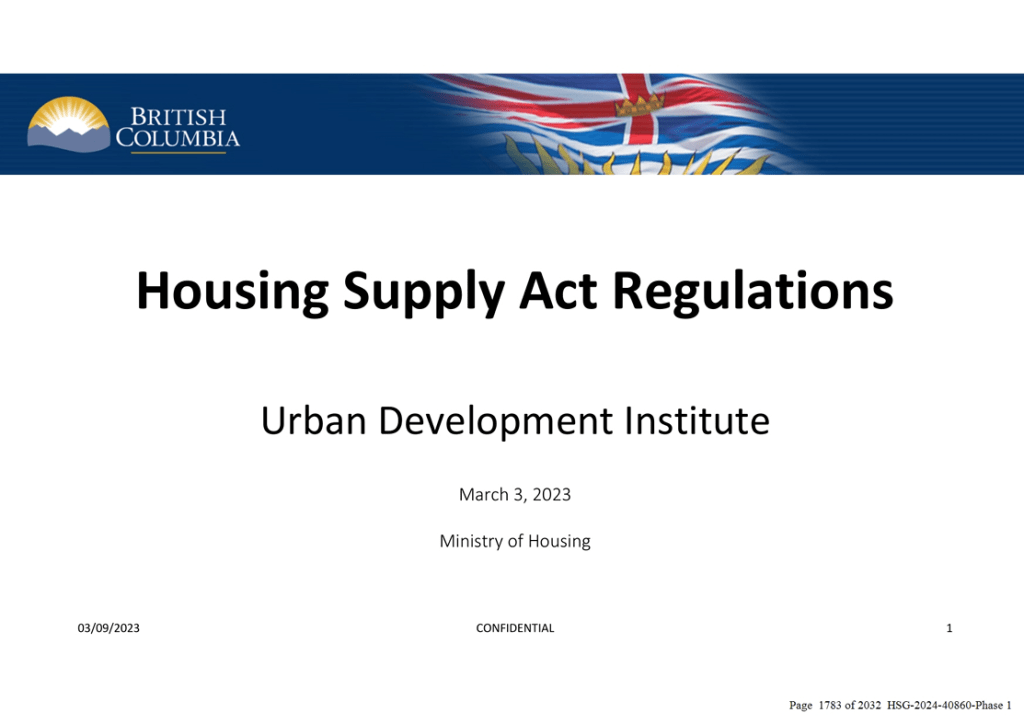
Freedom of Information releases provide the paper trail around these NDAs: bundles of emails, slide decks, agendas, and lobbying letters show UDI executives in repeated contact with then‑Attorney General and Housing Minister David Eby and other senior officials, pitching “Global Housing Targets,” growth projections, and a downgraded definition of “affordability” as the backbone of provincial intervention in local planning. When those FOI responses are released to requesters but kept off the government’s public “open information” portal for over a year, the effect, as Izard highlights, is to lock in the legislative framework while the broader public remains unaware of how closely it tracks UDI’s playbook.
Policy capture in slow motion
Those FOI packages show that, as early as March and April 2022, UDI’s executive committee was placing concrete proposals in front of Eby: enforceable “Global Housing Targets,” provincial growth projections to drive municipal housing needs reports, and a “first step target‑based approach” inspired, remarkably, by the hyper‑speculative Hong Kong housing model. Within a year, the province was rolling out Bills 43–47, including the Housing Supply Act and province‑wide up‑zoning measures that effectively eliminate traditional single‑detached zoning, just as the UDI had urged.
In Izard’s critical frame, there is a straight line from those closed‑door, NDA‑bound presentations and lobbying letters to the text and structure of the enacted legislation. The very concepts UDI pushed, growth targets masquerading as housing needs, “below‑market” as the operative definition of affordability, and provincially enforced targets tied to carrots and sticks, reappear in the statutes and regulatory schemes that now constrain municipal councils. What is usually dismissed as ordinary consultation becomes, on this account, policy capture: the industry’s preferred model is adopted almost wholesale by a government that had campaigned on confronting that same industry.
On‑camera admissions and the crafted relationship
The October 3, 2025 luncheon in Vancouver, branded as a “conversation” between Premier David Eby and marketer‑developer Bob Rennie, is the public face of this relationship. It is not their first such conversation but one in a series, presented to a room full of industry figures and elected officials who paid roughly $300 per ticket, often with public funds. With UDI’s chair and CEO on stage or in the program, and jokes about Helijet flights traded between the UDI leadership and the Premier, the staging underscores familiarity and repeated access, rather than distance.
What makes this event “the confession,” in Izard’s telling, is that Eby’s own remarks acknowledge how UDI’s lobbying and feedback played critical role in the formation of the government’s housing agenda, including the contentious provincial override bills, something already revealed in Freedom of Information, but more telling for the general public, when it comes straight from the premier’s mouth at a lobby event.
When a premier, on camera, casually credits the development lobby for critically influencing the design of the architecture of housing reform, it functions as an admission against the carefully maintained fiction that these laws emerged solely from neutral public policy analysis and are there for the public benefit. The jokes and asides about flights, closeness, and long‑running conversations. become in this critical perspective, revealing slips that confirm how deeply industry has been brought into the inner circle, or rather government into industry’s fold.
Public money and the subsidised lobby
Behind the optics is a more prosaic but potent element: who pays for this access. Expense reports and event materials show that elected officials routinely charge their $300 luncheon tickets and associated travel to municipal or provincial budgets, effectively converting taxpayer funds into access fees for a private lobby forum, and in the process helping keeping its lavishness afloat. The room in which the premier and “Condo King” trade insights is thus not just industry‑funded; it is partially financed by the same public whose ability to influence housing policy has been not only diminished, but practically eliminated through vast removals of public hearings over much of the province.
Sponsorships deepen this concern. Promotional materials identify not only private developers and a major law firm, but also a federal Crown corporation, Canada Lands Company, as a sponsor of these events. In Izard’s reading, a public landowner helping bankroll a lobby platform that presses for province‑led up‑zoning and growth targets is emblematic of a broader blurring of roles: entities that should be stewards of public interest are aligning financially with an agenda that prioritises steady growth and asset values over genuine affordability or democratic control.
Silenced municipalities and asymmetric voice
Most striking against this background of repeated, public conversations between the premier and UDI is the reported use of NDAs on mayors. Statements such as those from View Royal’s mayor, suggest that local officials were required to sign confidentiality agreements as a condition of participating in provincial housing‑target consultations, constraining what they could disclose to their councils and residents. Meanwhile, their counterparts in the lobby, UDI executives, were meeting under their own NDAs with provincial officials to refine the very targets and override mechanisms that would bind municipalities, according to their own mandated growth schemes, regardless of considerations of infrastructure, environmental, monetary, economical, or other concerns.
The asymmetry is stark. Industry leaders enjoy open, recurring, high‑profile access to the premier, use FOI‑shielded channels to press their model, and then sit with him on stage at well‑sponsored luncheons that function as victory laps for the legislative agenda they championed. Local governments, by contrast, are presented with legislation largely aligned with the UDI’s demands and are, in many cases, contractually limited in what they can say about how those laws came to be. In Izard’s framing, the “partners” in the new housing regime are the province and the development lobby, while municipalities are relegated to implementers of a growth‑first, top‑down directive.
Crisis as method and the erosion of democracy
All of this is wrapped in the language of emergency. The housing crisis is invoked to justify rapid, sweeping interventions: province‑wide up‑zoning, mandatory targets, truncated public hearings, and new powers to override local planning instruments like official community plans. Izard labels this “crisis capitalism”; a style of governance in which an acknowledged problem becomes the pretext for bypassing slower, more accountable processes in favour of solutions that align with well‑organised private interests.
From this vantage, the pattern is not incidental but programmatic. NDAs, delayed FOI postings, and constrained municipal consultations keep the formative role of UDI out of public view while the bills move quickly through the legislature. High‑priced, publicly subsidised industry events showcase a premier in close, almost collegial dialogue with the lobby that has just seen its wish list largely enacted, while local citizens and councils are told the measures are necessary, urgent, and non‑negotiable. The housing crisis is real, but in Izard’s critical narrative, the response has been engineered so that the costs, loss of local democratic control, continued high land values and downgraded affordability standards, are borne by the public, while the benefits of “steady growth” accrue to those who were in the room, under NDAs, when the new rules were written.
—————————————————————————————————
See also:
Index of articles revealing major lobbying influence on B.C. Provincial Housing Bills and Housing Targets. – CRD Watch Homepage
Index of articles regarding lobby events and other meetings between government and lobbyists. – CRD Watch Homepage
The Government of British Columbia had top figures in the most powerful lobbying organization for development and real estate interests in the province, sign Non-Disclosure Agreements (NDAs) as they advised the Province on adopting mandatory/enforceable targets for municipalities and for other upcoming housing legislation to be able to override local government autonomy. – CRD Watch Homepage
The David Eby Confession: Premier Eby talking to the ‘Condo King’ Bob Rennie, finally spilled the beans in front of the camera, on how UDI lobbying played key role in the creation of the Provincial Housing Bills. – CRD Watch Homepage
David Eby Before and After: How David Eby’s former criticisms of the political influence of the so-called ‘Condo King’ of Vancouver Bob Rennie, when Eby was a member of the opposition; turned once in power, to Eby becoming Rennie’s political follower. – CRD Watch Homepage
Freedom of Information reveals that the Province of B.C. was working to implement what the registered lobbying organization, the Urban Development Institute, had been pushing for. This culminated in the recent Housing Bills that override local government authority on zoning. – CRD Watch Homepage
How the Development and Real Estate Lobby Pressed Mandatory Housing Targets, Mass Upzoning, Captured Official Community Plans, and Made the Shutting Down of Public Hearings the Norm in British Columbia Under the NDP Government – CRD Watch Homepage
Freedom of Information reveals that the Province of B.C. was working to implement what the registered lobbying organization, the Urban Development Institute, had been pushing for. This culminated in the recent Housing Bills that override local government authority on zoning. – CRD Watch Homepage
The Urban Development Institute lobbied the Province of BC to implement what they called “Global Housing Targets”. The Province would deliver new Housing Bills in response. – CRD Watch Homepage
In March 2023, prior to the release of the BC Provincial Housing Targets for select municipalities, the Urban Development Institute (UDI), not only lobbied the Province on Enforceable Housing Targets, but also on an Advisor for municipalities “should they be appointed”. – CRD Watch Homepage
The “Hong Kong Model, transit density – Setting expectations and having clear guidance. MDE [Minister David Eby] First step target approach”. UDI Executive Committee Meeting in April 13, 2022 with David Eby when he was the Attorney General and Minister Responsible for Housing. – CRD Watch Homepage
Public release of UDI March 10, 2022 presentation slides, agenda, and lobbying letters to David Eby. – CRD Watch Homepage
Too much heat: The UDI pulls down its list of backroom committees that meet with the Government of British Columbia and Local Governments – CRD Watch Homepage
Public Release of the Urban Development Institute (UDI)’s hidden members directory dated to the beginning of 2024. The directory contains dozens of government branches that are hiding their memberships in the registered lobbying organization for development and real estate interests from the public. – CRD Watch Homepage
“Statement from View Royal Mayor Sid Tobias on Bill 15 and Bill 7” “Secrecy, NDAs, and the Collapse of Trust” – CRD Watch Homepage
Director Hurley (Burnaby Mayor) lambasted the UDI’s stranglehold over Provincial housing policy at the Oct 17, 2025 Metro Vancouver Mayors Committee Special Meeting: “You got everything you wanted”. – CRD Watch Homepage
Presentation by Sasha Izard to the Special Committee to Review the Lobbyists Transparency Act – CRD Watch Homepage

 CRD Watch Homepage
Leave a comment