Presentation to the Special Committee to Review the Lobbyists Transparency Act
Sasha Izard
Dec 11, 2025
Yesterday, on Dec 10, 2025 – I presented to the Special Committee to Review the Lobbyists Transparency Act, in the Parliament Building in Victoria BC. I consider that the Act is in critical need for major overhaul, as it has failed to provide the sort of transparency around lobbying that the name of the Act implies, and which is necessary for true democracy.
We have seen the failure to provide transparency in a major way, with the Provincial Housing Legislation over the last several years that overrode municipal decision-making regarding zoning and has denied vast amounts of public hearings.
The legislation was advanced, in the style of pseudo-crisis corporatism, very quickly and almost without any opportunities for debate or reflection. The consultation for the legislation involved top lobbyists and public officials signing non-disclosure agreements with the Province – something that defies any sense of transparency and democracy, that might be left with the Act.
The result has left much of the public disoriented dazed and confused, and their communities and environment are being transformed likely irrevocably, according to industry’s profit-based agenda, and which has as source (often hidden or disguised), lobbying from the development industry, real estate and peripheral sectors that profit from them, most notably the financial sector.
—————————————————————————————————
The following are links to the material.
https://www.leg.bc.ca/hansard-content/Committees/43rd1st/lta/20251210am-LTAReview-Victoria-Blues.htm (My presentation and dialogue with the MLAs started at the 2:30PM mark in the transcript.)
My submission to The Special Committee to Review the Lobbyists Transparency Act: Committee Content | Legislative Assembly of BC
My submission letter, is better formatted here: Submission to the Province of British Columbia’s “Lobbyists Transparency Act Consultation” (Sept 14, 2025) – CRD Watch Homepage
The article that I wrote that I referenced in the presentation:
Does the Provincial Government of British Columbia Legally Recognize the Existence of Any Lobby? – Creatively United Community
—————————————————————————————————
My presentation can be read here below. I have included it here, because while Hansard did an excellent job of transcribing my presentation, there were some errors in the text, and the formatting did not always make sense.
—————————————————————————————————
My Presentation to the Special Committee to Review the Lobbyists Transparency Act:
Thank you for your invitation to participate in this committee process, in regards to the Lobbyists Transparency Act. It is an honour.
It is critical to note, that the name of the Lobbyists Transparency Act,is not accurate. It is misleading and it should be changed.
Lobbying in British Columbia is simply not transparent.
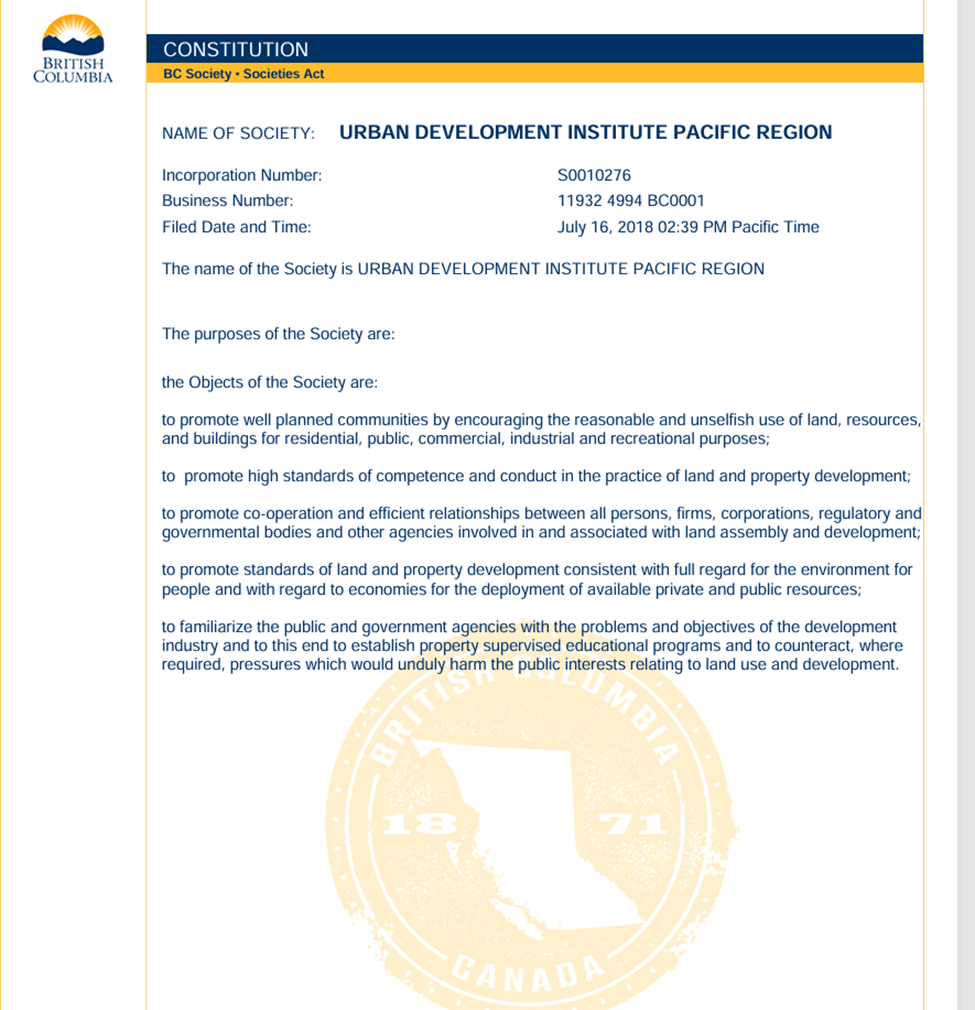
Nothing better illustrates that, than that the Government of British Columbia had top lobbyists of a major lobbying organization for corporate development and real estate interests, the Urban Development Institute, sign Non-Disclosure Agreements, as they advised the Province on provincial housing targets for municipalities, a program of targets to municipalities that they had been lobbying the Province for years to implement, and the Province responded, by implementing housing targets as requested.
The practice of having lobbyists sign Non-Disclosure Agreements, while advising the Province on the subjects of their lobbying, completely violates the spirit of the Act, which is to make lobbying transparent, and this practice should be forbidden under the Act.
Also, from what I understand, there is an exemption whereby, the Province, if the Province invites lobbyists e.g. the UDI, for consultation, then when they attempt to convince the Province of items that they are being consulted on, this is not considered lobbying, and they and others in such a situation do not have to register such activity, as lobbying. This double standard should be ended. It allows lobbying to go under the radar, and thus there is a lack of requirements for lobbying registration in the LTA, in regard to this form of what I call reverse lobbying, which should be ended.
Having topics of discussion, often vague, and registered only after meeting certain criteria, cannot be said to make lobbying transparent. Rather, this fulfills some bare bones requirements of the most basic levels of transparency.
To be transparent, all lobbying would have to be recorded and instantly be made publicly available without censorship (i.e. without redaction), which would make lobbying democratic, in that the demos, or the public, could see what is transpiring between their elected officials and bureaucrats as actually takes place, and thus understand how that leads to policy decision-making.
Right now, much of this takes place behind closed doors, with many secretive lobby committees advising branches of government behind the scenes, as revealed by Freedom of Information.
Freedom of Information, is also a misnomer, as sections of the Freedom of Information and Protection of Privacy Act, most notably Section 13, which is discretionary, allows the Provincial Government to censor (redact), most lobbying derived content that is circulated internally, as these can be considered advice or recommendations developed for a public body, and the government can pick and choose including in a heavy-handed way, what content the public can see or not see in this regard. Heavy-handed delays and costs can also be barriers to the public being able to see and in a timely manner, lobbying’s affects on policy-making before the public has time to react to them, as legislation can and has quickly been advanced that has been heavily based on lobbying. This undermines democracy.
Therefore, as lobbying in the Province cannot in any true sense of the word, be called transparent, I suggest renaming the Act, to the accurately named: Lobbying Registry Act (or Lobbying Registration Act). Alternatively, lobbying could be made fully transparent, which would include having all lobbying activity fully recorded and made immediately without censorship/redaction, available to the public. If that were achieved, and I suggest it be, but I doubt it will be; then yes, the name Lobbyists Transparency Act could live up to its name, and warrant being kept.
As this is not the case, at present, once again I suggest that the Act be renamed the Lobbying Registry Act to accurately reflect what it is, for the most part. I say for the most part, because from what I understand, and from my communications with the BC Office of the Registrar of Lobbyists, unpaid lobbyists are not required to register their activity on the BC Lobbyists Registry.
This creates major opportunities for what I refer to as proxy lobbying, or astroturf lobbying, whereby volunteer organizations e.g. societies, or other groups including student groups lobbying in the same interests of industry that is helping to organize and finance them (e.g. the UVic Real Estate Club), can advance lobbying of other interests without having to register lobbying activity, and that activity can thus, pass under the radar; something that can undermine democracy, while advancing private and/or outside interests – even co-opting the use of the name of a public body, in this example, the University of Victoria, which as it receives significant government funding is classified as a public body under FOIPPA.
—————————————————————————————————–
I direct you to my article, which can be read at the Creatively United website, titled
“Does the Provincial Government of British Columbia Legally Recognize the Existence of Any Lobby?”
It is a critical question to ask.
Lobby is not defined as a noun in the so-called Lobbyists Transparency Act, nor is “lobbying organization”, as a compound noun, recognized under the Act, as I was informed by the B.C. office of the registrar of lobbyists. There are many problems with this, as lobby and lobbying is treated as a verb under the Act, but the Act does not recognize a lobby as being a distinct entity, a critical omission.
By using the word lobbyist, and in other instances, the Act often focuses on individuals, while often overlooking organizational accountability i.e. in examples of conflict of interest.
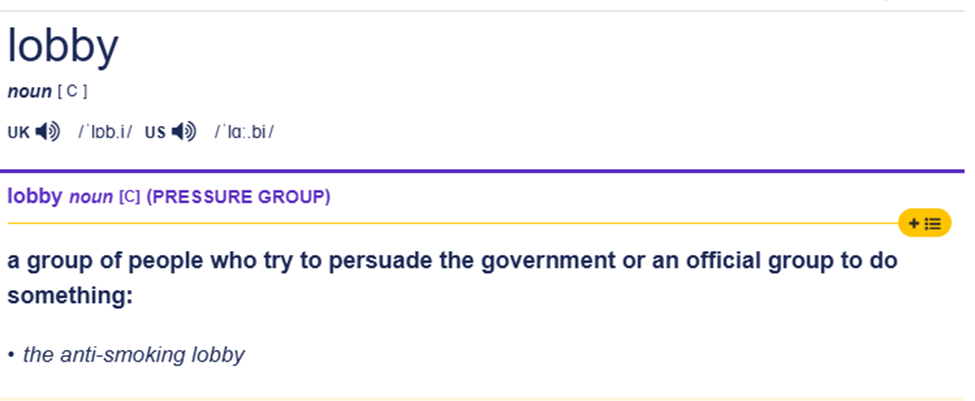
The following is the defintion from the Cambridge Engish Dictionary, of “lobby” as a noun:
lobby noun [C] (PRESSURE GROUP)
a group of people who try to persuade the government or an official group to do something:
That is a very good starting point. We can see how “lobby” is defined in the English language as a noun. Does the Lobbyists Transparency Act capture even a fraction of that activity in its registration requirements? I think not, and therefore these omissions must be found and fixed, in order to live up to the Act’s name.
————————————————————————————————
I offer the following examples of what could be added to the Act to identify what is a lobby:
a. A lobby (noun) is a non-public organization that offers influencing public officials, elected, or otherwise, e.g. bureaucrats, as a service to others.
b. A non-public organization that is not a registered charity, which offers, or provides political influence to its paying members, should for the purposes of the Act be considered a lobby (noun).
c. A non-public organization will also be considered a lobby (noun), if among the purposes of such an organization, is to influence elected officials.
d. If the Constitution of a society or business operating in British Columbia, whether profit, or non-profit – indicates that among the purposes of the organization, are to convince or influence elected officials, then that organization provided that it is not a public body, is considered a lobby (noun.) for the purposes of this Act, and must register its status as a lobby (noun), as per the Act.
————————————————————————————————
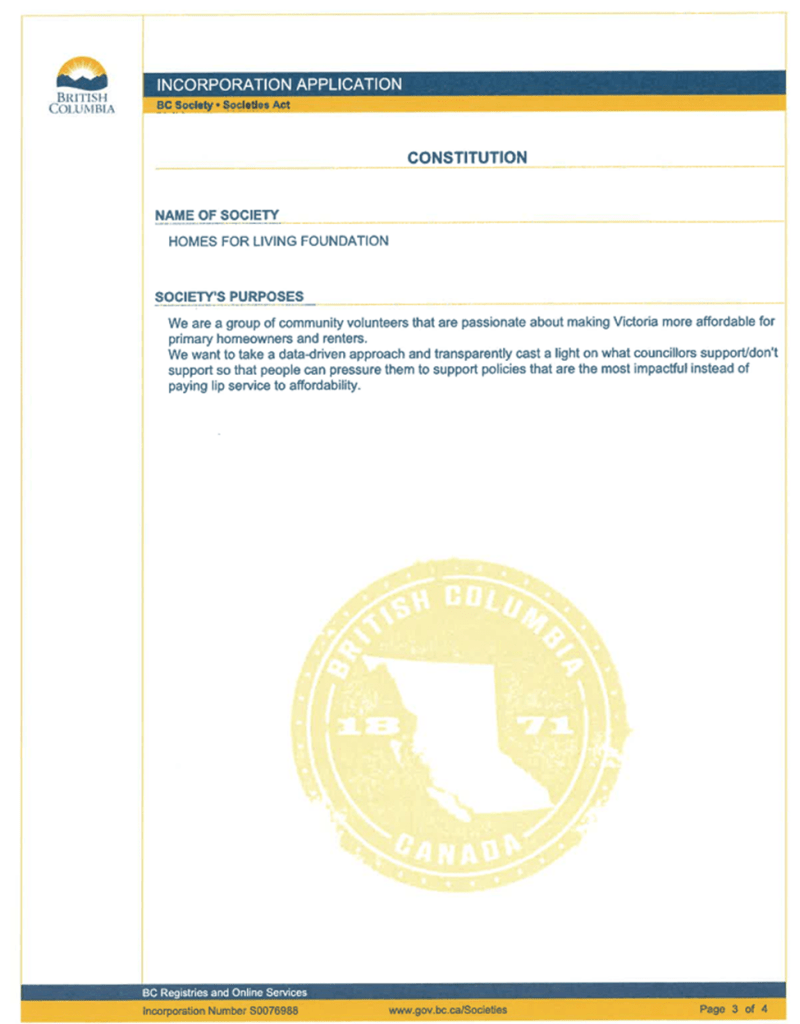
In regard to this latter example that I have provided as a recommendation to be included in the Act, I will quote an excerpt from the stated purposes of a society, from the very brief Constitution of the Homes For Living Foundation, which is registered under the Societies Act, as a non-profit entity, and which has also functioned as a 3rd party advertising sponsor during the General Local Government Election of 2022:
“We want to take a data-driven approach and transparently cast a light on what councillors support/dont support so that people can pressure them to support policies that are the most impactful”
The organization is clear in its stated purposes in its constitution, that it wants to pressure elected officials to support certain policies. Yet, Homes For Living, which has sent lobbying letters to MLAs, and its members have met with MLAs, advancing a development agenda very similar to registered lobbying organizations, does not register lobbying activity. The Act ignores organizations like them, which lobby without those involved in the organization being paid for it, yet which are clearly acting as a lobby, by the Cambridge English Dictionary definition of lobby as a noun, which categeorizes the word lobby (noun) as quote “Pressure Group”. Pressuring politicians as a want of the organization is clearly stated in the purposes of the organization in its registered Constitution.
Why is this not covered by the Act? This is clearly an omission, as such lobbying by the use of the word in English is not transparent in the Province, as it does not have to be registered under the LTA.
As I stated in my submission, there should be two types of lobbying that require registration, the category unpaid lobbying/unpaid lobbyists, and the category paid lobbying/paid lobbyists. This could be indicated by boxes represnting the categories, which can be ticked off accordingly, while registering lobbying activity.
Another critical elephant in the room omission in the Act, is the major double standard, whereby municipalities are not provided for in Provincial Legislation to have and enforce mandatory lobbyist registries, unlike the Province itself, which requires such activity aimed at the province to be registered under the LTA. Yet, local governments are under Provincial Legislation.
This can be solved simply, as has been proposed through UBCM, that the Province include in the LTA that the activity of lobbying of municipalities be required to be registered, just as it is currently required for lobbying of the Province.
—————————————————————————————————
I suggest the following to be included under definitions of lobby as a noun, in addition to the examples that I have already provided:
Organizations that are not public bodies, and are not registered charities, that hold events for elected officials, where the elected officials can be influenced, such as events that involve advocacy, lobbying, education, dining, and/or networking; such organizations should be defined as lobbies, and such events should be defined as “lobby events”, in the LTA.
Some reasonable exemptions could apply to this in the Act, but they should be specific, rational, and not used as loopholes to be exploited for the purposes of crypto-lobbying, which is something that unfortunately flourishes in the Province of British Columbia, oweing much to a lack of appropriate provisions in the Act, as it currently stands. I hope these are fixed.
Thank you.
—————————————————————————————————
The following from Hansard, are the questions asked to me after my presentation by various MLAs, and my answers to them:
Steve Morissette (Chair): Thank very much for your presentation, Sasha. We’ll open the floor to questions from members.
Susie Chant: Thank you for your presentation, Sasha.
Can you tell me what crypto lobbying means when you say it like that? I don’t understand.
Sasha Izard: Well, crypto is secret. It’s secret because the lobbying is not registered. It may not be viewable to the public at all, or it may not be recognized as lobbying, but it fits the Cambridge English definition of lobbying and lobby as a noun.
Steve Morissette (Chair): Any other questions?
Kiel Giddens: Thank you, Sasha, for taking the time to present and provide a submission.
You’ve referenced the use of NDAs in that process. I’m wondering if you could elaborate a little bit more on what brought you to just become interested in that particular situation and what you see is happening, I guess, in that regard with NDAs in particular.
Sasha Izard: Sure. Is anybody familiar with the Urban Development Institute? [Several MLAs answered yes.]
It’s a registered organization, actively registered on the B.C. lobbyists registry. It’s regarded by many as the most powerful and influential lobbying organization for development in real estate in the province.
The province consults with them on a regular basis. The UDI has many committees that meet with the province, that was on its website, udi.org, and it has taken down those committees. I have an article that documents those committees, and who are on those committees, which include not only industry representatives but even public officials and public organizations — for example, QuadReal, which is a branch of the B.C. Investment Corporation.
The government and lobbies have overlapped significantly, to the point where I think we need a separation of lobby and state.
I contacted the Ministry of Housing, through the FOI process, and asked them about the committees, and they didn’t want to answer many questions about the committees. I would describe their response as evasive.
I made a major freedom of information request, which you can access through the B.C. government’s online portal, for all the communications with the ministry, with the UDI, and also the Ministry of Municipal Affairs and some other ministries as well.
The result of that is, that I have in my possession, and I have published articles on this, the actual signed NDAs of top lobbyists in the Urban Development Institute, that signed non-disclosure agreements with the province so that when the province consulted them on the upcoming housing legislation, which they themselves had lobbied for, the UDI lobbyists would not have to divulge that information.
Rosalyn Bird (Deputy Chair): I wanted to thank you for coming today, not only your written submission but in person. I sit on a couple of committees, and we don’t often get individuals doing that type of thing. They usually always represent a fairly significant entity of one type or another.
I wanted to thank you for your passion and being participatory as a citizen, actually, in this process. I wish we saw it more, to be quite honest. I just wanted to applaud you for that.
Sasha Izard: Thank you. I wish we saw that more as well. I wish we saw it from our wonderful media in the province, which does not do appropriate investigatory journalism. [I say that], because they do not talk about these issues.
Rosalyn Bird (Deputy Chair): I just wanted to, especially this time of year…. I very much appreciate you taking the time.
Sasha Izard: I very much appreciate your comments. Thank you.
Steve Morissette (Chair): Seeing no more questions, thank you very much for your presentation. We appreciate you taking the time to come and present to us as our first review of this act, so appreciate your comments and your perspective.
Sasha Izard: Any time. If you wish to contact me, I can provide you any articles or references, including freedom-of-information content, of which I have much.
Steve Morissette (Chair): Thank you, Sasha. Appreciate it.
Okay, we’ll take a 15-minute recess.
The committee recessed at 2:44 p.m.
—————————————————————————————————
Resources:
LOBBY | English meaning – Cambridge Dictionary
—————————————————————————————————
Transparency International Knowledge Hub | Knowledge Hub
“Introduction to undue influence on decision-making
There are several ways through which interest groups, such as companies, professional groups or public interests groups, try to influence the decision-making process. Interest group influence, commonly known as lobbying, encompasses “any direct or indirect communication with public officials, political decision-makers or representatives for the purposes of influencing public decision-making carried out by or on behalf of any organised group[1]”..
Interest group influence is not a corrupt or illegitimate activity per se, but when opaque and disproportionate it may lead to undue influence, corruption and even state capture. Undue influence is a more subtle form of corruption as interest groups often make use of legal mechanisms to influence the decision-making process[2]. For instance, they may legally contribute to electoral campaigns; provide research and host receptions but expecting favourable decisions in exchange. Undue influence may also be achieved by promising decision-makers well-paid future jobs in exchange for support[3].
In certain contexts, disproportionate and unregulated influence by interest groups may also lead to state capture, which occurs when corruption is so systemic and infiltrated within the institutions of the state that private interests substitute themselves to the common good as main drivers of policy and regulation. When the state is captured, companies and individuals shape and affect the formulation of laws and regulations through illicit payments (for example, bribes to parliamentarians and illicit contributions during electoral campaigns, among others).”
———————————————————————————————–
Index of articles regarding lobby events and other meetings between government and lobbyists. – CRD Watch Homepage
https://creativelyunited.org/does-the-provincial-government-of-british-columbia-legally-recognize-the-existence-of-any-lobby/
https://creativelyunited.org/petition-that-the-province-of-british-columbia-define-the-word-lobby-as-a-noun-in-the-lobbyists-transparency-act-lta/
Index of articles regarding Law and Bylaw – CRD Watch Homepage
The Government of British Columbia had top figures in the most powerful lobbying organization for development and real estate interests in the province, sign Non-Disclosure Agreements (NDAs) as they advised the Province on adopting mandatory/enforceable targets for municipalities and for other upcoming housing legislation to be able to override local government autonomy. – CRD Watch Homepage
“Statement from View Royal Mayor Sid Tobias on Bill 15 and Bill 7” “Secrecy, NDAs, and the Collapse of Trust” – CRD Watch Homepage
Petition · That Section 13 of British Columbia’s Freedom of Information Legislation FOIPPA be removed – Canada · Change.org
How the Development and Real Estate Lobby Pressed Mandatory Housing Targets, Mass Upzoning, Captured Official Community Plans, and Made the Shutting Down of Public Hearings the Norm in British Columbia Under the NDP Government – CRD Watch Homepage
Freedom of Information reveals that the Province of B.C. was working to implement what the registered lobbying organization, the Urban Development Institute, had been pushing for. This culminated in the recent Housing Bills that override local government authority on zoning. – CRD Watch Homepage
A brief look at UDI member TransLink and BC Bill 47 (2023) – Sasha Izard
The proposed “Permanent Provincial Housing Policy Roundtable” is an astroturfing effort by the Real Estate Lobby in BC, with the help of a complicit media in the province. Questions must be asked about close to $100 in value gifts to numerous MLAs. – CRD Watch Homepage
“No, we do not have minutes.” – The Union of BC Municipalities (UBCM) fails to document meetings that lead to resolutions. – CRD Watch Homepage
What is the Greater Victoria Housing Society (GVHS) and what is their relationship to the UDI development/real estate lobby and the Provincial Government of British Columbia? – Sasha Izard
Index of articles and other documentation of lobbying of the Federal Government. – CRD Watch Homepage
Index of articles about David Eby meeting with Bob Rennie. – CRD Watch Homepage
Index of articles about lobbying influence on the City of Victoria and deliberations regarding it. – CRD Watch Homepage
Index of Articles regarding Jet Flights for City of Victoria Staff to development lobby events, that were charged to the City. – CRD Watch Homepage
Index of articles, letters, and other material in regards to the Bayview/Roundhouse Property in Vic West. – CRD Watch Homepage
Index of articles regarding the Saanich Official Community Plan (OCP) and the “decoupled” Local Area Plans (LAPs) – CRD Watch Homepage
Index of documentation covering the UVic Real Estate Club and development industry influence over it. – CRD Watch Homepage
Index of material hidden from the public by the development lobby. – CRD Watch Homepage
Index of articles regarding proposed plans for Quadra/McKenzie and transit-enabled development upzoning. – CRD Watch Homepage
Index of Crown Corporations and Statutory Entities that have acted evasively about their development lobby memberships. – CRD Watch Homepage
Too much heat: The UDI pulls down its list of backroom committees that meet with the Government of British Columbia and Local Governments – CRD Watch Homepage
Public release of UDI March 10, 2022 presentation slides, agenda, and lobbying letters to David Eby. – CRD Watch Homepage
Public Release of the Urban Development Institute (UDI)’s hidden members directory dated to the beginning of 2024. The directory contains dozens of government branches that are hiding their memberships in the registered lobbying organization for development and real estate interests from the public. – CRD Watch Homepage
Director Hurley (Burnaby Mayor) lambasted the UDI’s stranglehold over Provincial housing policy at the Oct 17, 2025 Metro Vancouver Mayors Committee Special Meeting: “You got everything you wanted”. – CRD Watch Homepage
R1 zoning, public hearings and 16 Metro Mayors calling on the Province to pause and reconsider | City of Burnaby “Last week, a meeting with the mayors of Metro Vancouver led to me sending a letter to Premier Eby on behalf of 16 mayors. We are calling on the Province to pause and reconsider its recent housing legislation.”
2 Sentence Constitution of the Homes For Living Foundation removes any doubt that Homes For Living (HFL) is a purpose-built pressure group designed to influence municipal politicians. – CRD Watch Homepage

 CRD Watch Homepage
Leave a comment