The Case for Honest Transit Planning: Why Words Matter When Building Cities
By Arthur McInnis
Nov 14, 2025
Let’s talk about a word that’s being stretched so thin it’s practically transparent: “rapid transit.” In British Columbia’s current planning regime, this term has become so elastic that it now applies to pretty much any bus route, regardless of whether that bus is stuck in traffic behind someone’s minivan or gliding along dedicated tracks at 80 kilometres per hour. This is not just sloppy terminology; it is a fundamental dishonesty that undermines both housing policy and transportation planning.
What “Rapid Transit” Actually Means
Real rapid transit is not hard to define. It has dedicated right-of-way that keeps it separate from regular traffic. It runs frequently throughout the day, not just during rush hour. It is fast enough to compete with driving. It has the capacity to move large numbers of people. And crucially, it involves permanent infrastructure investment, the kind that signals “we’re committed to this for the long haul, not just until the next budget cycle.”
Think SkyTrain. Think Canada Line. Think West Coast Express. These are systems where you can actually leave your car at home and not regret it. They justify building apartment towers nearby because residents can genuinely rely on them for transportation.
The Fiction We’re Being Sold
Now contrast that with what’s happening under current provincial policy. A conventional bus route, stopping at red lights, getting stuck behind delivery trucks, subject to service cuts when budgets tighten, gets labelled “rapid transit” for planning purposes. Suddenly, that designation triggers mandates for high-density development along the corridor. In fact, in Victoria it can trigger high density development on the streets on either side of the corridor as well. Apartment buildings must be approved. Local concerns about infrastructure capacity must be overridden. All in the name of “transit-oriented development.”
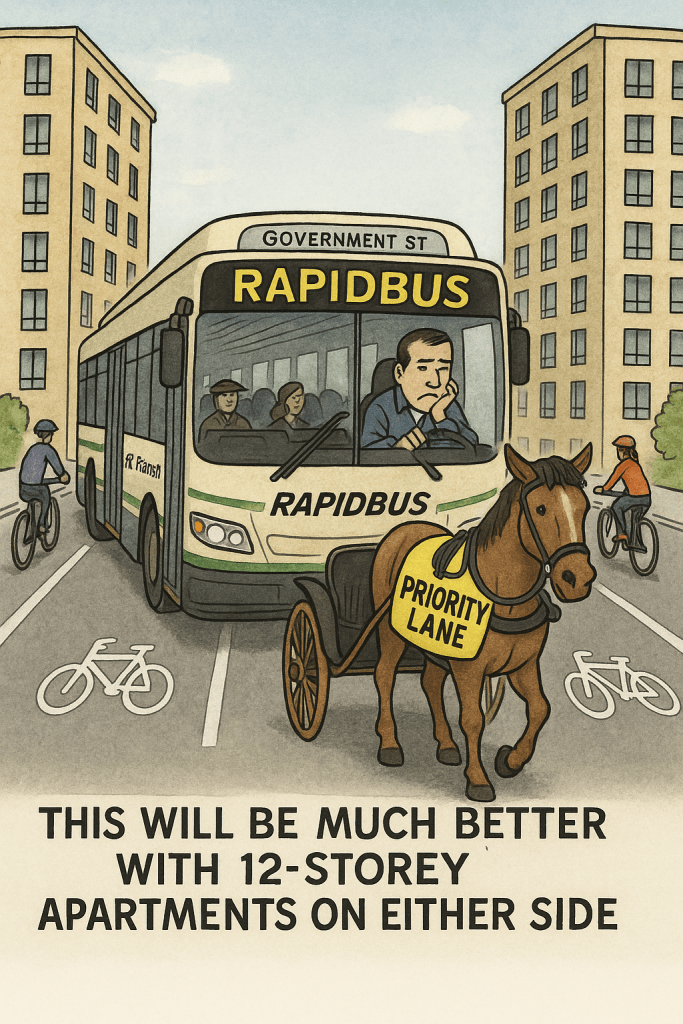
But here’s the thing: it’s not transit-oriented development if the transit is not actually rapid, at least in my view. It is just development. Development that will generate more car trips because the bus service is too infrequent. Development that will create more traffic congestion, not less. Development that proves to residents that the entire planning rationale is, to put it bluntly, what you find behind the horse-drawn carriages in James Bay.
Why This Dishonesty Matters
This terminological sleight-of-hand creates three serious problems that compound over time.
First, it generates justified community opposition to housing growth. When residents see apartment buildings rising along bus routes that remain hopelessly stuck in traffic, they are not being NIMBYs, they are being rational. They recognize that calling this “transit-oriented” is fraudulent, and they correctly conclude that their concerns about parking, traffic, and infrastructure are being dismissed with planning buzzwords rather than addressed with actual solutions.
Second, it undermines the case for real rapid transit investment. Why should the provincial government spend billions on SkyTrain extensions or light rail when they can simply declare existing bus routes “rapid transit” and achieve the same planning designation? This creates a perverse incentive where politicians avoid expensive infrastructure commitments by manipulating definitions instead. It is cheaper to redefine words than to build train lines.
Third, it creates development patterns that fail their core objective. Transit-oriented development is supposed to reduce car dependence. But when you build density along corridors with inadequate transit, new residents still drive everywhere because they must. The result is more density and more traffic, the worst of both worlds. You have increased strain on infrastructure without achieving the transportation benefits that were supposed to justify the whole approach.
What Honest Transit Planning Would Look Like
The solution is not complicated, though it does require courage and honesty from politicians.
Establish objective criteria for rapid transit designation. Require dedicated or substantially separated right-of-way. Demand high frequency throughout the day. Insist on competitive travel speeds. Look for permanent infrastructure commitment. These are not arbitrary standards; they are the characteristics that distinguish transit you can rely on from transit you tolerate.
Limit transit-oriented development mandates to corridors with genuine rapid transit. If a corridor meets the criteria, then yes, mandate higher density. The transport infrastructure justifies it. But if it is just a regular bus route, leave density decisions to the communities impacted where they can consider the actual transportation context alongside other community factors.
Tie provincial density mandates to provincial infrastructure commitments. Here is a radical idea: if the province wants to require transit-oriented development somewhere, it should commit to providing the transit infrastructure that makes that designation honest. Want Victoria to accept high-density development along a corridor? Build Light Rail to Langford. Put your money where your mandates are.
The Victoria Example
Victoria’s 2050 Official Community Plan shows the problem. The city has adopted ambitious targets: 80% of trips by active transportation (walking, cycling, non-single car) for transit by 2050. Priority growth areas along transit corridors. Compact, mixed-use nodes around low-carbon mobility. This can make sense but 12 storey heights everywhere that is not already 4, 6 or 18 storeys! That is right. In case you missed it, Victoria is now up-zoned (a little Urban Development Institute initiative) across the board at 4 to 6 storeys, 12 on these transit corridors and 18 storeys in Town Centres and Urban Villages. By the way, if you are unhappy about what is coming forget about raising your objections in a Public Hearing. They are now gone. So, the only recourse you will have in future to demonstrate your opposition is through the ballot box.
The dishonesty is that these goals and the assumption for these heights is that they are predicated on transportation infrastructure that does not exist. Victoria has been asked to accept density on the promise of future rapid transit. Residents are told to trust that the infrastructure will follow the development.
Forgive me for being sceptical. We have heard these promises before. We have seen density arrive while rapid transit remains perpetually “under study” or “in future planning phases.” The honest approach would reverse the sequence: demonstrate commitment to real rapid transit infrastructure first, then mandate the density that such infrastructure can support.
Local Decision-Making for Everything Else
This does not mean banning apartments along conventional bus routes. Communities may well decide that increased density makes sense along major corridors, even without rapid transit. Perhaps the corridor is slated for future upgrade? Perhaps other factors: walkability, proximity to employment, local amenities, support higher density regardless of transit quality. The converse must also be considered though and thus current density, heritage, services for example may not. A balance must be struck. All the city has struck, is out.
The point is that such decisions should reflect local assessment of actual conditions, not provincial mandates based on fictional transit designations. Trust communities to make informed decisions about their own development patterns when they are not being forced into a one-size-fits-all (remember “One City One Plan”) framework based on terminological manipulation.
The Stakes
Victoria, and yes British Columbia itself, faces genuine challenges around housing affordability and climate action. Transit-oriented development, done honestly, can address both. Higher density near genuine rapid transit increases housing supply while reducing transportation emissions. It is smart policy.
But smart policy requires honest implementation. The current approach, declaring every bus route “rapid transit” and mandating density accordingly, serves neither housing nor climate goals. It generates opposition that could otherwise be avoided. It creates development patterns that increase rather than decrease car dependence. It allows government to avoid infrastructure investment by substituting word games for real service.
Most importantly, it erodes public trust in planning processes. When residents see the gap between planning rhetoric and transportation reality, they conclude that planners are either incompetent or dishonest. Neither conclusion encourages cooperation with future policy initiatives.
A Path Forward
It’s time to stop pretending that every bus route is rapid transit. The alternative is straightforward: insist on honesty in transit planning. Use clear, objective criteria to distinguish genuine rapid transit from conventional bus service. Mandate higher density around real rapid transit where it exists or infrastructure capacity already justifies it. Commit provincial resources to building the transit infrastructure that development mandates assume and trust local decision-making on it for areas without genuine rapid transit. Recognize that sustainable development requires real infrastructure, not planning fiction. The choice is simple: build the infrastructure we claim to have or stop demanding the density it cannot support.
—————————————————————————————————
See also:
Thrown under the Bus: how so-called rapid transit is being used to force high density on communities, while greenwashing the developers’ for-profit agenda. – CRD Watch Homepage
How the proposed “RapidBus” lanes in the Capital Region, including on McKenzie, were used as part of the UDI development lobby’s push for enforced densification/upzoning along rapid transit corridors, during their lobbying to David Eby in 2022 – CRD Watch Homepage
More Freedom of Information data surfaces, this time from Saanich, regarding the May 7, 2024 UDI event at the Union Club: “Pathways to Progress: Uniting Land Use and Transit Strategies for Sustainable Growth” – CRD Watch Homepage
A brief look at UDI member TransLink and BC Bill 47 (2023)
A 2017 letter from the UDI to the Federal government offered a series of recommendations, including density targets around transit stations/corridors and for the adoption of TODs (Transit Oriented Developments). – CRD Watch Homepage
After a Comedic Exchange of Emails, BC Transit Admits that it has a Membership with the Urban Development Institute. The Implications of that for BC, may be more Tragic than Comic. – CRD Watch Homepage
Index of articles regarding proposed plans for Quadra/McKenzie and transit-enabled development upzoning. – CRD Watch Homepage

 CRD Watch Homepage
Leave a comment