
Who is Tavish? Victoria City Councillor Matt Dell reported to Elections BC, a Tavish as having provided $500 for his 2022 election campaign, yet Dell did not provide a last name for him to Elections BC.
By Sasha Izard
Sept 25, 2025
For the General Local Election in British Columbia in 2022, Matt Dell, who would be elected councillor for the City of Victoria in that year, raised a considerable amount of money for his election campaign. According to Elections BC over $24,000.
FRPC – Local Election Contributions Search Results
There is one name however, that is a mystery on Dell’s campaign contributions listing that he sent to Elections BC. It is the name Tavish, which as he submitted, donated $500 to his elections campaign, in both the original report, and in the amended report; both available on the Elections BC website.

100145467.pdf
100146479.pdf
Unlike every other name that he submitted in the reports, Tavish is missing a last name.
Does Tavish not have a last name?
Did Elections BC ask Dell about why he did not include a last name in his campaign contributions report that he submitted to it?
An Elections BC employee must have seen it, as Elections BC turned his report digital and an employee must have punched it into a database, because in the digital version as well, publicly posted on their website, simply the name Tavish was applied.

FRPC – Local Election Contributions Search Results
I don’t know who Tavish is, but I am aware of one person named Tavish that donated to quite a few candidates’ campaigns in the 2022 local government election. It is Tavish Rai, CEO of Abstract Developments.
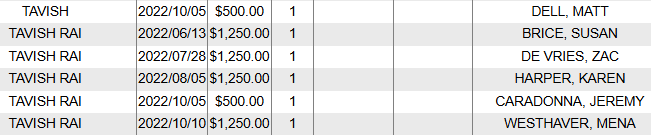
When I put the name Tavish into the search results for the Elections BC Local Election Contributions, I received the following entries:

Zoomed:
FRPC – Local Election Contributions Search Results
Every councillor other than Dell that received a campaign donation from a Tavish in the election, included the last name Rai. However Dell did not do so.

Tavish Rai – Abstract “As Chief Executive Officer, Tav guides the Abstract executive team with recognized leadership and extensive experience.”
In a letter that I sent to Councillor Dell earlier today (see link at end), I enquired: Is Tavish Rai, the Tavish you listed on your campaign contributions report that you submitted to Elections BC?
The name Tavish was on $6000 of donations to candidates last election, and all but $500 of that from the name: Tavish Rai.
Why was Matt Dell the only candidate that did not include a last name for Tavish?
Why did Elections BC allow him to do it?
—————————————————————————————————
On Sept 23, 2025
I sent an email to Elections BC with the following question:
Hello Elections BC,
Is it allowed in British Columbia, for a candidate in a local government election to put in only the first name of a donor to their election campaign on the campaign contribution disclosure forms which are submitted to Elections BC?
Thank you,
Sasha Izard
—————————————————————————————————
On Sept 26, 2025 an Elections BC Compliance Officer, Electoral Finance responded:
Hello Sasha,
Contributor information must include the full name, first and last, of the contributor, the amount of the contribution, the date the contribution was made, and the full residential address. If any of the required contributor information is missing it will become a prohibited contribution and must be returned.
Contributions are reported based on the total amount of contributions the contributor gave to a campaign in a calendar year. If the amount is $100 or over, then the full names and collected information is to be reported on the campaign financing disclosure statement submitted after the election. The residential addresses of the contributors will be obscured prior to publication.
Please note that submitted reports are published as submitted other than obscuring contributor addresses. Reports then go through a review process and if there is missing information or errors, the audit and assessment team will work with candidates and financial agents to rectify any issues in subsequent filing amendments.
Regards,
—————————————————————————————————
I replied to Elections BC, the same day:
Hello,
Thank you for your response.
What is the consequence for a candidate having accepted a prohibited contribution (such as the example mentioned in which only the first name of the donor was reported), other than simply returning the money?
If a candidate is elected during the election, but did not return the money of the prohibited contribution before the date of the election, what is the consequence of that?
– Sasha
————————————————————————————————–
On Sept 29, 2025 Elections BC replied:
Hello Sasha,
If a financial agent becomes aware that a contribution is prohibited, they must return the contribution, or an amount equal to its value, within 30 days. If the contribution cannot be returned (such as an anonymous contribution over $50, or a contribution without contact information) the financial agent must send it to Elections BC.
Monetary penalties may be administered for financial agents that accept or fail to return prohibited contributions. These penalties may also be applied to individuals and organizations that make prohibited contributions. For more on the investigations process, see our website: Our Investigation Process | Elections BC.
————————————————————————————————–
I replied:
Hello Elections BC,
Thank you for your response.
“If a financial agent becomes aware that a contribution is prohibited, they must return the contribution, or an amount equal to its value, within 30 days.”
Is this 30 days after the election?
Who must they return the contribution to, the person who made the contribution, or to Elections BC?
“Monetary penalties may be administered for financial agents that accept or fail to return prohibited contributions. These penalties may also be applied to individuals and organizations that make prohibited contributions.”
Do the penalties only apply to the financial agent, or to the candidate whose campaign accepted prohibited contributions as well?
Thank you again,
Sasha Izard
—————————————————————————————————
Elections BC replied on Oct 1, 2025
Hello Sasha,
The requirement is to return a prohibited contribution to the contributor within 30 days from the financial agent becoming aware of the prohibited contribution. This may be at any time. If they cannot return the funds to the contributor, for example the funds were anonymous, or they cannot reach the contributor, then the funds must remitted to Elections BC, made out to the minister of finance, and the funds go to general revenue.
The determination of monetary penalties and who is responsible in each case is made by the investigations team. If you have evidence of potential contraventions you can make a complaint to investigations: How to Make a Complaint | Elections BC.
—————————————————————————————————
I replied on Oct 3:
Hello Elections BC,
If the financial agent became aware of the prohibited contribution, over 30 days after the date of the election, are they still required to return the prohibited contribution to the contributor?
Thank you,
Sasha Izard
—————————————————————————————————
Elections BC replied:
Hello Sasha,
The Local Elections Campaign Financing Act (LECFA) just says that the requirement is to return a prohibited contribution to the contributor within 30 days from the financial agent becoming aware of the prohibited contribution. This may be at any time. There is no reference to the date of the election in LECFA.
If you have evidence of potential contraventions you can make a complaint to investigations: How to Make a Complaint | Elections BC. They will then look into the matter.
—————————————————————————————————
Hello Elections BC,
Thank you for your response.
Am I correct in the following?
1: A donor who provides a non-prohibited contribution, does not get their money back after the election.
2. A donor who provides a prohibited contribution and if the election has taken place, once the financial agent has noticed the error; is required to return the prohibited contribution back to the donor.
Thank you again,
Sasha
—————————————————————————————————
Hello Sasha,
If there are funds remaining after all financial obligations are met, including the repayment of prohibited contributions, should there be any, the funds are dealt with in the following ways:
- If the candidate contributed money to their own campaign, the financial agent can only repay the candidate up to the value of those contributions. There is no other specified provision for returning contributions to contributors, other than the repayment of prohibited funds.
After the candidate has been reimbursed, any remaining surplus campaign funds must be dealt with as follows:
- Under $500: The financial agent must pay the amount to the candidate or deal with those funds as directed by the candidate.
- $500 or more: The financial agent must pay the total amount of the surplus campaign funds (not just the amount over $500) to the jurisdiction where the candidate ran.
- If a candidate who paid surplus funds to a jurisdiction seeks office in the same jurisdiction in the next general local election or an earlier by-election, the jurisdiction must pay the surplus campaign funds to the candidate’s financial agent for use in the new election. If the candidate does not run for office in the same jurisdiction in the next election, the funds become the jurisdiction’s to be used at its discretion.
If prohibited funds are discovered after the funds have all been disbursed, the campaign can collect eligible contributions or seek an allowable loan to repay the prohibited funds within the 30 day time frame after they discovered or were informed of the error. This may be before, during or after the election, dependent on when the financial agent became aware of the error.
For more information on campaign financing, please see our Guide to Local Elections Campaign Financing in B.C. for Candidates and their Financial Agents.
—————————————————————————————————
Hello, thank you for your response.
Is my understanding correct, that there are only 2 types of donor who can potentially get money back from the campaign fund after the election? The two types of donor that appear to be able to receive money back from the campaign fund, seem to be:
1. a candidate under the conditions you outlined
2. a person who made a prohibited contribution to the campaign.
—————————————————————————————————
Hello Sacha,
Candidates are only reimbursed after all expenses have been paid and if there are remaining funds in the campaign account to do so.
The handling of prohibited contributions is covered by section 28 of the Local Elections Campaign Financing Act (LECFA). I have copied the relevant section below:
28 (1) If a financial agent becomes aware that a campaign contribution was made or accepted in contravention of this Act or the regulations under this Act, the financial agent must, within 30 days after the financial agent becomes aware of the contravention,
(a) return the campaign contribution to the contributor, or
(b) pay to the contributor an amount equal to the value of the campaign contribution.
(2) If a financial agent is not able to comply with subsection (1), the financial agent must, as soon as practicable, deal with the campaign contribution as follows:
(a) in the case of a contribution of money, pay to the BC chief electoral officer an amount equal to the value of the contribution;
(b) in any other case, either
(i) pay to the BC chief electoral officer an amount equal to the value of the contribution, or
(ii) deal with the contribution in accordance with the directions of that officer.
(3) An amount to be paid under this section must be paid from a campaign account of the applicable candidate or elector organization, unless all campaign accounts of the candidate or elector organization have been closed.
(4) A financial agent who contravenes this section commits an offence.
There are multiple factors that affect how a prohibited contribution should be handled based on the circumstances surrounding the specific contribution. Our office cannot offer advice on hypothetical scenarios as the application of the legislation is dependent on a variety of conditions under which a situation occurs.
—————————————————————————————————
Conclusion: Elections BC left me with a thin veneer of vague ambiguity as to my question, as to whether or not the only people who can potentially get money back after an election, is a candidate, and a person that made a contributed contribution.
They made it clear earlier in the dialogue that a person who made a prohibited contribution is supposed to receive that money back under the Act and that this could take place after the election if circumstances permit.
The only question is, how is the money supposed to be refunded to a person with only a first name provided?
The BC Local Elections Campaign Financing Act is a Farce. Like a yo-yo, it allows donors, who made prohibited election contributions, to get their money refunded to them after the election. – CRD Watch Homepage
—————————————————————————————————
Tavish Found: Over 3 years after the election, Victoria Councillor Matt Dell has now been compelled by Elections BC to finally submit Abstract CEO Tavish Rai’s full name as a campaign donor. – CRD Watch Homepage
Elections BC allows Matt Dell to get away with impunity for not disclosing the last name of campaign donor [an Abstract Executive] during the 2022 election campaign for Victoria Council. – CRD Watch Homepage
—————————————————————————————————
See also:
Letter to Councillor Dell in regard to your comments during the deliberations regarding the City’s membership in the Urban Development Institute at the City of Victoria Sept 4 Committee of the Whole – CRD Watch Homepage
Money still skewing local elections – Commentary – Focus on Victoria

 CRD Watch Homepage
Leave a comment