
Letter to Councillor Coleman in regard to your comments during the deliberations regarding the City’s membership in the Urban Development Institute at the City of Victoria Sept 4 Committee of the Whole
By Sasha Izard
Sept 13, 2025
Hello Councillor Coleman,
You will recall that recently on Sept 1, 2025 I sent you and the other City of Victoria Councillors the following letter in regard to the Sept 4 Councillor Member Motion that the City of Victoria end its membership with the Urban Development Institute:
Letter sent to Victoria’s Mayor and Council and City Manager’s office, regarding the City’s potential withdrawal from the UDI development/real estate lobby. – CRD Watch Homepage
I did not, however, get the impression that you read that letter based on your deliberations at Council. I suggest that you review it closely so that you are informed on the subject of development industry lobbying in the City of Victoria, and not merely speculating about it during important council deliberations on the issue.
I observed closely the deliberations on the subject, and transcribed the content so as to analyze the discussions involved.
This can be helpful to you as well moving forward.
The transcription of your deliberations, I’ve added as an appendix to the end of this letter.
I will add my own commentary to your comments below, so that you are more fully informed on this issue and that you are under no illusions as to the UDI and the City’s relationship to it, as you proceed forward on the issue of lobbying in the municipality, which recently appeared, and will appear in the near future as the UDI withdrawal motion was temporarily postponed to be deliberated on soon after the issue of a potential municipal lobbyist registry.
————————————————————————————————————
Councillor Coleman, you began your deliberation with the following sentence:
“Our membership includes not just the body of council, but it includes our staff, which has been pointed out in numerous emails that we’ve got.” – Cllr. Coleman
I will set the record straight on this, because it seems that you may be under a misunderstanding. The UDI previously had personal staff memberships, as a membership category. The first taxpayer paid staff membership in the development lobby was taken out in 2008.
There is no membership for the body of council per se, although the councillors do get a minor membership discount for attending UDI events, as do staff using taxpayer dollars – something like a 15 or 20% discount, sort of like a discount sticker in a supermarket.
To attend the events now from what I’ve seen, it often takes around $100 per staff member or elected official to attend a UDI lobby event e.g. a luncheon, which operates in such instances much as a taxpayer subsidized lobby fundraising lunch, while they are able to indoctrinate elected officials and unelected staffers according to their agenda, which is focused on bringing as much profits to the industry as possible, and in gaining favourable zoning and other policies from government. This will keep their private corporate member organization happy, who they are selling political influence to in the form of their paid memberships which are much more expensive than government memberships.
The elected officials did not vote to have the City join the UDI as a paying member. Staff did that behind the scenes without the approval of elected officials, by using city funds starting in 2013 – when they used City funds to sign the City up as a corporate member of the UDI.
In 2023, the UDI changed its membership scheme to not include personal memberships in the UDI. There are now only corporate memberships. The City of Victoria is a corporate member in the UDI. There are staff categories under the umbrella of corporate memberships, but they are not personal memberships as such.
The following is screen captured from the UDI’s current website at the time of writing at the Join UDI | UDI – Urban Development Institute “Membership” page:
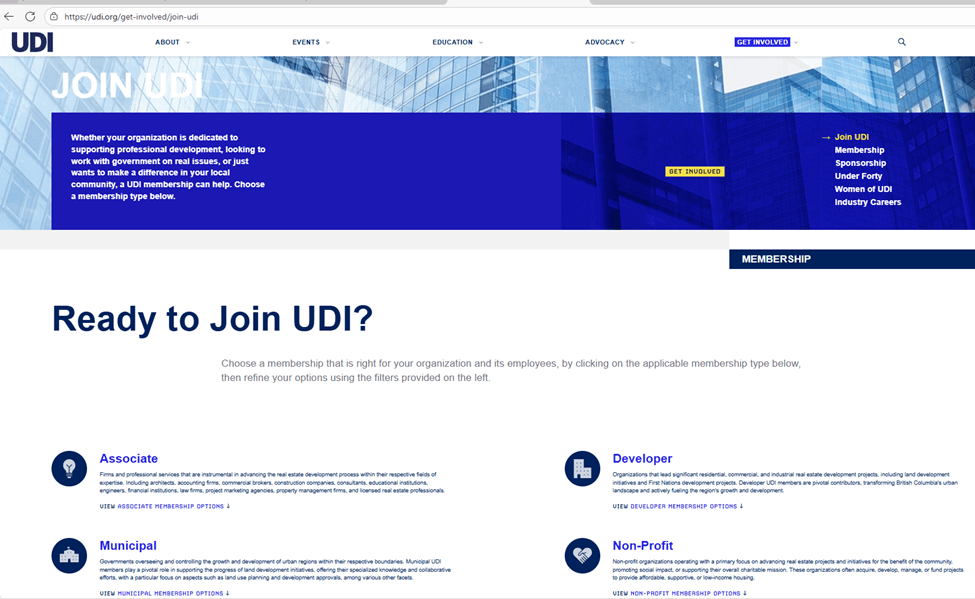
It states: “Ready to Join UDI? Choose a membership that is right for your organization and its employees by clicking on the applicable membership type below”
That’s right the City of Victoria has joined this lobbying organization for corporate development and real estate interests by taking out a paid membership in it.

This is what it states under the category Municipal:
“Governments overseeing and controlling the growth and development of urban regions within their respective boundaries. Municipal UDI members play a pivotal role in supporting the progress of land development initiatives, offering their specialized knowledge and collaborative efforts with a particular focus on aspects such as land use planning and development approvals, among various other facets.”
Without the approval of elected officials, staff members signed up the entire municipality to be a paying member of the lobby using taxpayer funds.
You then asked:
“Do staff find value in the discussions? With UDI?” – Cllr. Coleman
Staff responded:
“Um Through the UDI membership, there’s a couple of things that we get access to.
Um one is the sort of educational events and panel discussions that happen.
I don’t know, maybe four times a year, I think it is now. Um and there’s also a newsletter.
Um, it doesn’t actually impact our discussions with UDI as a stakeholder of um individuals who, you know, actually build the housing and other buildings in the city. Um so certainly from the um educational events and panels, I would say there is value, um, because it often brings together um different levels of government, um, you know, the province, CMHC, other municipalities, and there’s a sharing of information.
So that is a value, um, and but you do not have to be a member.” – Staff member
Guess who figured that out? The CMHC did. The CMHC withdrew its membership from the UDI two years ago, as did fellow Federal Crown Corporation: Public Services and Procurement Canada. Thus, the Federal level of government in quick secession was smart enough to clean its hands of all of their paid UDI lobby memberships.
They are more clever in this regard than the lower levels of government, which have been slower in comparison, although it should be said that half the UDI’s municipal memberships on Southern Vancouver Island have been withdrawn over the last 2 and a half years, in addition to that of the regional government, the CRD, which withdrew its membership from the UDI last year, after 23 years of membership.
In a way, quite frankly, I wish that the Feds hadn’t, because otherwise the needed separation of lobby and state for a real democracy would have become a national issue, as it should be, as the inappropriate merger of lobby and state affects the entire country and undermines democracy, mostly beyond the radar of the public.
Let’s look at the Vic Staffer’s comments again:
“Um so certainly from the um educational events and panels, I would say there is value, um, because it often brings together um different levels of government, um, you know, the province, CMHC, other municipalities, and there’s a sharing of information” – City Staffer
And who is the medium of this information sharing between different levels of government? The government itself, as would be appropriate? No, the go-between is the development lobby representing billions of dollars of outside interests. It doesn’t take a rocket scientist to figure out what is wrong in this scenario.
To give some insight of how this type of relationship and information sharing between the UDI and multiple levels of governments goes, I exhibit the following excerpts from the response to an Access to Information request that I made to the CMHC 2 years ago:


The above excerpted subject and content of communication between the CMHC and the UDI was in regard to a CMHC meeting with UDI lobbyists that was set for Sept 17, 2021.
The UDI lobbyists (registered as such on the BC Lobbyists Registry) wanted information from the CMHC about the UK’s Housing Needs Assessments prior to their lobbying Minister Eby, when he was the Housing Minister and Attorney General.
The UDI has lobbied the Province for many years to force mandatory housing targets on local governments, such as Victoria. One of the first iterations of these in the last decade, was the Housing Needs Reports/Assessments. Near to this time, the Capital Regional District, which is the regional government on Southern Vancouver Island, provided a monopoly of contracts to generate Housing Needs Reports for all of the Local Governments including the City of Victoria that are part of the CRD’s Regional Growth Strategy, to Urban Matters.
Urban Matters is a subsidiary of paying UDI member, the engineering consulting company Urban Systems. Urban Systems netted a hefty amount for not only generating these Housing Needs Reports and most of those across the Province, but as wide-scale engineering consulting company – Urban Systems makes millions from advising on infrastructure and was thus poised to potentially make vast amounts of profits from consulting on the infrastructure upgrades that such housing targets if implemented, would necessitate. They advised for example on the CRD’s Water Development Cost Charges (Water DCCs) a result of matching water policy to massively increased development, and they have advised the municipality of Saanich on community amenity contributions and other charges from developers.
The Regional Growth Strategy (RGS) of the CRD, legally mandates that Official Community Plans of municipalities under it conform to it. Thus, the Official Community Plans (OCPs) of municipalities under it were required to conform to the same housing targets created for them, by a paying member of the UDI development lobby, that itself profits from advising on development and needed infrastructure that goes along with it.
Mere mandatory housing targets, something the UDI lobbied the Province to adopt, were not good enough for the UDI however. The UDI wanted such targets enforced, and a carrot and stick approach adopted that would incentivize local governments to achieve housing targets, and penalize local governments that don’t.
By lobbying higher levels of government and getting them to adopt regulatory changes that the UDI wants, the UDI seeks to tie the hands of municipalities so that they are compelled to adopt the policies that the UDI and its paying member companies want implemented. Key targets for this include demanded zoning changes in the form of upzoning, and the reduction of public input on zoning (pre-zoning).
As the UDI Capital Region’s former Executive Director put it to View Royal Council on Sept 12, 2023:
“We do extensive policy work, um, and this is where we look at informed changes across all levels of government. So we try to align the uh, policies, that are being, um brought forward by the federal government, the provincial government, and the municipal government, and to kind of help them align, so that they don’t, uh, collide with each other.”
See: The Urban Development Institute lobbied the Province of BC to implement what they called “Global Housing Targets”. The Province would deliver new Housing Bills in response. – CRD Watch Homepage
Public release of UDI March 10, 2022 presentation slides, agenda, and lobbying letters to David Eby. – CRD Watch Homepage
Freedom of Information reveals that the Province of B.C. was working to implement what the registered lobbying organization, the Urban Development Institute, had been pushing for. This culminated in the recent Housing Bills that override local government authority on zoning. – CRD Watch Homepage
How the Development and Real Estate Lobby Pressed Mandatory Housing Targets, Mass Upzoning, Captured Official Community Plans, and Made the Shutting Down of Public Hearings the Norm in British Columbia Under the NDP Government – CRD Watch Homepage
Index of articles revealing major lobbying influence on B.C. Provincial Housing Bills and Housing Targets. – CRD Watch Homepage
Documents obtained by Freedom of Information reveal that the Urban Development Institute (UDI) and the Province of BC collaborated on the Housing Supply Act. The Act would lead to Provincially mandated housing targets and advisors being appointed for some municipalities. – CRD Watch Homepage
The Urban Development Institute lobbied the Province of BC to implement what they called “Global Housing Targets”. The Province would deliver new Housing Bills in response. – CRD Watch Homepage
In March 2023, prior to the release of the BC Provincial Housing Targets for select municipalities, the Urban Development Institute (UDI), not only lobbied the Province on Enforceable Housing Targets, but also on an Advisor for municipalities “should they be appointed”. – CRD Watch Homepage
The Government of British Columbia had top figures in the most powerful lobbying organization for development and real estate interests in the province, sign Non-Disclosure Agreements (NDAs) as they advised the Province on adopting mandatory/enforceable targets for municipalities and for other upcoming housing legislation to be able to override local government autonomy. – CRD Watch Homepage
—————————————————————————————————
Returning to the deliberations.
Staff continued:
“There’s a different, there’s a fee differential, but you don’t have to be a member to do that.
So that has been of benefit.” – City Staffer
As I mentioned previously, the supposed ‘fee benefits’ of attending such events are not born out in reality. The City of Victoria’s membership in the UDI is over $1500 annually. The reduced costs for elected officials and staff to attend lobby events, is generally in the ballpark of around 15-20%.
There is no way, that the City will ever come out as a net cost saver in this scenario. The cost savings are an illusion and nothing else. This is merely a convenient excuse for the UDI to provide a thin veneer of justification for local governments to be spending taxpayer dollars on their influence events, where they are able to network with elected officials and staff in an untransparent manner.
Just one meeting with City of Victoria staff and the UDI, cost almost $800 in a venue rental, as evinced by this excerpt from an FOI response:

Yes, that is about half the cost of the entire annual UDI membership on simply the venue for a City of Victoria/UDI meeting. What are the costs of having staff at such meetings?
“I think corporately.
I’m and I’m just speaking from my experience because there’s um quite a few people in the city staff and councillors that that have attended these um educational sessions.
Um So, as long as it’s under like, there there’s just needs to be an understanding that the conversations that staff have with UDI um around policy initiatives, and things like that, as we would with other stakeholders, that continues regardless of being a member or not a member, um, that’s simply a stakeholder discussion.” – City Staffer
—————————————————————————————————
What is the difference between a stakeholder discussion and a lobbying discussion? When it comes to the UDI the seemingly omnipresent stakeholder, and government; not much.
The following is an excerpt from a Freedom of Information response in regard to meetings between the UDI and City staff. Those scheduled for attendance, associated with the UDI (13 staff, board members and/or employees of UDI member companies) are in the column on the right and the UDI Chair above, and City of Victoria staffers (11) are listed on the left.

The following is a quote from the former UDI Capital Region’s Executive Director and registered in-house lobbyist with the Province (at the time) at the Sept 12, 2023 View Royal Committee of the Whole:
“UDI representatives get together with the directors of the develop or the departments that work directly with development, and we exchange information and we help the municipalities out by creating working groups that can inform and, and help make decisions, uh for your policies.”
Where is the benefit in being a member, other than providing a convenient foot in the door for lobbyists to have unrecorded access to government officials elected or otherwise? It is not one of costs. The benefit is to the UDI and only the UDI. It normalizes what I consider to be unethical conflict of interest through merging lobby and state and paying for this process with state funds. The UDI is then able to advertise to its paying private member companies that it has inside access to elected officials and unelected staffers as part of showing their influence and clout to their private members.
The following, Councillor Coleman was your reasoning on the UDI membership during the deliberations:
“Thank you for that response.
The problem for me is I’m personally, I’m ambivalent about UDI, but I look at the global politics that we deal with and we’re told that we have to work really hard at making sure everybody’s voice is involved. But we don’t want that to capture us where we’re merely pawns of a group.” – Cllr. Coleman
Your final sentence there was sound reasoning.
“So it was referenced earlier, we are also members of the Chamber and they lobby us on certain issues.
We are members of Tourism Victoria.
They lobbied us recently on a hotel that we’ve built. If we’re going to go down this path of saying, I don’t want this industry voice, then we’re gonna have to go through an assessment of all the other voices that are either registered lobbyists or lobbyists de facto, and cut them all out and say, we will only deal with you in personal meetings with or without staff.
Staff can deal with their own schedules.
I, this is a bit of a slippery slope issue.
I look back on some of the things that UDI have lobbied us on you referenced one earlier. Um step code was another where we chose not to take that advice and went in a different direction.” – Cllr. Coleman
If the UDI are lobbying at cross purposes with the elected officials, why are you as elected officials, allowing the use of public funds to pay money to the lobbying group?
They didn’t just lobby you in opposition to aspects of the step code and its implementation, they lobbied the District of Oak Bay for example on these subjects as well. If the elected officials are going in a different direction from the UDI development lobby, then why are you financing the UDI’s lobbying activity that are operating on other branches and levels of government at cross purposes to what you the elected officials are doing in the City of Victoria? What good would it be, for example, for the City of Victoria to adopt environmental policies, that the UDI was able to lobby other branches of government not to adopt, or to delay? We all live on the same planet. Many of your own activities in such a scenario would be nullified using taxpayer funds as part of that process.
You continued:
“I think, um it is conspiratorial in many ways that we see the conspiracies growing around not just in Victoria, but provincially, regionally, nationally, internationally, um and there is a danger in cutting out voices.”
With all due respect Councillor Coleman, your comments above have an appearance of gaslighting, even if inadvertently. Your own thoughts here are incomplete. What exactly are you referring to? Please provide specifics.
“I recognize that people are concerned that we get constrained, and the $1575 means that we’re pawns of this group.” – Cllr. Coleman
No one has said that the $1575 (annual base charge before the numerous additional costs discussed) means you are pawns to the group. This is simply reductio ad absurdum. However, it is true that this one-way annual payment does indicate that the development lobby is using the City of Victoria for its own purposes, and not the other way around.
Simply making this an issue of money ignores the real costs at stake. This is a serious issue of integrity, of ethics, of major at the very least ethical conflict of interest issues that have far reaching repercussions.
The total amount the city pays each year to the UDI is much higher than $1575. That is merely the annual membership fee, the cost of which is inconsequential in comparison to the other issues at stake. It is grossly unethical at any cost.
Is that the price you are willing to sell the integrity of the state and the City of Victoria?
For the UDI lobby, it is a foot in the door. After becoming members, the UDI, if they can get away with it, as they have with the City of Victoria, set up a liaison committee with the municipality where they lobby staffers behind closed doors. Have you ever been to one of these meetings? Do you know what happens in them?
The following is an excerpt from an FOI response that I received in regard to UDI-Victoria Liaison Committee Meetings. The following excerpted text was under the heading “Information sharing”:

“3. Collaborative work with all departments to ensure there is alignment with all departments
4. Staff are looking at requesting more delegated authority to staff. ACTION Kathy and Alison will connect on this to give UDI more information and timing to have a letter written.”
From the appearance of this excerpt, the city staff were asking the UDI to write a lobbying letter in this regard requesting more delegated authority to staff. The UDI has pushed delegating authority from elected officials to unelected staff on issues such as variances and waiving public hearings based on staff-claimed OCP compliance of development applications. This has taken place in the District of Saanich, and recently, a delegation of powers from elected officials to staff has also taken place in the neighbouring District of Oak Bay.
Housing minister orders Oak Bay to amend bylaws to meet housing targets – Oak Bay News
The following is a screenshot of two subsequent pages from the UDI’s Policy and Advocacy Updates News letter from March 2023, as revealed by Freedom of Information:

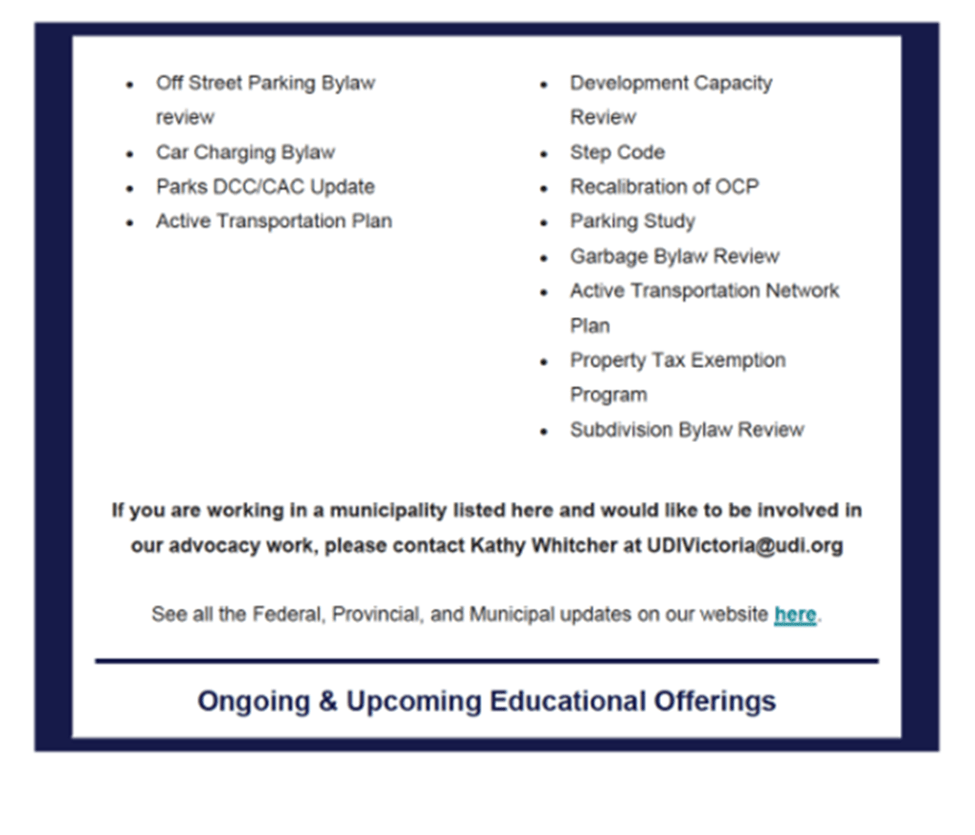
Note the text at the bottom of the 2nd image:
“If you are working in a municipality listed here and would like to be involved in our advocacy work, please contact” [The UDI Capital Region’s Executive Director/registered UDI in-house lobbyist with the Province].
That this text was below several municipalities including The City of Victoria, shows that the UDI was seeking municipal employees including the City of Victoria’s to be involved with their advocacy work. When the UDI legally files lobbying registrations, they typically file those lobbying activities as “advocating”, which shows that the UDI uses the terms lobbying and advocating synonymously.
The following is from an email sent to CALUCs from a City of Victoria staffer:
“Subject: Delegating Minor Variances
Date: May 9, 2023 at 3:27:10 PM PDT”
“Hello CALUCs,
Council passed a motion at the February 9, 2023 daytime Council Meeting directing staff to seek input from the UDI and the CALUCs and bring forward recommendations to delegate minor variances to staff for Council’s consideration (see the January 19, 2023 Committee of the Whole staff report for more information here). A potential benefit of expanding delegated authority is that applications could advance through the system more quickly if only minor variances are required and if it complies with Council-adopted guidelines.
We are reaching out for your input on this proposed change to help staff determine potential variances and define appropriate parameters and guidelines. The following list reflects recent variance applications and offers some examples of the types of variances that could be delegated:
- setbacks and site coverage to accommodate accessibility features
- setback for the location of rooftop mechanical screening from the outer edge of a roof
- setbacks to heat pumps and landscaping structures such as pergolas
- projections into setbacks for stairs, ramps, porches, and eaves
- siting and height variances where it can be demonstrated that there is a negligible impact on neighbours or the public realm
- distance from a parking stall to a street
- height clearance for underground parking stalls.
If you have thoughts on this, please email me directly by June 5, 2023 for consideration in our analysis and recommendations to Council. Please give me a call at the number below if you have any questions.”
The following is quoted from the Archive.org Waybackmachine snapshot of the UDI Capital Region’s Policy and Advocacy Updates page prior to that website being taken down by the UDI.
Policy and Advocacy Updates – UDI Capital Region
“Oct 26, 2021 – Development Approvals Process Review (DAPR)
Development Approvals Process Review
UDI participated in the Ministry’s Development Approvals Process Review (DAPR). On October 26, the Hon. Josie Osborne, Minister of Municipal Affairs, introduced Bill 26, the Municipal Affairs Statutes Amendment Act (No. 2), 2021. It includes several DAPR recommended improvements that would “…give local governments more powers to simplify and speed up their development approvals processes…”. If the legislation is passed:
- It would remove “…the default requirement for local governments to hold public hearings for zoning bylaw amendments that are consistent with the official community plan;”
- Councils would be able to delegate decision-making powers for minor development variance permit decisions to their municipal staff”
I have bolded these last two sections, because it shows that democratic power is being removed from the public in the form of waived public hearings, and from the elected officials in the form of delegating certain decision-making to staff. At each step of the way UDI works with various levels of government to push such an anti-democratic agenda, and staff involvement in this process has been documented. The ever-present danger of undue influence in this untransparent relationship between lobby and staff is clear.
This is what Transparency International, writes about undue influence:
“There are several ways through which interest groups, such as companies, professional groups or public interests groups, try to influence the decision-making process. Interest group influence, commonly known as lobbying, encompasses “any direct or indirect communication with public officials, political decision-makers or representatives for the purposes of influencing public decision-making carried out by or on behalf of any organised group[1]”.. - Interest group influence is not a corrupt or illegitimate activity per se, but when opaque and disproportionate it may lead to undue influence, corruption and even state capture. Undue influence is a more subtle form of corruption as interest groups often make use of legal mechanisms to influence the decision-making process[2]. For instance, they may legally contribute to electoral campaigns; provide research and host receptions but expecting favourable decisions in exchange. Undue influence may also be achieved by promising decision-makers well-paid future jobs in exchange for support[3].
- In certain contexts, disproportionate and unregulated influence by interest groups may also lead to state capture, which occurs when corruption is so systemic and infiltrated within the institutions of the state that private interests substitute themselves to the common good as main drivers of policy and regulation.”
Transparency International Knowledge Hub | Knowledge Hub
—————————————————————————————————
Returning to your comments during the deliberations Councillor Coleman:
“I recognize that people are concerned that we get constrained, and the $1575 means that we’re pawns of this group.
I don’t believe that to be the case. Um and I if there is some value that staff can get by having those discussions, whether it’s through membership or non-membership, I think we should keep that going.
Um, as I say, personally, I can live either way which we go with this, but I have a real concern that we’re opening a slippery slope and closing out all memberships because people may lobby us.
That’s we are a governance table.
People are always going to lobby us.
We have to have one the intelligence to recognize that we’re being lobbied.” – Cllr. Coleman
Good. Step 1: admitting that there’s a problem.
Step 2: having the intelligence to recognize that the state and taxpayer that supports it shouldn’t be paying money towards those lobbying activities.
“And two, um the circumspection to say, I’ve heard both sides all sides and staff, what is your recommendation, based on the evidence you have?
That doesn’t constrain us, but it just means we have to think of the way through.
So I I’m opposed to this because I think it’s the wrong step on a slippery slope.” – Cllr. Coleman
The slippery slope argument is not a good one. In reality the slippery slope is in reverse.
The slippery slope of using taxpayer funds to fund a lobbying organization representing billions of dollars of outside private profit-based interests, is the normalization of what in my view and that of others, is at the very least, very serious conflict of interest in terms of ethics, using taxpayer dollars to subsidize the same lobby that is lobbying the politicians and unelected bureaucrats (often behind closed doors). This normalization of unethical conflict of interest becomes part of the culture among bureaucrats. Maintaining this sordid state of affairs, becomes a mere exercise of deflection, but as it is said that sunlight is the best disinfectant, it is one that with enough light shone on the issue, becomes see-through for the general public, and the practice of mere deflection of the issue by the bureaucrats is not one that is sustainable in a truly democratic society.
One should look at this situation not merely as an onlooker asking for government responsibility and accountability in its dealings with industry lobbying organizations (that will not arrive so easily), but as a cultural anthropologist viewing an entire culture where this sort of dubious activity has become normalized, and as a result we are left to view and experience in day to day life, the costs and consequences of this.
The slippery slope is branches of government paying lobbying organizations for memberships, and for their officials to attend their lobby events. Once that sort of activity gets started, established, normalized and engrained, events can move quickly downhill from there, as we have seen. A cultural decadence and Oblomov-style malaise, sets into a bureaucracy that has become compromised, and this situation rapidly grows worse over time, sending the culture and society downhill with it.
Councillor Coleman, please review this letter, and the previous letter that I sent to you 2 weeks ago on this critical issue. It is crucial for the integrity of the City of Victoria and that of its staff and elected officials, that the City end its grossly inappropriate and unethical merger of lobby and state.
Thank you,
Sasha Izard
—————————————————————————————————
Appendix: Transcription of Councillor Coleman’s deliberations at the Sept 4, 2025 Committee of the Whole in regard to the potential withdrawal of the City’s paid membership in the UDI.
Cllr. Coleman:
Thank you, a question through you, your worship, to Ms. Hoese. Our membership includes not just the body of council, but it includes our staff, which has been pointed out in numerous emails that we’ve got.
Um, do staff find value in the discussions? With UDI?
Staff: Thank you through you Mayor.
Um Through the UDI membership, there’s a couple of things that we get access to.
Um one is the sort of educational events and panel discussions that happen.
I don’t know, maybe four times a year, I think it is now. Um and there’s also a newsletter.
Um, it doesn’t actually impact our discussions with UDI as a stakeholder of um individuals who, you know, actually build the housing and other buildings in the city. Um so certainly from the um educational events and panels, I would say there is value, um, because it often brings together um different levels of government, um, you know, the province, CMHC, other municipalities, and there’s a sharing of information.
So that is a value, um, and but you do not have to be a member.
There’s a different, there’s a fee differential, but you don’t have to be a member to do that.
So that has been of benefit.
I think corporately.
I’m and I’m just speaking from my experience because there’s um quite a few people in the city staff and councillors that that have attended these um educational sessions.
Um So, as long as it’s under like, there there’s just needs to be an understanding that the conversations that staff have with UDI um around policy initiatives, and things like that, as we would with other stakeholders, that continues regardless of being a member or not a member, um, that’s simply a stakeholder discussion.
Thank you.
Cllr. Coleman:
Thank you for that response.
The problem for me is I’m personally, I’m ambivalent about UDI, but I look at the global politics that we deal with and we’re told that we have to work really hard at making sure everybody’s voice is involved. But we don’t want that to capture us where we’re merely pawns of a group.
So it was referenced earlier, we are also members of the Chamber and they lobby us on certain issues.
We are members of Tourism Victoria.
They lobbied us recently on a hotel that we’ve built. If we’re going to go down this path of saying, I don’t want this industry voice, then we’re gonna have to go through an assessment of all the other voices that are either registered lobbyists or lobbyists de facto, and cut them all out and say, we will only deal with you in personal meetings with or without staff.
Staff can deal with their own schedules.
I, this is a bit of a slippery slope issue.
I look back on some of the things that UDI have lobbied us on you referenced one earlier. Um step code was another where we chose not to take that advice and went in a different direction. I think, um it is conspiratorial in many ways that we see the conspiracies growing around not just in Victoria, but provincially, regionally, nationally, internationally, um and there is a danger in cutting out voices.
I recognize that people are concerned that we get constrained, and the $1575 means that we’re pawns of this group.
I don’t believe that to be the case. Um and I if there is some value that staff can get by having those discussions, whether it’s through membership or non-membership, I think we should keep that going. Um, as I say, personally, I can live either way which we go with this, but I have a real concern that we’re opening a slippery slope and closing out all memberships because people may lobby us.
That’s we are a governance table.
People are always going to lobby us.
We have to have one the intelligence to recognize that we’re being lobbied.
And two, um the circumspection to say, I’ve heard both sides all sides and staff, what is your recommendation, based on the evidence you have?
That doesn’t constrain us, but it just means we have to think of the way through.
So I I’m opposed to this because I think it’s the wrong step on a slippery slope.
– Cllr. Coleman
———————————————————————————————–
See also:
City Councillors Hammond and Gardiner put forward Motion to “Terminate Victoria’s membership in the Urban Development Institute” “effective immediately”. – CRD Watch Homepage
Transcript of City of Victoria Council Deliberation on Motion put forward by Councillors Hammond and Gardiner to “Terminate Victoria’s membership in the Urban Development Institute”. (Sept 4, 2025) – CRD Watch Homepage
Letter to Councillor Thompson in regard to your comments during the deliberations regarding the City’s membership in the Urban Development Institute at the City of Victoria Sept 4, 2025 Committee of the Whole – CRD Watch Homepage

 CRD Watch Homepage
Leave a comment