
2 Sentence Constitution of the Homes For Living Foundation removes any doubt that Homes For Living (HFL) is a purpose-built pressure group designed to influence municipal politicians.
“We want to take a data-driven approach and transparently cast a light on what councillors support/dont support so that people can pressure them to support policies that are the most impactful instead of paying lip service to affordability.”
Despite its claimed focus on affordability. Homes For Living, whose members have frequently cheered on luxury development proposals, primarily advances a market/supply/increased-density based approach to housing, that although it has netted developers and speculators vast profits, has not corresponded to affordability, particularly in dense urban examples e.g. Toronto, Vancouver, and New York City.
By Sasha Izard
July 18, 2025
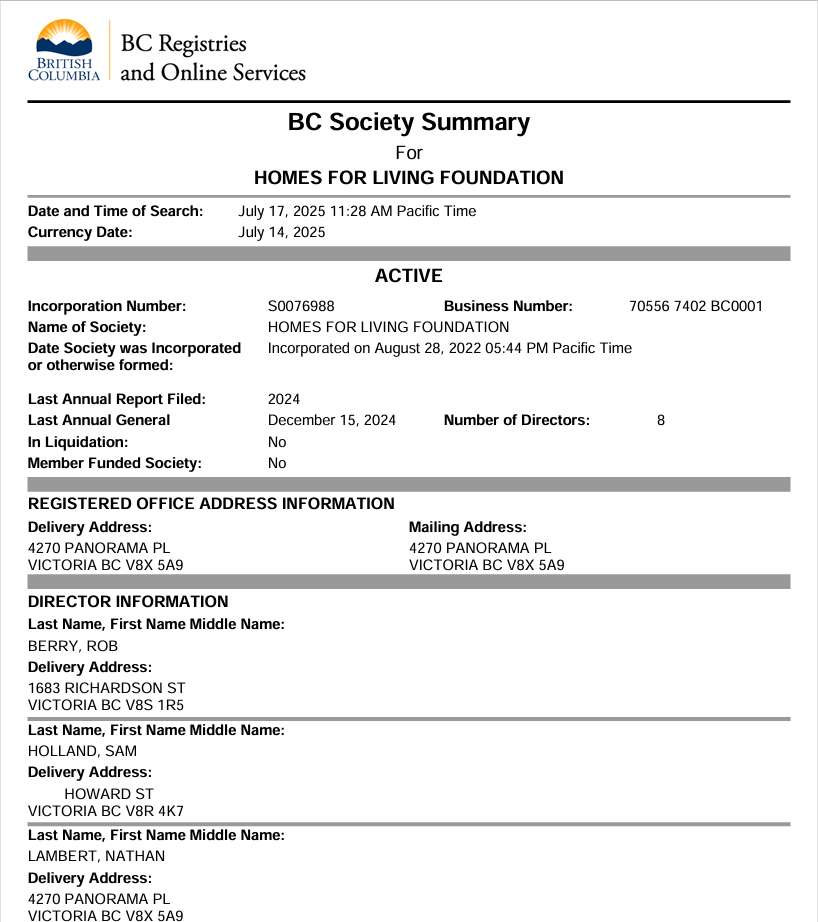
The Homes For Living Foundation is the incorporated name under which the political pressure group better known as Homes For Living exists under the Societies Act of British Columbia.
Although Homes For Living claims in its constitution to be data-driven, they advance an unproven if not completely discredited (see Patrick Condon’s research) mostly supply/market-based narrative as route to housing affordability, which is directly contradicted in places like Toronto, Vancouver and New York City, where massive increases in housing supply correlated instead to sky-high housing costs.
Data-driven, or hot air?
The organization’s unusually brief 2 sentence Constitution is as follows:
“We are a group of community volunteers that are passionate about making Victoria more affordable for primary homeowners and renters.
We want to take a data-driven approach and transparently cast a light on what councillors support/dont support so that people can pressure them to support policies that are the most impactful instead of paying lip service to affordability.”
Note: The wishful statement “We want to take a data-driven approach”, is not the same as actually taking a data-driven approach, nor is wanting to transparently cast a light, necessarily doing so transparently.
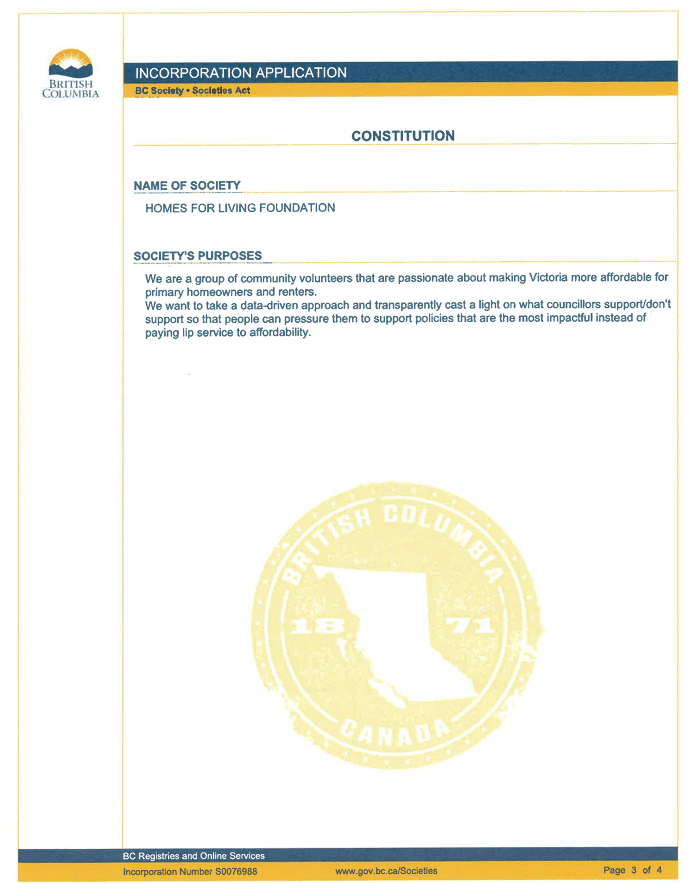
If there was ever any doubt that Homes For Living is a political pressure group, it should be removed completely by the second sentence of its Constitution:
“We want to take a data-driven approach and transparently cast a light on what councillors support/dont support so that people can pressure them to support policies that are the most impactful instead of paying lip service to affordability.”
Although the registered non-profit organization features pressuring councillors to support its preferred policies in its 2 sentence Constitution, it makes no mention of pressuring higher levels of government to adopt its preferred policies; yet it does. It targets the Province of B.C., including on the subject of mandated housing targets. It even proposed to the Province punishing municipalities that don’t build fast enough in the organization’s view.
Homes For Living (HFL) and other ‘YIMBY’-oriented groups’ Lobbying Letter to Premier Eby and Housing Minister Kahlon, Mirrors the UDI’s lobbying efforts, raising important questions about the relationship between the UDI and HFL, as they both press the Province for a practically identical development agenda, while simultaneously being treated as stakeholders by it. – CRD Watch Homepage
The following is the Cambridge Dictionary’s definition of lobby; note that the entry refers to a lobby as a “PRESSURE GROUP”:
lobby noun [C] (PRESSURE GROUP)`
a group of people who try to persuade the government or an official group to do something:
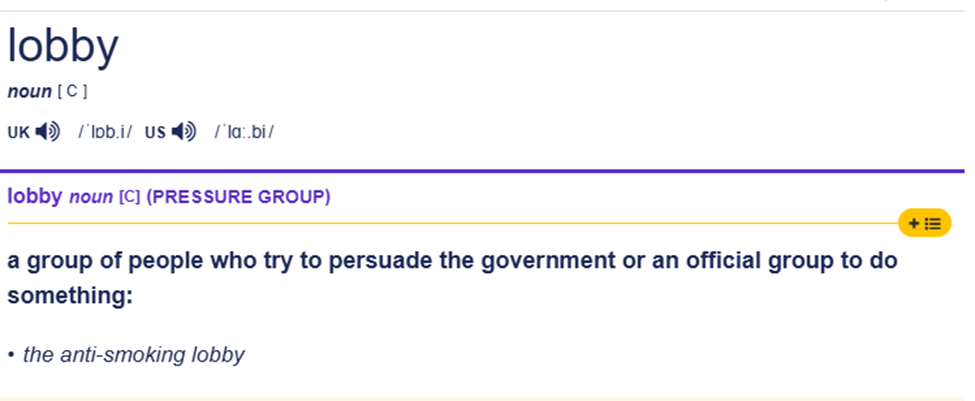
Once again, the following quote is from the Constitution of the Homes For Living Foundation under the Society’s Purposes: “cast a light on what councillors support/dont support so that people can pressure them to support policies that are the most impactful“.
By the Cambridge Dictionary’s use of English, that would be a textbook example of a lobby. Yet. this does not appear to be recognized under the Lobbyists Transparency Act (LTA) in British Columbia, as lobby is not defined in it as a noun, and unpaid lobbyists by any sense of the word, do not appear to be required to register lobbying activity by the LTA.

“lobbyist
noun [ C ] politics
uk /ˈlɒb.i.ɪst/ us /ˈlɑː.bi.ɪst
someone who tries to persuade a politician or official group to do something”.
Homes For Living does not register lobbying activity, unlike fellow registered non-profit the Urban Development Institute aka the UDI; although HFL’s vice-president has described lobbying activity to MLAs, and until recently thought the organization was registered as a lobbyist.
Feb 2025 Dialogue with Jack Sandor of Homes for Living provides a fascinating window onto Homes for Living and described lobbying activities to MLAs. No Entry for the organization appears when searched on on the BC Lobbyists Registry. – CRD Watch Homepage
Its vice-president also now claims a technicality that Homes For Living did not actually endorse candidates during the last election they just ranked them; yet it is difficult to see how what they posted (and advertised with election posters) does not actually in their view constitute endorsements for candidates during the 2022 general local government election.
As the Times Colonist put it during the final runup to the 2022 general local government election:
Jack Knox: Endorsements can offer path to follow, or avoid – Victoria Times Colonist Oct 11, 2022
“Notes from the last week of the election campaign.
• Victoria Mayor Lisa Helps has released a list of the city council candidates she’s supporting in the Oct. 15 vote.
It’s a rare move for a sitting mayor, but one that Helps, who isn’t running for re-election, felt free to make.
It was no accident that her list mirrored that of the Homes For Living group: Marianne Alto for mayor, and Dave Thompson, Jeremy Caradonna, Matt Dell, Tony Yacowar, Susan Kim, Khadoni Pitt Chambers, Anna King and Krista Loughton for council. “I thought about all the ways I could approach this question, and kept coming back to housing,” Helps blogged.”
————————————————————————————————-
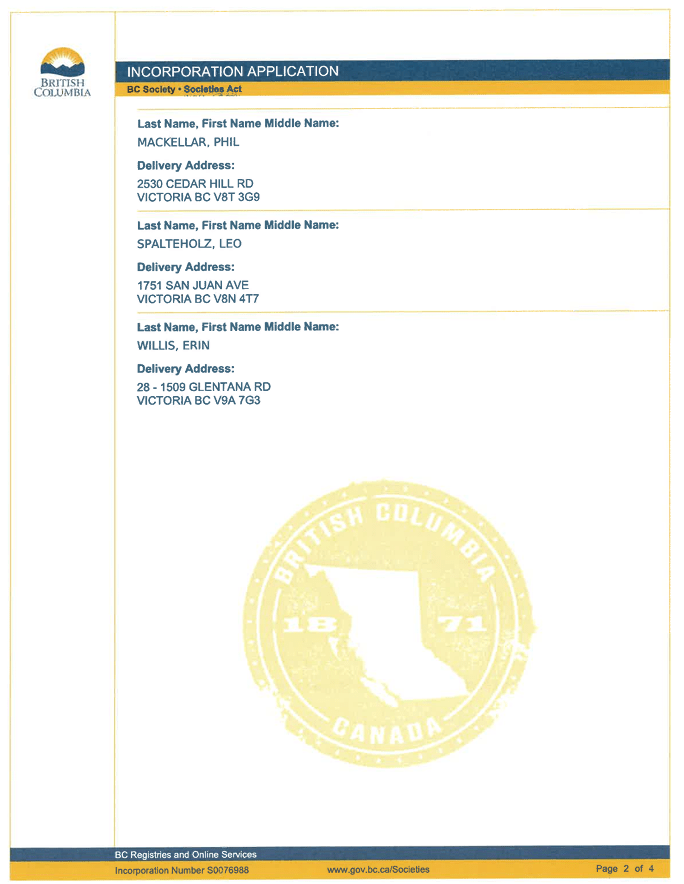
As revealed by their incorporation document (see appendix at the end of the article), the Homes For Living Foundation was incorporated on August 28, 2022.
Homes For Living registered with Elections BC as a Third Party Sponsor during that election: https://elections.bc.ca/docs/lecfa/Registered-Third-Party-Sponsors-LEGE-2022-10-15.pdf
The reader can decide for themself whether Homes For Living endorsed candidates during the last election or not.
Here is an excerpt from their candidate rankings for Oak Bay. For Mayor and For Council is bolded including only the candidates HFL preferred for election.
As Homes For Living framed it above: “Note that Oak Bay had fewer pro-housing candidates than council seats.”
Endorsement or non-endorsement you decide.
As the saying goes, “If it looks like a duck and quacks like a duck, it probably is a duck.”
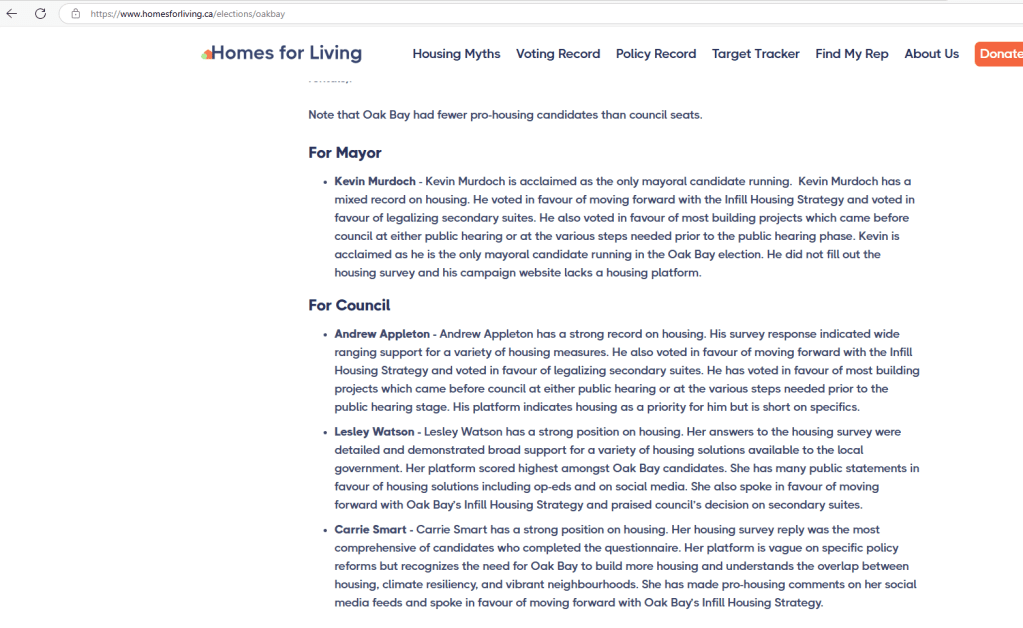
Oak Bay Candidate Rankings (Accessed July 12, 2025)
Oak Bay Candidate Rankings (Archived version from April 20, 2024)
Saanich Candidate Rankings (Accessed: July 12, 2025)
Saanich Candidate Rankings (Archived version from Jan, 2025)
Victoria Candidate Rankings (Accessed: July 12, 2025)
Victoria Candidate Rankings Archived version from Jan, 2025
Whether overtly endorsed or otherwise, the preferred candidates of the Homes For Living pressure group received majorities on the councils of the City of Victoria, the District of Saanich, and the District of Oak Bay.
Elected officials in the City of Victoria that Homes for Living was “For” during the 2022 general local government election included: Marianne Alto, Dave Thompson, Jeremy Caradonna, Matt Dell, Susan Kim, and Krista Loughton.
Elected officials in the District of Oak Bay that Homes for Living was “For” during the election included Kevin Murdoch, Andrew Appleton, Lesley Waston, and Carrie Smart
Elected officials in the District of Saanich that Homes for Living was “For” during the election included: Dean Murdock, Zac De Vries, Karen Harper, Susan Brice, Colin Plant, and Teale Phelps Bondaroff.
The result has been a massive construction agenda advanced particularly in the City of Victoria and in Saanich (now both looking at amalgamation with each other) and severe curtailing of public input during council meetings within those municipalities.
While there has been ongoing controversy about development in Oak Bay, an area that Homes For Living members want to densify significantly, the Homes For Living preferred council members in the District defeated a motion that would have prevented the most powerful lobby for development and real estate in BC from becoming a stakeholder on the District’s new Official Community Plan.
Motion Debated at Oak Bay Council Meeting that the Urban Development Institute (UDI), Not Be Included as a Community Stakeholder on the District’s OCP Update. – CRD Watch Homepage
————————————————————————————————–
Conclusion:
Homes For Living is a political pressure group whose stated purpose in its Constitution involves influencing municipal politicians to adopt the organization’s preferred development oriented policies, but where is its stated purpose on influencing higher levels of government e.g. the Province of British Columbia which it targets in order to get top down policies that compel local governments to achieve construction quotas?
If the organization, a registered non-profit, is lobbying the Province including its MLAs for its preferred policies as evinced by comments on social media from its vice president, why does it not have to register those activities on the BC Lobbyists Registry? Its fellow pressure group for a development/real estate agenda, the Urban Development Institute (UDI) certainly does.
Why does the non-profit like the UDI consider it acceptable to advance to the Province potential punishments to municipalities that don’t build fast enough according to its preferences?
Why do the elected officials that HFL were “for” during the 2022 campaign not take umbrage to that fact?
Why does the Province of BC, continue to include these political pressure groups as stakeholders on their housing policies, while reducing public input in local governments and even having gone so far as to demand elected officials sign Non-Disclosure Agreements in order to be involved in the housing policy process?
These are questions that are crucial to ask, and also crucial to investigate in order to find a conclusion to them.
Don’t expect a media that portrayed them as “housing experts” to shine that sort of light on them.
————————————————————————————————–
See also:
Index of Articles and other Media Coverage about Homes For Living – CRD Watch Homepage
https://crdwatch.ca/2025/07/12/homes-for-living-hfl-and-other-yimby-oriented-groups-lobbying-letter-to-premier-eby/
Freedom of Information reveals that the Province of B.C. was working to implement what the registered lobbying organization, the Urban Development Institute, had been pushing for. This culminated in the recent Housing Bills that override local government authority on zoning. – CRD Watch Homepage
Public release of UDI March 10, 2022 presentation slides, agenda, and lobbying letters to David Eby. – CRD Watch Homepage
Too much heat: The UDI pulls down its list of backroom committees that meet with the Government of British Columbia and Local Governments – CRD Watch Homepage
https://crdwatch.ca/2025/07/17/feb-2025-dialogue-with-jack-sandor-of-homes-for-living/
Appendix: Corporate Registration Documents for the Homes For Living Foundation





 CRD Watch Homepage
Leave a comment