BC Ministry of Housing violated Freedom of Information Legislation: Ministry’s non-responsiveness in delivering its completed FOI results regarding its dealings and communications with a registered lobbying organization (the UDI), was deemed a refusal to comply with the legislation, by the Office of the Information and Privacy Commissioner (OIPC), which subsequently compelled the Ministry to deliver the results after.
Part of a general pattern: In previous years the Royal BC Museum and the University of Victoria also had been found by the OIPC to have refused similar FOI requests and were compelled to deliver them after.
By Sasha Izard
May 29, 2025
Over a year ago, I made the following Freedom of Information request to a number of Ministries including the Ministry of Housing, for:
“All communication records between the Ministries selected and the Urban Development Institute (UDI), including records referencing UDI. Any records of meetings between the UDI and the Province of BC found in the Ministries selected including but not limited to: minutes, agenda items, videos, transcriptions etc. of or recordings regarding such meetings. (Date Range for Record Search: From 1/1/2020 To 3/28/2024)“
No doubt it was a tall order to fill. Most Ministries had completed their responses in a few months, but the Ministry of Housing which initially estimated the cost of completing the FOI to be $990 (after the $10 I already paid it), took a lot more time to complete their request. Understandably so, the results included over 3000 pages which ultimately were sent in 3 phases, the first phase which included over 2000 pages, I received in the fall of 2024.
Accordingly and understandingly, I gave them every opportunity for extending their time to provide their FOI response, that is until my patience started wearing out the following year.
While the first phase was completed in the fall and contained over 2 thousand pages of content, a considerable amount of which was covered in many articles on CRD Watch; the second phase followed a few months later containing under 700.
Now a 3rd phase would be required so the Ministry informed me. Couldn’t they just have included it in the 2nd phase results and released them at the same time?
Patiently, I kept giving them permission for extensions to their due date. Why not? I barely had time to process the several thousand pages from the first FOI response.
On March 14, 2024, I received the following email from the Ministry of Housing’s Corporate Records and Records Management Department:
“I’ve just received a message, advising me that the Deputy Minister’s Office has questions regarding my recommendations on disclosure. The legislated due date is Monday March 17th, and I suspect the issue will take most of next week to resolve. Will you consent to a 10-day extension? That would move the due date to March 31st.”
After waiting for approaching a year for the FOI request to be completed, I was a bit tired of granting extensions, especially when what I regarded as what looked like Ministerial meddling at this point prior to release, looked like a questionable reason to grant another extension beyond the legislated due date.
I replied:
Hi,
If I don’t grant the extension, would anything be omitted from the FOI response, that I would have received if I didn’t grant the extension?
Thank you,
Sasha
————————————————————————————————-
The Ministry responded 4 days later on March 18 (after the legislated due date had expired):
“Good morning Sasha,
Apologies, I was away from the office yesterday.
Whether or not you decide to grant the extension does not affect what you receive. The extension will simply keep the file from going overdue.“
————————————————————————————————-
So what were we waiting for then?
I replied:
Hi,
Just to confirm: no additional material would be omitted from the FOI response if I don’t grant the extension?
Thank you,
Sasha
————————————————————————————————-
The Ministry responded succinctly:
That is correct.
————————————————————————————————-
The same day on March 18, 2025, I replied:
Hi,
Then I don’t grant the extension, as I see no purpose to it.
Thank you,
Sasha
————————————————————————————————-
This was followed by a prolonged period of silence from the Ministry.
After listening to the proverbial crickets chirping for approaching a month and a half, I sent an email to the Office of the Information and Privacy Commissioner (OIPC) on May 1, 2025:
Hello OIPC,
I am reporting the Ministry of Housing for refusing to disclose the completed contents of this FOI request.
Thank you,
Sasha Izard
————————————————————————————————-
The OIPC responded an hour and a half later:
Good morning, Sasha,
To process this complaint, are you able to provide is with a copy of your original access request?
Thank you,
OIPC Intake Team,
————————————————————————————————-
The following day on May 2,
I responded to the OIPC:
Hi,
I just forwarded it to this email address. Please let me know if you received it.
Thank you,
Sasha
————————————————————————————————-
The proverbial crickets now began chirping from the direction of the OIPC. After over 2 weeks of waiting for a response from them, I sent them the following email on May 21, 2025:
Hello OIPC,
Did you receive a copy of the original access request that I forwarded to you on May 2, 2025?
Thank you,
– Sasha
————————————————————————————————-
21 minutes later, the OIPC responded:
Good afternoon, Sasha,
Thank you for your email.
We cannot confirm receipt of any correspondence from you in response to our May 1, 2025 email.
OIPC Intake Team,
————————————————————————————————-
That evening on May 21, I replied to the OIPC:
Hello,
This is a screenshot of the email I sent. Did the OIPC receive it or not? If not, I can resend it.

If you received it, was that what you were looking for? If not, how can I find it and move this process forward?
Thank you,
Sasha
————————————————————————————————-
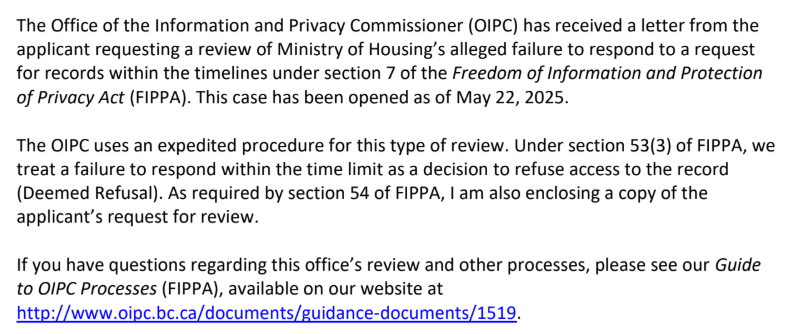
Almost 3 weeks later on May 22, 2025, the OIPC sent the Ministry the following:

————————————————————————————————-
4 days later on May 26, I replied:
Thank you,
Has the Ministry’s non-response within that time period been deemed a refusal by the OIPC?
Thank you,
Sasha
————————————————————————————————-
The OIPC replied 2 days later on May 28 at 9:18am:
“Good morning, Sasha,
Thank you for your email.
OIPC file INV-F-25-00982 is a deemed refusal”
————————————————————————————————-
Within half an hour on May 28, 2025 at 9:47am I received the completed phase 3 final response to my FOI request to the Ministry of Housing from the OIPC:
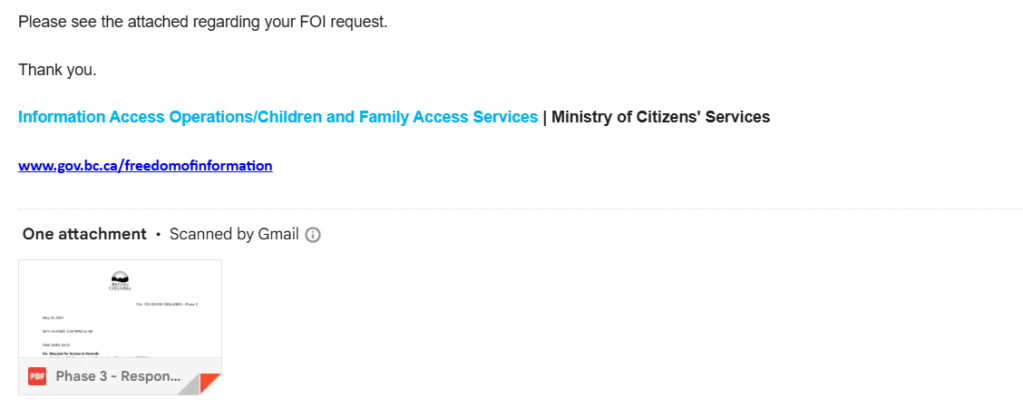
The Phase 3 Response contained 518 pages.
————————————————————————————————-
Thus it took only a week from the OIPC taking action on the file, and having deemed the FOI a refusal by the Ministry, for the Ministry to finally comply and deliver the response.
Which begs the question? Why did it take the Ministry being forced by the Office of the Information and Privacy Commissioner to finally deliver the information?
The FOI request was received completed in full almost a year after the original due date and over a year since the request was made:
Almost a year earlier, I had been informed by the Province:
“FOI Request # HSG-2024-40860 is now due on June 07, 2024.”

The speed at which the Ministry finally complied with the OIPC, shows that they could have delivered the response much earlier and within the legislated due date, after many extensions over a year, provided by a very patient member of the public.
That the Ministry refused to comply with the legislation until finally being compelled to by the OIPC, and that the Ministry refused in the end to respond on the issue shows a contempt in my view of the law and of the public.
This however has been part of an established pattern from a number of government bodies in regard to similar FOI requests in the past.
On Oct 27, 2024 the OIPC wrote:
“I am substantiating your complaint as the public body (UVic) did not respond in time to your request and therefore failed to comply with section 7 of FIPPA.”

—————————————————————————————————
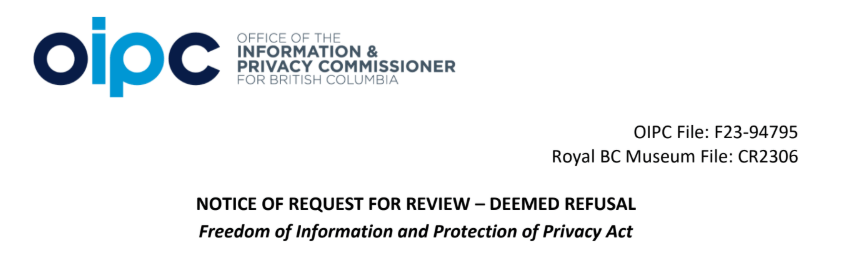
A year earlier on November 2, 2023 the OIPC found that the Royal BC Museum had deemed an FOI a refusal, after the museum had failed for months to respond in regard to an FOI I had made, again in regard to similar content involving the UDI.
—————————————————————————————————
Conclusion:
In all 3 of these cases different government bodies; the Ministry of Housing, the University of Victoria (UVIC), and the Royal BC Museum had been found to have refused FOI requests in regard to their communications and other documents regarding the Urban Development Institute (UDI) a registered lobbying group on the BC Lobbyists Registry that advances interests in real estate and development.
In all 3 cases the pattern was the same. After making the FOI request, the public body would take months (understandable as all 3 similar FOI requests would require a considerable search, the Ministry of Housing and UVic FOIs, yielding several thousand pages each; the Royal BC Museum FOI revealed a couple hundred pages in comparison, albeit quite interesting in content, but that still involved searching many departments. In each case, I would generously provide permission for the Public Bodies to take extension after extension, but then after purporting to be carrying out the task, the Public Body would go far beyond the due date, mysteriously fall silent and then refuse to answer an email asking why the long overdue FOI request is not being delivered.
Each time that the OIPC stepped in and deemed the Public Body’s non-responsiveness beyond the due date a refusal, it would take the Public Body only days to send the completed FOI request in full.
In other words, they could have delivered those FOI requests much earlier, yet their refusal to respond until compelled to do so speaks volumes.
In each case I view this as a contempt of both the legislation and of a member of the public seeking the truth about government in regard to its vast dealings with the development and real estate lobby.
The established pattern in a number of separate Public Bodies (although certainly not all of them, a number have complied), begs the question: Is there a standard government operating procedure, in order to delay and obstruct information from the public view, even violating the government’s own legislation in doing so, when that content is considered by government officials to be inconvenient for the public to know about?
The 3 Public Bodies had in common that all refused to hand over completed FOI requests until days after being compelled to do so by the Office of the Information and Privacy Commissioner. These 3 Public Bodies also had in common that they had some of the most extensive dealings with the development and real estate lobby that I have found in making such FOI requests.
Finally this begs the question about the elephant in the room – why does the government of British Columbia in numerous diverse branches have such vast dealings with the development and real estate lobbies; and why has it operated so opaquely in regard to its dealings with them?
As always such FOIs when completed, would contain vast amounts of censorship, in the form of redactions, many of them questionable and arbitrary, in particular, S.13 redactions.


Although there are other sections of FOIPPA that make it easy for government to hide information from the public that it finds inconvenient, in my view Section 13 is the worst, because it allows government to essentially hide almost all lobbying from public view when it wants. It gets to be selective about what it releases and hides in this regard.
Section 13 – Policy advice or recommendations – Province of British Columbia
Is this acceptable in a supposed democracy in the 21st century? In my view Section 13., is simply a legislated opportunity for tyranny.
In the end, the public gets to decide however.
If it considers this acceptable from government, even operating above its own laws (by refusing to complete various FOI requests) until compelled to do otherwise, then we must all live with the consequences of that.
Unfortunately we already are. Take a look around us and see what the development and real estate industries have done to our communities and ecology, while the government has taken vast liberties for itself in hiding from the public the lobbying that it receives these industries, lobbying that they have based vast amounts of their decisions on.
The government has even gone so far as to make lobbyists and elected officials sign non-disclosure agreements (NDAs), so as to prevent the public from seeing their discussions in regard to policy that will affect everyone. Signed NDAs by lobbyists, (although not their contents) were included in the FOI.
This is not democracy. Democracy means rule by the people. Let’s stop pretending that this is. The evidence in British Columbia shows otherwise.
See also:
“Statement from View Royal Mayor Sid Tobias on Bill 15 and Bill 7” “Secrecy, NDAs, and the Collapse of Trust” – CRD Watch Homepage
Public release of UDI March 10, 2022 presentation slides, agenda, and lobbying letters to David Eby. – CRD Watch Homepage
The Government of British Columbia has repeatedly failed to post Freedom of Information response on its so-called “Open Information” catalogue regarding Housing Target Consultations that the Province made with Municipalities, after almost a year and a half since the FOI request was made. – CRD Watch Homepage
The Government of British Columbia finally posts Freedom of Information response on its “Open Information” catalogue regarding Housing Target Consultations that the Province made with Municipalities; after almost a year and a half since the FOI request was made. – CRD Watch Homepage
Index of articles regarding Law and Bylaw – CRD Watch Homepage

 CRD Watch Homepage
Leave a comment