
Registered Lobbying Group for Real Estate and Development Helped Draft the Community Charter of British Columbia.
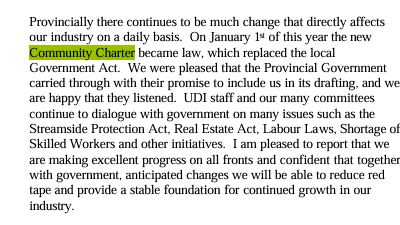
Excerpt from the UDI ANNUAL REPORT
· MAY 2004 · PAGE 3
By Sasha Izard
Dec 12, 2024
The Community Charter is one of the most important Statutes in the province of British Columbia.
The Union of BC Municipalities had described the function of the Municipal Charter as follows:
“The Community Charter (Charter) provides the statutory framework for all
municipalities in British Columbia (other than the City of Vancouver). The
Charter sets out municipalities’ core areas of authority, including: broad
powers (e.g., municipal services); property taxation; financial management;
bylaw procedures; and bylaw enforcement. The Charter provides the
principal source of municipal corporate (“natural person”) powers,
including broad spheres of service and regulatory powers, and specific
powers (e.g., expropriation). While the Charter is focused on municipalities
it should be noted that many provisions, such as public accountability and
procedural matters, apply to regional districts. The Charter also sets out
principles of municipal-provincial relations, including consultation
requirements and dispute resolution processes.”
The Community Charter was enacted in 2003 and offered broad levels of autonomy or semi-autonomy to Local Governments in British Columbia. 20 years later in 2023, the Provincial Housing Bills being introduced that year were rapidly eroding powers of local governments and curtailing vast amounts of public hearings across the Province.
The irony is that some of the same forces that helped draft the Community Charter, had now convinced the Province to seize back zoning powers from local governments by intervening in municipal affairs.
The primary organization behind this push is the Urban Development Institute (UDI), the most powerful and influential lobbying organization for development and real estate interests in the Province.
Yet the UDI’s influence had been there from the Charter’s very beginning. As Provincial Housing Bills 44-47 were being rushed through in November of 2023 and the UDI’s influence on them was being exposed, the UDI pulled down all its branch websites, and replaced them with a new site UDI.org. Many of the documents that detailed the UDI’s lobbying over the years, including most of its annual reports over the last couple decades, disappeared from public access, as did the UDI’s members directory containing a list of hundreds of corporate members involved in development and real estate that the UDI was offering representation and political influence to, including for big banks and credit unions.
Of the few documents to survive from that purge, the UDI’s 2004 Annual report is one of the most telling. The UDI were proud of their many recent lobbying achievements at the time, including getting environmental regulations shelved for protecting fish habitat in natural streams.
They were also particularly proud of their having helped the Province draft the Community Charter, something so they mentioned that the Province had promised that they would be able to do. Just as recently they have helped the Province undo many municipal powers, in favour of provincial power, so they helped the Province draft the Community Charter which granted numerous powers to the municipalities.
The question then, as now, is why was and is a lobbying organization representing hundreds of corporate members, helping (now I’d say it’s more like the driving force) not only for the Province but for all levels of government to generate and implement legislation relevant to urban planning and housing policy in BC?
Was the UDI’s influence over all levels of the government (something they are very proud of), both acting within and outside the governmental system, appropriate due influence, or was and is it, a powerful example of undue influence operating on the governmental system?
Has this power and influence recently been used, in order to railroad corporate agendas on vast geographical areas and steamroll the public by removing them from public input processes such as public hearings on zonings?
Why were the UDI so enthusiastic about helping the Province draft the Community Charter in the first place? Shouldn’t the Province have kept such a powerful lobby for real estate and development at an arm’s length from the Charter’s start?
Ultimately this comes down to a question of democracy vs., hidden corporate influence on the Province of B.C. Who is really in charge, the people, or the corporations in the Province?
By important powers over municipalities shifting from The Local Government Act to the Community Charter was a certain amount of deregulation involved right from the outset?
While the UDI certainly still appears to be as avid as ever in helping the Province and other levels of government draft legislation that is in tune with their paying member company’s agenda’s and the Province seems to be as avid as ever, perhaps even more so than in the past to take them up on their offer, so does its paying member company Urban Systems help the Province on the generation of policy, particularly around transportation and on housing targets by a virtual monopoly on the creation of so-called Housing Needs Reports across the Province, something that had been lobbied to the Province by the UDI.
As the UDI’s power and influence and government were never effectively challenged from the outset, so with the adoption of the recent housing bills, it appears to have snowballed out of control. Is the government at all levels really in charge of its urban planning and housing policies? Many indications suggest that multiple levels of government have been playing second fiddle to the lobby’s agenda in regard urban planning policy for far too much time.
Where were the media all this time? They were giving them more than a free ride, they were often pumping the UDI’s agenda to the public, without asking critical questions about its overarching influence on governmental housing policy. Often media coverage of the UDI have blurred the lines between journalism, public relations, and what may be so-called native advertising, if not native advertising per se, the advertising revenue the media gets from real estate ad and other revenue is enough to put undue pressure on the media to conform and even push their narrative/agenda. The UDI even offers Communications memberships for media, including the Times Colonist, and its parent company Glacier Media.
The following are two excerpts from the UDI’s 2004 Annual Report showing their influence on the media of the day (don’t think anything has changed since):
Excerpt 1:
“In an effort to share more information with members, government and
the public, our communications committee followed through on some
key objectives this past year – the creation of a newsletter aimed at
informing municipalities on a number of relevant topics, and two
special edition sections of the Vancouver Sun and Province
newspapers aimed at informing the public of the role of the Institute
and the industry as partners in community building.”
Excerpt 2:
“Two special newspaper supplements were published by Pacific Press
under the “Building B.C.” masthead, featuring the development
industry with U.D.I. controlling the editorial content. One was
distributed as an insert in the Vancouver Sun last Fall and the other
was distributed in the Province early this Spring.
UDI has also begun contributing to editorial submissions to Pacific
Press’ monthly new home finder magazine.
As well, Bob Ransford, one of UDI’s directors, continues to write his
“City Vision” bi-weekly column in the Vancouver Sun Westcoast
Homes section, often featuring issues of interest to UDI.
The Communications Committee has also been involved in providing
advice and support to UDI staff and to the Board in developing
strategies and key messaging in response to issues such as the shortage
of skilled workers, DCL rates in Vancouver, streamside protection
regulations, the Arbutus corridor land use issue, Coquitlam DCC rates
and a wide range of other issues.
———————————————————————————————
The following are 2 excerpts from the UDI’s 2004 Annual Report showing their influence with the BC Liberal government of the day:
Excerpt 1:
“Our relations with the provincial government remain strong. Premier
Campbell recognizes the importance of our industry to the provincial
economy and continues to meet annually with your Board of Directors
and address the membership. Although the Honourable George
Abbott left the municipal affairs and housing portfolio to take over the
sustainable resource management portfolio, the groundwork he
undertook to ensure a strong and stable development industry is being
carried on by the Honourable Murray Coell. UDI president Ward
McAllister and I have met with Minister Coell as well as Ministers
Abbott, Barisoff, Hagen, Collins, Falcon, Murray, and others along
with senior officials on matters ranging from deposit insurance and the
new Real Estate Development Marketing Act, environmental
legislation including the Streamside Protection Regulation and Waste
Management Act, the skilled worker shortage, Community Charter,
economic policies, energy efficiency policies, deregulation, to name a
few. UDI has a long track record of being a “voice of reason” and
governments continue to turn to the Institute for advice and thoughtful
comment on public policies and legislative initiatives.”
Excerpt 2:
“The Institute is now in its 31st year and it has been both exciting and
rewarding being part of the evolution. Today the Institute has become
a leading voice on any and all issues associated with community
building. We have done an excellent job of communicating and
educating all levels of government, many whom firmly believe we are
partners in the process of community building.
In the fall of 2002 your Board, through a series of planning sessions,
agreed upon a new Strategic Plan for the Institute, which would shift
the direction of our resources to education and discussion more
focused on our responsibilities at a municipal level. This decision led
us to the recruitment of Cameron Thorne, as our Director of Municipal
Affairs. Cameron was formerly the Ministerial Assistant to the
Honourable George Abbott, Minister of Community, Aboriginal, and
Women’s Services. Cameron has done an exceptional job of
reformating and expanding our municipal liaison functions with the
City’s of Vancouver, Richmond, Coquitlam, and Burnaby. These
committees are working well and we feel privileged to have so much
commitment from both councils and staff for being included in the
process of shaping our communities. I thank every one of our
members who give up their time to be part of these very important
committees as we plan to devote more attention to these vital roles.
Provincially there continues to be much change that directly affects
our industry on a daily basis. On January 1st of this year the new
Community Charter became law, which replaced the local
Government Act. We were pleased that the Provincial Government
carried through with their promise to include us in its drafting, and we
are happy that they listened. UDI staff and our many committees
continue to dialogue with government on many issues such as the
Streamside Protection Act, Real Estate Act, Labour Laws, Shortage of
Skilled Workers and other initiatives. I am pleased to report that we
are making excellent progress on all fronts and confident that together
with government, anticipated changes we will be able to reduce red
tape and provide a stable foundation for continued growth in our
industry.”
———————————————————————————————–
References:
Local Government in British Columbia – 4th Edition
Local Government in British Columbia Fourth Edition
Robert L. Bish Eric G. Clemens
UBCM (2008)
UBCM Local Govt Fact Sheets 2022_0.pdf
Table of Contents – Local Government Act
Table of Contents – Community Charter


 CRD Watch Homepage
Leave a comment