How the proposed “RapidBus” lanes in the Capital Region, including on McKenzie, were used as part of the UDI development lobby’s push for enforced densification/upzoning along rapid transit corridors, during their lobbying to David Eby in 2022
AKA Thrown under the Bus: how transit is being used to force high density on communities, while greenwashing the developers’ for-profit agenda.
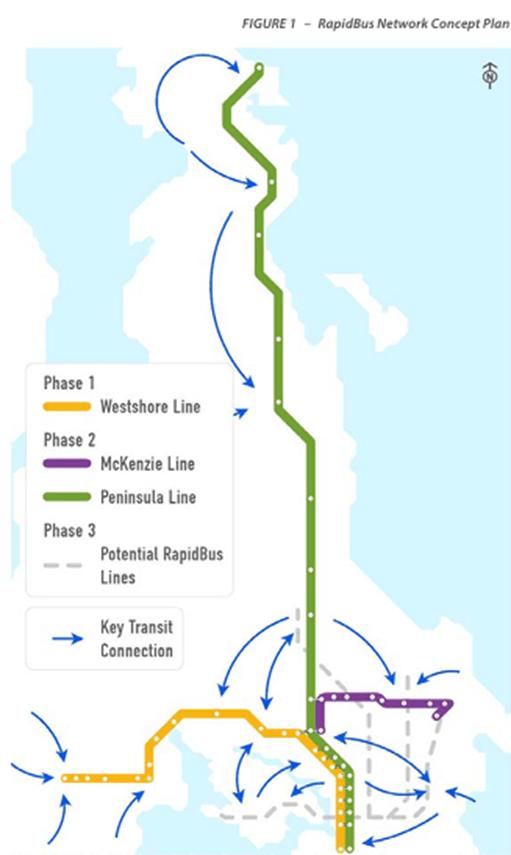
Image Source: BC Transit (2021)
The planned “RapidBus”, McKenzie line was revealed in mid 2021, by the Crown Corporation BC Transit through its BC Transit Victoria Regional Transit RapidBus Implementation.
This plan was synchronous with Saanich’s Centre Corridor and Village (CCV) work plan, decided on only a few months earlier. The new CCV work plan corresponded directly to the pausing of Saanich’s Local Area Plans. The majority council decision to pause the LAPs and the decision to endorse the CCV work plan took place simultaneously.
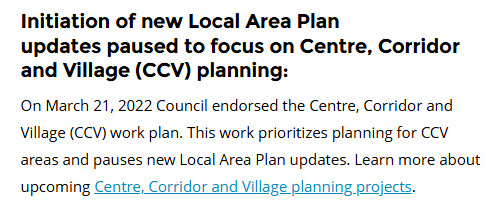
Source: Local Area Plan Updates | District of Saanich (Accessed: Dec 5, 2024)
The Local Area Plans were ultimately rendered legally non-binding 3 years later on May 7, 2024 by a majority council decision to remove them from the District’s Official Community Plan (OCP) Bylaw, at the same council meeting that Saanich adopted its new OCP. At the meeting both third reading of the OCP, the 4th and final reading were read in the same night, something that was noted in the press as “unusual.” Thus, the new OCP was approved in Saanich, over a year and a half prior to its required completion due date from the Province.
Earlier that day, Saanich’s Mayor Murdock had been a featured speaker at the Union Club for an event of the registered lobbying group the Urban Development Institute (UDI). Other featured speakers at the event included BC Transit’s Director of Corporate & Strategic Planning, a Senior Economist and Vice President of Intelligence at Rennie (the company of Bob Rennie the so-called Condo King of Vancouver), the Minister of Transportation and Infrastructure at the time Rob Fleming, Victoria’s Mayor Alto, and the UDI Capital Region’s Chair Ben Mycroft.
The event was titled: “Pathways to Progress: Uniting Land Use and Transit Strategies for Sustainable Growth”
By Sasha Izard
Published: Dec 5, 2024
and updated subsequently.
On March 10, 2022 the Executive Committee of the Urban Development Institute (UDI), a registered lobbying organization for development and real estate on the BC Lobbyists Registry, met with David Eby, when he was the Attorney General/Minister Responsible for Housing. He would become Premier by the end of the year. His only challenger for the NDP leadership, had been disqualified by the party elite.
At the meeting and in a 19 page letter for it, the UDI lobbied Eby to force local governments through provincial pre-zoning, to drastically increase density/upzoning in areas around rapid transportation corridors, something that could make the lobbying organization’s paying member companies involved in development and real estate, billions of dollars in potential profits through resulting land-lift around them.
While the developers would benefit from such policies, the residents would lose their power of public input through the waiving of public hearings on a vast amounts of zoning proposals.
The following is a copy of the UDI’s Lobbying Activity Report 3004-17730 on the BC Lobbyists Registry for lobbying activity dated to March 10, 2022:
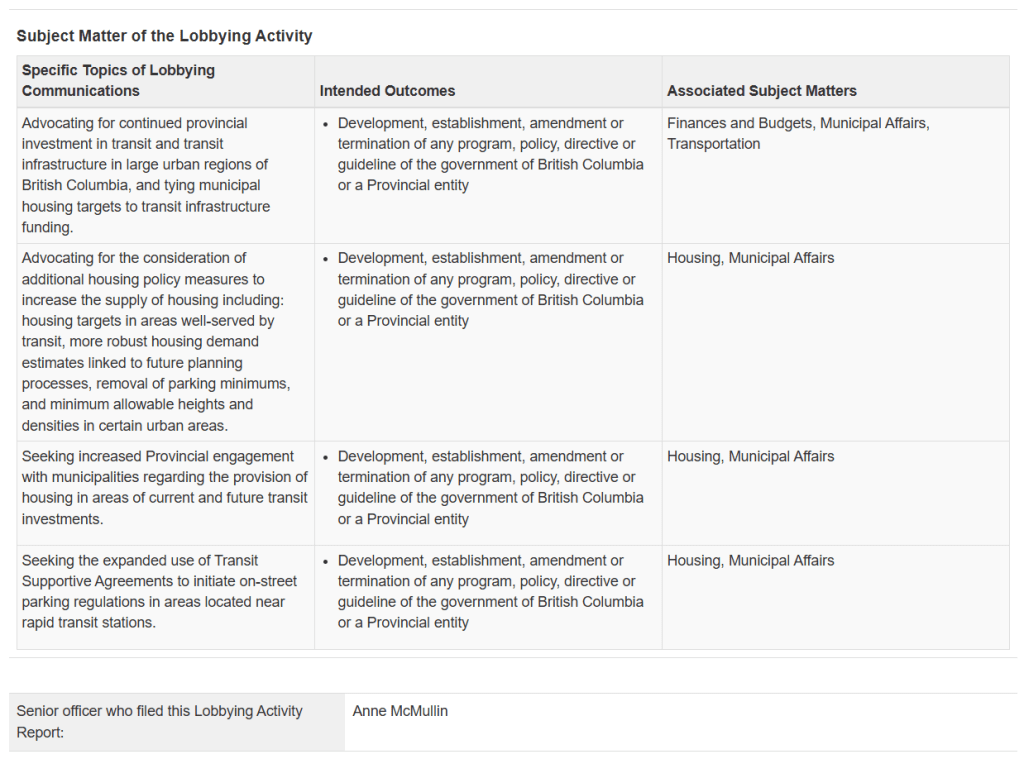
The UDI’s push for the Province to force upzoning along rapid transit lines, included a proposed rapid bus line in the Capital Region with a map from BC Transit (p.5 of the document as seen at the top of this article). The UDI however, did not cite the map’s source in the letter, while placing it beneath their own logo. The map showed an intended rapid bus line going through McKenzie and also potentially on Quadra as well.
Readers of the archived BC Transit Victoria Regional RapidBus Implementation Strategy will be familiar with what is now being proposed along McKenzie in the Quadra McKenzie Draft Plan. BC Transit, a Crown Corporation is a paying member of the UDI, as is its spinoff, the Statutory Authority TransLink in Vancouver.
Urban Systems, an engineering consulting company and paying UDI member, did the consultation work for the BC Transit Plan, as is evinced by its corporate logo twice placed by BC Transit in the opening page about it. Urban Systems around this time veiled by its subsidiary Urban Matters, was also receiving a monopoly on the Housing Needs Reports (HNRs) aka Housing Needs Assessments, for the municipalities beholden to the CRD’s Regional Growth Strategy (RGS), and a virtual monopoly on creating them across the Province of BC that netted the company hundreds of thousands of dollars.
The UDI had lobbied the Province extensively for the creation of housing needs reports, to which it succeeded, at least twice now, and it continues to lobby the province to require further batches of them from municipalities.
In addition to the creation of housing needs reports and having them legally mandated where they were adopted, the UDI also lobbied for enforceable housing targets, particularly around transportation corridors, much like in the BC Transit plan that notes that a purpose of the plan is to promote growth in such places, in following with the CRD’s Regional Growth Strategy.
The Housing Needs Reports were part of the CRD’s Regional Growth Strategy. The RGS mandated that the Official Community Plans of the municipalities must conform legally to the housing targets. This alone was not enough for the UDI however. They demanded that not only must the local governments conform legally to the targets, the targets would have to be enforceable as well and to make them enforceable required enforcement mechanisms.
The following are slides from the presentation the UDI provided to Eby on March 10, 2022
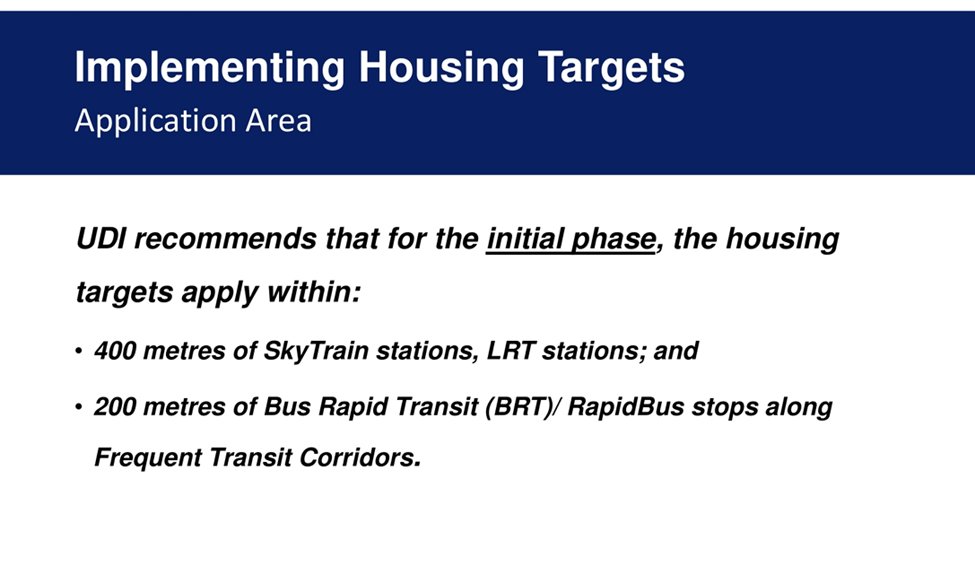
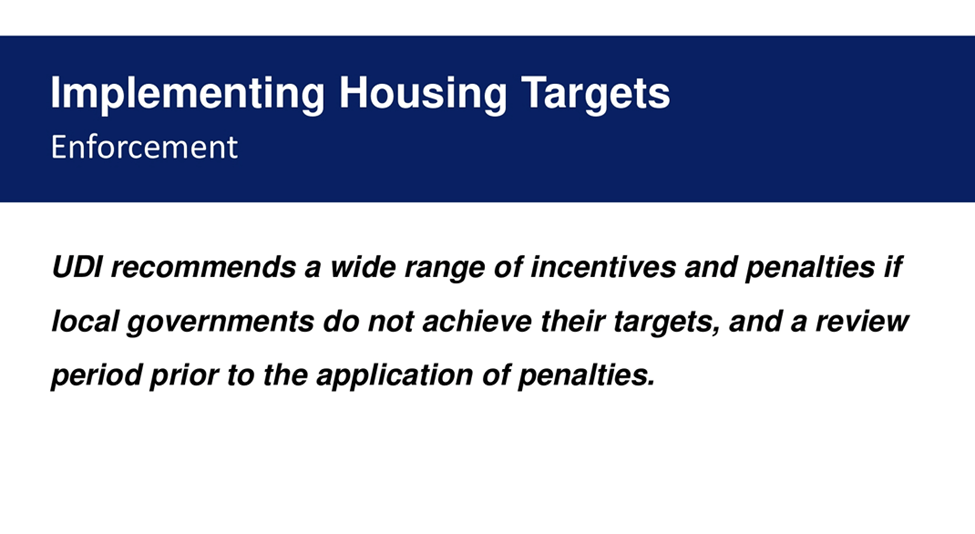
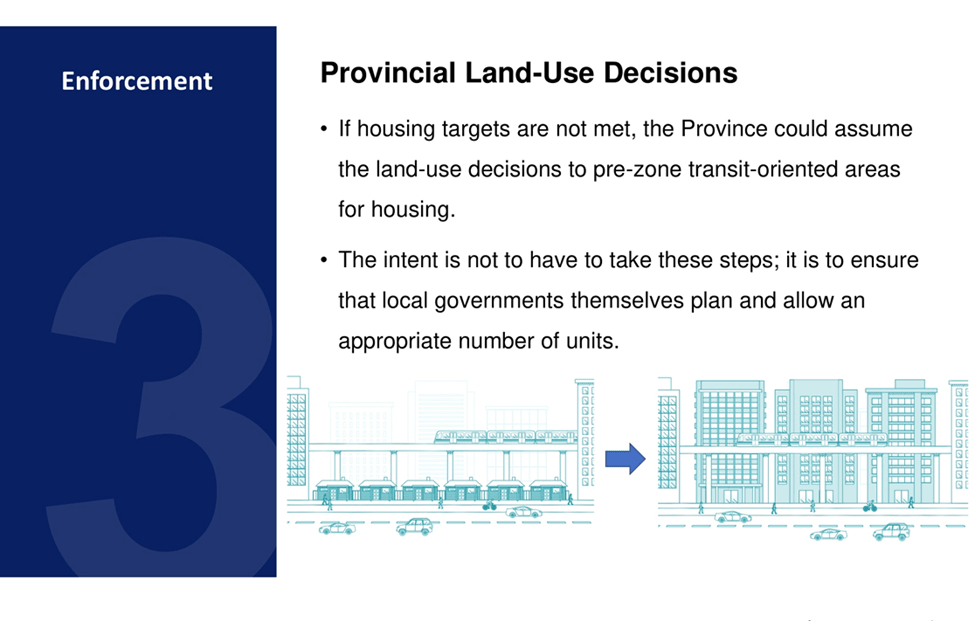
The UDI prescribed to the Province harsh medicines for local governments that might dare to not go along with the UDI’s agenda of forced housing targets along rapid transit corridors:
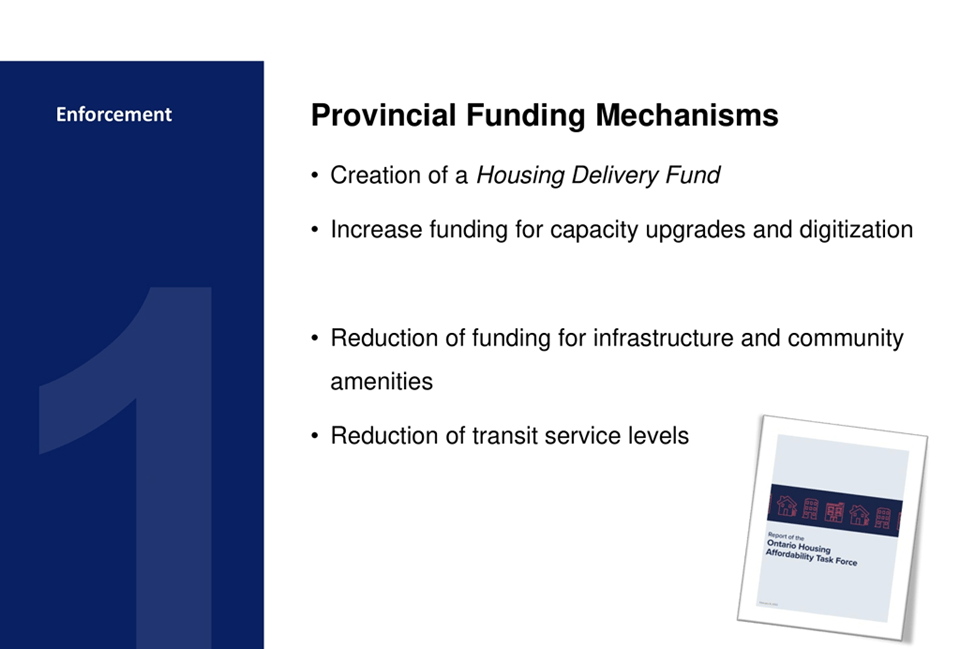
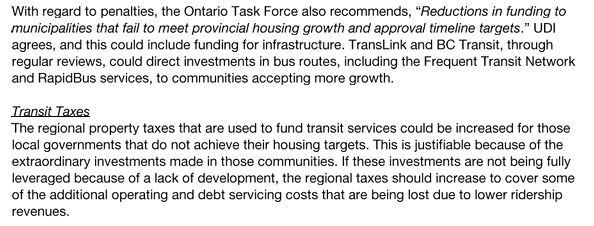
The punitive stick approach to local governments, not approving enough construction as to be satisfactory to the UDI, could as suggested, involve for example, cutting infrastructure funding to local governments, or increasing taxes on those living around these areas:
Their second prescription involved what certainly looks to have been none other than regulatory capture:

The province didn’t just offer the threat to local governments as the UDI suggested, of the possibility of seizing land-use decisions from them. The Minister of Municipal Affairs at the time, proposed this to cabinet a month later with his April 14, 2022 Cabinet Concept Paper titled:

The Province did exactly that 2 and a half years later with the housing bills and it did pre-zone/upzone around transit oriented areas, with what became Bill 47 with its Transit Oriented Development Areas (TODs) or Transit Operating Areas (TOAs).
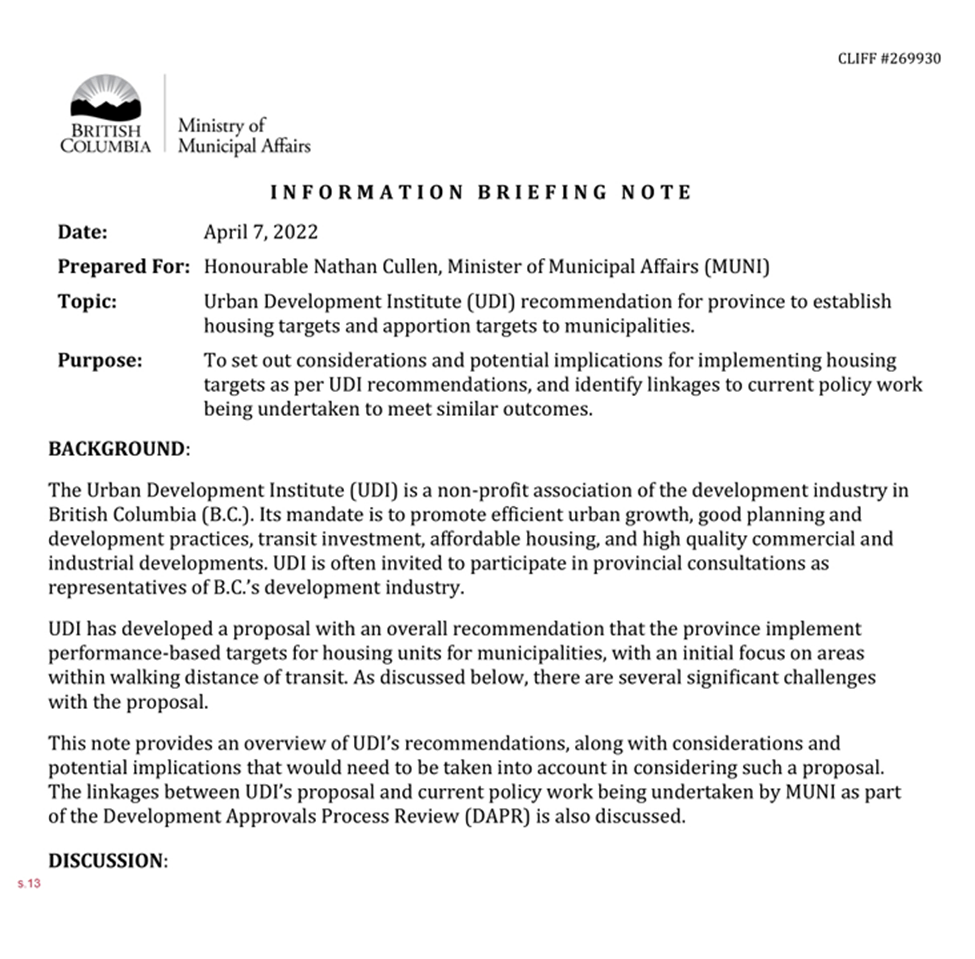
A week previously, the Minister had received the following briefing from his ministry:
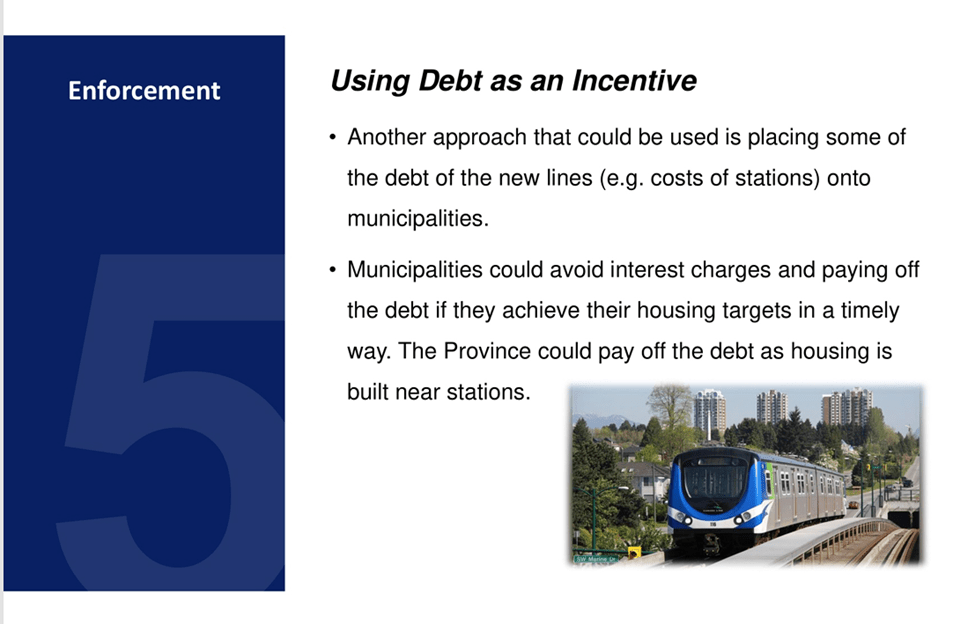
The last “enforcement” slide in the UDI’s presentation to David Eby on March 10, 2022:
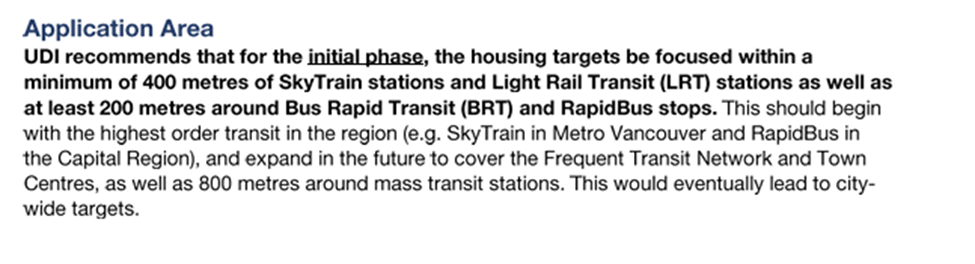
The following 2 image excerpts are from the UDI letter to Eby. What the UDI lobbied Premier Eby for in 2022, looks remarkably similar to what the Province tabled 2 and a half years later in Bill 47.
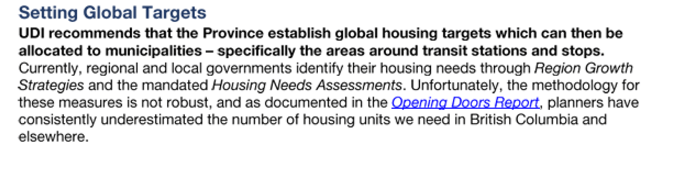
Not only was UDI member company Urban Systems (through its subsidiary Urban Matters) receiving a virtual monopoly on the housing needs reports/assessments across the province, and a full monopoly on the reports for the municipalities that are part of the CRD’s regional growth Strategy including Saanich, but it was also (as through Urban Matters) a consultant for the Saanich Housing Strategy of August 2021 where it worked with Saanich’s Housing Strategy Task Force described as a “Stakeholder Task Force” in the Saanich News, which included numerous members of that have or had ties to the UDI and UDI member organizations.
Urban Systems and was also key consultant on the BC Transit plan. It was also a key consultant and Project Manager on the Province’s Active Transportation Design Guide (2019), that helped the Ministry of Transportation develop and direct the 577 page guide. Under the acknowledgements for the guide (p.3), its logo was placed next to the Ministry of Transportation. Urban Systems was also a consultant hired for Saanich’s Active Transportation Plan, both of which were synchronous with the BC Transit plan. It also “prepared” with help from an architectural firm, the BRITISH COLUMBIA ACTIVE TRANSPORTATION AND TRANSIT-ORIENTED DEVELOPMENT DESIGN GUIDE: A Supplement to the British Columbia Active Transportation Design Guide (June 2021) You might have noticed a pattern by now. The guide introduced Transit Oriented Development Areas (TODs) for provincial policy, something that will be discussed in more and which were applied Provincially through Bill 47, and to which the UDI had demanded enforceable housing targets for. The UDI had lobbied the Federal government in 2018 for the adoption of TODs (See appendix on this).
Urban Systems was also a key consultant on the Shelbourne Valley Action Plan, which would involve, active transportation, upzoning, and major sewer upgrades necessary for massively increasing the density of the valley (that wiped out dozens of once mighty Shelbourne Trees). The UDI was also a stakeholder consulted on the plan. The UDI Chair at the time the plan was being drafted was also on the Shelbourne Valley Stakeholders Committee, along with the UDI Capital Region’s Executive Director. The Chair was also serving on Saanich’s Planning, Transportation & Economic Development (PTED) advisory committee. The UDI was also a key stakeholder on Saanich’s new OCP.
Urban Systems had also received at least one contract in Sooke regarding consulting for the Province’s Development Approval Process Review (DAPR), a process initiated by the Province to ‘streamline the development process’, and ‘remove red tape’ around development approvals that looked remarkably like the UDI’s own material. The UDI served as as stakeholder to the Province on the DAPR.
Urban Systems also advised Saanich on various charges for developers, as well as on underground sewage infrastructure. They would do a similar analyses of developer cost charges (DCCs) for the CRD’s water expansion plans in 2023/2024, presenting these to municipalities in the CRD, while the UDI ran a massive public relations plan in parallel, asking for a reduction in DCCs for the plan which would cost hundreds of millions of dollars in order to create the water infrastructure necessary to feed the sort of development the UDI pushed to all levels of government and to which its paying member companies would profit from, while the public would be pressed with an added tax burden to cover the increased infrastructure costs.
Contracts from the District of Saanich to Urban Systems over a 5 year period:

Below the same BC Transit map showing the intended McKenzie RapidBus line (see below), and elsewhere in the letter that the UDI sent to Eby in March 2022, the UDI railed about “NIMBY groups” and what they referred to as the coming “uphill battle” to be faced by such groups, against development around transit stations.
The UDI offered a set of tools that they suggested to Attorney General and Minister Responsible for Housing David Eby (now Premier). These included the possibility and/or threat of meting out punishments to municipalities that fail to densify fast and high enough, according to the UDI’s agenda of “enforceable” housing targets set by the Province upon Local Governments.
The Province implemented the UDI’s enforceable housing targets with Bill 43 (2022) the so-called Housing Supply Act, which the Province consulted the UDI on during its generation, and also by the subsequent housing bills 44 and 47 (both tabled in 2023), both of which involved provincial prezoning on a vast level.
The following is quoted from an April 18, 2022 article ”City of Victoria eliminates rezoning and public hearings for affordable housing” by Kenneth Chan (the text was bolded by myself.):
“In an interview with Daily Hive Urbanized last month, David Eby, BC Attorney General and Minister responsible for Housing, said he will reform the municipal approval process for housing construction later this fall — to clear red tape that prevents some much-needed new condos, apartments, and townhomes from being built for years.”[i]
[i] https://dailyhive.com/vancouver/city-of-victoria-affordable-housing-rezonings-public-hearings-requirement (Accessed: April 18, 2022)
2 years after the UDI March 2022 letter/meeting with David Eby, the proposed Quadra/McKenzie draft plan includes a rapid bus line going down McKenzie and also sections of Quadra, but bizarrely, limiting auto traffic to a single lane on either side to facilitate it. This is perhaps not so unpredictable, if to view BC Transit’s 2021 plan that was taken down from their website, but the archived version of which still exists.
If the RapidBus lane on McKenzie plan were to fail, the UDI would have lost a key raison dêtre for the Province to impose such draconian conditions on the area in the future, in order to facilitate the UDI’s plans for sky-high density along it. It would also negate much of the raison dêtre for Saanich’s plans for the Corridor including its upzoning proposals, many of which are part and parcel with the RapidBus plan.
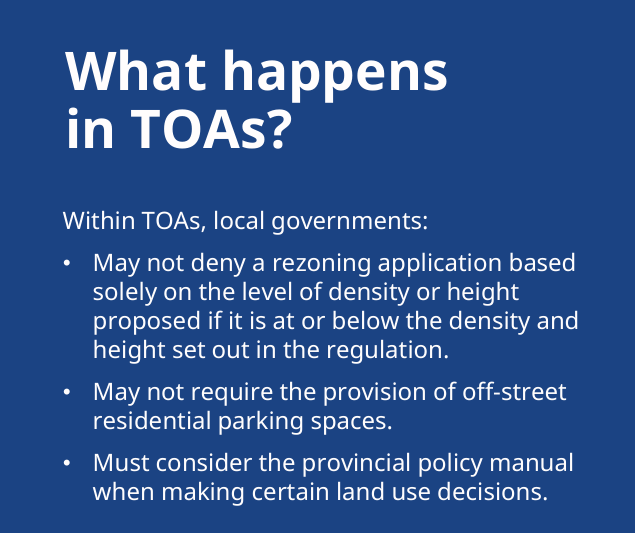
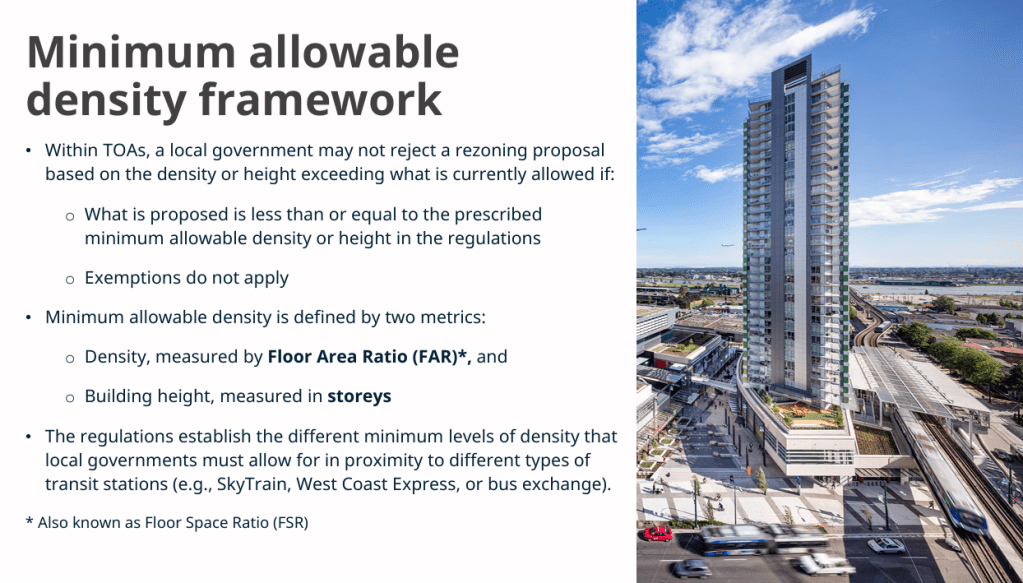
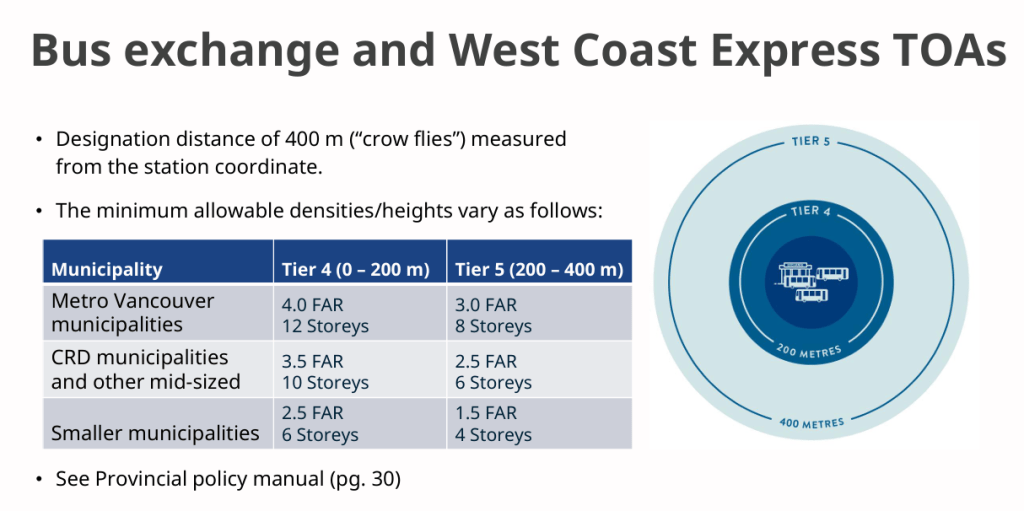
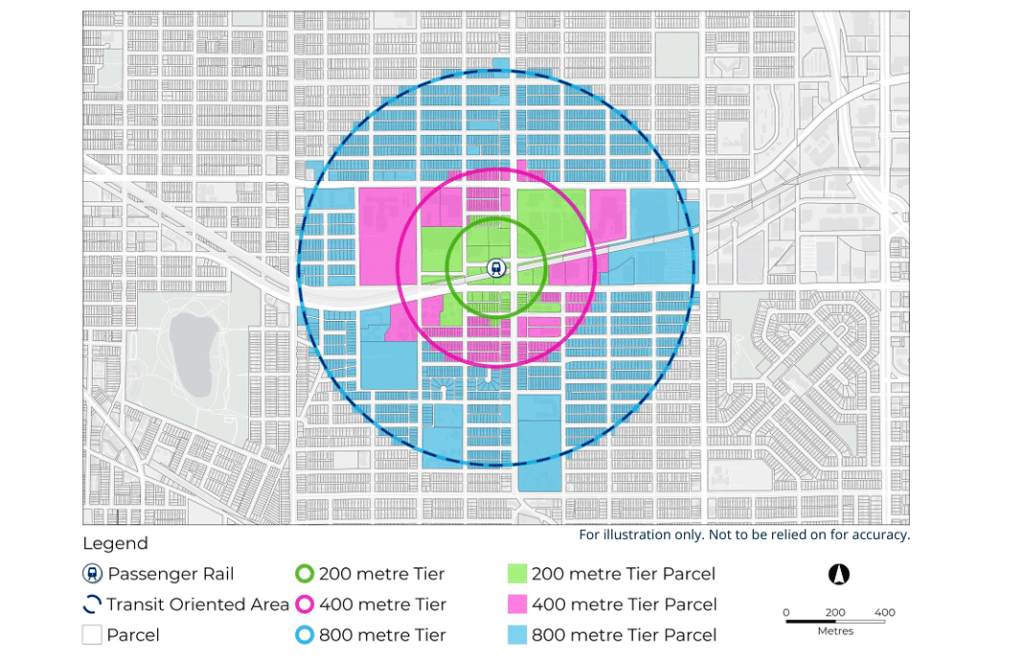
The UDI’s perhaps greatest fear for the area, might be that the collapse of the RapidBus plan along McKenzie/Quadra, could prevent a future Transit Oriented Area (TOA), which according to Bill 47 could force pre-zoning/upzoning within the TOA’s radius to much higher minimum building heights/densities.
The following image excerpts are from a Provincial guide to Bill 47:


————————————————————————————————
As only one TOA was listed by the Province for Saanich (in the Uptown core), I sent the following email to Saanich’s Planning department:
Hello Saanich Planning,
I have a question. Is there any TOA/TOD being proposed for the Quadra/McKenzie plan/area?
Thank you,
—————————————————————————————————
Saanich planning responded:
“Good afternoon, Sasha,
The Official Community Plan (OCP) identifies Saanich TOA’s and Provincial TOA’s. Quadra McKenzie Centre and Shelbourne McKenzie Centre are the two Saanich TOAs within the Quadra McKenzie study area and identified in the OCP, and Gordon Head McKenzie Centre is a new Centre identified through the Quadra McKenzie Plan. Note that Saanich TOAs are not subject to provincial regulations (minimum density and height regs) but are critical to the District’s land use framework and are important locations to prioritize future transportation and land use investments. I hope this answers your question.
Thank you,
Quadra McKenzie Team.”
————————————————————————————————
Thank you very much, your response is much appreciated.
“Note that Saanich TOAs are not subject to provincial regulations (minimum density and height regs)”
Why are Saanich TOAs not subject to provincial regulations?
Are you saying that Saanich has created its own TOAs, and that these are not Provincial TOAs?
————————————————————————————————
A Saanich planner responded:
“That is correct that Saanich identified additional TOA sites, beyond the Provincial TOAs.
It is important to note that no Provincial requirements apply to the Saanich TOAs, as they are not specifically identified in the Provincial legislation.
The main reason why this was done is to ensure transit investments will be directed to those locations that have and will continue to have strong ridership demand. The Saanich TOAs are also identified in BC Transit’s Transit Future Plan as exchanges.
We are not privy to the Province’s methodology for selecting Provincial TOA sites, but we felt it was important to ensure that we were clear about the locations that warranted priority for transit investments, including those not identified by the Province.”
————————————————————————————————
I responded on December 14: Hi,
Thank you for your response.
Do Saanich TOAs like Provincial TOAs involve pre-zoning, or increased density/height zoning in those areas in the OCP?
In the OCP it says: “Provincial TOAs are located at the Royal Oak Exchange, Uptown Multi-modal Transit Hub and the University of Vicotoria Exchange. A separate bylaw is being prepared to meet the June 2024 deadline and will officially designate these TOAs.””
Yet in the Province’s material, I’ve only seen the Province designate one TOA for Saanich at the Uptown Mall.

Where has the Province designated the Royal Oak Exchange and the UVic Exchange as TOAs?
Transit oriented development areas – Province of British Columbia
————————————————————————————————
On Dec 31, the planner responded again:
Here are the links to where the Province designated Royal Oak and UVIc in the Housing Statutes (Transit-Oriented Areas) Amendment Act
Also a general overview here:
Transit oriented development areas – Province of British Columbia
————————————————————————————————
The planner also responded to my previous question (“Do Saanich TOAs like Provincial TOAs involve pre-zoning, or increased density/height zoning in those areas in the OCP?”:
Hi Sasha,
The Saanich TOAs do not include any of the minimum height / density requirements associated with Provincial regulations (Note: provincial regs do not technically pre-zone areas, they just prevent municipalities from turning down rezoning applications on the basis of height / density within prescribed minimums).
Saanich TOAs are areas where additional density is seen to be desirable, but specific heights/densities are based local conditions and are more nuanced than provincial guidance.
Please call me if you would like to discuss further.
————————————————————————————————
I consider the planner’s last email to be pretty nuanced. How preventing municipalities from turning down rezoning applications on the basis of height/density within prescribed minimums is not pre-zoning is beyond me.
Frankly, the expression if it quacks like a duck, it probably is a duck comes to mind.
The second part of their response, I found to be very vague.
————————————————————————————————
I replied to the Planner:
Hi,
Thank you for the answers to my questions.
The first email is as clear as day. Thank you for that clarifying and additional information.
Your second email, I find a bit more vague.
“(Note: provincial regs do not technically pre-zone areas, they just prevent municipalities from turning down rezoning applications on the basis of height / density within prescribed minimums).”
How is this not technially pre-zoning?
“Do Saanich TOAs involve pre-zoning, or increased density/height zoning in those areas in the OCP?”
You responded: “The Saanich TOAs do not include any of the minimum height / density requirements associated with Provincial regulations”
Thank you for the response, but it doesn’t quite answer my question. I will rephrase it:
“Do Saanich TOAs involve pre-zoning, or increased density/height zoning in those areas in the OCP?”
Thank you again,
Sasha
————————————————————————————————
Conclusion to the dialogue:
While Provincial requirements do not apply to Saanich’s own TOAs, that doesn’t mean that the Saanich TOAs will not be used to push density in those areas as well, which is the point of Saanich’s Centres Corridors and Villages (CCV) planning.
The following with map showing TOAs overlapping with centres is from p.78 of the pdf of Saanich’s new OCP (Accessed Dec 6, 2024):


The Uptown Core TOA is the only one mandated for Saanich by the Province on their list of 52 TOD Areas designated by regulation – in effect immediately. However 2 other TOAs are also the requirement of Provincial Statues: The Royal Oak Exchange and the UVIC Exchange TOA. Saanich’s own non-Provincially mandated TOAs include the Quadra/McKenzie TOA and the Tillicum/Burnside Centre TOA, thus the total number of TOAs for Saanich is 5 with potentially more to come.
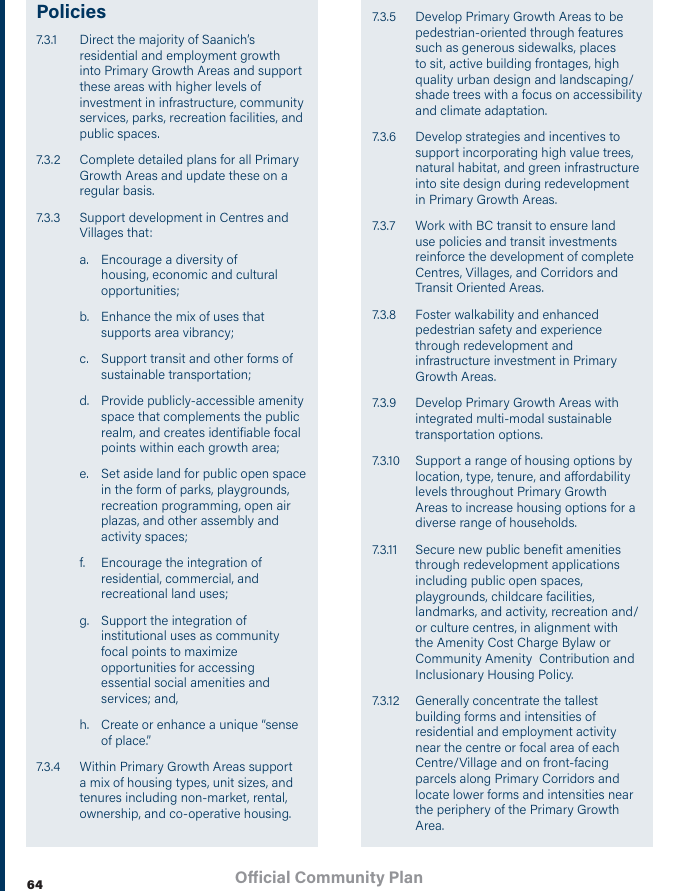
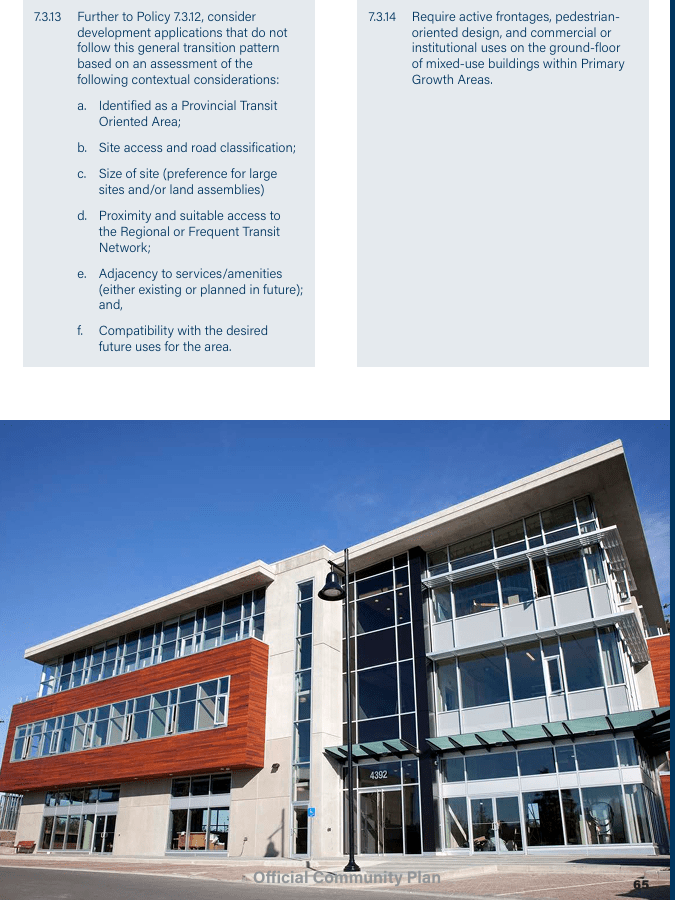
More pages related to this from the OCP are below:
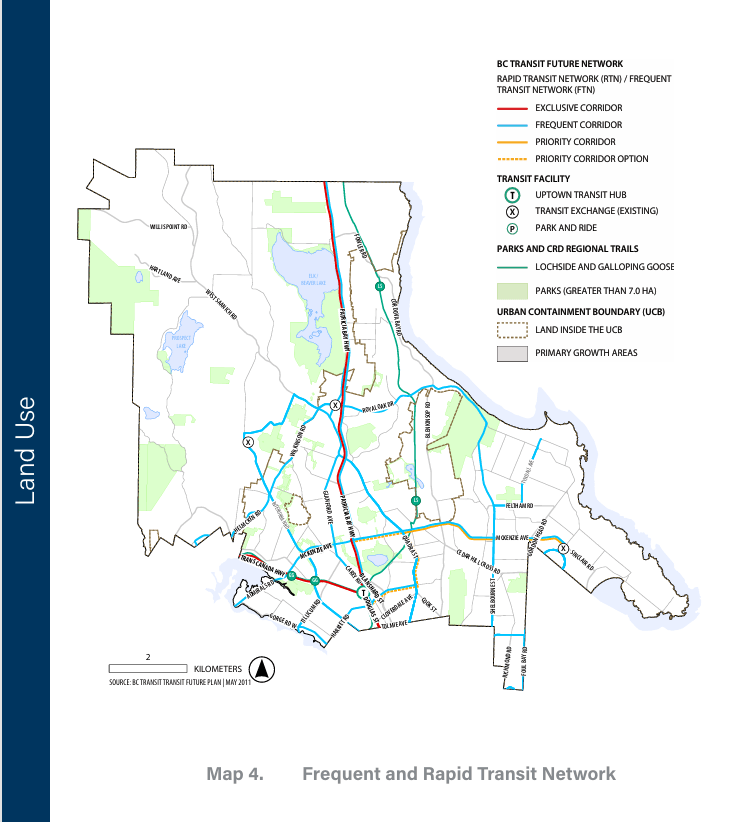
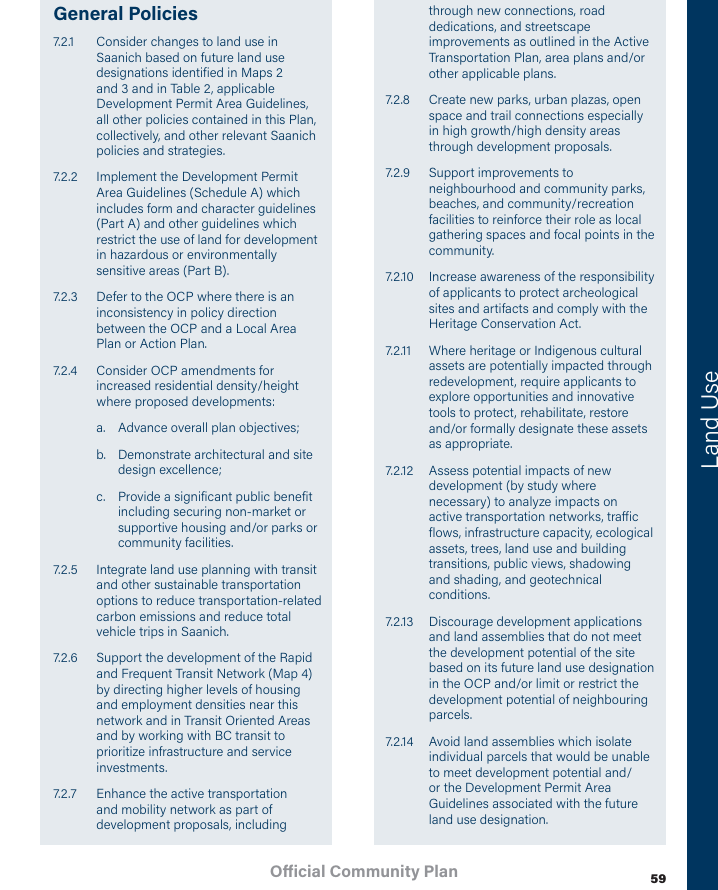
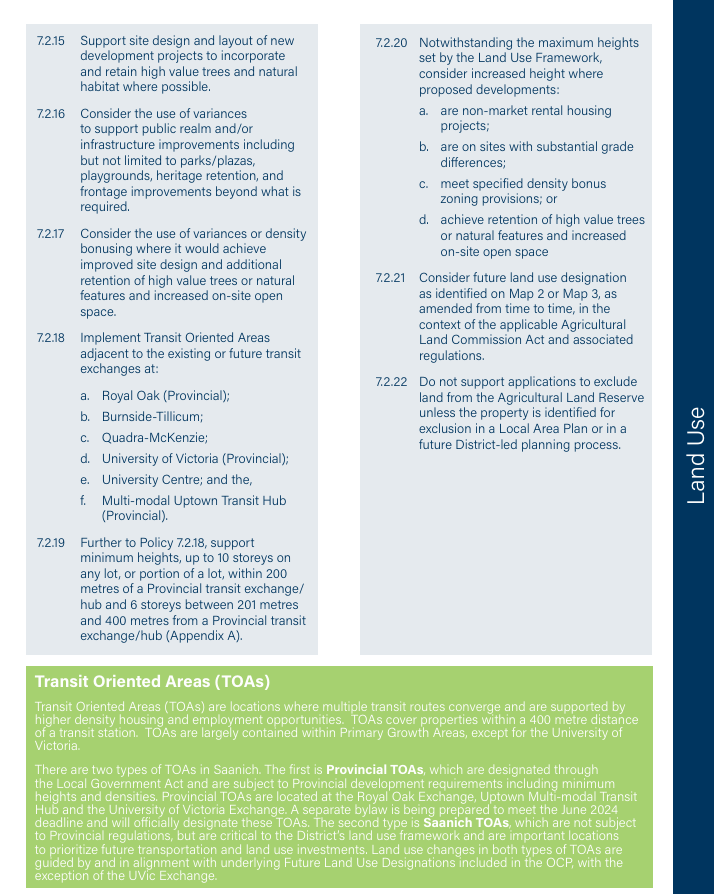
Note: the greenwash colour text in the OCP on the TOAs, certainly doesn’t make for easy and accessible reading.
I have retyped them to make it more clear.
“There are two types of TOAs in Saanich. The first is Provincial TOAs, which are designated through the Local Government Act and are subject to Provincial development requirements including minimum heights and densities. Provincial TOAs are located at the Royal Oak Exchange, Uptown Multi-modal Transit Hub and the University of Vicotria Exchange. A separate bylaw is being prepared to meet the June 2024 deadline and will officially designate these TOAs.”
“The second type is Saanich TOAs, which are not subject to Provincial regulations, but are critical to the District’s land use framework and are important locations to prioritize future transportation and land use investments. Land use changes in both types of TOAs are guided by and in alignment with underlying Future Land Use Designations included in the OCP, with the exception of the UVic Exchange.”

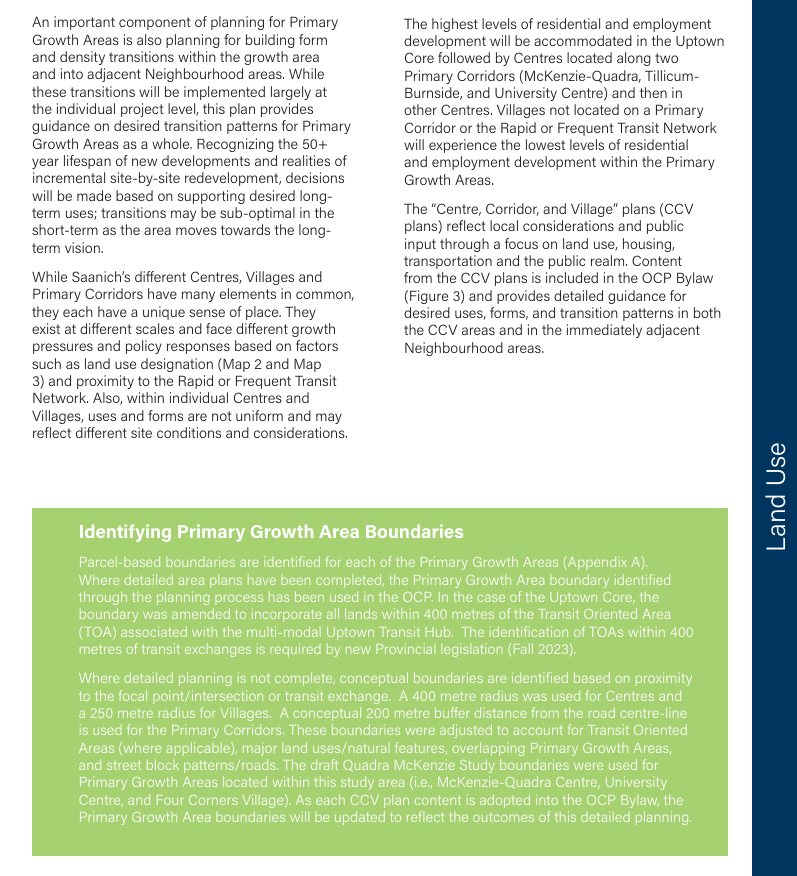
Note again: the greenwash colour text in the OCP on the TOAs certainly doesn’t make for easy and accessible reading.
Once again, I have typed it out for accessible reading:
“Identifying Primary Growth Area Boundaries
Parcel-based boundaries are identified for each of the Primary Growth Areas (Appendix A). Where detailed area plans have been completed, the Primary Growth area boundary identified through the planning process has been used in the OCP. In the case of the Uptown Core, the boundary was amended to incorporate all lands within 400 metres of the Transit Oriented Area (TOA) associated with the multi-modal Uptown Transit Hub. The identification of TOAs within 400 metres of transit exchanges is required by the new Provincial legislation (Fall 2023).
Where detailed planning is not complete, conceptual boundaries are identified based on proximity to the focal point/intersection or transit exchange. A 400 metre radius was used for Centres and a 250 metre radius for Villages. A conceptual 200 metre buffer distances from the road centre-line is used for the Primary Corridors. These boundaries were adjusted to account for Transit Oriented Areas (where applicable), major land uses/natural features, overlapping Primary Growth Areas, and street block patterns/roads. The Draft Quadra McKenzie Study boundaries were used for Primary Growth Areas located within this study area (i.e., McKenzie-Quadra Centre, University Centre, and Four Corners Village). As each CCV plan content is adopted into the OCP Bylaw, the Primary Growth area boundaries will be updated to reflect the outcomes of this detailed planning.”
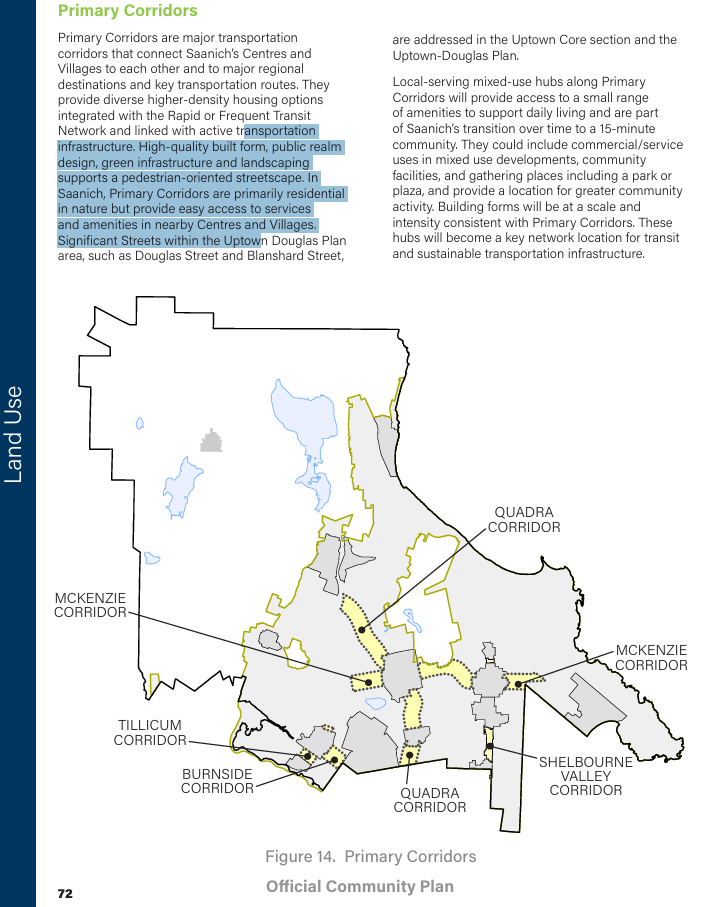
The following showing Primary Corridors is from p.82 of the new OCP pdf:
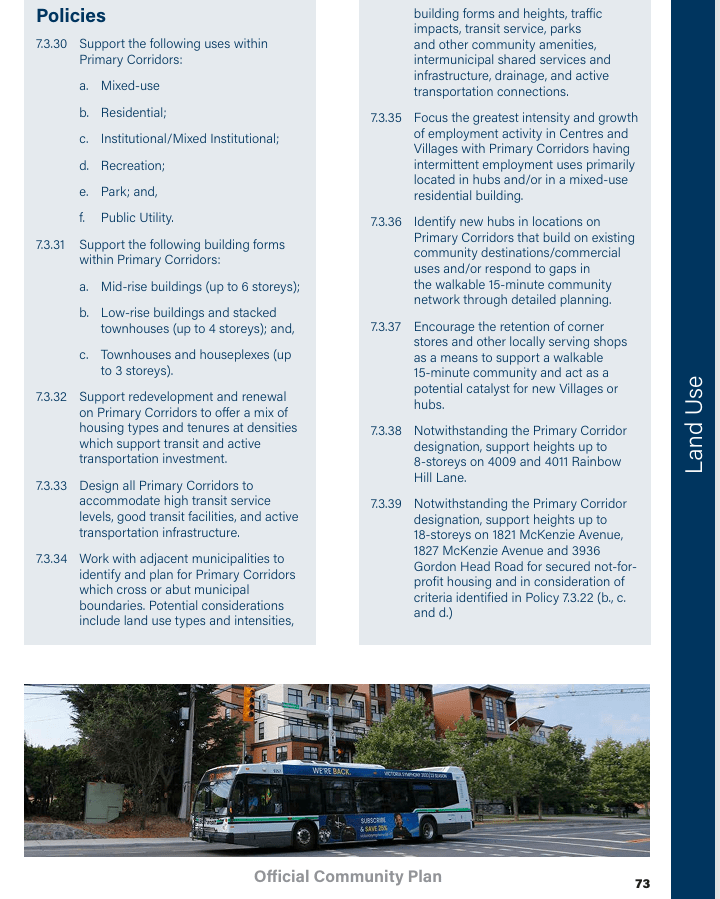
With a vast amount of public opposition against the McKenzie/Quadra draft plan emerging, Saanich is in a tough position. Do they do the democratic thing and let the public decide? Or will they ignore the public and ram through the RapidBus lane plan just like they did the new OCP, which itself allows massive previously unprecedented development in such areas through its CCV planning? (More on that later in the article)
If they do choose to ram the plan through, it will be at the expense of bringing traffic to practically a grinding halt with the backlog stretching far into the distance, through reducing traffic to a single lane on either side, as was evinced last week, when a vehicle crash on Saanich Rd. and McKenzie led to exactly such a scenario.
The inevitable idling would run contrary to stated intentions of emissions reduction and even contrary to the CRD’s own anti-idling bylaw. Similar effects on traffic in the area, were noted previously in the month of November, when 2 fires on different days in the area led to first a key section of McKenzie being shut down to traffic, and then also Quadra with the next fire, a raging inferno, which makes the prospect of increasing densification look sadly like a potential fire storm in the future…
The following images below are excerpts from the UDI’s March 2022 lobbying letter to Eby, when he was the Attorney General and Minister Responsible for Housing.
The complete letter can be viewed in an appendix to the following article: Freedom of Information reveals that the Province of B.C. was working to implement what the registered lobbying organization, the Urban Development Institute, had been pushing for. This culminated in the recent Housing Bills that override local government authority on zoning. – CRD Watch Homepage
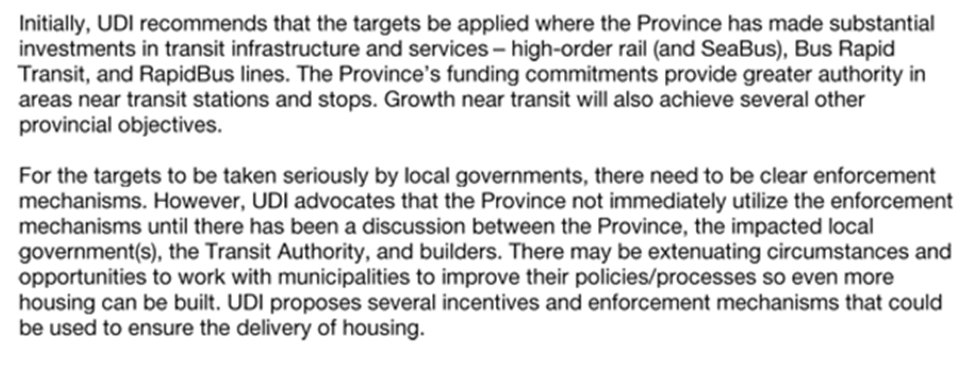
In the March 2022, letter to Eby, the UDI used BC Transit’s maps for proposed rapid transit lines (including the one proposed for McKenzie) in the Capital Region, and also for transit in the Okanagan (there are UDI Chapters in each region), without citing the source of the maps, and placing them under the UDI’s own logo.
Below the maps, the UDI railed about “NIMBY groups” and what they referred to as the coming “uphill battle” to be faced by such groups, against development around transit stations. In this context, the BC transit maps come off looking more like invasion maps.
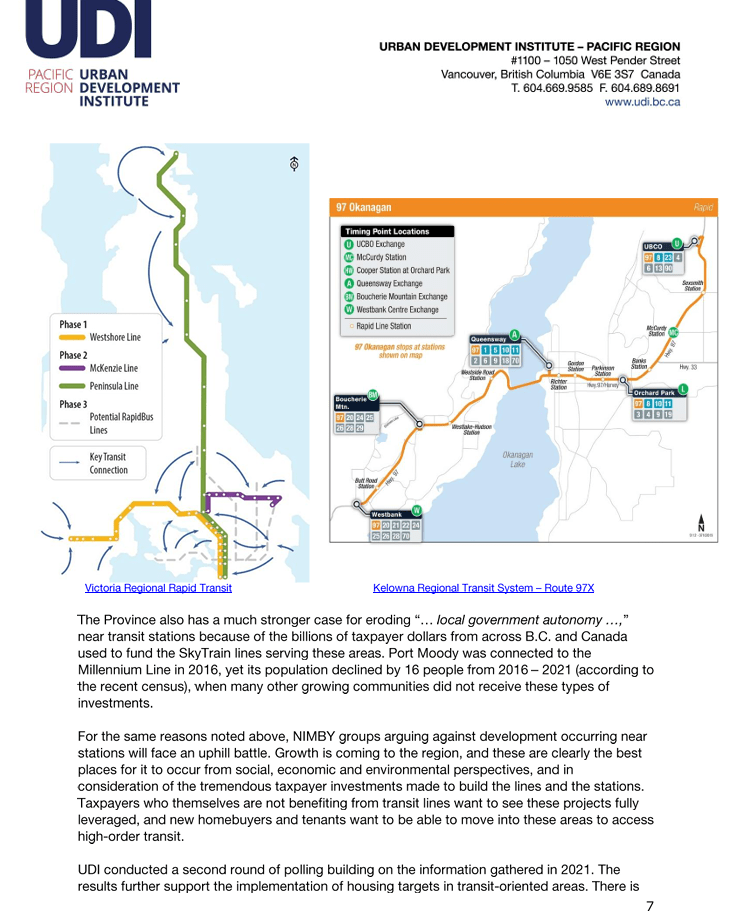
Note: At the bottom of the letter the UDI used the term “transit-oriented areas”, a term the Province would adopt in Bill 47 for its TOAs, which were much as the UDI had proposed to force high density development around transit exchanges.
McMullin, whose connections to TransLink deserve close scrutiny, continued railing against hypothetical “NIMBY groups” in the way of the UDI’s agenda in the letter:
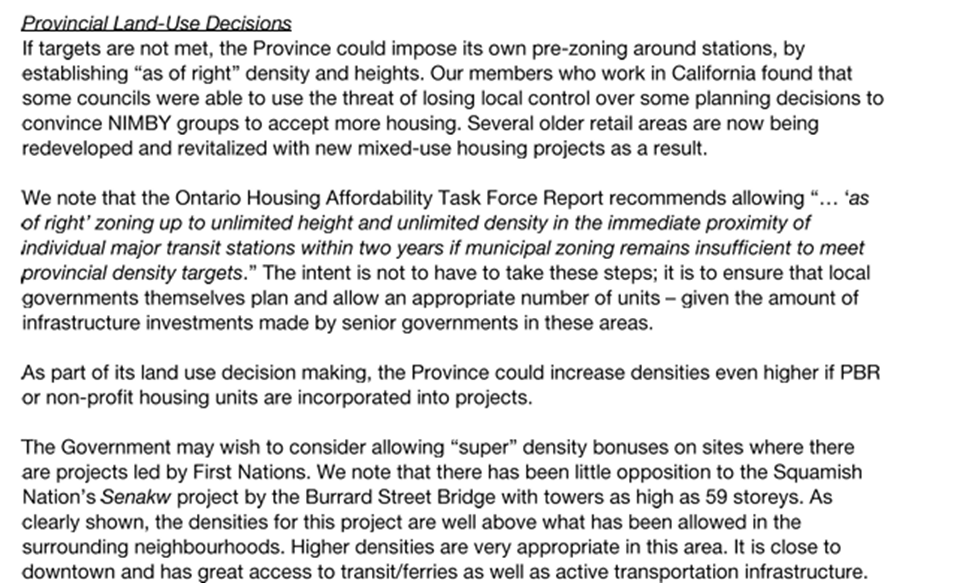
Note: The Nch‘ḵay̓ Development Corporation of the Squamish Nation was a member of the UDI, according to the backed-up UDI members directory. The UDI took its members directory offline, as the housing bills were being pushed through in November of 2023.
In order to achieve the UDI’s goals towards local zoning, the UDI offered a carrot and stick approach for the Province to adopt towards municipalities.

The punitive stick approach to local governments, not approving enough construction as to be satisfactory to the UDI, could as suggested, involve for example, cutting infrastructure funding to local governments, or increasing taxes on those living around these areas:


The following is an excerpt from this article:
After a Comedic Exchange of Emails, BC Transit Admits that it has a Membership with the Urban Development Institute. The Implications of that for BC, may be more Tragic than Comic. – CRD Watch Homepage
Let’s take a look now at BC Transit’s relation to the UDI Capital Region, which it has a paid membership with:
On May 7, 2024 – The majority of Saanich Council voted to pass a new Official Community Plan (OCP) by unusually passing both third and fourth readings of the proposal that same evening, thus rendering a new OCP into existence on that date, while at the same time Saanich’s Local Area Plans (LAPs) were rendered legally non-binding by removing them from the OCP Bylaw (something the Mayor had referred to as “decoupling” the LAPs from the OCP. The new OCP wasn’t actually due until the end of 2025. Why was it as so many commented, rushed through so quickly?
The UDI’s 2023-2024 Annual Report has a section titled “Advocacy Initiatives”. The term advocacy is often used synonymously with lobbying, “influence” and “impact”, the latter quoted terms appearing on the same page. Under the subheading “District of Saanich” is written the following: “OCP Update/Terms of Reference” above the item “Housing Strategy/Land Capacity” among others including “Centre, Corridor and Villages Plan”. The first item under the subheading “BYLAW REVIEW” was listed: “Active Transportation Network Plan”.
Earlier that day on May 7, 2024, Saanich’s Mayor, Dean Murdock presented at an Urban Development Institute event at the Union Club in downtown Victoria.
The event was called: “Pathways to Progress: Uniting Land Use and Transit Strategies for Sustainable Growth”

The speakers included the Minister of Transportation and Infrastructure Rob Fleming, Victoria’s Mayor Alto, Matthew Boyd (Director of Corporate & Strategic Planning at BC Transit), Mayor Murdock of Saanich, the Chair of the UDI Capital Region Ben Mycroft (Director of Development at Gablecraft Homes), and Ryan Berlin (Senior Economist and Vice President of Intelligence at Rennie)
The Sponsors of the Event were: Rennie, the company of Bob Rennie (the so-called “Condo-King” of Vancouver) and the Urban Development Institute itself.


Both Mayor Murdock and Minister Fleming who presented at the event have been proponents of pre-zoning along transportation corridors, something that the UDI has lobbied the province to achieve for years.
See: Article: “Placing housing near transit hubs will encourage use, Saanich councillor says Province plans to buy land, encourage development along transportation corridors“ Megan Atkins-Baker April 14, 2022 Saanich News
https://www.saanichnews.com/news/placing-housing-near-transit-hubs-will-encourage-use-saanich-councillor-says/ (Accessed: Dec 1, 2022)
The following is quoted from the article:
“Transportation Minister Rob Fleming recently introduced changes that will allow a provincial agency to buy and develop land for housing and amenities along transit corridors – an opportunity Saanich Coun. Susan Brice sees as promising for Greater Victoria.
The province is moving to ensure development density follows transit routes. Bill 16, introduced on April 5 by Fleming – also Victoria-Swan Lake MLA – calls for changes to the Transportation Act that would give the BC Transportation Financing Authority the ability to purchase land not just for transportation projects, but to support the development of housing and amenities near stations or exchanges built as part of the public transit system.
Brice, who also chairs the Victoria Regional Transit Commission, said there is a total commitment in the region to connect transit with land-use planning.
“Our goal of reducing greenhouse gas emissions means that we plan in a manner that hopefully has people choose transit as their means of moving about the community whenever possible.” Making transit closer, more reliable and more frequent will get people in ‘transit mode,’ she added.
“I was so pleased to see the minister table this legislation,” said Dean Murdock, an advocate for active transportation and housing affordability and a declared Saanich mayoral candidate.
Creating centres where people can find good homes well-served by quality public transit is an important step forward, he said, and ticks the boxes for housing, climate and affordability.
The major centres identified in Saanich’s Official Community Plan (OCP): McKenzie and Quadra, McKenzie and Shelbourne, Tillicum, Uptown and Royal Oak, are examples of where the district can develop transit-oriented centres, Murdock said. With provincial support, Saanich will be able to move OCP plans forward more efficiently, he added.”
————————————————————————————————–
See also article: “B.C. to force higher-density development along transit lines”
Tom Fletcher April 5, 2022 https://www.mapleridgenews.com/business/b-c-to-force-higher-density-development-along-transit-lines/
—————————————————————————————————
Amazingly, given the prescience of that article, Murdock now Mayor of Saanich, would present with Minister Fleming at an Urban Development Institute event at the Union Club, alongside BC Transit’s Director of Corporate & Strategic Planning, on exactly the same day that Saanich’s new OCP was passed and the District’s local area plans (LAPs) were rendered legally non-binding, culminating in what appeared to have been many years in the making.
—————————————————————————————————
The “decoupling” as the Mayor and various Councillors called it, of the Local Area Plans (LAPs) from the Official Community Plan (OCP )was actually discussed between Saanich and the UDI in their meeting 2 years earlier:
Saanich and a lobbying organization for development and real estate discussed decoupling the Local Area Plans from the Official Community Plan in the spring of 2022 – CRD Watch Homepage
Saanich’s Quadra McKenzie Draft Plan, a manifestation of its Centers, Corridors and Villages (CCV Planning).
Saanich’s CCV planning has gone back many years, and has been a way of rezoning Saanich in order to fulfill its obligations under the CRD’s Regional Growth Strategy.
Saanich’s recent OCP has densified the CCV plans as never before. There are many overlaps with the UDI’s, the CRD’s and BC Transit’s plans, and this may not be a coincidence. Some Saanich politicians have served on BC Transit’s board and naturally they have served on the CRD board.
Up until recently the CRD was a paying member of the UDI, as was Saanich, although both Saanich and the CRD left the UDI in 2023 and 2024 respectively. BC Transit is still a paying member of the UDI.
Although Saanich left the UDI, it still continues to have meetings with it, as does the CRD, which similarly recently suspended (for the time being during ongoing review) its Regional Housing Advisory Committee which the UDI had a permanent seat on.
The following is an excerpt related to CCVs in the UDI’s minutes of a UDI liaison committee meeting with Saanich in the spring of 2022.
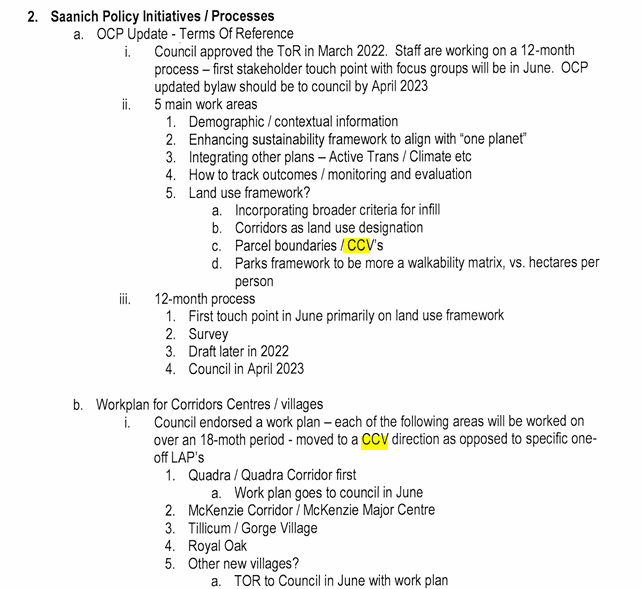
Note: TOR stands for Terms of Reference, CCV stands for Centre, Corridor and Village.
The above excerpt was from:

The following is excerpted from Saanich’s website (Accessed: Dec 4, 2024)
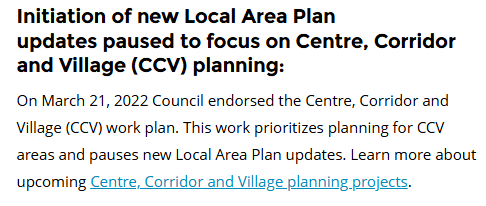
Local Area Plan Updates | District of Saanich
Note that the pausing of the Local Area Plans (LAPs) directly corresponded to the endorsement of the CCV work plan. This happened just before BC Transit released its RapidBus plans which synchronize with the CCV planning.
The following are sections excerpted from Saanich’s Quadra McKenzie Draft Plan, from which can be discerned the relation between Centres and Corridors to BC Transit’s plans for Quadra and McKenzie. Overlaps between Saanich’s and the UDI’s plans, as well as to Bill 47 should also be noted.
I have listed the pages by their place in the PDF of the Draft Plan from Saanich’s website (Accessed Dec 4, 2024), rather than from the page #s of the plan itself, so that it is easy for the reader to find them in the pdf file.
The following excerpt is page 21 of the Draft Plan:
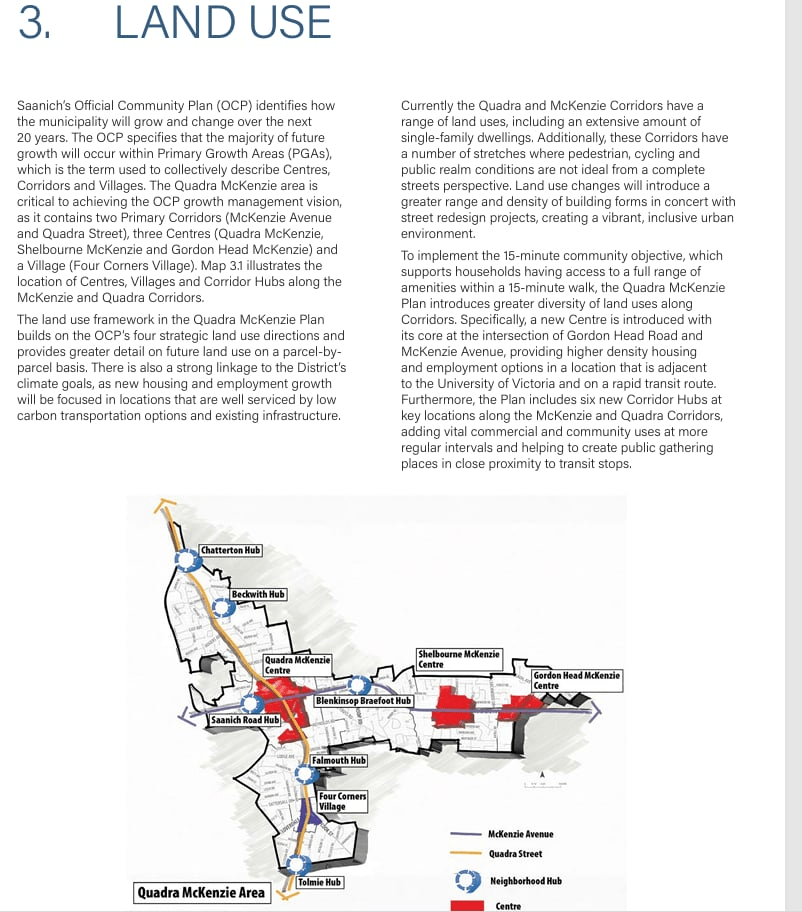
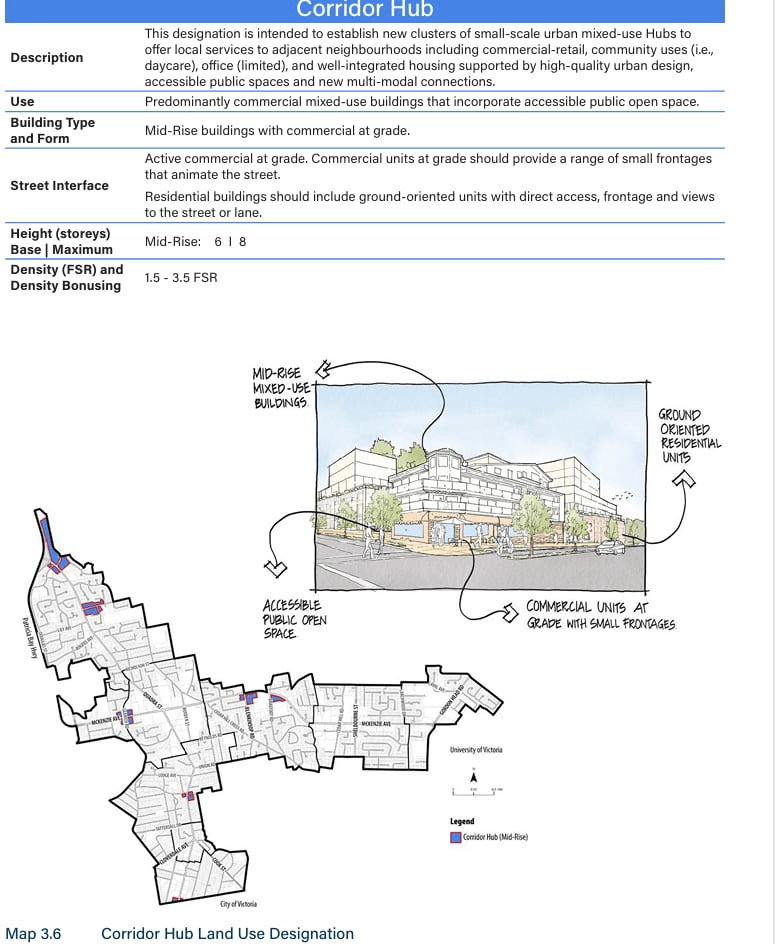
“To implement the 15-minute community objective, which supports households having access to a full range of amenities within a 15-minute walk, the Quadra McKenzie Plan introduces greater diversity of land uses along Corridors. Specifically, a new Centre is introduced with its core at the intersection of Gordon Head Road and McKenzie Avenue, providing higher density housing and employment options in a location that is adjacent to the University of Victoria and on a rapid transit route. Furthermore, the Plan includes six new Corridor Hubs at key locations along the McKenzie and Quadra Corridors, adding vital commercial and community uses at more regular intervals and helping to create public gathering places in close proximity to transit stops.”
Note: What are being referred to as “community hubs” appear to be what has been referred to in discourse previously, as “growth nodes”. Many of the hubs appear to correspond to likely locations for stops along BC Transit’s proposed RapidBus line.
The following map is from page 34 of the Draft Plan:
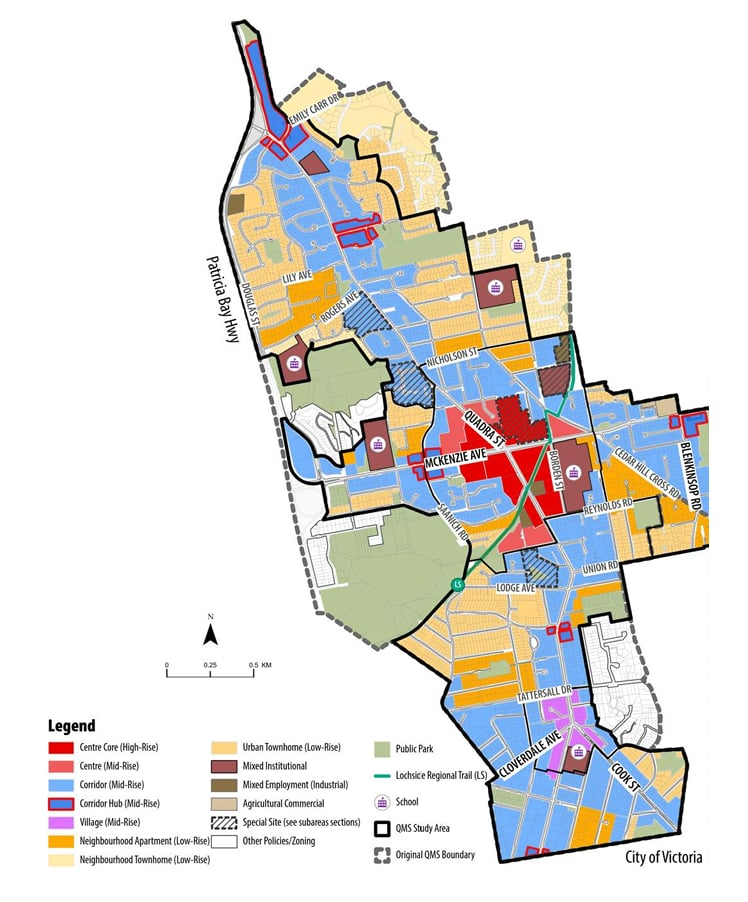
Notice the focus of proposed mid-rise zoning, along the transportation corridor and proposed high-rise zoning along the core.
The following map is from page 35 of the Draft Plan:
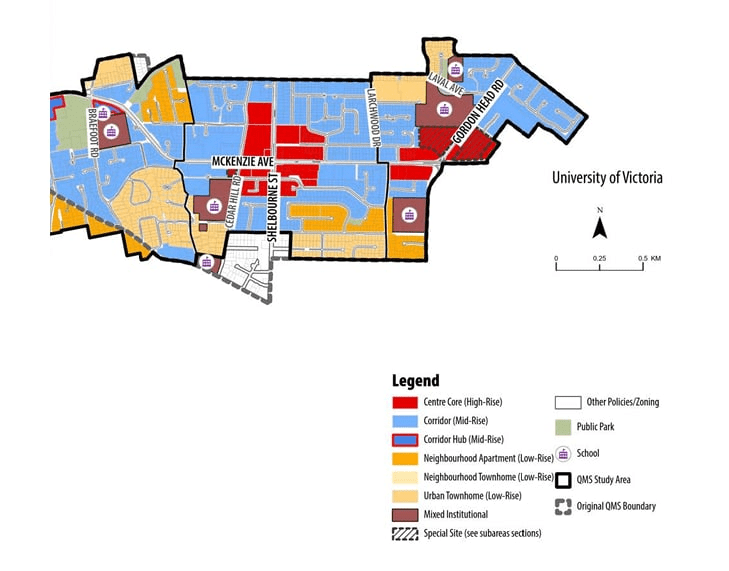
Notice how the area of the rapid bus line and proposed single lane auto traffic passes through to the centre core and its proposed high-rise zoning.
The following excerpt is page 36 of the Draft Plan:
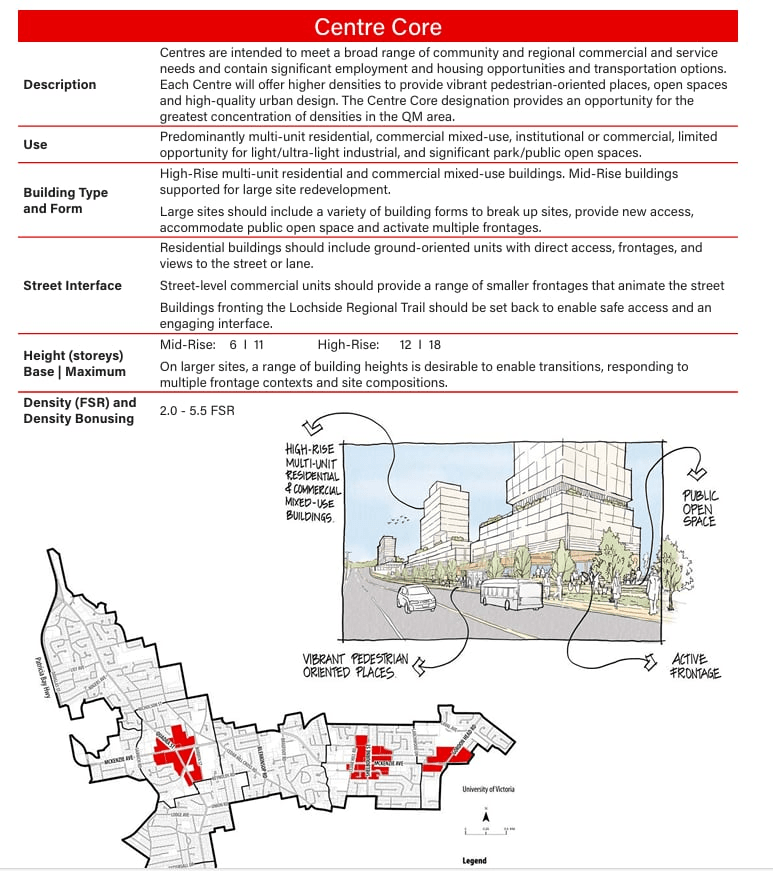
Note proposed mid-rise zoning is listed from 6-11 storeys and proposed high-rise zoning is listed as up to 18 storeys, although note that the new Saanich OCP adopted this year, also has provisions for density bonuses, which could see as high as at least 20 storeys in such areas.
The following excerpt which shows Centres (potentially zoned 6-12 storeys) is from page 37 of the Draft Plan:
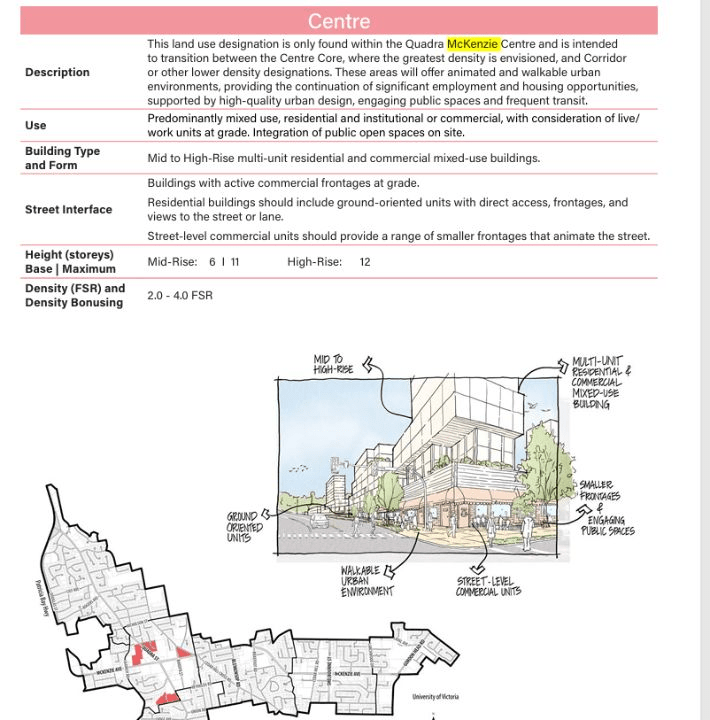
The following excerpt showing corridors potentially zoned 3-6 storeys is from page 38 of the Draft Plan (note the image of the bus one one lane and a car on the other):
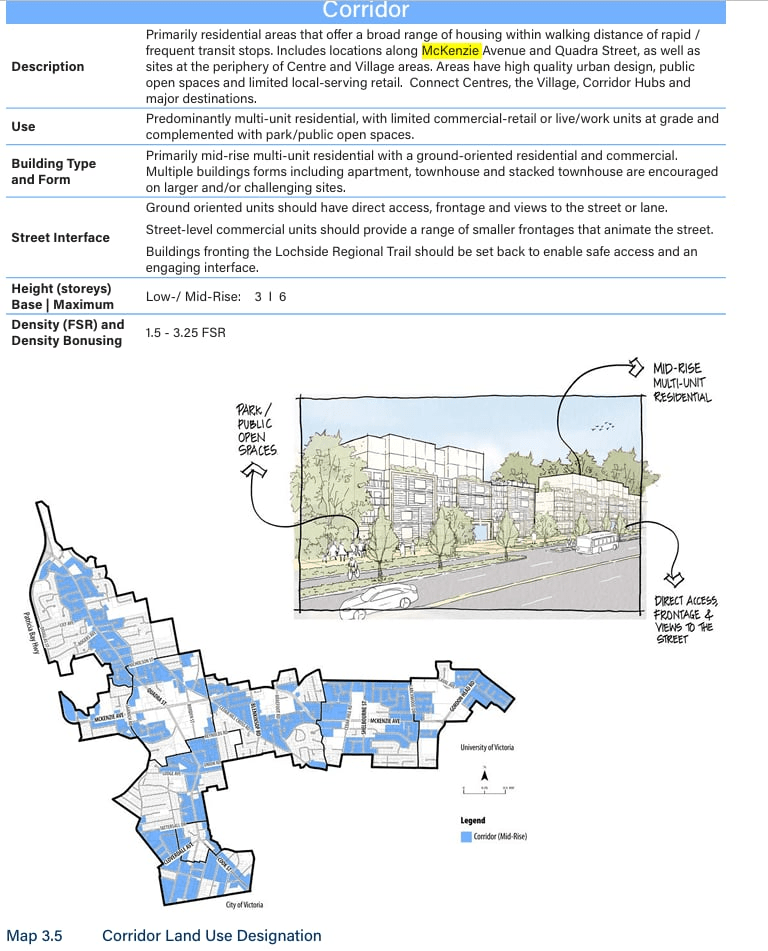
The following excerpt regarding so-called corridor hubs with proposed up to 6-8 storey zoning (but which as mentioned previously could actually go higher with potential density bonusing in the OCP) is from page 39 of the Draft Plan :
The following excerpt is page 29 of the Draft Plan:

The following excerpt is page 28 of the Draft Plan:

The following excerpt is page 27 of the Draft Plan:
Appendix: Excerpts from the UDI’s Policy and Advocacy Updates Newsletter April 5, 2020



As mentioned previously, Urban Systems involvement in the development of both of those guides mentioned in the UDI’s Provincial Policy and Advocacy updates, was key:
BRITISH COLUMBIA ACTIVE TRANSPORTATION AND TRANSIT-ORIENTED DEVELOPMENT DESIGN GUIDE A Supplement to the British Columbia Active Transportation Design Guide (Accessed: Dec 8, 2024)
BRITISH COLUMBIA ACTIVE TRANSPORTATION DESIGN GUIDE 2019 Edition (Accessed: Dec 8, 2024)
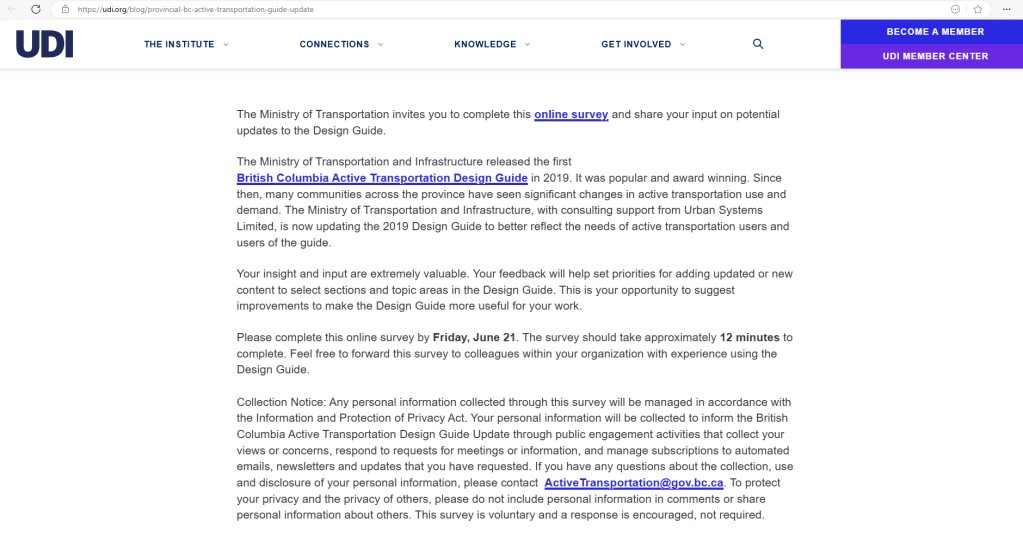
In June of 2024, the UDI posted on their website the Province’s the survey for the update to the Active Transportation Design Guide, once again with the Ministry of Transportation being aided in their work by Urban Systems.
Screenshots from the UDI’s website Dec 8, 2024:
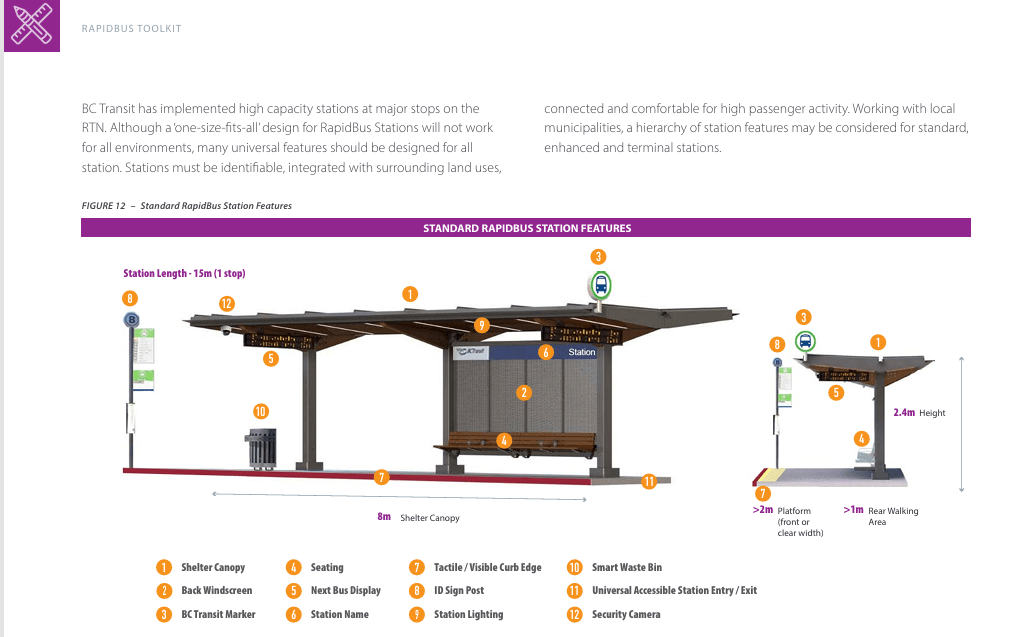
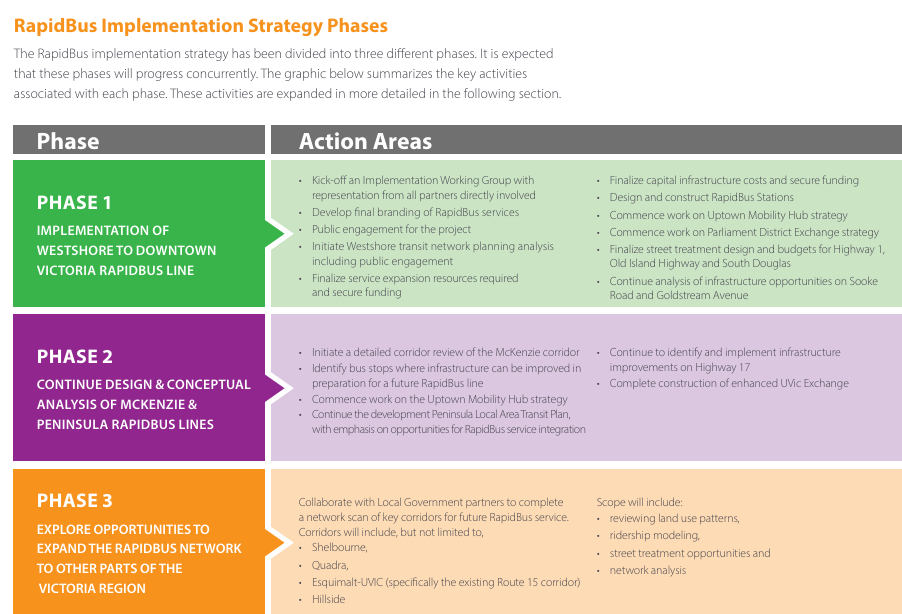
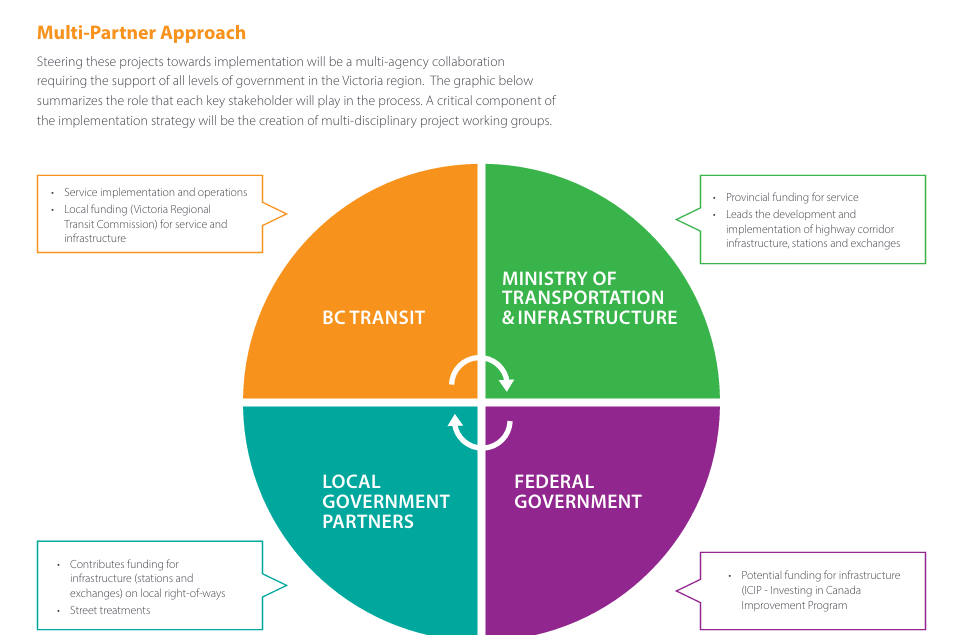
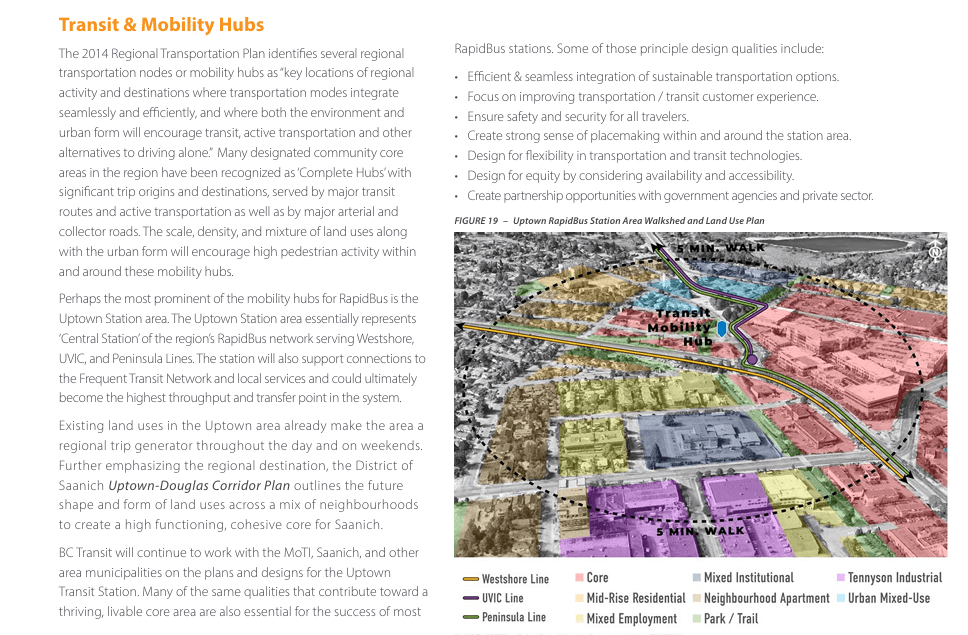
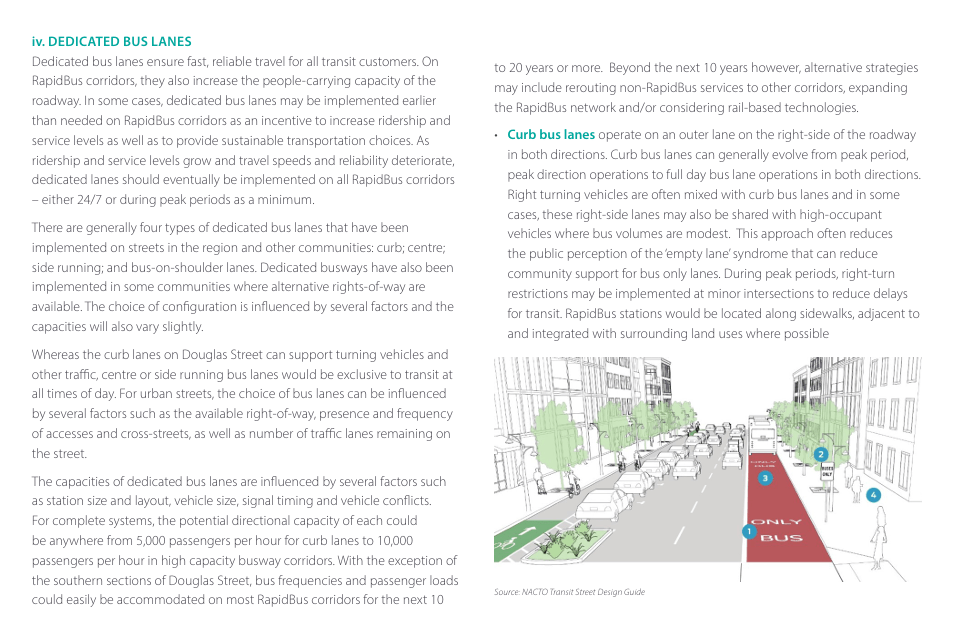
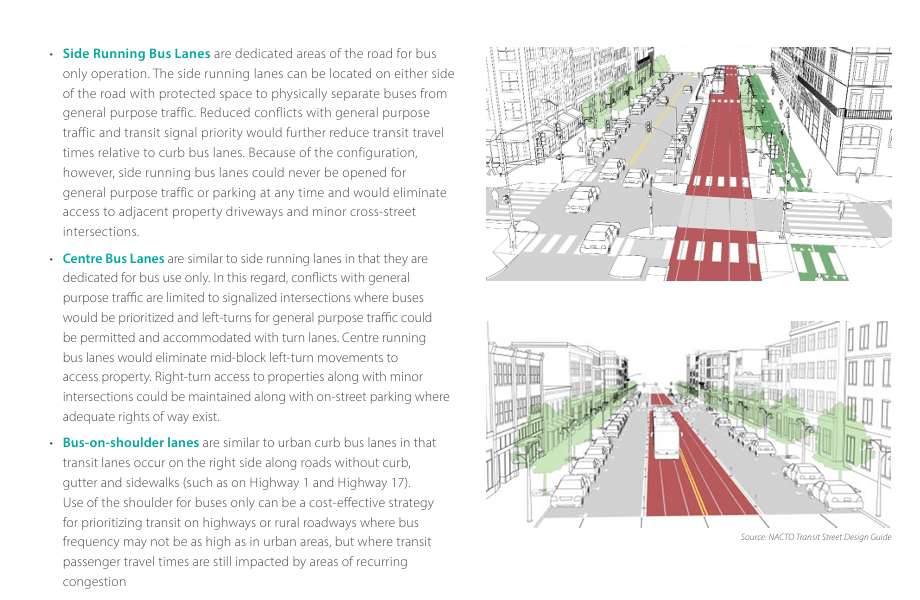
Appendix: Diagram from BC Transit in 2021 of planned McKenzie “RapidBus” line
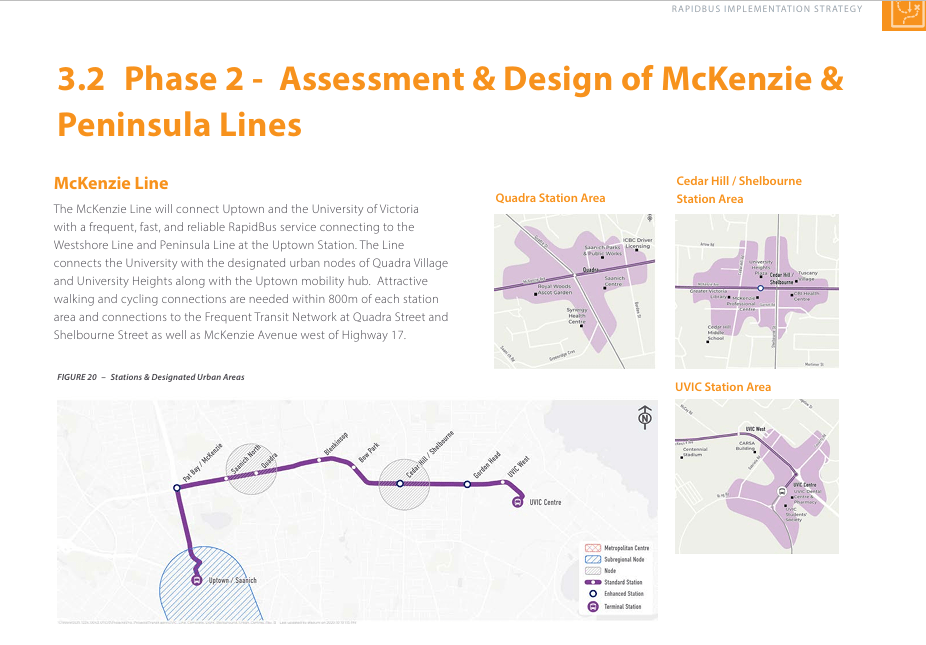
Archived source: BC Transit Victoria Regional Transit RapidBus Implementation Strategy Wayback Machine (July 2021)
After Bill 47 was released Saanich Uptown Exchange has been included as one of the TOAs listed by the Province: saanich_uptown_exchange_toa_map_day_1.pdf
Transit oriented development areas – Province of British Columbia
Notice how it corresponds to what BC Transit had referred previously as a “Sub regional node” on its map of Stations & Designated Urban Areas.
The other two circles listed as “nodes” would become Saanich TOAs in the District’s new OCP approved on May 7, 2024.
New BC Transit Board of Director appointments announced by Province
West Shore-Downtown RapidBus service launches in April – Island Social Trends Feb 15, 2023 Island Social Trends
By Mary P Brooke
Excerpts:
“The next-phase McKenzie line will run from Uptown Centre to the University of Victoria campus where there is a major bus depot across from the Student Union Building.”
“Political support:
Back in June 2021 a range of municipal leaders and south Vancouver Island cabinet ministers gathered at the bus loop alongside West Shore Parks and Recreation, to announce the west shore transit improvements.”
“RapidBus politics:
BC Transit has collaborated with municipal, regional and provincial partners to develop the Victoria Regional RapidBus Implementation Strategy. [The link is no longer active, but the archived link is, as posted previously]
This strategy builds on the momentum of the South Island Transportation Strategy (which was politically stick-handled by the former Minister of Transportation and Infrastructure Claire Trevena in 2018 and 2019) and provides the strategic and technical foundation needed to accelerate the implementation of RapidBus services throughout the Victoria region.
The implementation of RapidBus services in the Victoria Region has the potential to significantly increase transit mode share by:
Support the region’s climate action goals
Supporting post-pandemic regional economic recovery
Shaping and supporting growth and regional connectivity
Improving passenger comfort and convenience
Improving efficiency and capacity of the transit system”
—————————————————————————————————
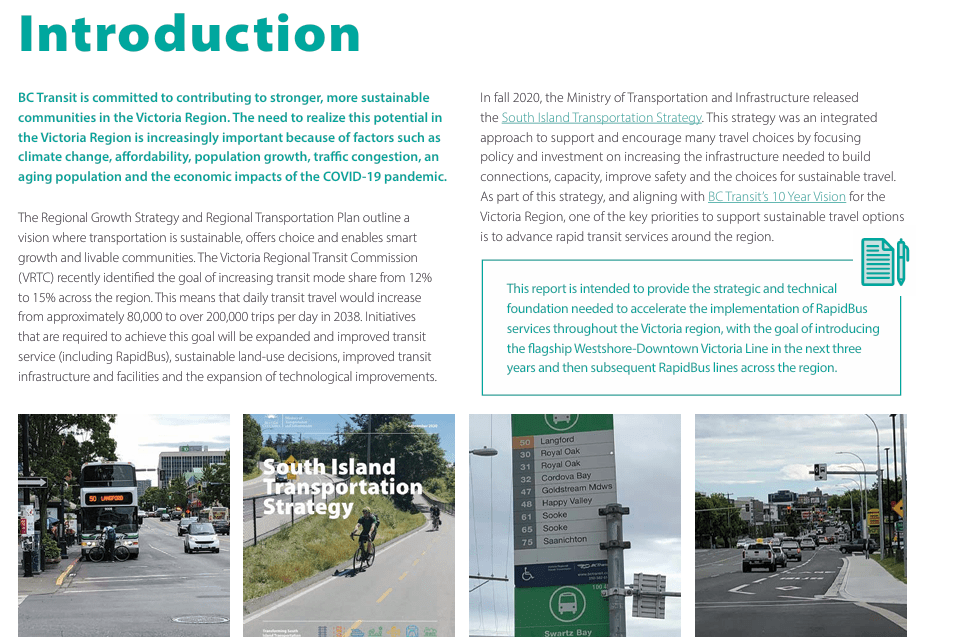
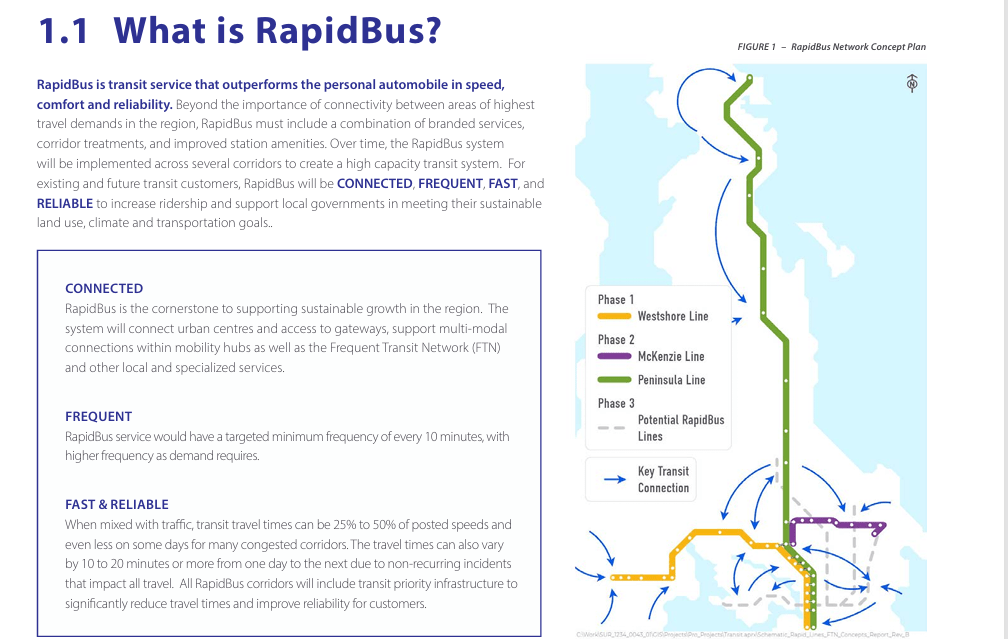
Appendix: Screenshots from the BC Transit Victoria Regional RapidBus Implementation Strategy (2021)




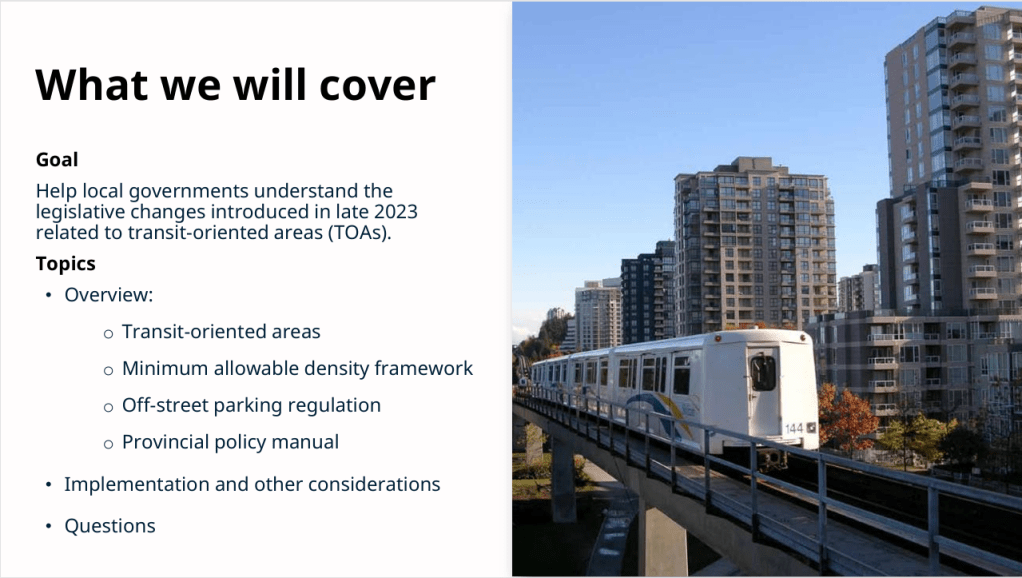
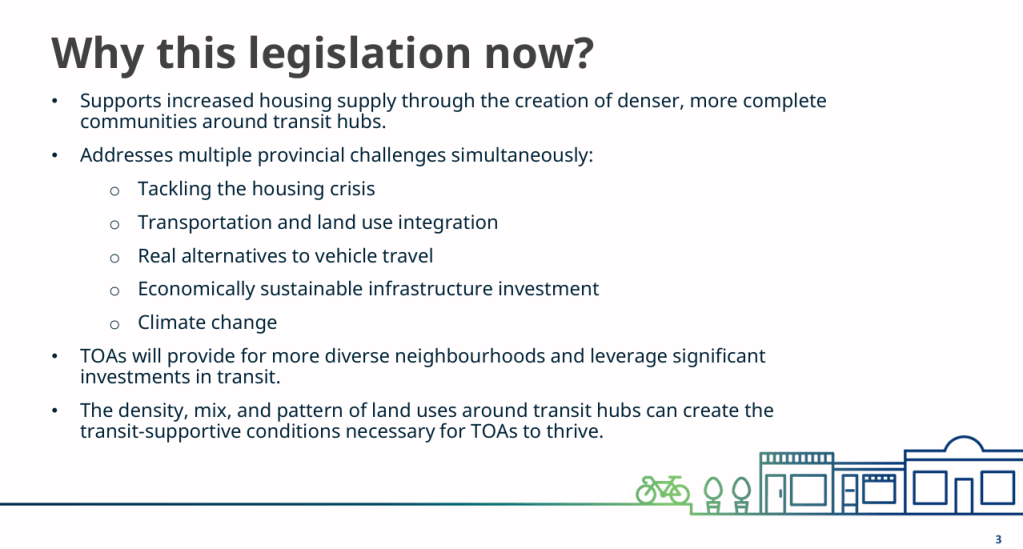
Appendix: What are Transit Operating Areas (TOAs), and what are Transit Oriented Development Areas (TODs)?
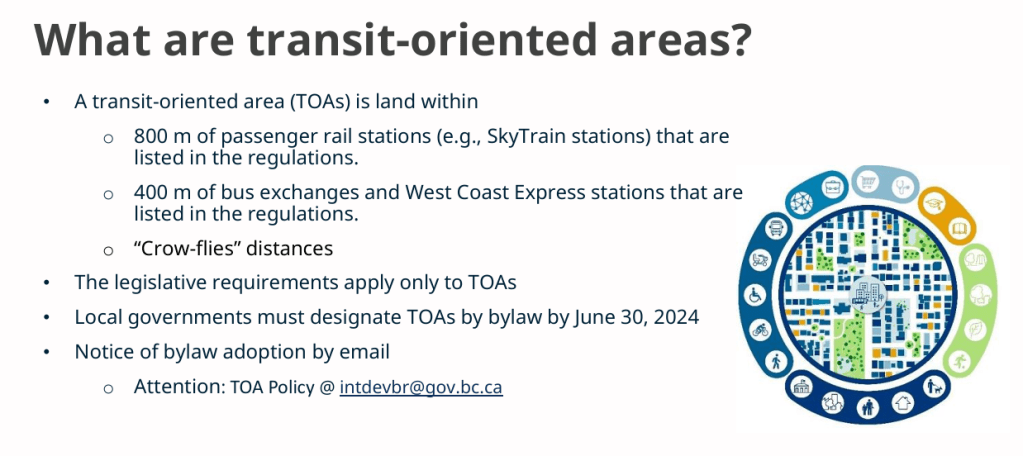
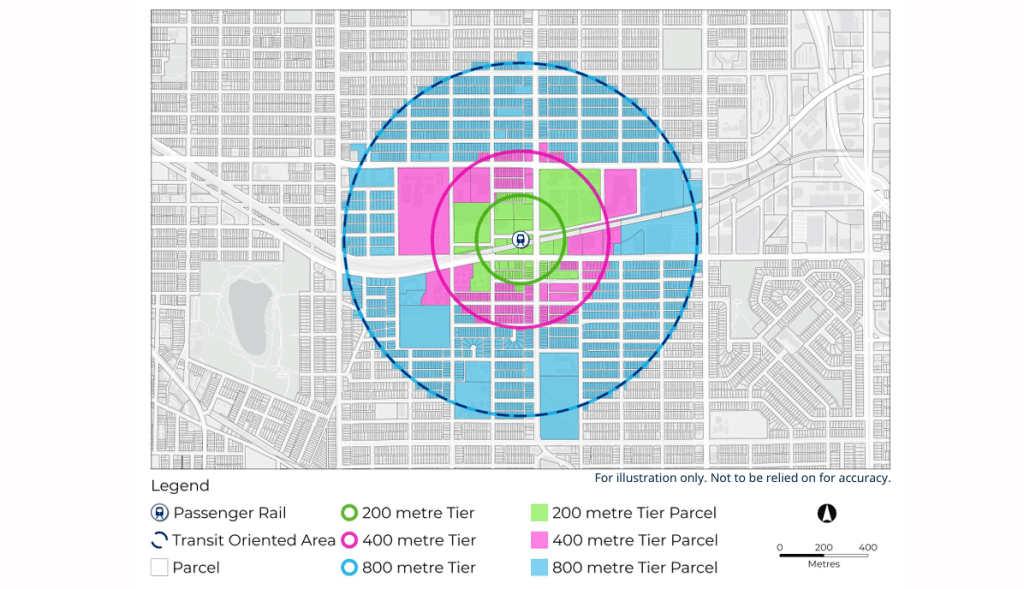
The Province initiated Transit Oriented Development Areas (TODs) and Transit Operating Areas TOAs, part of Bill 47 tabled in 2023. The difference between them is slim.
TODs are the general concept. TOAs are the areas designated by the province to local governments for the TODs.
The following slides were made by the Province of B.C. to help understand Bill 47, which itself can be quite vague and confusing. They are from the Province’s 59199 – PIBC Presentation Housing Updates May 2023



Excerpt from a letter to the UDI by the Assistant Deputy Minister
Housing and Land Use Policy dated Sept 25, 2023:
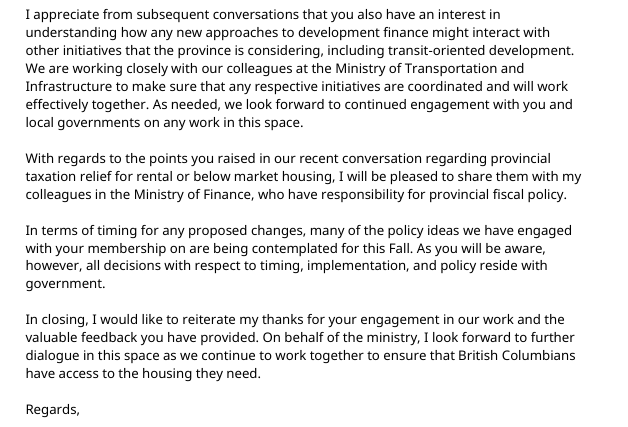
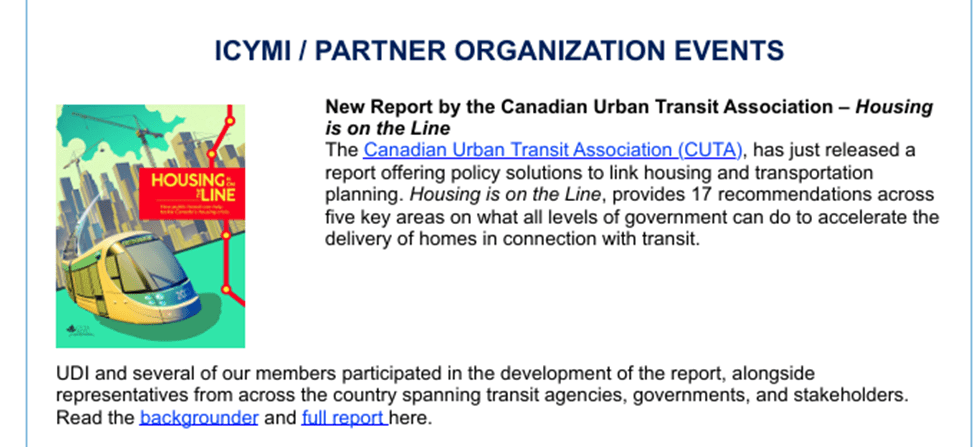
Image excerpt from UDI Policy and Advocacy updates newsletter Oct 31, 2023:
—————————————————————————————————
Appendix: Section of 2017 letter from the UDI to the Federal government offering a series of recommendations, including density targets around transit stations/corridors and for the adoption of TODs (Transit Oriented Developments).
The 2017 letter from the UDI to the federal government can be read in full at this link: [October 20, 2017 UDI letter to the Federal Goverment] from the House of Commons website ourcommons.ca
At present, I have been unable to locate Urban Development Institute (UDI) registrations of lobbying activity to the federal government within the last 15 years.
On April 5, 2024, In regard to a different UDI letter to a Federal Minister, I sent the following email to the Federal Government:
Hello Office of the Commissioner of Lobbying of Canada,
I have a question:
If an organization has contacted Federal Ministers by email asking for/recommending the implementation of the organization’s preferred policies. Is that considered lobbying and is it required for such actions to be registered on the Federal Registration of Lobbyists?
Thank you,
Sasha Izard
—————————————————————————————————
The Federal lobbyist Comissioner’s Office responded:
Hello Sasha Izard,
Thank you for your email.
For organizations, lobbying is communicating, with federal public office holders, on behalf of the employer, regarding:
• the making, developing or amending of federal legislative proposals, bills or resolutions, regulations, policies or programs;
• the awarding of federal grants, contributions or other financial benefits;
If an organization’s lobbying activities by all paid employees represent A significant part of duties (“The 20% rule”), the most senior employee (the registrant) would be required to register the organization within 2 months of meeting this threshold. In the registration, the registrant would be required to name all employees who undertake lobbying activities on behalf of the organization.
Contacting Federal Ministers by email asking for/recommending the implementation of the organization’s preferred policies, is considered lobbying. As such, this organization may be required to register if they meet registration requirements under the Lobbying Act.
Please do not hesitate to contact us with any questions or if you require further clarification.
Sincerely,”
—————————————————————————————————
I responded: “Hello Office of the Commissioner of Lobbying of Canada.
Thank you.
I turn over this FOI to you for review.
You will note that on pages 33-39, the Urban Development institute is “Contacting Federal Ministers by email asking for/recommending the implementation of the organization’s preferred policies, is considered lobbying.”
These [potential] lobbying activities have not been registered on the Federal Lobbyist Registry.”
This was in regard to the following letter:
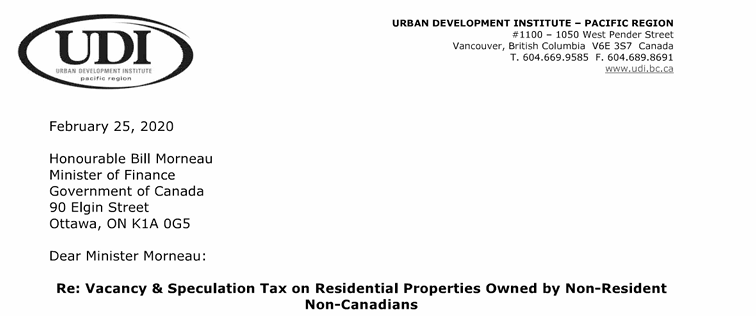
The letter concluded:

The letter was carbon copied to the following:

—————————————————————————————————
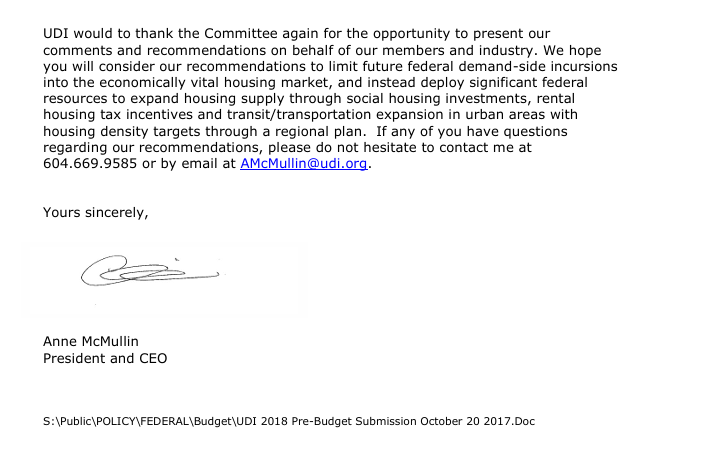
The following is excerpted from the Oct 20, 2017 letter from the UDI to the Federal Government:
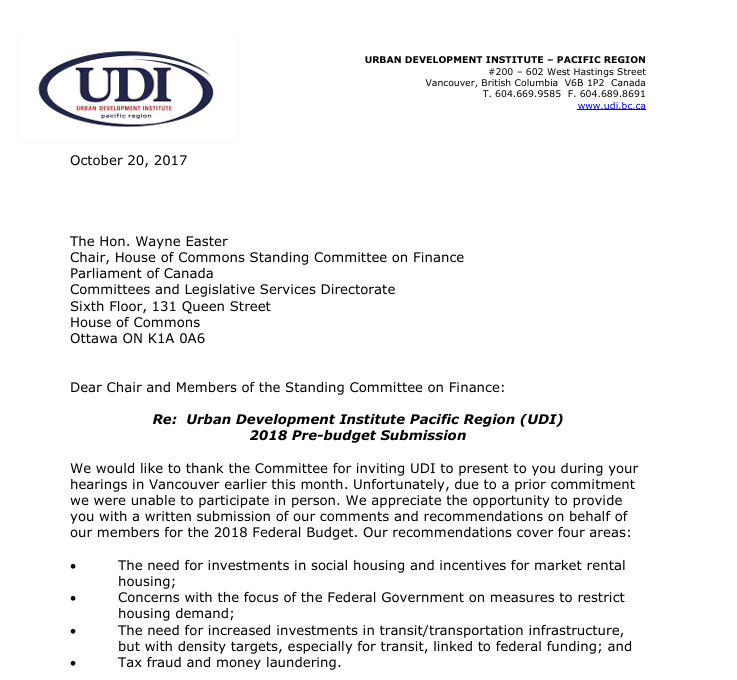
Excerpted section:
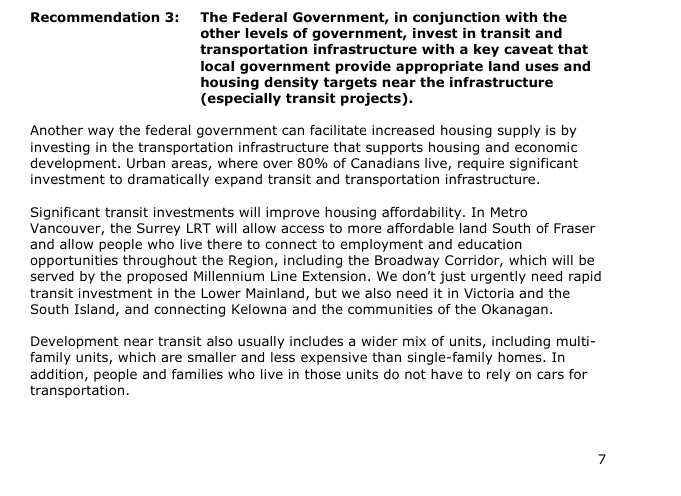

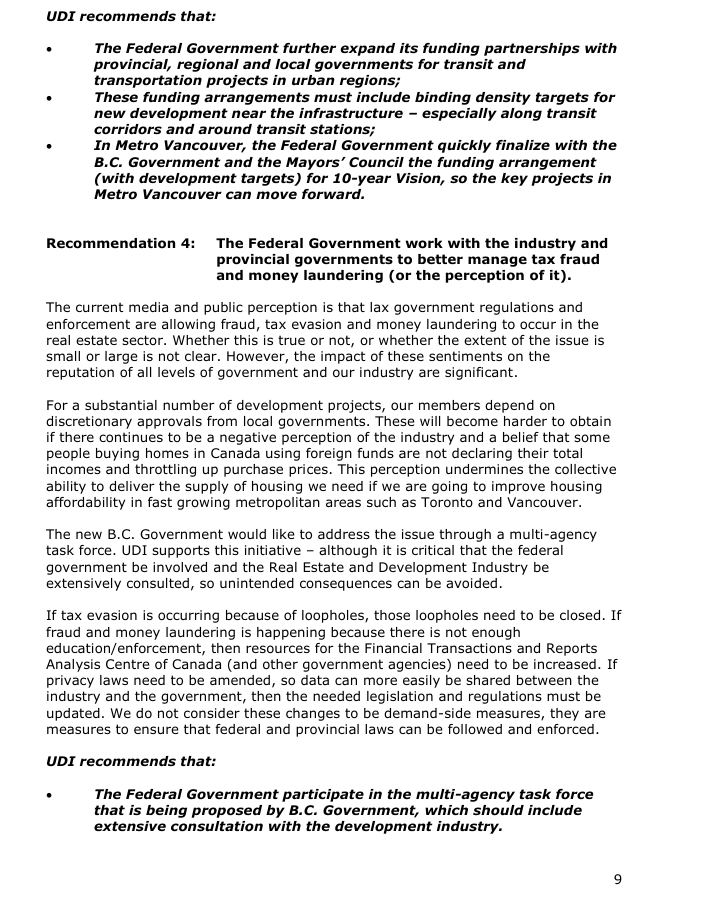
—————————————————————————————————
For further reading, see also:
Freedom of Information reveals that the Province of B.C. was working to implement what the registered lobbying organization, the Urban Development Institute, had been pushing for. This culminated in the recent Housing Bills that override local government authority on zoning. – CRD Watch Homepage
A brief look at UDI member TransLink and BC Bill 47 (2023)
After a Comedic Exchange of Emails, BC Transit Admits that it has a Membership with the Urban Development Institute. The Implications of that for BC, may be more Tragic than Comic. – CRD Watch Homepage
How the Development and Real Estate Lobby Pressed Mandatory Housing Targets, Mass Upzoning, Captured Official Community Plans, and Made the Shutting Down of Public Hearings the Norm in British Columbia Under the NDP Government – CRD Watch Homepage
A 2017 letter from the UDI to the Federal government offered a series of recommendations, including density targets around transit stations/corridors and for the adoption of TODs (Transit Oriented Developments). – CRD Watch Homepage
Archive.org snapshot of UDI policy page from March 30, 2023: By the end of the year, the Province would be implementing all 4 of the UDI’s key policy goals through the introduction of the UDI-lobbied-for Housing Bills (43-47) and through the creation of BC Builds. – CRD Watch Homepage

 CRD Watch Homepage
Leave a comment