Surely, that must be the other way around? University of Victoria (UVic) paid lobbying group $500 for the group to have a tour of UVic’s facilities, and a month earlier, $577.50 for a UVic staffer to take the lobbying group’s course on “Community Relations”.
By Sasha Izard
Nov 29, 2024
Summary:
On June 7 2023, the Urban Development Institute (UDI), a lobbying organization that is registered on the BC Lobbyists Registry, and that offers representation and political influence to its hundreds of paying corporate members involved in development and real estate, had a tour of the University of Victoria’s facilities.
One would expect that the tour would have at the very least been free, or that the UDI would have paid to have had it, given that it was the UDI who were the beneficiaries of the tour. Surprisingly, the University of Victoria, which receives public funding; paid the lobbying organization $500 to cover the organization’s administrative costs for attending, as revealed by a freedom of information response.
A month earlier, UVic paid the UDI $577.50, so that a UVic staffer could attend the lobbying organization’s course on “Community Relations”.
The following excerpt is quoted from the UDI’s new website (UDI.org) of the description of the same course which was last held in the spring of 2004:
“The course also emphasizes the importance of building and maintaining community support throughout the development process. Participants will learn how to effectively communicate with community members, address their concerns, and develop strategies to gain their trust and buy-in.”
—————————————————————————————————
Background and analyses:
To offer UVic the benefit of the doubt, the administrators may not have realized at the time, that the UDI was a registered lobbying organization. The administrators certainly know now, as I have informed them of it, and as the FOI response revealed; they were reading my 1st article about the UDI’s relation to the UVic Real Estate Club at the beginning of the year. Some of its administrators took special note of the following passage from its conclusion:
“I am suggesting however that there are forms of payments that could be
considered ethically to be indirect payments to student organizations that can
translate into potential support at council meetings and that this poses real
potential for ethical conflict of interest.”
Certainly, the UDI creates an image of itself that is often confusing and contradictory: they are a registered non-profit organization that is in their own words “influencing the issues that affect your bottom line”.
They don’t like to mention that they lobby the government, preferring to use words like “advocacy” and “advising” and “informing” in regarding to their dealings with government. In the UDI’s version of events, they are simply there with detached, but benevolent intentions, to help generate and implement housing policy at all levels, of government. Despite this, they only register lobbying activity on the Provincial level.
Sometimes they even deny outright that they are a lobbying organization, as when the UDI Capital Region’s Executive Director told View Royal Council at their Sept 12, 2023 Committee of the Whole: “UDI is not a lobbying group”, despite that they were registered on the BC Lobbyists Registry as UDI in-house lobbyist to the Province.
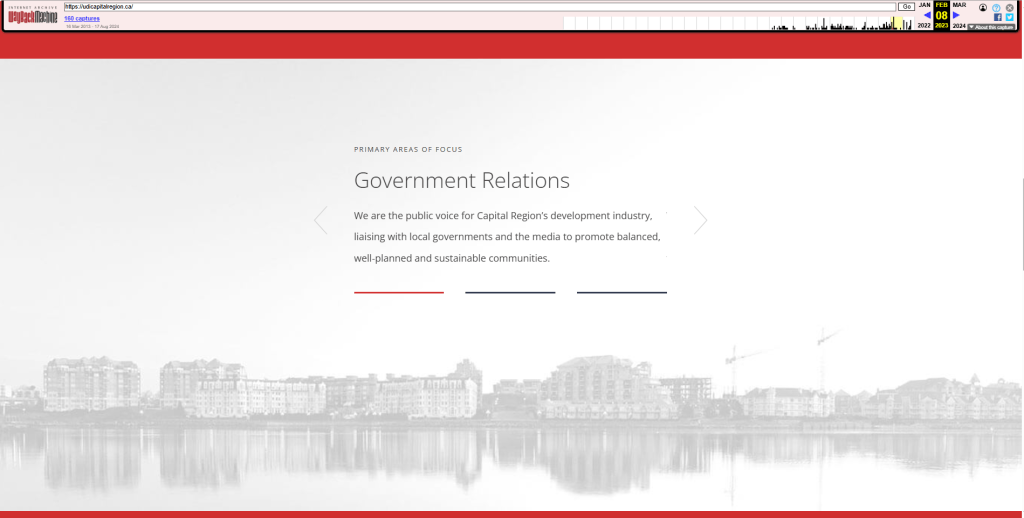
So it is easy to see how politicians and those working for public/publicly funded institutions can become confused as to their nature. Still a most cursory glance at the UDI Capital Region’s website in 2003, at the time UVic was making these payments to it, should at least have given the UVic Administrators a clue, as to who they were dealing with:
UDI Capital Region – Your voice in the local development industry (Snapshot of their website in February 2003. The website was replaced with UDI.org in November 2024)

—————————————————————————————————
The UVic Real Estate Club and the UDI
While the UVic administrators may not have paid keen enough attention to these details in 2003, when they were making the UVic payments to the UDI, their communications as revealed by FOI indicate that they became aware and concerned about potential ethical conflict of interest issues involving UVic and the UDI, particularly involving the UVic Real Estate Club.
They also came to realize that one of the UVicRec’s sponsors was the UDI member Pooni Group. Gary Pooni, of Pooni Group; had been instrumental in setting up the recent relations between the UDI and UVic in the spring of 2023 that culminated in the UDI tour of the campus. They, as revealed by the FOI became aware of these connections and issues when one of them found my 2024 article about the UVicRec:
Is the UVic Real Estate Club Acting as a Lobby for the Development and Real Estate Industries in Greater Victoria? – Sasha Izard
In the administrator’s communications they quoted the following from my article:
“I am suggesting however that there are forms of payments that could be
considered ethically to be indirect payments to student organizations that can
translate into potential support at council meetings and that this poses real
potential for ethical conflict of interest.”
One administrator suggested alerting a number of others to the issue, but the Associate Vice-President, Alumni & Development chimed in, indicating that they did not want to bring Anita in on it. Anita, having already been mentioned in the communications, is the Dean of the Gustavson School of Business.
I myself informed the Dean of the Gustavson school of Business about this, and as a result, she delegated an investigation into the issue by the Associate Dean, External & Outreach of the Gustavson School of Business , who all too hastily concluded:
“The club is not incorporated, and as such, the board of directors is merely advisory.”
I say all too hastily, as this reveals ignorance of what the function of a board of directors actually is, which is surprising to hear from the leadership of the Gustavson School of Business; which should not be unwise to the fact that a board of directors, is by definition not merely advisory, but manages and directs an organization.
Those serving on the UVIC Rec board of directors have not even an ounce of barely plausible deniability that they don’t know what a board of directors is.
The UVic Real Estate Club’s board of directors is composed overwhelmingly of those who either are UDI Directors, or have been previously been. 6 out of 8 are current (4), and (2) former UDI directors, including Gary Pooni himself. One of the UVIC Rec Directors is none other than the UDI Capital Region’s Executive Director.
See: Registered Organization on the BC Lobbyists Registry: Urban Development Institute (UDI) Board Directors Officiate Over ‘University of Victoria’ (“UVic”) “Student Group” – CRD Watch Homepage
Furthermore, although UVic’s administrators may have been able to claim ignorance up until recently about this situation, the administrator who arranged the UDI Tour, received the UDI’s newsletter, which if he looked closely at it, revealed that the UDI was advertising to those who received its newsletters (mostly its paying corporate members involved in real estate and development) UVic Real Estate Club support, and “connecting with the University of Victoria Real Estate Club for your next public hearing“.
UDI (registered lobbying organization) Newsletter from March 2023 Advertised “connecting with the University of Victoria Real Estate Club for your next public hearing” – CRD Watch Homepage
Still administrators receive many emails, and they should receive the benefit of the doubt, that they may not have read those newsletters in detail. If not, it’s time that UVic to pay closer attention to the material that the UDI send its, because it can be very revealing of what they are up to and how it overlaps with the university.
—————————————————————————————————
So, what happened with the payments?
In the spring of 2023, UDI Director Gary Pooni offered the university to organize a tour of UVic’s campus by the UDI’s board of directors, as evinced by a chain of emails titled: Thank you for meeting with us!
A number of UVic Administrators were enthusiastic about the proposition. However, there was also some confusion that emerged. Just over a week after the offer, the Director, Principal Gifts & Campaigns was confused, as they learned that Gary was listed on both the UDI Capital Region Board and on the UDI Pacific Region Board, and she wasn’t sure which UDI Board of Directors was going to show up on the tour, something that was discussed.
Over a year later, UVic administrators would find it even more confusing that Gary Pooni, who was described as “a fast-moving donor/community connection”, would along with a number of other UDI directors current and past, simultaneously and also overwhelmingly, appear on the board of the UVic Real Estate Club, ostensibly a students’ group, and thus be in a controlling position over the board.
There also had been a UVic Board Director, who had previously served on the board of directors of the UDI Pacific region and who was the owner/president of a development company.
After dozens of communications back and forth and more than one meeting between UVIC Staff and UDI reps, a tour date was settled on in June. Previously, it had been proposed for April.
The UDI sent out a release with information about the coming tour to the campus and a $500 price tag that UVic would pay for covering the UDI’s administrative costs for it.

The UDI tour of UVIC would be hosted by UVic’s Director of Campus Planning and Sustainability, who would authorize the payment; and it would also be hosted by Senior Project Manager from UDI member company Colliers Project Leaders. Colliers Project Leaders was the Project Manager of the new University of Victoria Student Housing and Dining Project, that towers above the UVic SUB building, as well as the site of the former Cadboro Commons building, which was demolished for its construction. The building was the main focal point of the tour.
University of Victoria Student Housing and Dining Project | Colliers Project Leaders
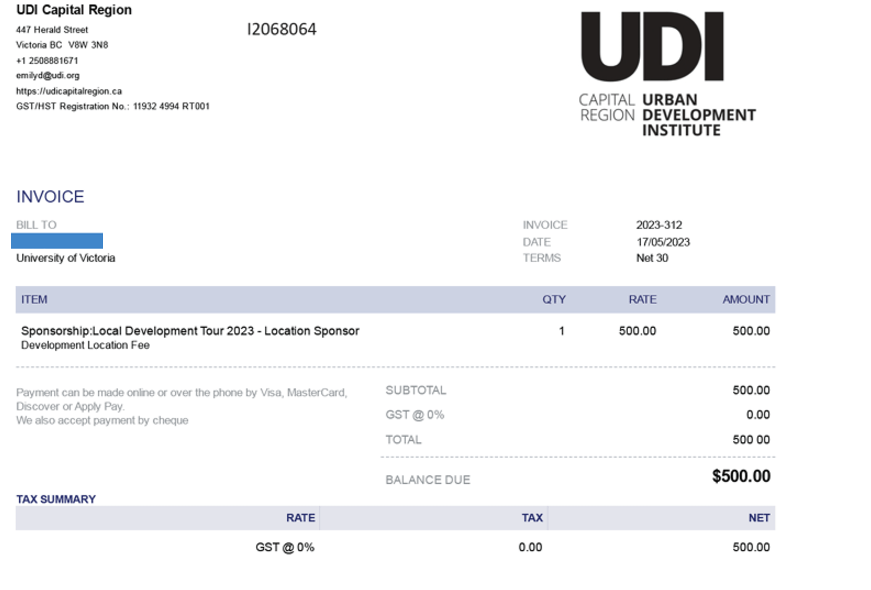
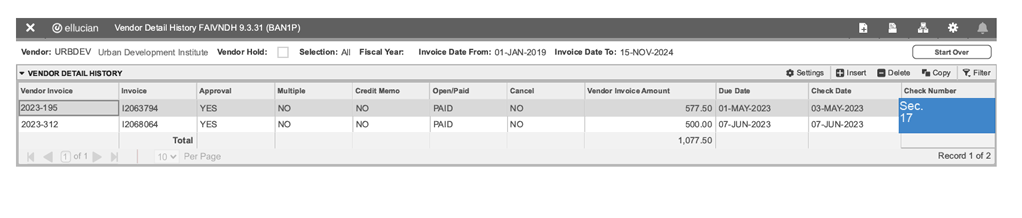
The following chart from UVIC FOI, shows payments made by UVIC to the Urban Development Institute. The first payment dated to May 3, 2023 of $577.50 was for a UVic staffer to attend a UDI course. The 2nd payment was for the UDI tour of the campus. The numbers on the payments match the numbers on the invoices.
—————————————————————————————————
The university paid $577.50 to the UDI for a UVic staffer to take the lobbying group’s course on “Community Relations”.
About a month prior to the tour, UVic paid the UDI so that a UVic Staffer could attend a UDI course.
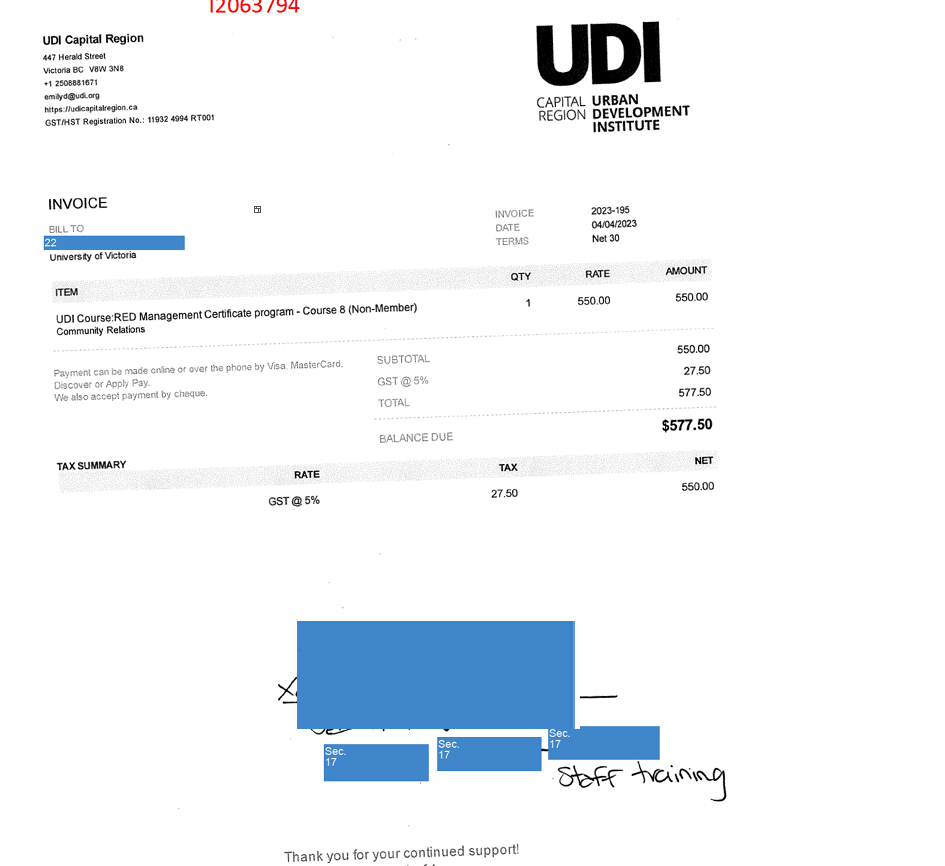
The payment was authorized by UVic’s Executive Director, Community and Government Relations. They are also on the Board of the South Island Prosperity Partnership (SIPP), an organization, setup by local governments in the CRD, and financially dependent on them. SIPP is a paying member of the UDI, and conversely, the UDI is a paying member of SIPP.
The following screenshot from the UDI’s new website (the previous branch websites were pulled down along with its members directory in November of 2023), is a description of the same course, as it was held again a year later in 2024.
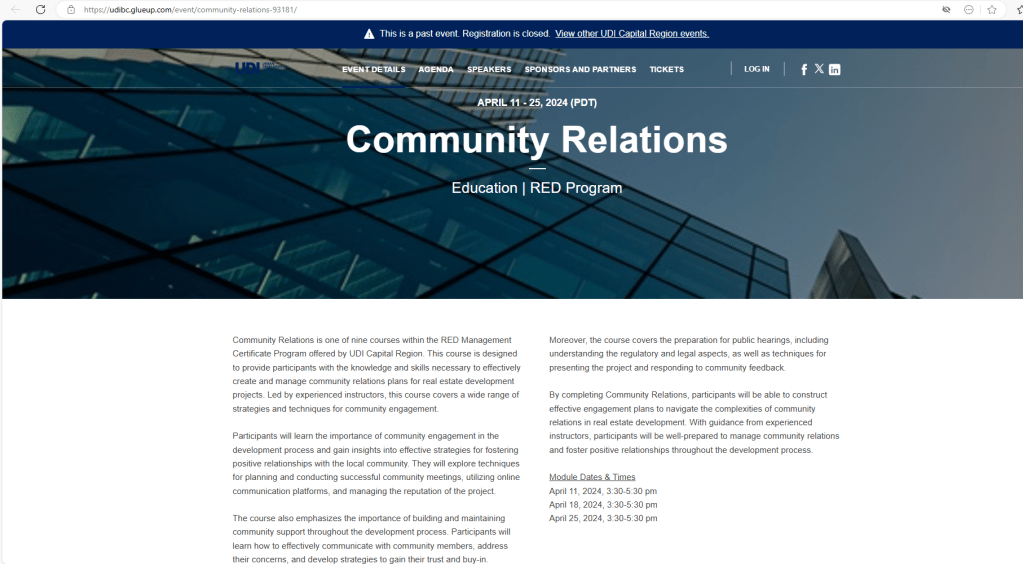
The following is a quote of the program that the course offered:
“Community Relations is one of nine courses within the RED Management Certificate Program offered by UDI Capital Region. This course is designed to provide participants with the knowledge and skills necessary to effectively create and manage community relations plans for real estate development projects. Led by experienced instructors, this course covers a wide range of strategies and techniques for community engagement.
Participants will learn the importance of community engagement in the development process and gain insights into effective strategies for fostering positive relationships with the local community. They will explore techniques for planning and conducting successful community meetings, utilizing online communication platforms, and managing the reputation of the project.
The course also emphasizes the importance of building and maintaining community support throughout the development process. Participants will learn how to effectively communicate with community members, address their concerns, and develop strategies to gain their trust and buy-in.
Moreover, the course covers the preparation for public hearings, including understanding the regulatory and legal aspects, as well as techniques for presenting the project and responding to community feedback.
By completing Community Relations, participants will be able to construct effective engagement plans to navigate the complexities of community relations in real estate development. With guidance from experienced instructors, participants will be well-prepared to manage community relations and foster positive relationships throughout the development process.”
The speakers teaching the course, included 3 members of Pooni Group, including its Vice President and Marketing Manager. Mark Holland, a UDI instructor and development consultant, was also a speaker/instructor.

The following were listed as Sponsors and Partners of the course:

—————————————————————————————————
Conclusion:
The University of Victoria, practically a quasi-governmental entity – is dependent on government funding, but it also looks to the development industry to help finance and undertake, an expansionist, but not necessarily sustainable business model – one that like other post-secondary institutions in Canada may now be on the precipice of collapse, due to a combination of rapid construction, a belt tightening pandemic, and a federal government that has starved post-secondary institutions of construction money for student housing since the 1990s and is now pulling back on foreign students numbers, something the university has made itself precariously dependent on for financing its costly ongoing operations.
In looking to the development lobby and its corporate members for support for its lofty projects and ambitions, the University runs into a serious danger, of moving too far in the direction of corporate interest, over that of both public and environmental interest.
UVic’s development-minded expansionism has been taking an environmental toll, with numerous trees being felled in and around the campus in recent years. UVic and its students’ push for more housing (encouraged by a development lobby that seldom appears to make a distinction between expensive, but profitable high end market-housing, and genuinely affordable housing that students and others are in need of) has led to tensions between the university and the surrounding community that for the most part would prefer not to be overwhelmed by the giant machine on the hill.
The shutting down of the former UVic Dog Park during the pandemic, and likely plans to build more student housing on the vast greenspace, has also led to tensions in nearby Cadboro Bay, as fewer wide-open spaces for pet owners both on the campus and in the surrounding community has led to claustrophobic pets, something not good for their health, and their owners feeling the issue as well.
In this atmosphere it could be seen to make some sense for the University of Victoria to provide a staffer with a course on “community relations”.
Was a registered lobbying group that pushes a development/real estate agenda for its corporate members to government, the appropriate venue to do that? Personally, I think not. Similarly, was it appropriate for the university to pay the same lobbying group $500 to have a tour of the campus? I can’t make any sense out of this payment, unless perhaps UVic thought of it like some sort of medieval courtship ritual. The main beneficiaries of the tour were the UDI, who received it.
As inevitably questions would arise, of how close the university has gotten to the UDI and its agenda; so has the spotlight recently been shone on its real estate club, which the UDI appears to have an undue position over through its overwhelming position on the UVicRec board, and with the organization and its member companies being its principle financiers. From some appearances the UDI comes across, as perhaps even its principle organizer, as it did for what appears to have been the UVicRec’s predecessor, the UVic Urban Development Club.
Although the amount of money spent on these cheques, for an organization the size of UVic and with its budget may seem minor, they do pose some pretty important philosophical questions, particularly in the ethics department; and they should provide cause to make the UVic administration take some time to pause, look in the mirror and think carefully before proceeding forward.
The UVic admin, may prefer to play down the issue, and keep pretending absurdly that they don’t know what the function of a board of directors is, but this game too is unsustainable. UVic should be an institution of learning, not an institution of feigned ignorance.
UVic’s best hopes moving forward would be to re-evaluate its model, to seek real sustainability and genuine balance, particularly in regards to the environment/eco-system it resides in; instead of chasing the unquenchable dragon of expansion at all costs. It would also be wise to seek genuine relations with its neighbours, treating them as equals, instead of looking to the development lobby to teach them how to deal with them.


 CRD Watch Homepage
Leave a comment