Freedom of Information reveals that the Province of B.C. was working to implement what the registered lobbying organization, the Urban Development Institute, had been pushing for. This culminated in the recent Housing Bills that override local government authority on zoning.
What was being proposed by the UDI to the David Eby, and other top provincial government officials, would 2 years later, become manifested with the forced housing targets and upzoning in the Provincial Bills 43 (2022), 44 (2023), and 47 (2023) etc.
By Sasha Izard
Nov 22, 2024
While the BC NDP government were busy pushing through Bills 44-47 last November (2023), I wrote an article titled: How the Development and Real Estate Lobby Pressed Mandatory Housing Targets, Mass Upzoning, Captured Official Community Plans, and Made the Shutting Down of Public Hearings the Norm in British Columbia Under the NDP Government
In the article I documented extensively in detail how the UDI had pushed the Provincial NDP over many years to force these policies on local governments/the public. Only 10 days after the article was written, the UDI in BC pulled down all their branch websites and replaced them with a single website UDI.org. Noticeably missing from the new website was the UDI’s members directory, which previously had included in addition to hundreds of paying corporate members involved in development and real estate, numerous branches of the government, including local and regional governments, as well as Crown Corporations. Luckily, some including myself saw this coming and copies were made of the UDI’s members directory, before it vanished from public sight.
That was not the end. The UDI’s new website revealed a wide array of committees that had been and were meeting with branches of government, including the Province of B.C., but no one I contacted in the Province of B.C. would provide information about, nor identify those committees, nor even tell me from which government branch I could receive information about the committees from. To be frank, they, in particular the Housing Ministry, were being clearly uncooperative, and the government appeared that it had something to hide.
In late March 2024, I submitted a Freedom of Information (FOI) request to multiple Ministries for their communications with and regarding the UDI. (You can scroll down to see the images below for a brief sampling of the results). Over 2 weeks later, I received an expensive initial quote of a sliver below a thousand dollars at $990.
Many months after paying half the price in deposit, this was reduced by a couple hundred dollars, and thankfully some people chipped in to help cover the costs which was much appreciated. After many months of delays – not unsurprisingly, as predicted: the FOI responses were finally arriving in large volumes of pages, as the BC election concluded and the NDP were left hanging on to a mere sliver remaining of their majority.
With thousands of pages of material to sift through and some of those pages seemingly in the folders of the wrong Ministries, this was no simple task. Still having seen many FOI responses, I have a bit of a sense of where to look to find the most crucially relevant content that is often found in the least apparent places. What I found, and I am certainly not finished, was the smoking gun, that what the UDI had lobbied the government and its leadership of, had been implemented by the Province. The implementation manifested in the housing bills that are dramatically changing the urban and semi-urban landscape over much of the Province.
This is something that I had already connected the dots on previously, but I didn’t have such glaringly direct examples of Provincial material as these to demonstrate it. There was instead, quite a lot of evidence from the UDI itself, but much of that disappeared from its branch websites that were taken down 10 days after my initial article, which had cited them extensively, although some of their PDFs I had saved previously.
Before, I proceed, I want to mention something about the media in B.C., that is that it has proven itself a complete failure to represent the public interest on these issues and has not only repeatedly turned a blind eye to them, but is actually active in keeping a lid on them, in the interests of the development and real estate industries above the public interest. That is, when the media isn’t simply pushing the UDI’s narrative, as if they were a public relations outfit.
I think this is not coincidental. Vast advertising revenue from developers and realtors, and investment pools, keep the corporate media afloat. Power structures in even the ostensibly non-corporate media appear far too attached to the state and corporate interests to be called anything resembling a free press, or avenue of critical inquiry, no matter how much they try to paint themselves as progressive publications.
As the UDI Capital Region put it on their website UDIcapitalregion.ca prior to its having been taken down last year, they are “Your voice in the Capital Region’s development industry”, and they invited you to “Join the team of industry leaders and professionals who are influencing the issues that affect your bottom line.” […] “We are the public voice for Capital Region’s development industry, liaising with local governments and the media” and the media here and elsewhere in B.C. have very close connections to the UDI. Sometimes more overtly, media outlets are even paying members, media sponsors and partners of the UDI. So much for independent journalism in the so-called free press in a democratic society.
What about the journalists themselves? My own impression is that all of them are too afraid to hold on to their tenuous jobs from the editorial staffs and administration to even attempt anything resembling a serious investigation into these issues. You can imagine for yourself what I think of the editorial staffs and administrators of our media. I consider them no better than your typical salaried life-long bureaucrat, who knows exactly what toes not to step on to maintain their positions. In many ways they are merely a microcosm of the state that much of our society is operating in. They are living a lie, and that lie is mostly by omission. It has by design left the vast public almost completely unaware of what entities are shaping, likely irreversibly, our lives and our futures and the environments that we live in.
That said, there are some exceptions to the rule. In particular, I would like to thank Randy Helten of City Hall Watch, and Frances Litman for being those exceptions. Randy has for years shone a light on the merger of lobby and state, including the UDI’s vast influence on the government. Randy through his own FOI saga with the Province found that a UDI lobbyist was consulted as an expert on the mandatory housing targets rolled out by the Province, and that the UDI received a sneak-peak of the list of municipalities that received the first provincial housing target orders before they were revealed by the Province to the public.
Frances, the creator of Creatively United for the Planet has been both kind and generous to host a number of my articles on the UDI and I am very thankful to her for that.
So there is hope for a free press of sorts, but I think that hope rests in citizen journalism. It will not come from the established media. It will not come from the ostensibly progressive media, which really operates no differently than the corporate media, and it often is the corporate media merely in disguise. It will not be televised. That is at least until the cat can’t be held in the bag any longer (even the CBC, establishment media that it is, eventually had to let the McKinsey cat out of the bag when it couldn’t be contained in there anymore).
Make no mistake: In my view, the UDI’s grip on housing policy over various forms of all levels of government is the most powerful merger of lobby and state policy on housing that I have witnessed, to the point that I can’t describe it as anything else other than state, regulatory and corporate capture. In particular, what the UDI achieved in lobbying the province, was the capture of the most crucial components of local government planning policy, what to many of the UDI’s paying corporate members is the gold they have been seeking for years, like a great El Dorado that had always been looming before them tantalizing them, and previously out of reach, but now firmly within their grasp: power over zoning policy.
What I view of the capture of zoning policy in the recent housing bills by corporate interests, is in my view one of the most brazen power grabs in the history of the Province, a brazen corporate takeover of previously democratic power, and yet this giant elephant in the room, especially the UDI’s involvement in it, the media has done everything it can to keep it under wraps. They will continue to do so, until they can’t anymore. Until then, it will take citizen journalism to expose this. Have no illusions what this means for democracy, but then again democracy is about citizens being in charge, and so citizen public interest journalism may be our only chance to really enable it. The media is just as captured and straightjacketed, as our public institutions are, from representing the public’s interest.
The UDI lobbied hard for public input to government to be reduced as much as possible, and this resulted in Bill 44 eliminating vast swathes of public hearings across the Province over instant upzonings of up to 4 to 6 times the density, in what is likely your own neighbourhood. To accomplish this, the public were reduced from citizens to nimbys in the propaganda by both lobby and state.
In Plato’s Republic, the state in a tyranny, is naturally in opposition to its own citizens by the nature of the power dynamic between them. The subtle, but effective debasement of the citizenry, is a sign that the direction has shifted from anything even resembling democracy, to oligarchy (the phase I consider us to be in now), and finally tyranny. Let the ship’s course be altered before it is too late.
—————————————————————————————————
What the FOI revealed:
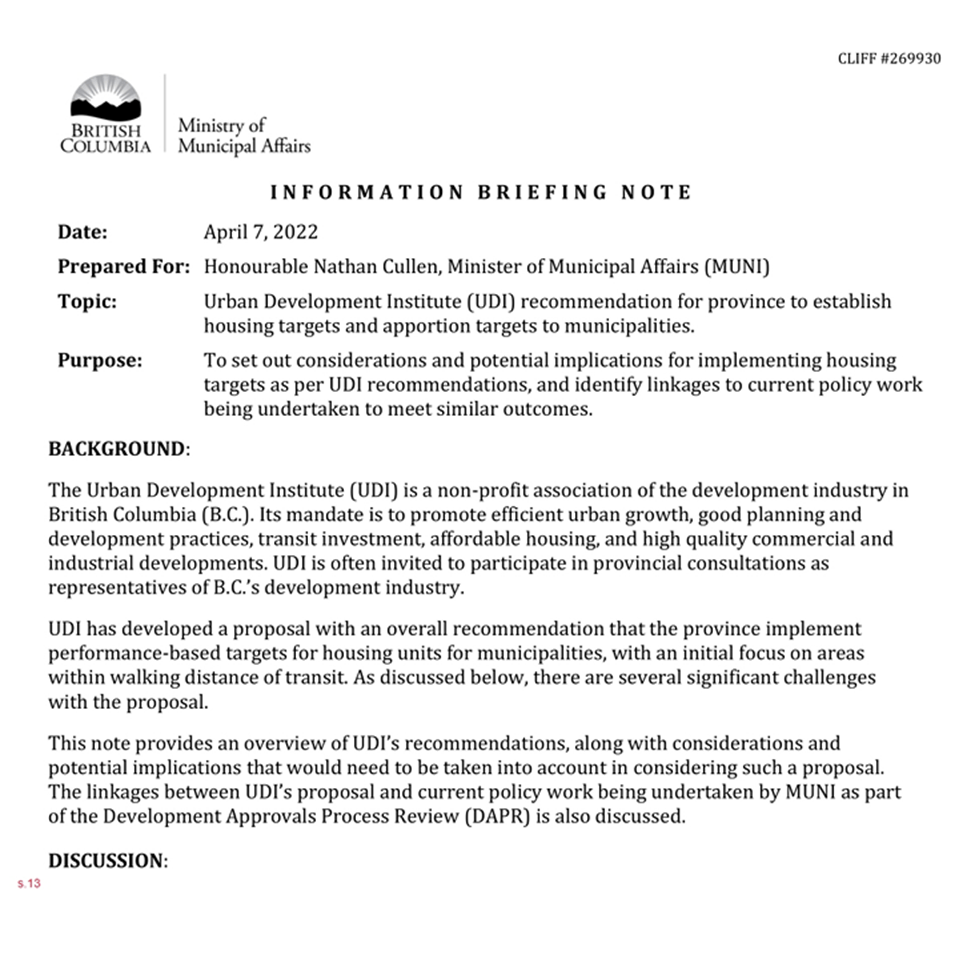
As the document mentions, it was prepared for Nathan Cullen, while he was Minister of Municipal Affairs.
The Cullen that begins to emerge from these documents, as head of the Ministry of Municipal Affairs is one that seems to have gone along far too comfortably with the direction the UDI was pressing the government to take, a direction the Ministry already appears to have been operating in line with and towards, but Cullen appears to have promoted that direction to levels unprecedented, as evinced by his subsequent Cabinet Concept Paper with a title beginning “Provincial Intervention in Local Zoning”, which contains the same conception that would ultimately be enacted through the passing of Bill 44, a conception that would radically override municipal powers over zoning across much of the Province.
As Minister of Municipal Affairs, Cullen and those under him were working towards many of the same objectives as the development and real estate lobby, whose hundreds of paying corporate members were making millions, if not billions of dollars from both internal and external sources, while housing prices skyrocketed in British Columbia, in particular in Vancouver and in the capital Victoria. They had a massive amount to gain from such policies becoming enacted by the Province by overriding municipal powers over zoning. It is difficult to imagine Cullen having been ignorant of this.
Amazingly from the Ministry, and for someone who should as Minister of Municipal Affairs be well versed on the world of real estate and development in British Columbia, and being in the position he was in, it is difficult to imagine that it wouldn’t have escaped the Ministry’s and his notice that this background provided in the briefing that describes the UDI in glowing terms, does not mention that they are a registered organization on the BC Lobbyists Registry that actively lobbies the same government he had such a senior position in, in the interests of its paying corporate members involved in development and real estate. I would imagine though it wouldn’t have been necessary to tell him that, as he would already have known that full well. Why then was it necessary to provide a glossy explanation of what the UDI was in the first place?
Here is a copy of the UDI’s Lobbying Activity Report 3004-17730 on the BC Lobbyists Registry for lobbying activity dated to March 10, 2022, about a month previous to the briefing paper for Cullen:
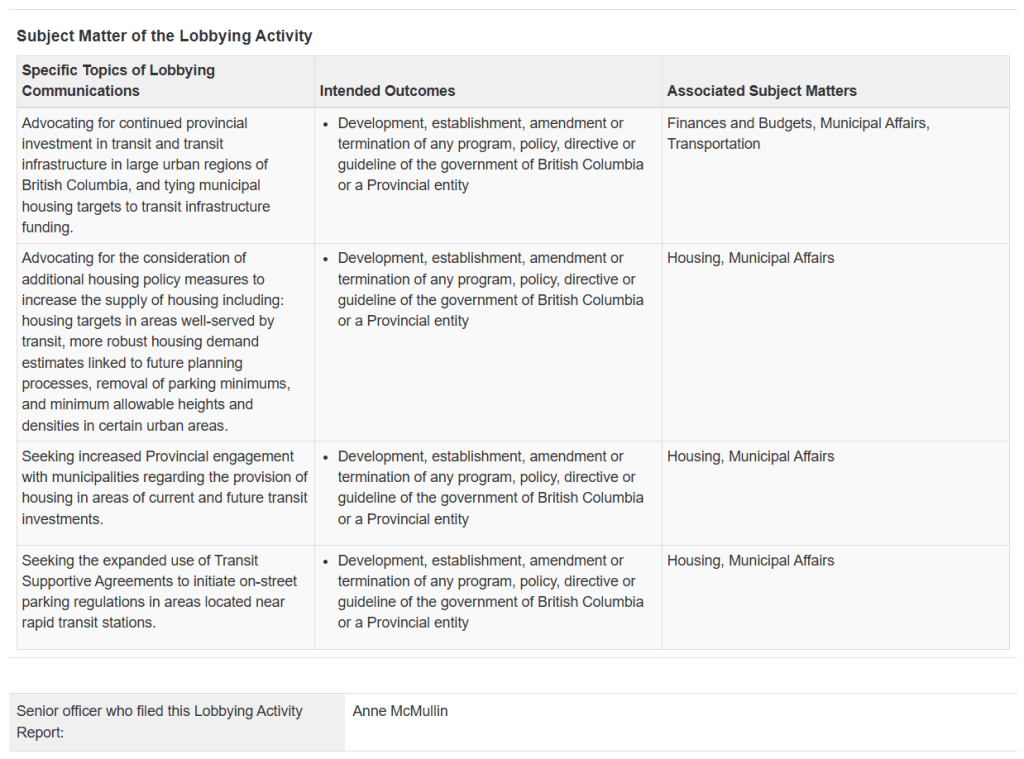
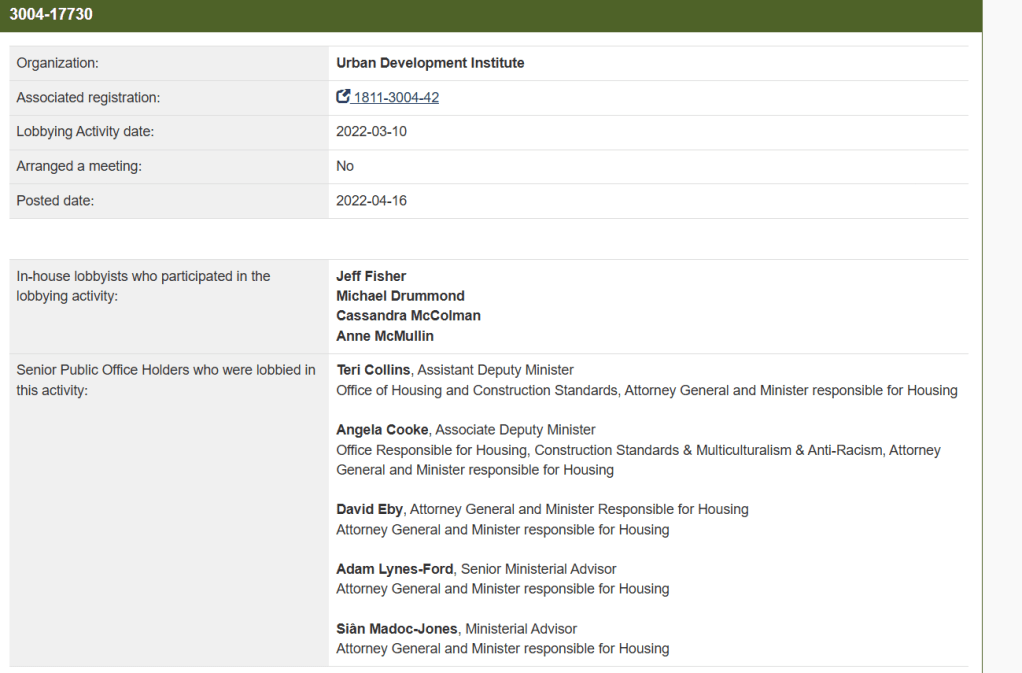
Note: The s.13 referred to at the bottom of the Ministry of Municipal Affairs briefing prepared for Cullen (the first image shown) and which continued on the subsequent page of it and others, is redaction, also known as severing of the text on the basis in FOIPPA: “Section 13 is a discretionary exception to the right of access to information. It permits public bodies to withhold information that would reveal advice or recommendations developed by or for a public body or a minister.
Section 13 is intended to allow full and frank discussion of policy issues within the public service, preventing the harm which would occur if the deliberative process were subject to excessive scrutiny.”
Who gets to arbitrarily determine what constitutes excessive scrutiny? The government of course.
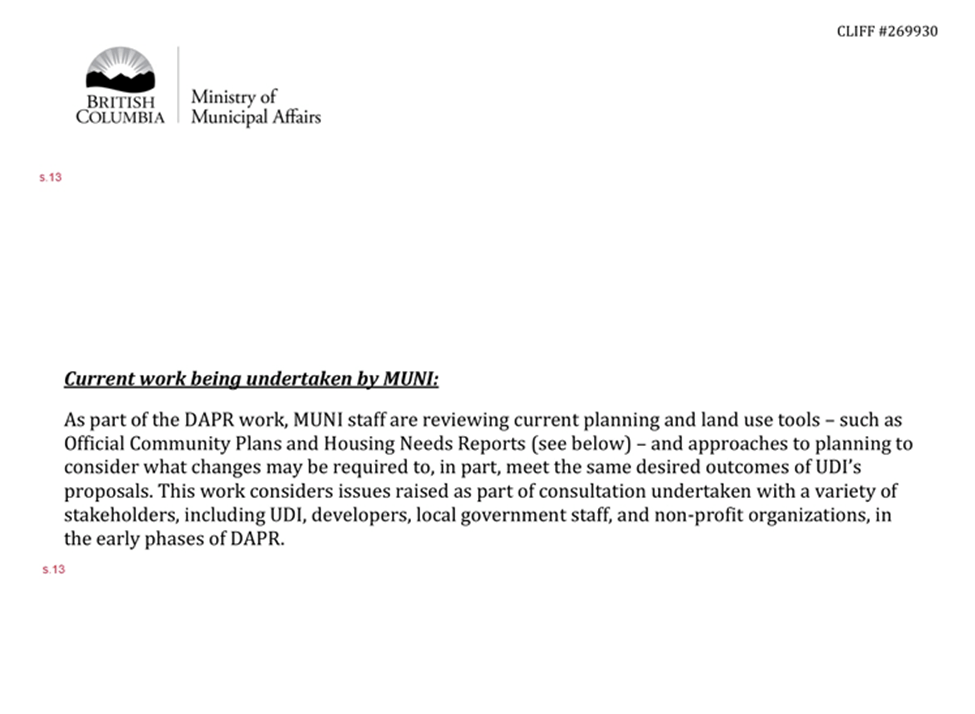
MUNI stands for the Ministry of Municipal Affairs. DAPR stands for the
Development Approvals Process Review, which the UDI was consulted by the Province on as a stakeholder, and involved a significant amount of content that looked remarkably similar to UDI material over the years.
Official Community Plans and Housing Needs Reports, meeting the same desired outcomes of the UDI’s proposals? Working with stakeholders including the UDI and developers, local government staff etc.? Sound familiar?
One week after this information briefing to the Minister appeared, Cullen’s name appeared once again at the top of the subsequent document mentioned:
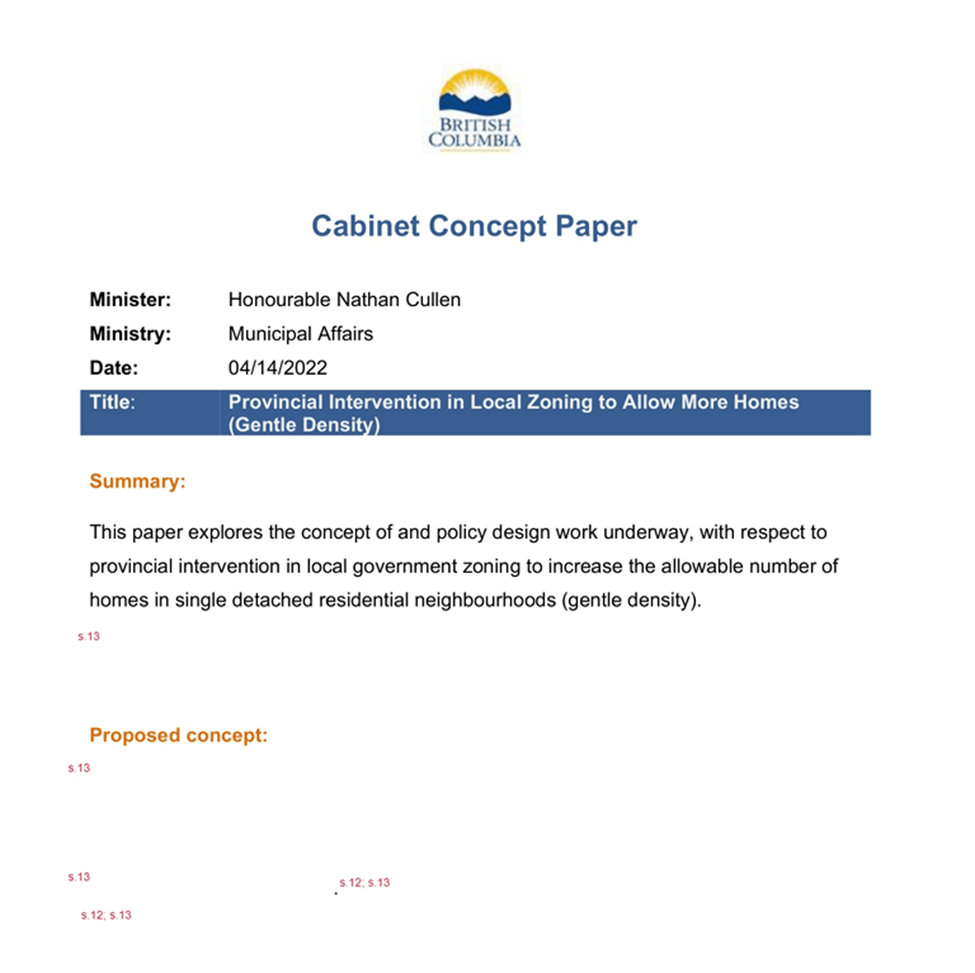
Yes, Provincial Intervention in Local Zoning to Allow More Homes. It has a nice ring to it doesn’t it? Don’t let the addition of the term (gentle density) give you the wrong impression. What was being talked about in this document was not about allowing garden suites on single family home lots, but about significantly increasing the amount of housing on them.
Beyond the title and summary, the document had a number of pages with all content other than headings and names, censored in the form of redactions from the FOI response.
This is the end of the document:
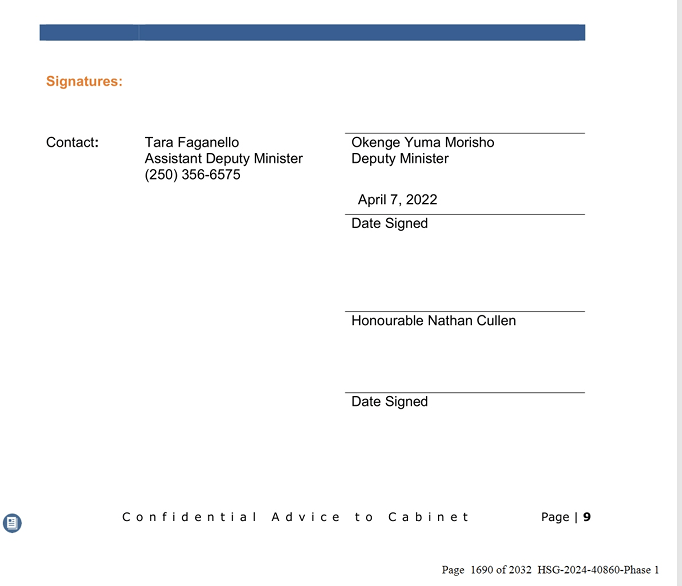
The document’s contact was Tara Faganello, who had also approved the briefing for Nathan Cullen a week earlier:
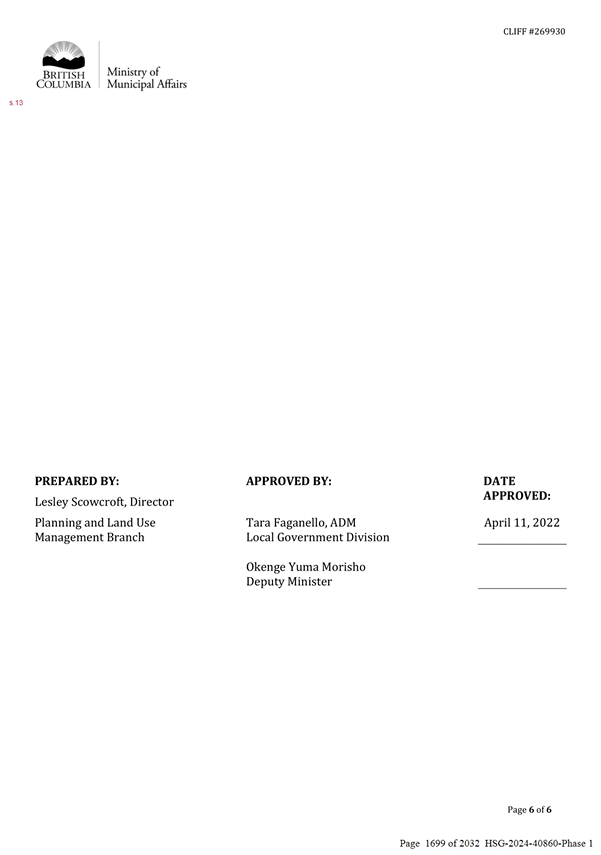
The briefing was also approved by the Deputy Minister at the time Okenge Yuma Morisho, who two days later on April 13, 2022 delivered a presentation titled “Overview of Work Related to Housing and the Development Approvals Process Review”, which can be read in full in this article:
Ministry of Municipal Affairs Presentation from April 13, 2022 provides a glimpse on the processes that led up to the Housing Bills (Bills 44-47) that were put forward in the Fall of 2023. – CRD Watch Homepage
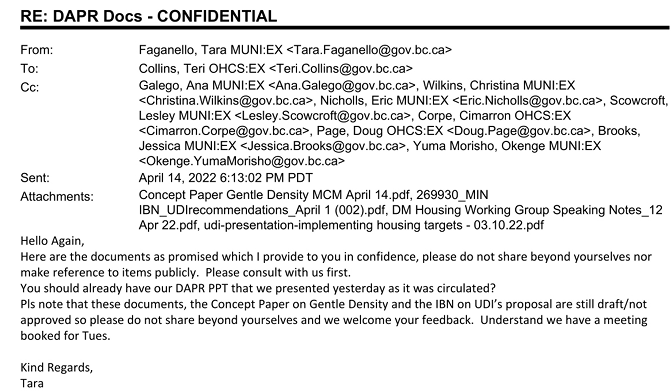
Excerpt from Ministry of Municipal Affairs email by Tara Faganello dated April 14 2022:

Note: Bill 44 was rammed through in the Leg in the Fall of 2023. The FOI email excerpt above was from:

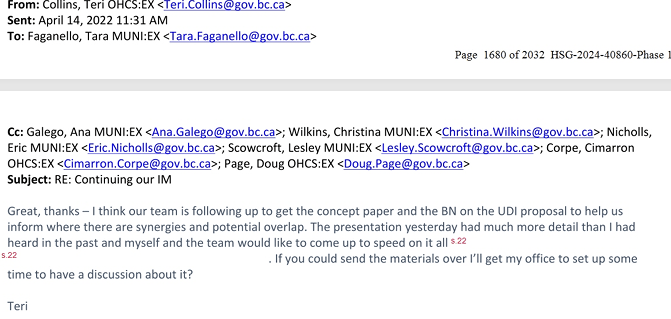
The following is another email sent later in the evening, in addition to the one which had the excerpt above:
From an earlier email sent that day:
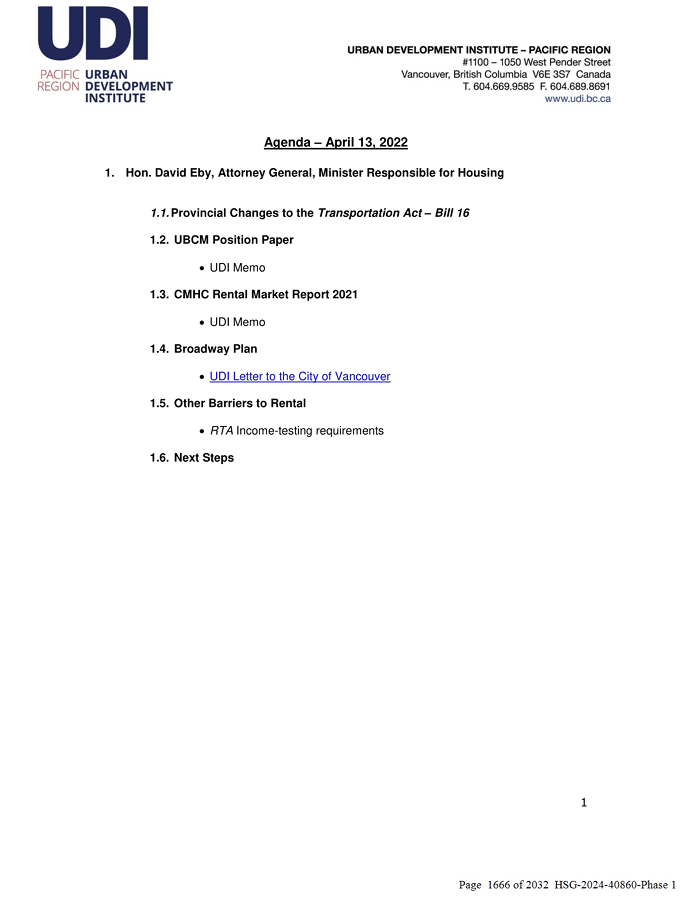
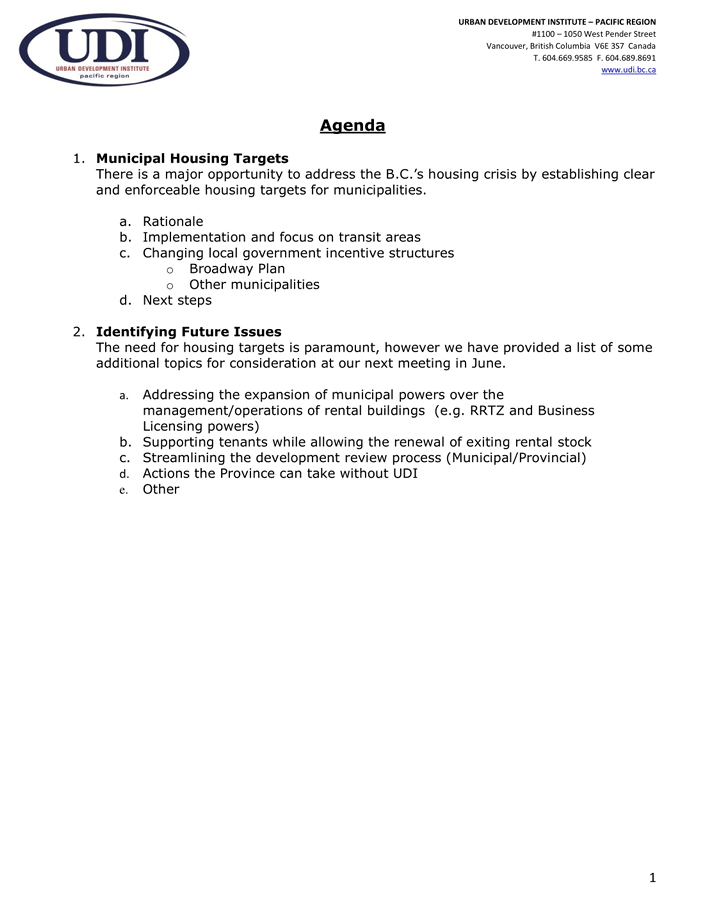
A day before these emails and the Cabinet Concept paper for ‘gentle density’, the UDI met with Eby. Here is the agenda from that day:
Related emails from a week earlier:
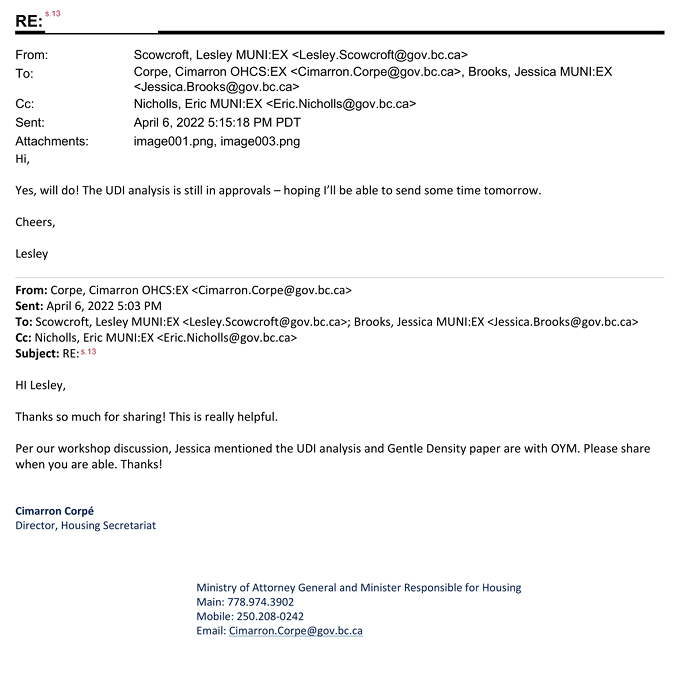
Cimarron Corpé would become Acting Executive Director of the Ministry of Housing’s Housing Targets Branch a year later.
What ultimately appeared in Bill-44, 2 and a half years after the Cabinet Concept Paper regarding ‘gentle density’, was not gentle density, but an increase of up to 4-6 times the amount of housing units on single family home lots, without adequate environmental protections and infrastructure considerations in place. The instant upzonings would involve no public hearings, as per the bill. It is clear that these radical new policies rammed by through by the Province, without much in the way of public debate nor consideration, did not emerge out of thin air, but rather had already been coming down the pipe, with origins years earlier.
‘Gentle density’ in my view, euphemises what was in actuality, to become a major power grab over local zoning by the Province, along the lines of what the UDI had been lobbying it to achieve: “Provincial Intervention in Zoning” as the title puts it, and the now former Minister Cullen’s name was at the top of the Cabinet Concept Paper regarding “the concept of and policy design work underway, with respect to provincial intervention in local government zoning to increase the allowable number of homes in single detached residential neighbourhoods.”
In the first of the two images shown of the April 7, 2022 Ministry of Municipal Affairs Briefing, the background of the information briefing prepared for Minister Cullen, mentioned “performance-based housing targets”. “UDI has developed a proposal with an overall recommendation that the province implement performance-based targets for housing units for municipalities.”
This was the clue that I needed to figure out where this was coming from. Where were the UDI’s recommendations regarding the performance-based targets for housing units for municipalities?
For this I had to look in other FOI response PDFs from other Ministries.
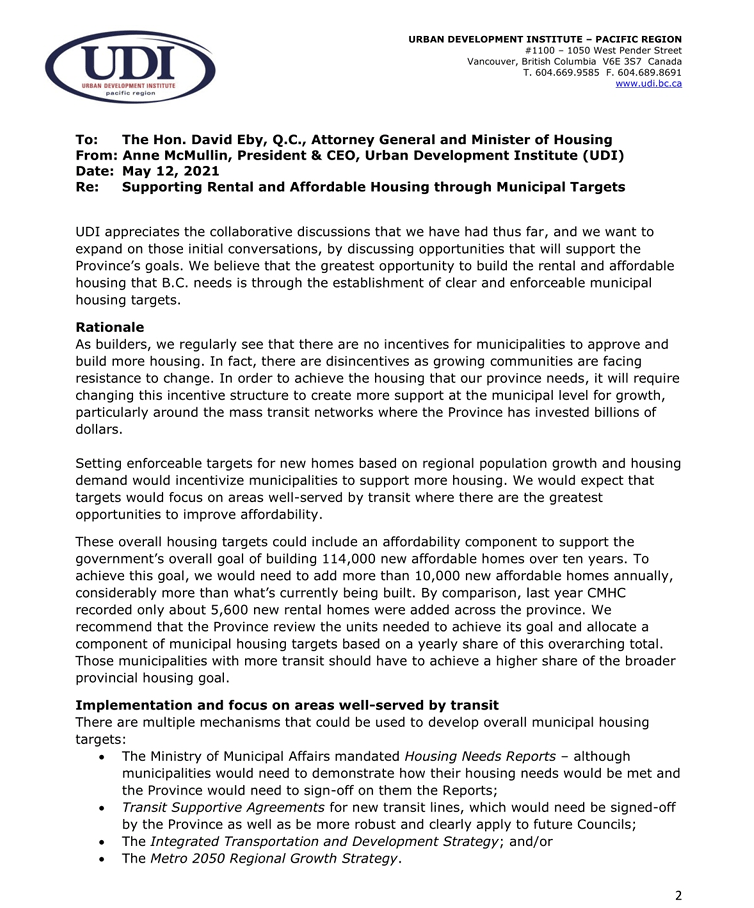
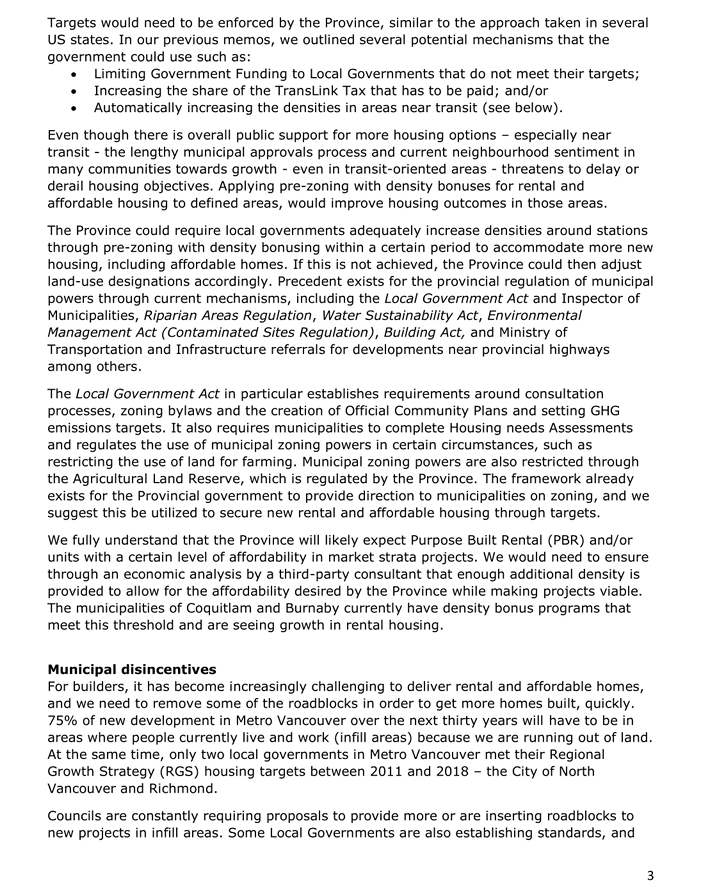
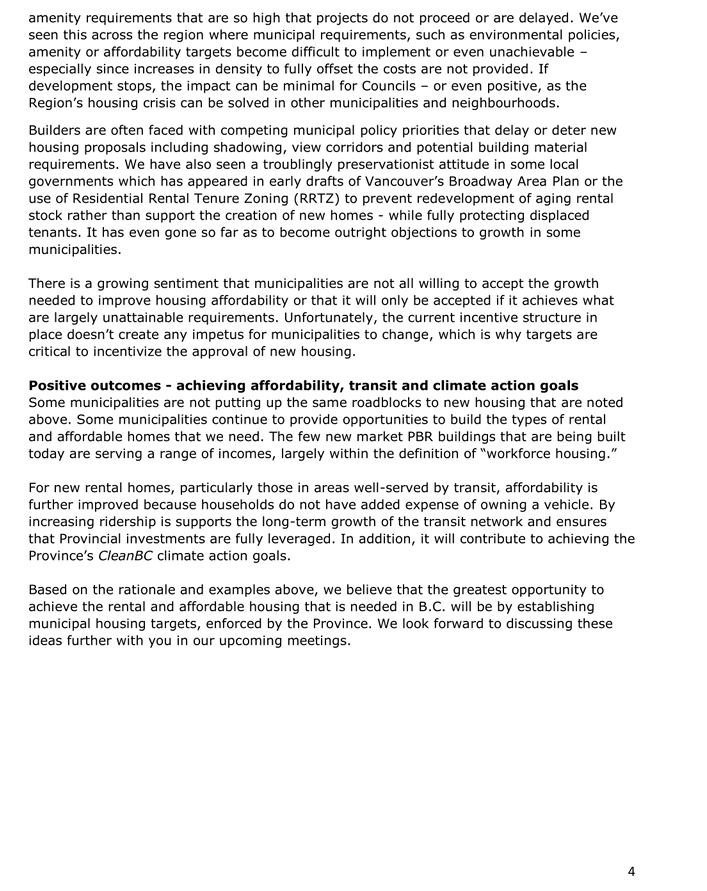
What I found was this letter from the President and CEO of the UDI to the Attorney General and Minister of Housing at the time, dated approximately a month prior to former Minister Cullen’s briefing:
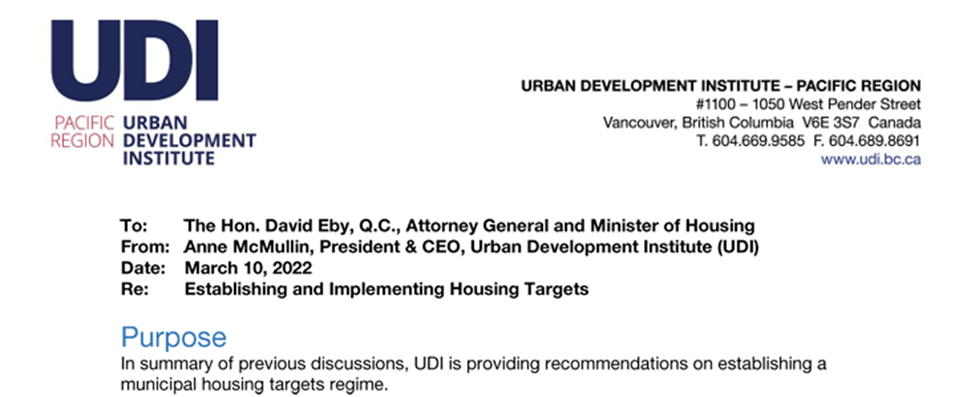
This was not beating around the bush…
The letter immediately continued with a summary that stated: “It is critical for the Province to take a leadership role and provide municipalities with enforceable housing targets”.
Performance-based housing targets are vaguely described in the next paragraph, mentioning that the “targets would provide local governments with autonomy”, which sounds quite benign, but the conclusion at the bottom of the summary sounds quite different: “For the targets to be taken seriously by local governments, there need to be clear enforcement mechanisms. however, UDI advocates that the Province not immediately utilize the enforcement mechanisms until there has been a discussion between the Province, the impacted local government(s), the Transit Authority, and builders. There may be extenuating circumstances and opportunities to work with municipalities to improve their policies/processes so even more housing can be built. UDI proposes several incentives and enforcement mechanisms that could be used to ensure the delivery of housing.”
Later in the document, these will be referred to as a carrot and stick approach.
The Purpose was immediately followed by a Summary:
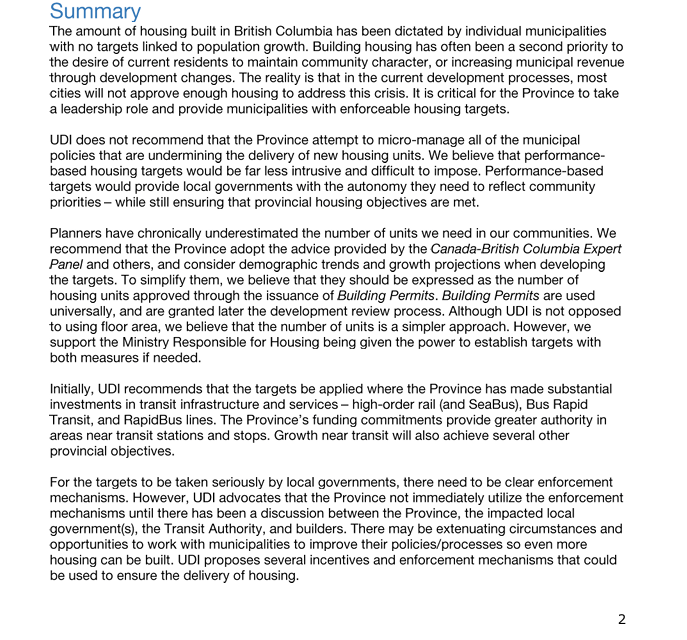
The discussion of performance-based targets continued on page 3:
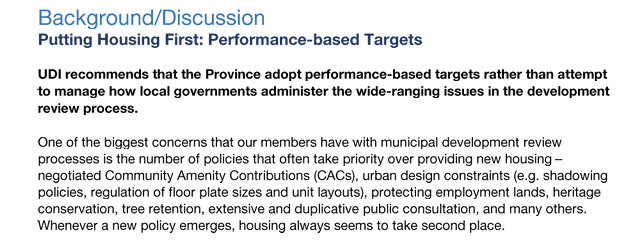
Tree retention, heritage conservation, public consultation etc., is in the way of new housing? The letter doesn’t appear to go into further detail about these supposedly problematic obstacles to unfettered construction.
More about this so-called performance-based targets were described on the next page:
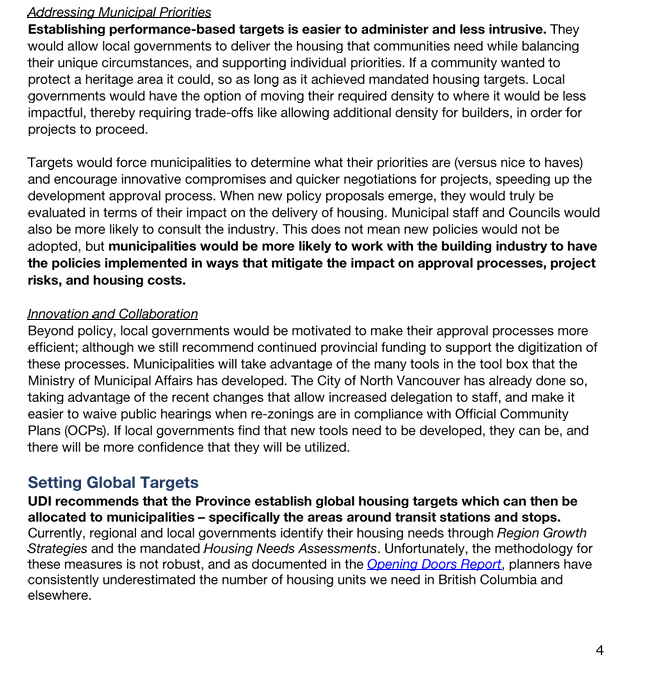
The next page elaborated on the proposed “global targets”:
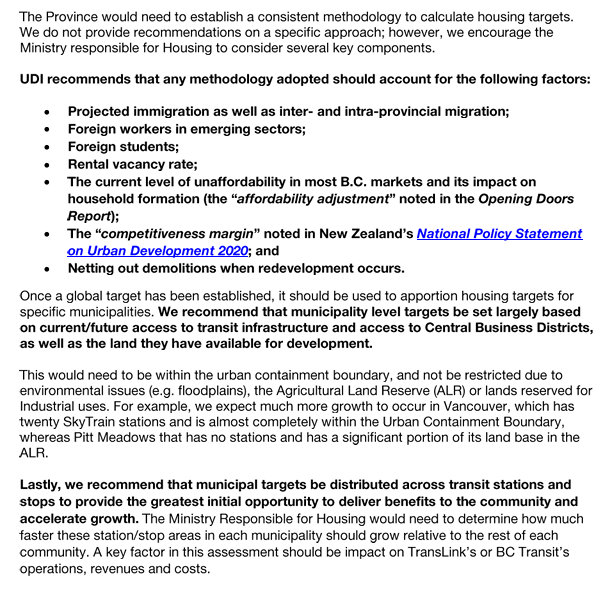
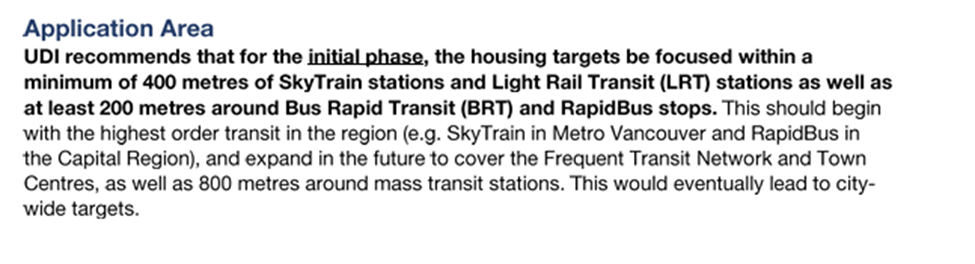
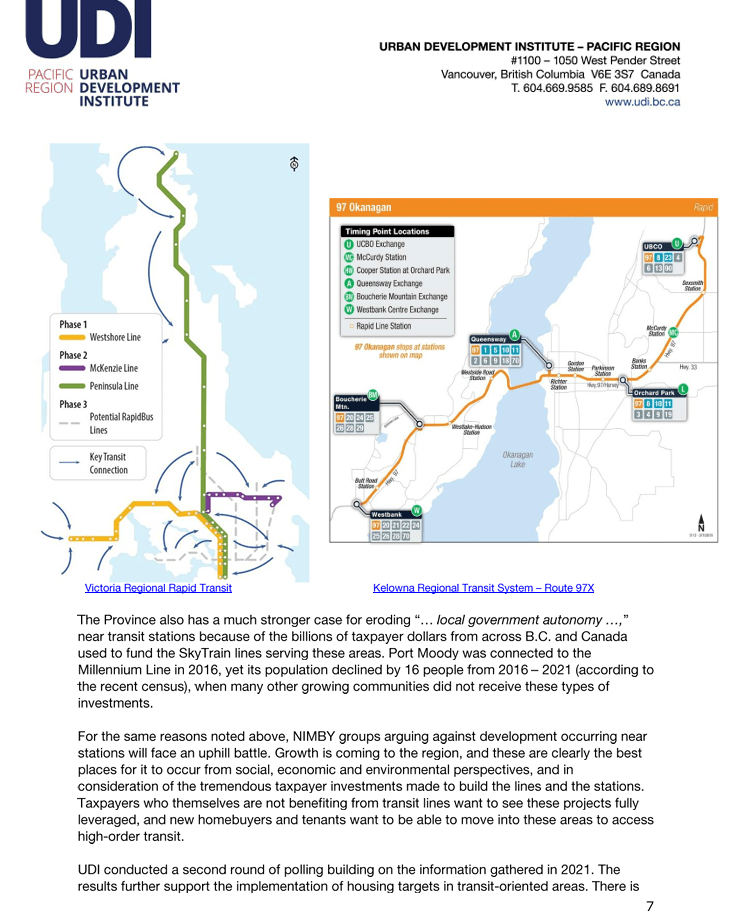
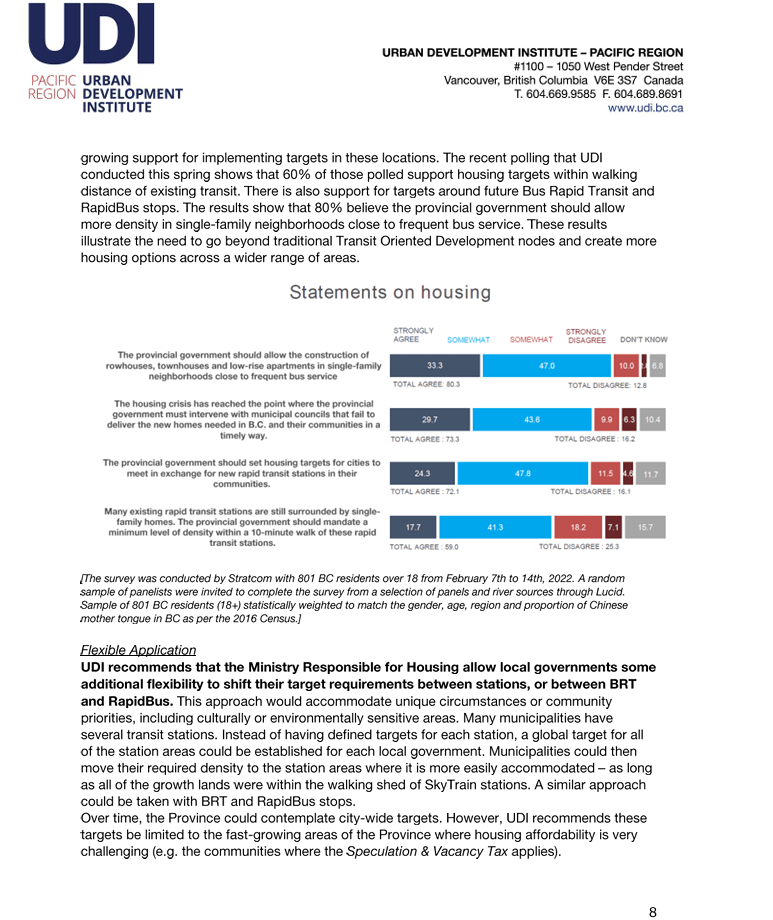
The bottom of this page contains one of the most important sections in the lengthy letter from McMullin to Eby, (the full letter will be attached to the end of this article). The following paragraph describes what is clearly the origin of what would be Bill 47 (2023) with its pre-zoned TODs Transit Oriented Development Areas/
TOAs Transit-oriented areas.
The city of Coquitlam at present describes Transit Oriented Areas as follows:
FAQs • What is a Transit-Oriented Area? (Accessed: Nov 21, 2024)

You can also compare the following as quoted from: Transit oriented development areas – Province of British Columbia (Accessed: Nov 21, 2024)
“TOD legislative framework
New legislation will require some municipalities to designate Transit-Oriented Development Areas (TOD Areas) near transit hubs. These TOD Areas are defined as areas within 800 metres of a rapid transit station (e.g., SkyTrain station) and 400 metres of a bus exchange and West Coast Express that the Province has listed in regulations.
In these areas, local governments are required to:
Ensure that minimum levels of density, size, and dimension established by the Province in regulations are allowed in TOD Areas. These will vary by municipality and may vary within the TOD Area. Local governments can approve densities that exceed the provincial regulations at their discretion”
This is incredibly similar to what the UDI had proposed 2 and a half years earlier, isn’t it? Coincidence? I think not. It looks like the Province eventually went for the UDI’s high-ball figures.
The document included pretty extensive details of the UDI’s vision:

McMullin continued railing against hypothetical “NIMBY groups” in the way of the UDI’s agenda in the letter:
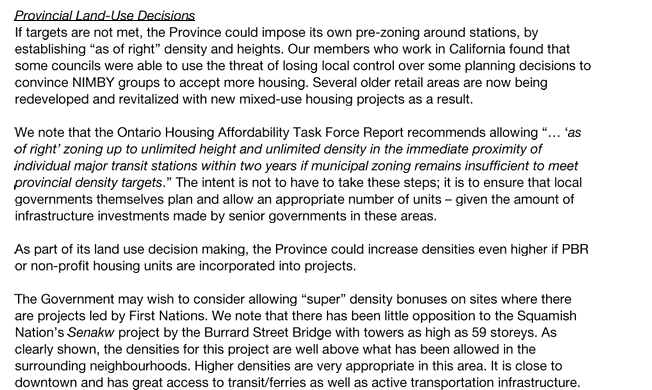
Note: The Nch‘ḵay̓ Development Corporation of the Squamish Nation was a member of the UDI, according to the backed-up UDI members directory.
In order to achieve the UDI’s goals towards local zoning, the UDI offered a carrot and stick approach for the Province to adopt towards municipalities

The punitive stick approach to local governments, not approving enough construction as to be satisfactory to the UDI, could as suggested, involve for example, cutting infrastructure funding to local governments, or increasing taxes on those living around these areas:
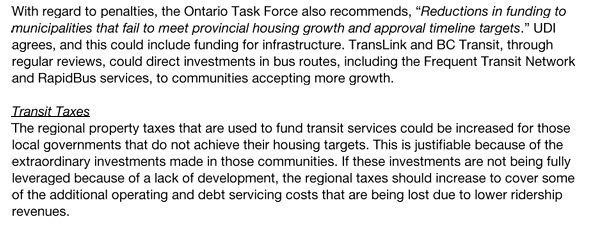
The letter concluded:

————————————————————————————-
The patterns regarding the UDI, McMullin, Bill 47, and TransLink (McMullin served on TransLink’s External Real Estate Advisory Group) – are something that I recognized very early on, as the Bill was being put forward last year.
On November 17, 2023 I wrote the following article: A brief look at UDI member TransLink and BC Bill 47 (2023) – Sasha Izard
TransLink, a Provincial Statutory Authority, was listed on the backed-up UDI members directory. TransLink has not responded to my question to them (sent on Oct 6, 2024), as to whether they are currently a paying member of the UDI, following a pattern of evasion regarding government entity UDI memberships that I have documented extensively in various articles regarding Provincial Crown Corporations.
TransLink’s FOI department is at present trying to charge me somewhere around what they have estimated to be at least $150 or more, for a mere handful of invoices/receipts showing the payments for their UDI memberships. Their reasoning? The receipts/invoices are held somewhere off-site and retrieving them would take approximately 8 hours, or so they claimed.
A quick Google search revealed the following places about 8 hours from Vancouver:

Source: 8 hours from Vancouver (Accessed: Nov 22, 2024)
Perhaps Mike from Canmore can help them find the receipts.
The following is from FOI:

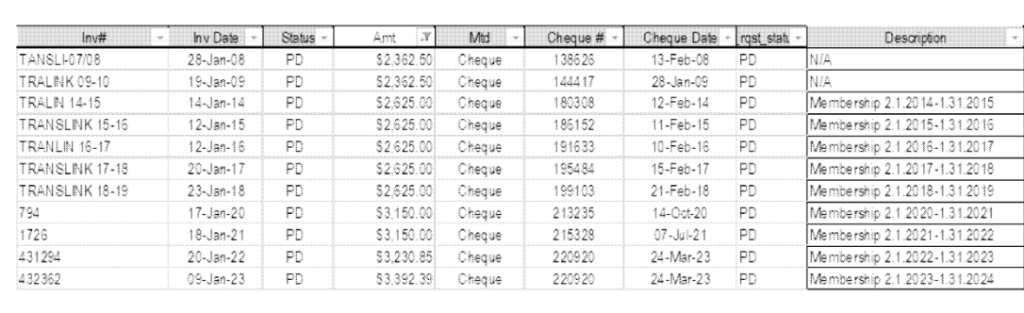
Apparently even the UDI have been having difficulty with TransLink’s accounting for their membership dues. A message from the UDI to TransLink regarding “Outstanding Membership Dues Invoices” was sent in March of 2023:

See also: After a Comedic Exchange of Emails, BC Transit Admits that it has a Membership with the Urban Development Institute. The Implications of that for BC, may be more Tragic than Comic. – CRD Watch Homepage
The following excerpts are from a UDI letter to David Eby dated to July 8, 2021 from p.1000 of the Ministry of Housing FOI:
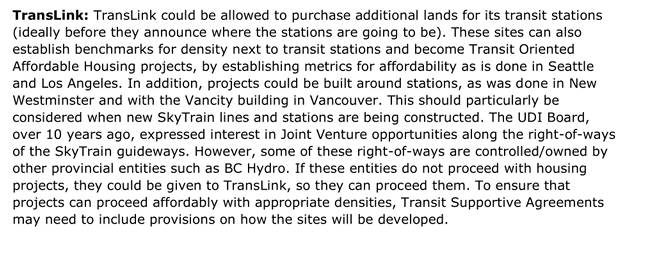
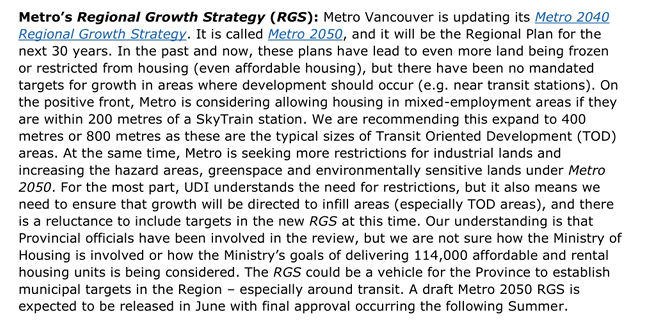
———————————————————————————

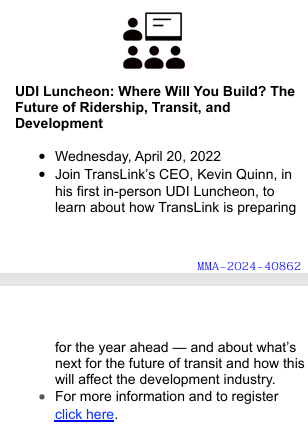
————————————————————————————-
Page 1 of the UDI’s 2023-2024 Annual Report states:
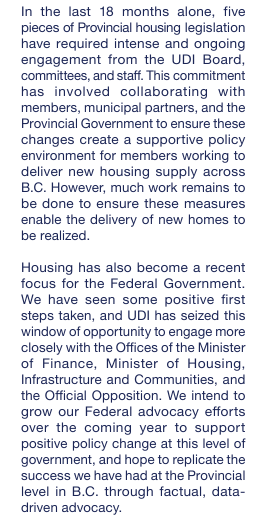
Not only did the UDI lobby for the contents that would become Bill 47, but in their March 2024 Newsletter (FOI: OOP-2024-40863 p.318) they mentioned that they were working with the Province to help implement it.
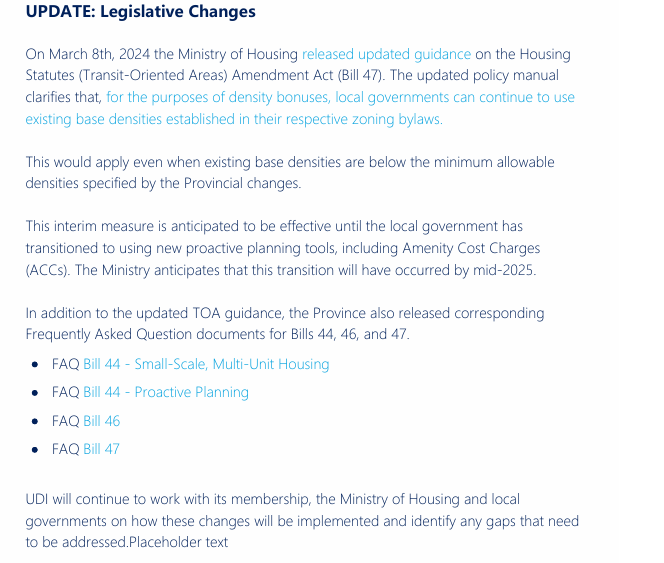
————————————————————————————-
Appendix I: Both full UDI letters from McMullin to Eby, dated March 10, 2022 and the agenda for the UDI meeting with Eby that day.
The following is a message sent from the UDI to Eby about the upcoming meeting on March 10, 2022 (From the Ministry of Housing FOI p.1629)
The following is from p.31 etc. of the Ministry of Municipal Affairs FOI:
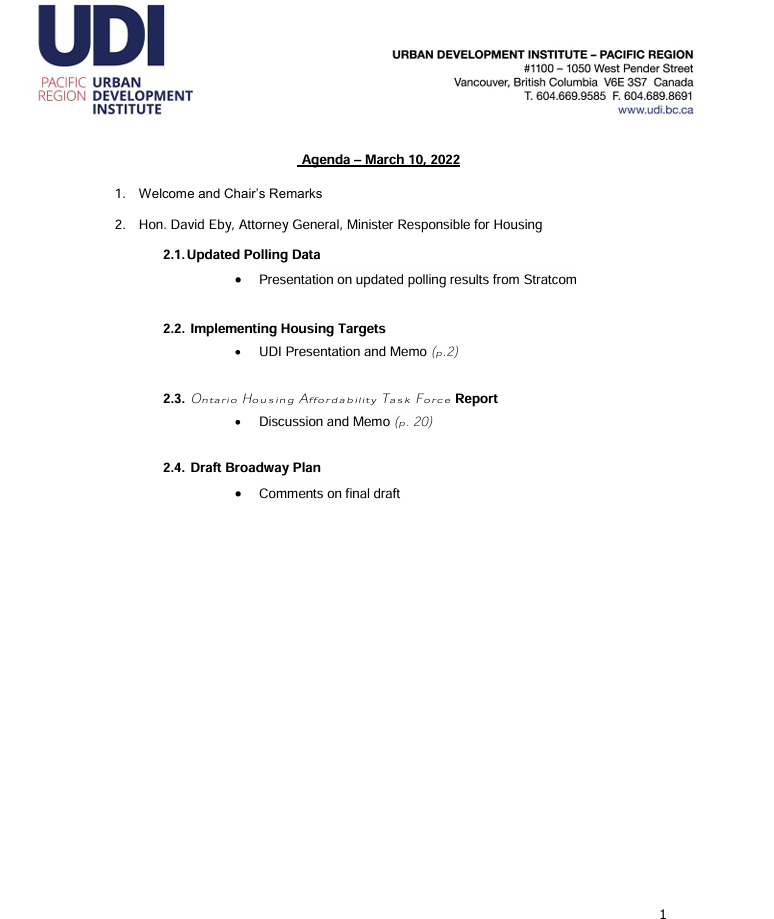
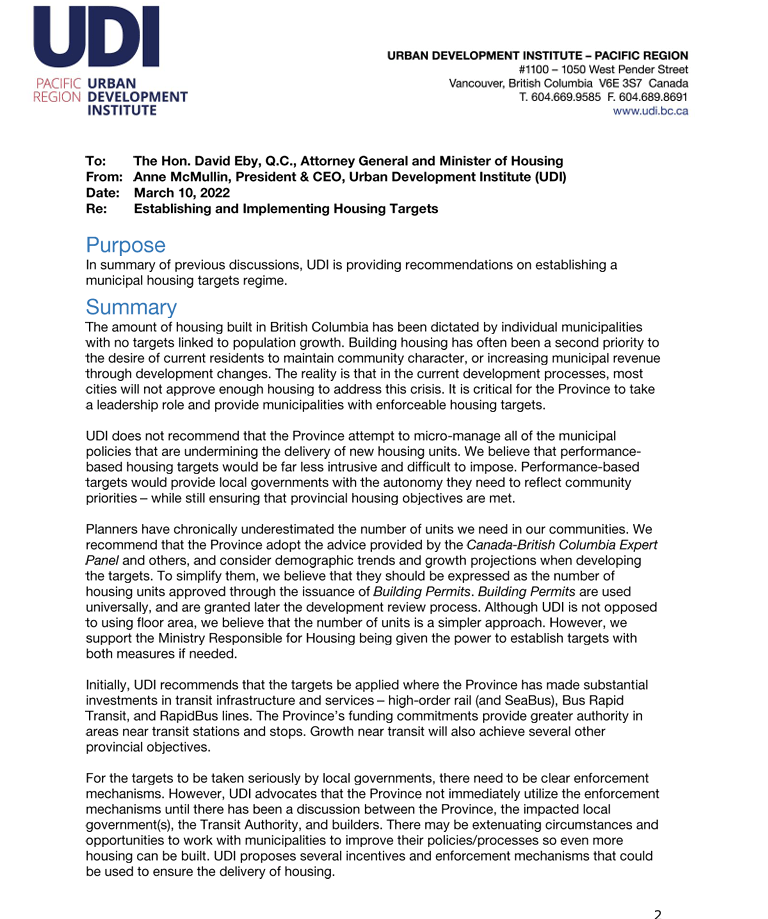
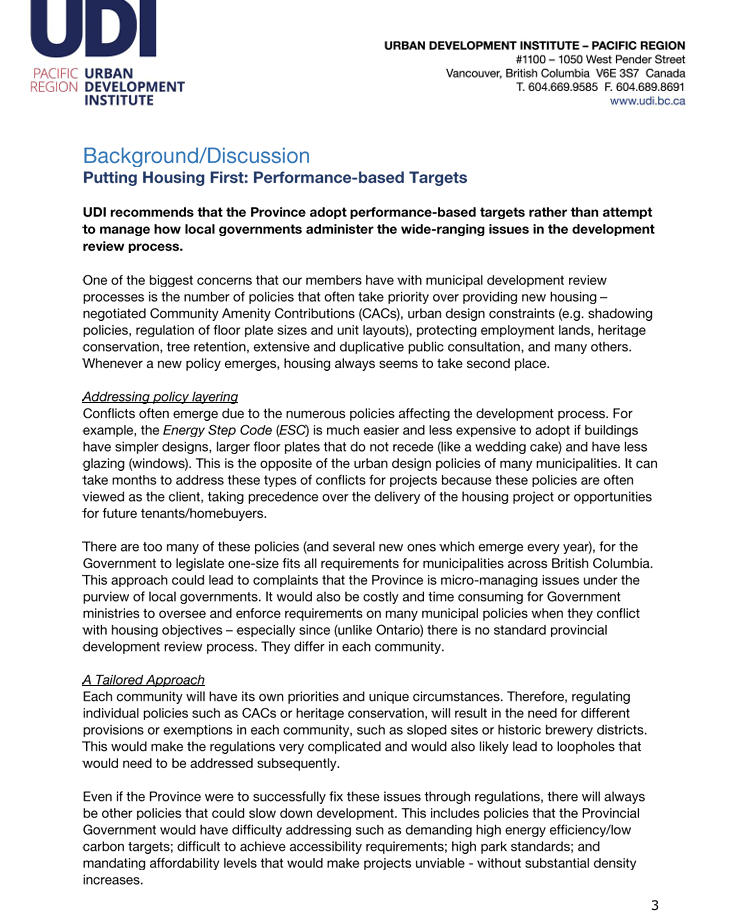
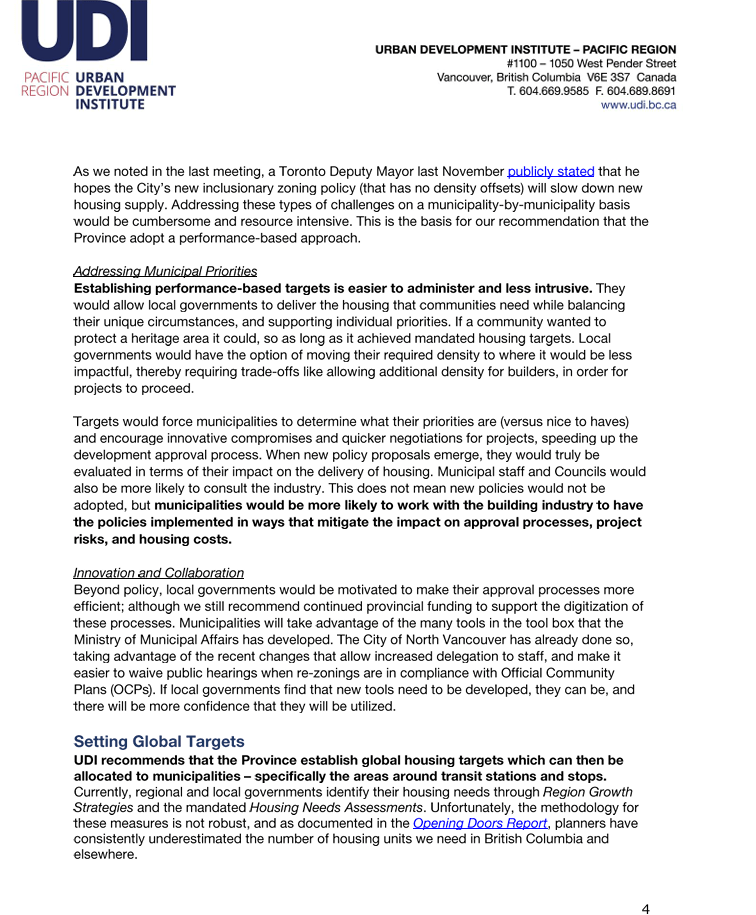
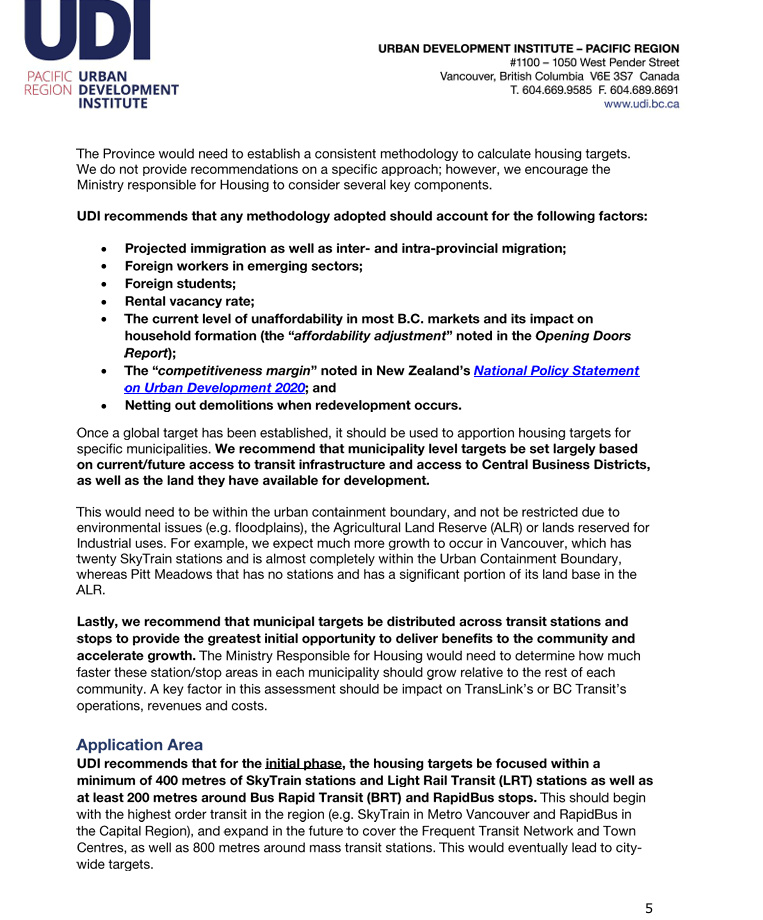
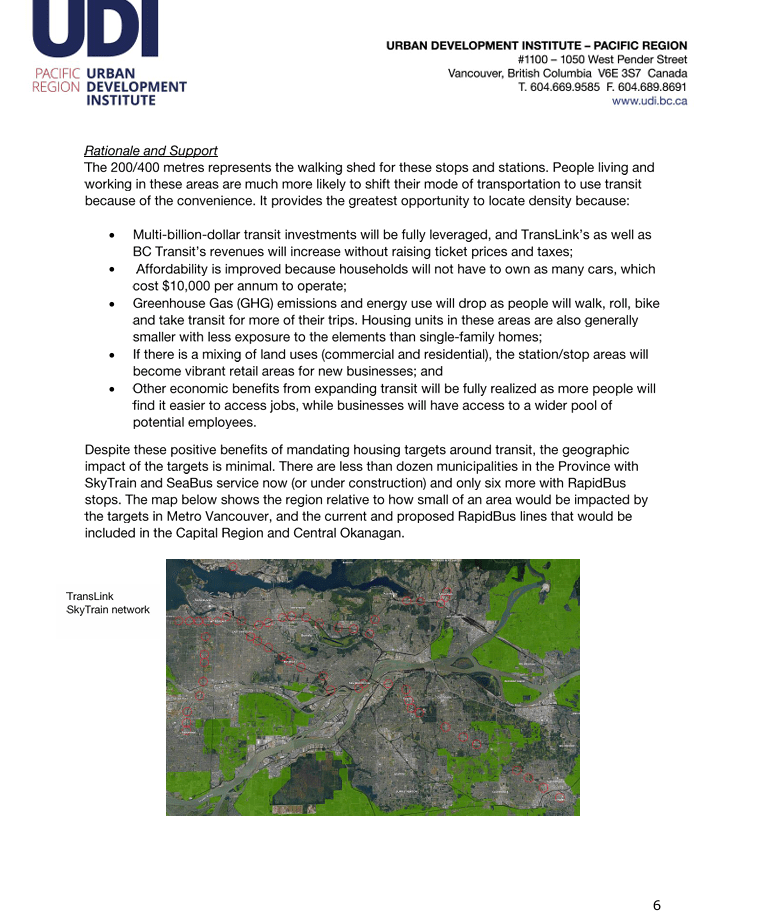
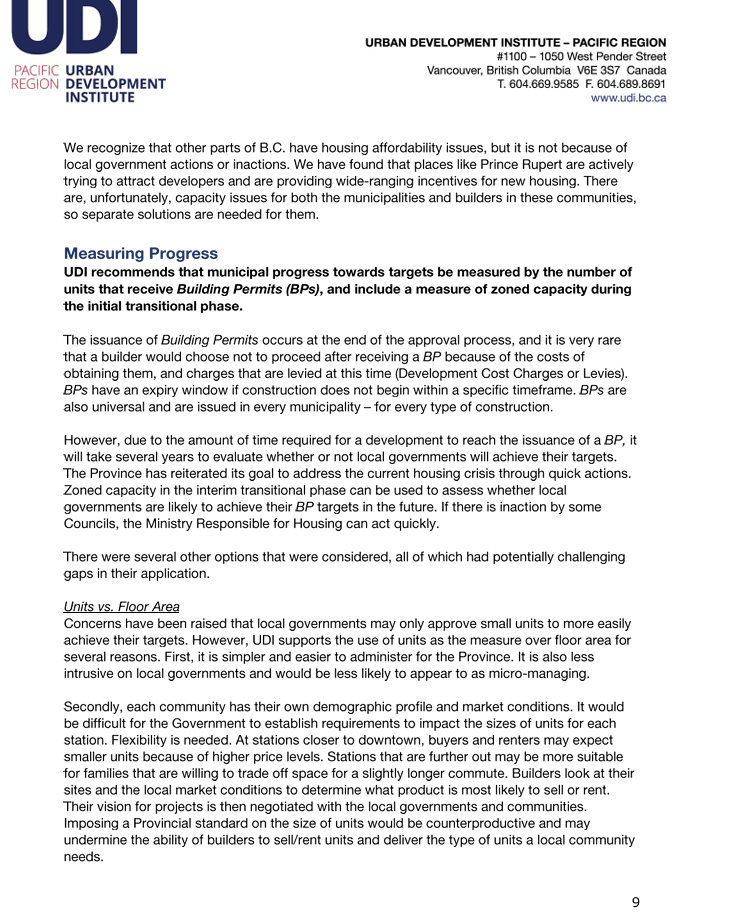
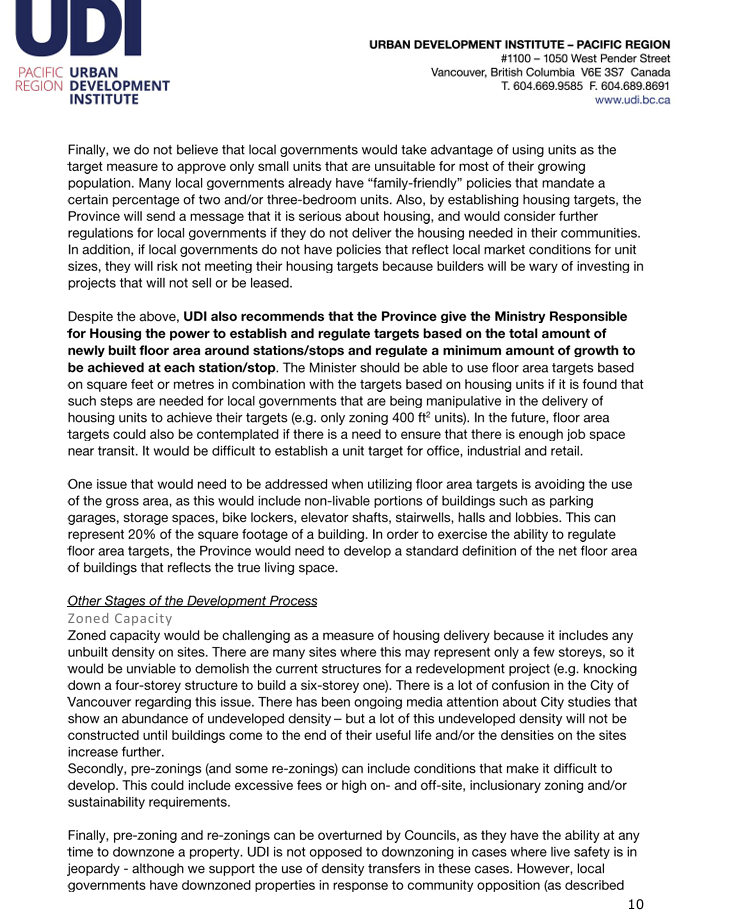
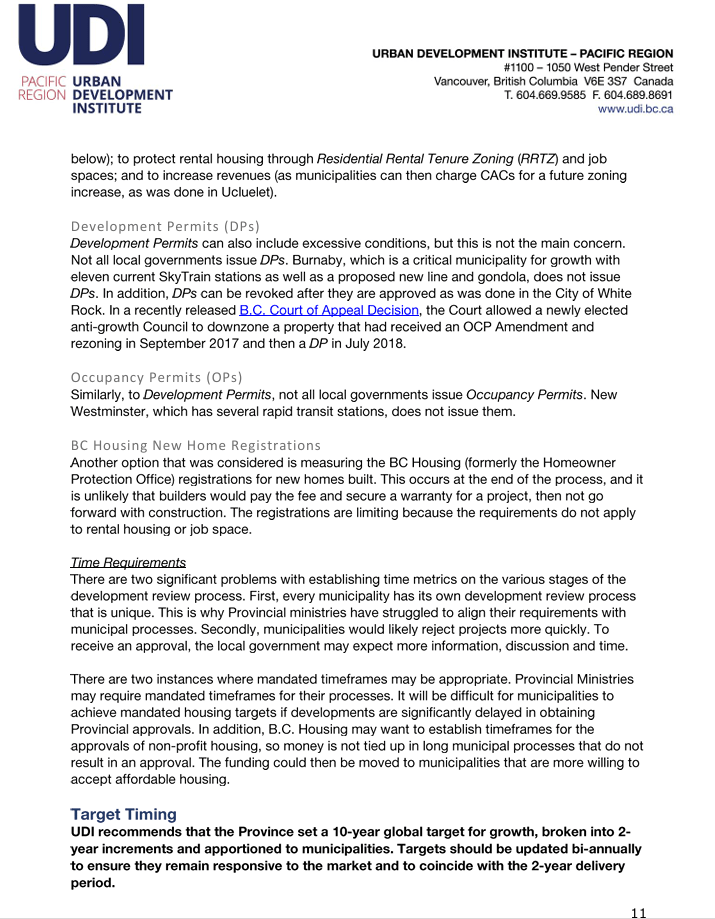
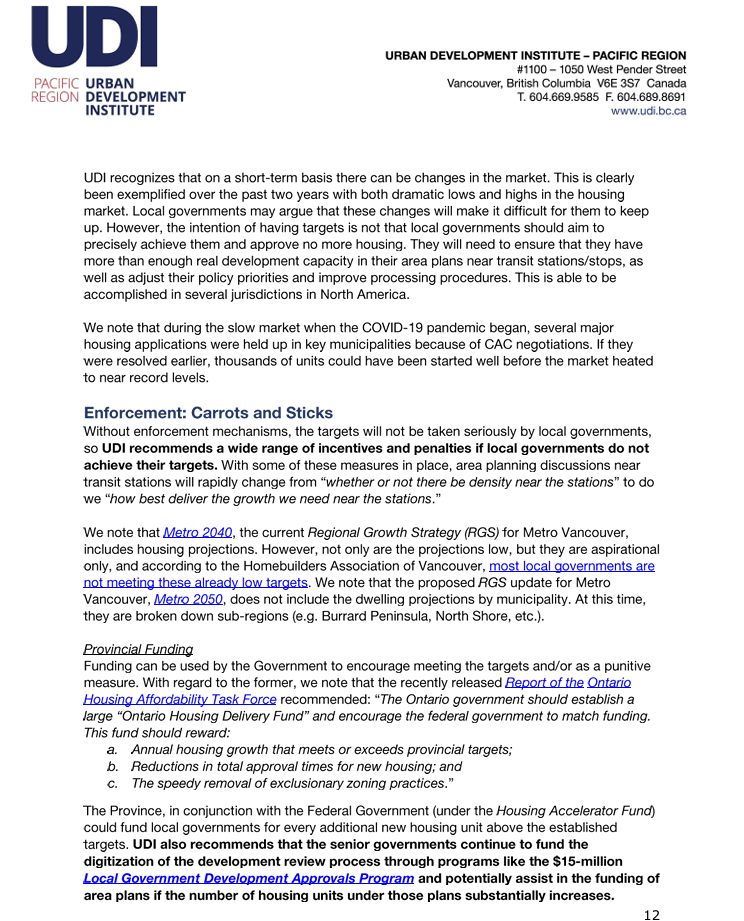
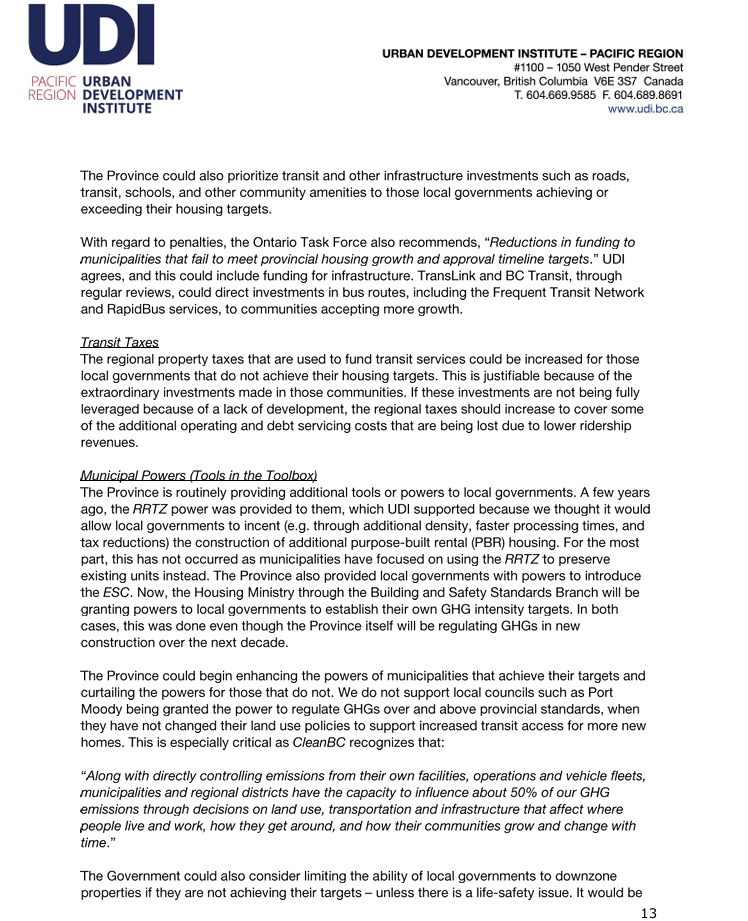
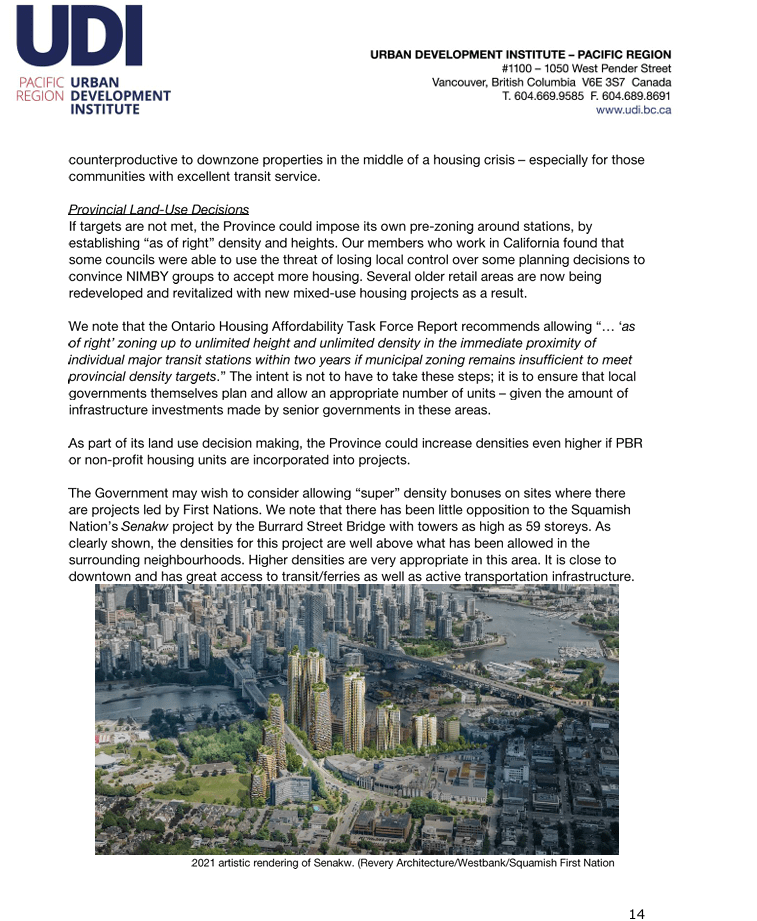

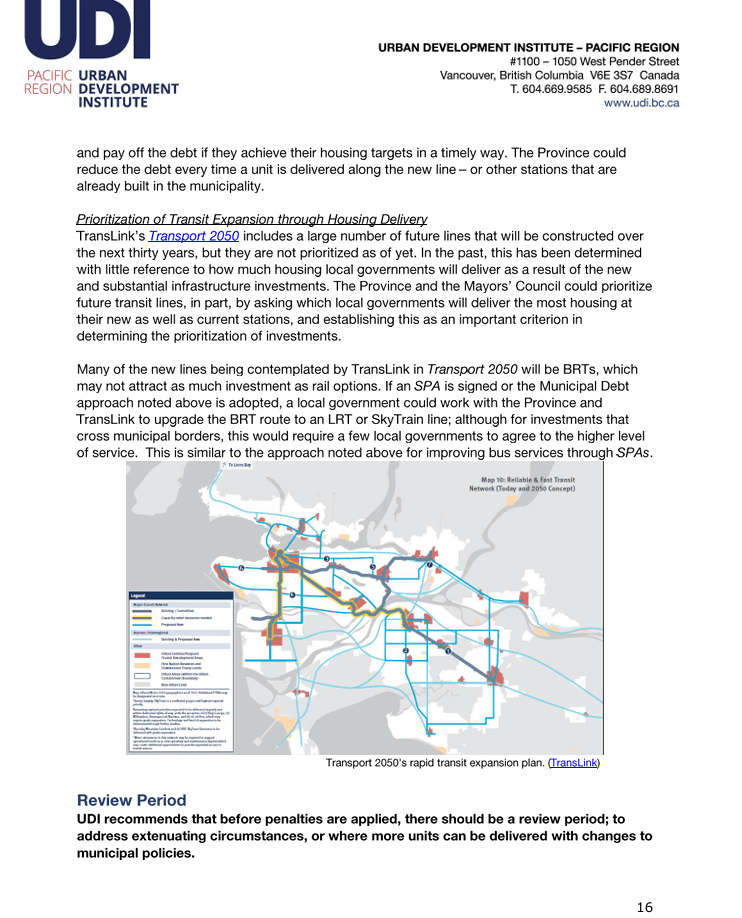
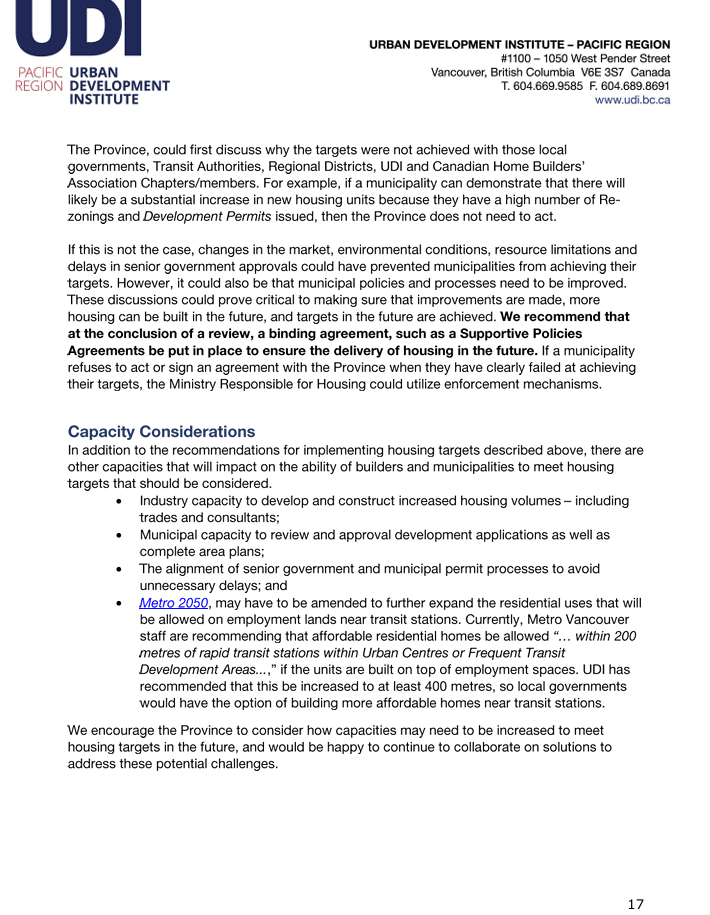
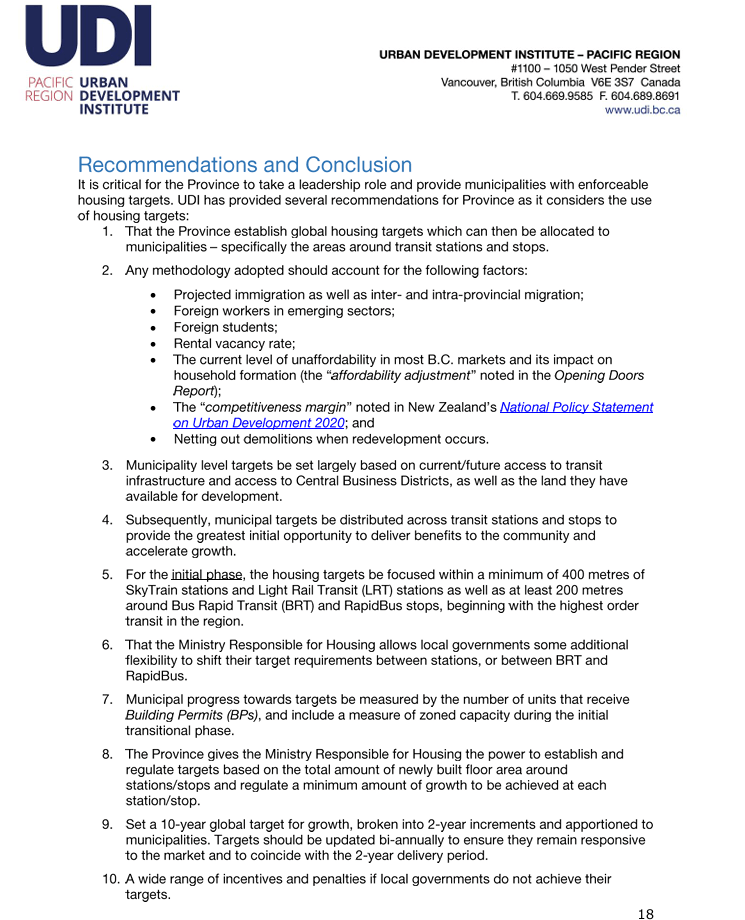
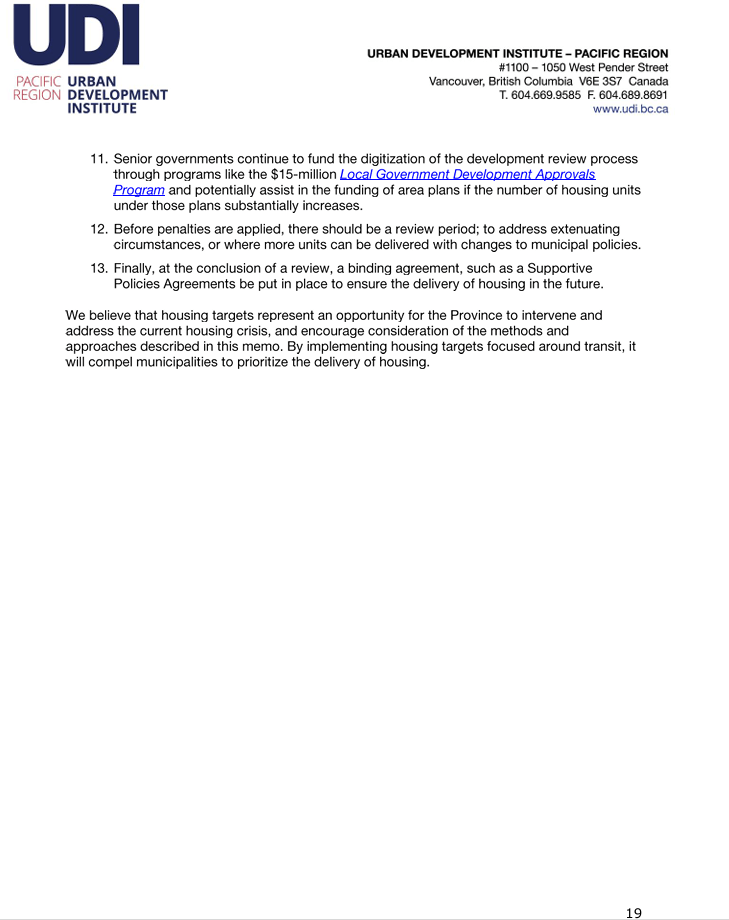
McMullin’s 2nd letter to Eby on March 10, 2022 (see below) involved many ideas taken from Ontario.
Not much time after this the Greenbelt scandal would erupt in Ontario.
The following is from p.49-51 from the Ministry of Municipal Affairs FOI:
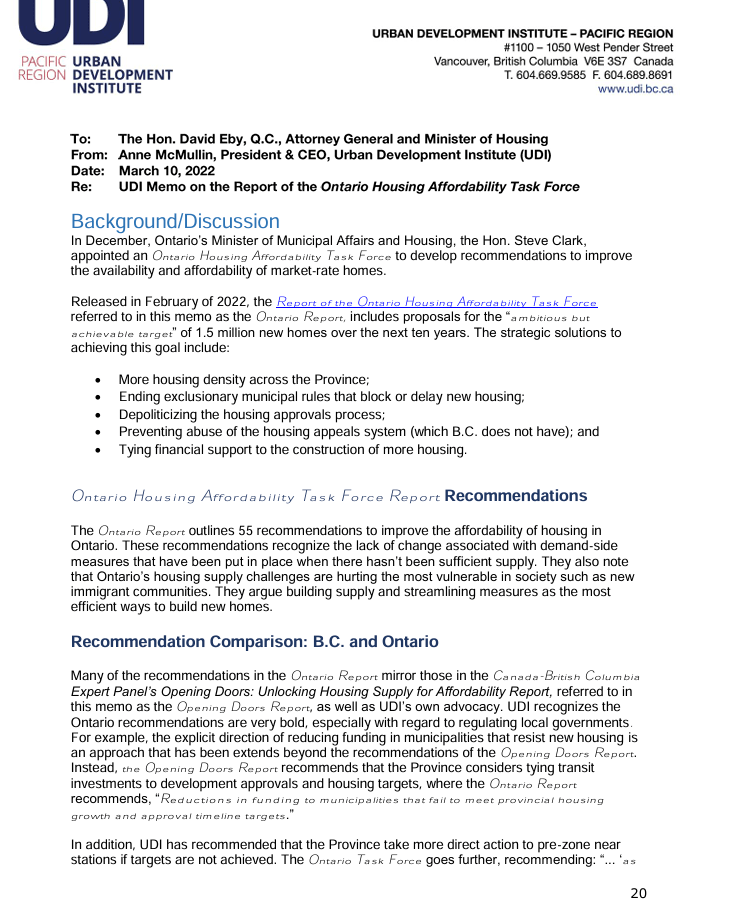
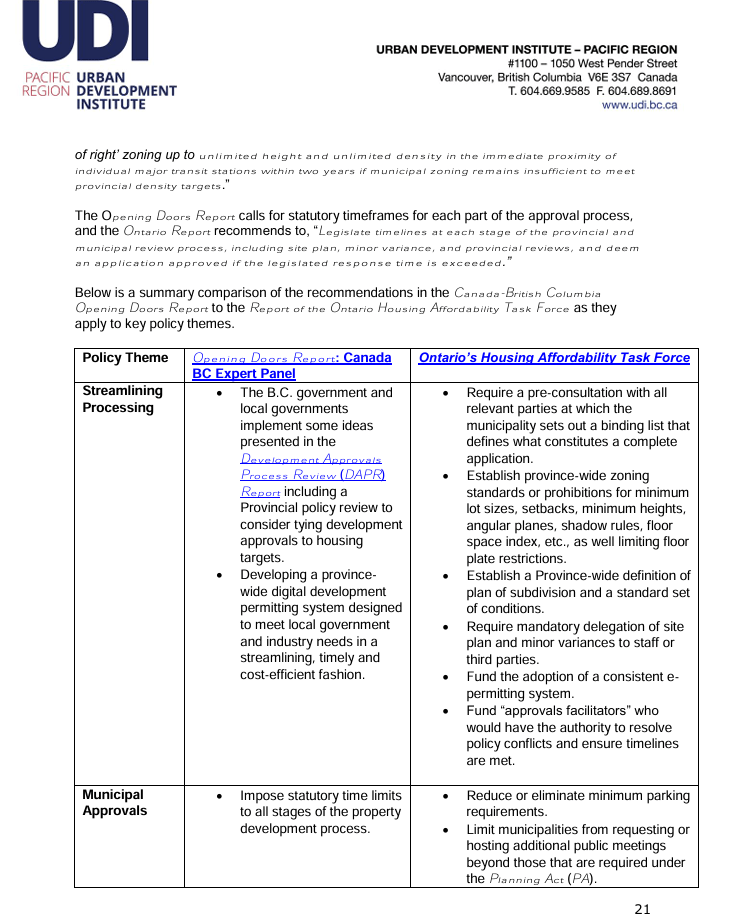
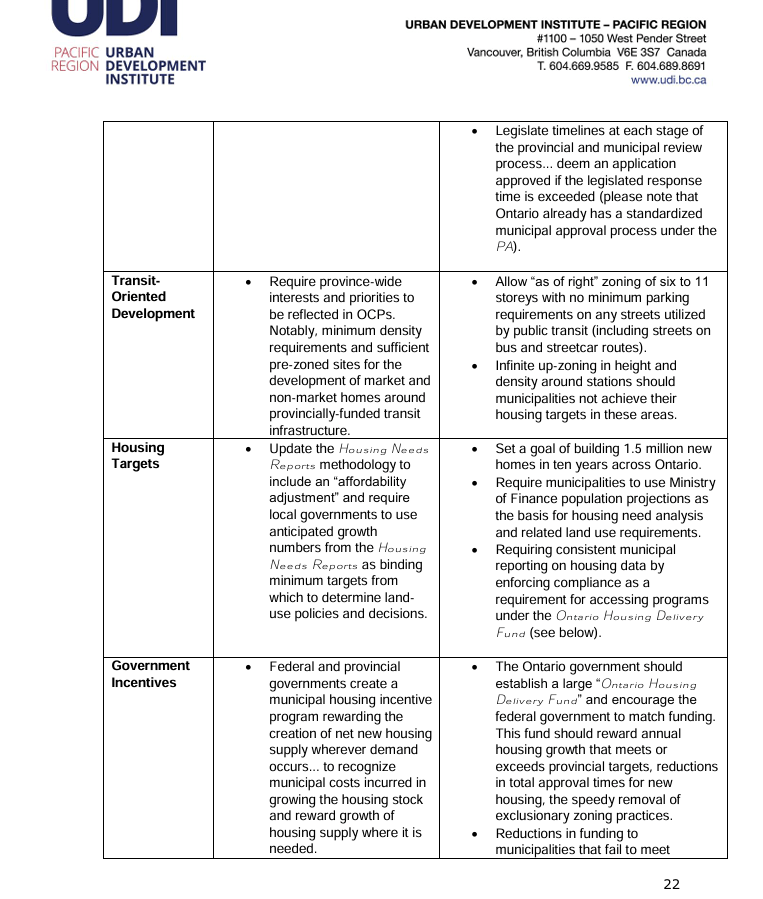
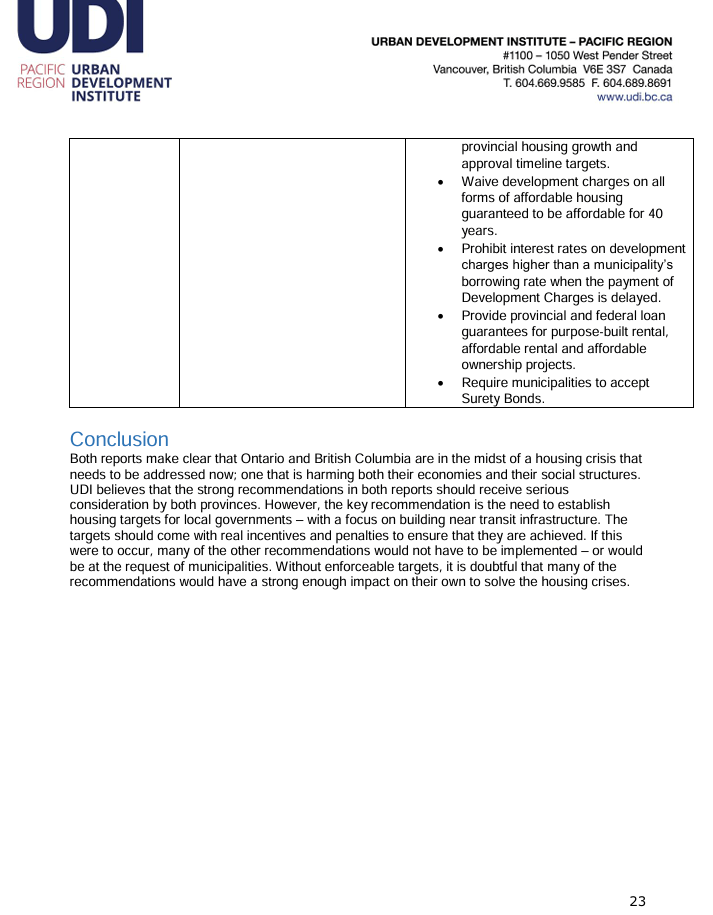
5 days after this letter, the Assistant Deputy Minister
Housing and Construction Standards
Ministry of Attorney General and Ministry Responsible for Housing
wrote:

(p.63 Ministry of Municipal Affairs FOI).
(MDE appears to have been an abbreviation for Minister David Eby, elsewhere in the communications it is written MDEby)
Appendix II: The full UDI letter from McMullin to Eby, dated March 12, 2021 and what appears to be the agenda for a UDI meeting with Eby that day.
The following is from p.867 etc. from the Ministry of Housing FOI:
On March 12, 2021 late in the day, a top person in the Province of BC Building Safety and Standards Branch (BSSB) wrote:

“As I prepare Minister David Eby’s speech, I will use the previous UDI speech as the basis of content. There is a lot of Housing Policy Branch content in there.”
From p.745 of the Housing Ministry FOI.
This was in regard to preparations for a speech that would take place a week later for the March 19, “2021 Provincial Meeting Ministers’ Address” which would include Minister Eby, Josie Osborne (Ministry of Municipal Affairs), and the Canadian Homebuilders Association.
It is difficult to tell from the FOI, whether the “UDI speech” referred to, was a speech the UDI gave with Eby in attendance on March 12, 2021, or a speech that Minister Eby provided the UDI that day.
That conundrum might be emblematic of the whole UDI-NDP relation in general. I don’t know where the UDI starts and the NDP ends and vice versa. As David Eby in his address to the UDI described the relation between them and other levels of government, it’s a “partnership”.
Minister David Eby message to UDI (Update: since initially publishing this article, this Youtube video was made unavailable to the general public). That’s OK, as that was predicted to happen, a backed-up version can be seen by clicking this link.
———————————————————————————————–
See also: A 2017 letter from the UDI to the Federal government offered a series of recommendations, including density targets around transit stations/corridors and for the adoption of TODs (Transit Oriented Developments). – CRD Watch Homepage
How the proposed “RapidBus” lanes in the Capital Region, including on McKenzie, were used as part of the UDI development lobby’s push for enforced densification/upzoning along rapid transit corridors, during their lobbying to David Eby in 2022 – CRD Watch Homepage
Archive.org snapshot of UDI policy page from March 30, 2023: By the end of the year, the Province would be implementing all 4 of the UDI’s key policy goals through the introduction of the UDI-lobbied-for Housing Bills (43-47) and through the creation of BC Builds. – CRD Watch Homepage
https://crdwatch.ca/2025/06/06/the-government-of-british-columbia-had-top-figures-in-the-most-powerful-lobbying-organization-for-development-and-real-estate-interests-in-the-province-sign-non-disclosure-agreements/

 CRD Watch Homepage
Leave a comment