CRD Cleaning up its act on the Regional Housing Advisory Committee
After discontinuing its 23 year-old membership with the Urban Development Institute (UDI), in June of this year (2024), the CRD has taken the next step in separating lobby and state, by cleaning up the CRD’s Regional Housing Advisory Committee (RHAC) where the UDI has held a permanent seat over the last half decade.
CRD minutes from the RHAC in 2022, reveal that the UDI had promoted lobbying of its agenda to the other committee members through the governmental institution.
Although, the CRD is cleaning up its Act with the RHAC, its relationship to the UDI, appears paradoxically to be moving ever deeper underground.
By Sasha Izard
Oct 26, 2024
In June of 2024, after a decision made by top-level staff, the Capital Regional District of Greater Victoria (CRD), the regional government discontinued its paid membership with the Urban Development Institute (UDI), a registered organization on the BC Lobbyists Registry, that offers political influence for its paying member companies involved in development and real estate.
The CRD had been a member of the UDI for approaching a quarter century, having joined as a paying member in 2001, without a vote by the CRD Board to do so.
The CRD’s Regional Growth Strategy (RGS) appeared 2 years later in 2003. The Official Community Plans (OCPs) of the municipalities that are signed onto the RGS in the CRD, are mandated by law to conform to the RGS, thus making them the official plans for communities, instead of the official plans of communities. This is something that the majority of those living in those communities are unaware of.
The RGS contains Housing Needs Reports/Assessments that were created by a paying member company of the UDI, (Urban Systems Ltd. through its subsidiary Urban Matters). Freedom of information regarding the UDI’s communications, revealed that the UDI had lobbied the Premier of BC David Eby, to adopt similar Housing Needs Assessments to those in the UK. The Housing Needs Reports/Assessments dictate to the municipalities that are part of the RGS, by law – how many housing units they must build.
Seeing potential conflict of interest issues involved, I addressed the CRD Board of Directors on the issue at their office on Fisgard St. The video of my presentation can be viewed by clicking on this link and then by clicking on the item on the index listed as: 5.1.1. 23-360 Delegation – Sasha Izard; Resident of Saanich: Re: Agenda Item 6.7. Capital Regional District External Grants Update.
Several days after I addressed the board, I created a petition on May 13 of last year (2023), calling on the CRD to withdraw its paid membership from the UDI. Although the amount of signatures on the petition (72 in total) was not particularly overwhelming, I think that the issue now being presented/out in the public was important (as previously the issue had been existing under the public radar). I also think that the content of the petition was compelling enough in getting some people thinking on an issue that might have otherwise been possible to brush under the carpet.
CRD Watch, was also created around this time, ensuring that the issue would not be brushed under the carpet.
During 2024, from January onward, I communicated with top-level staff at the CRD regarding the issue and found that there were signs of cooperation on the issue. On July 2, 2024, I was informed by the CRD CAO (who had taken on that role relatively recently): “That the Capital Regional District (CRD) made the decision not to renew its membership with Urban Development Institute (UDI) going forward.”
I congratulated the CRD on doing the right thing moving forward, and on my website on July 4, 2024, I encouraged the CRD to follow up, by taking appropriate action regarding the CRD’s regional Housing Advisory Committee:
“I would like to further call on the CRD to end the permanent seat that it had allotted the UDI on its Regional Housing Advisory Committee.
Thank you to those in the CRD who made the decision and to everyone who signed this petition and raised awareness about the issue in their communities.
This is a win for democracy, but while the CRD has withdrawn its membership officially, it is crucial that we follow through by helping to ensure that the CRD make any contact with this organization open and transparent and that it end the practice of providing the lobby with a permanent seat on its Regional Housing Advisory Committee.”
———————————————————————————————-
On July 3, I emailed the CRD CAO asking:
“Now that the CRD is not a member of the UDI, will it still be providing the UDI with its permanent seat on the CRD Regional Housing Advisory Committee?”
———————————————————————————————-
The CAO responded 2 days later with the following:
“The decision not to renew the CRD UDI membership was a staff level decision on the basis that the decision to become a member many years ago was a staff level decision.
The UDI will continue to have a representative seat on the Regional Housing Advisory Committee as per the Committee terms of reference. The terms of reference are reviewed from time to time by the Hospitals and Housing Committee and CRD Board (the last review was in 2022); staff take direction from the Board regarding any changes to the Committee terms of reference. The UDI representation on the RHAC is unrelated to the CRD’s (past) UDI membership.”
———————————————————————————————-
I responded:
Thank you for clarifying that. I appreciate the CRD staff’s decision.
Is there any way that when it comes up that I could be notified when the next review of the terms of reference will take place?
I had a look at the terms of reference for the RHAC, and found this section particularly questionable:
“f) At the request of a Committee member, and with the consent of the Committee Chair, guests or delegations may be invited to attend, present to and/or participate in meetings of the Committee”
Is that usual for CRD committee procedure, or is it unique to the RHAC?
In essence, how I read it: the public in a public institution are barred from attending specific committee meetings involving a registered lobbyist group with a permanent seat in that committee, unless they have special permission from a committee member (the committee members consist of outside organizations, including non-governmental which includes said lobby), as well as permission from the CRD Chair.
I cannot see how this stipulation in the Terms of Reference for the RHAC meets an acceptable threshold for democratic transparency, nor for good governance and procedure.
Thank you again,
Sasha
———————————————————————————————-
An hour later (July 11) I received a response from another person working for the CRD.
It was in regard to my question submitted through the CRD’s contact form on July 8:
Hello CRD,
I am wondering if it is possible for members of the public to attend CRD Regional Housing Advisory Committee Meetings as observers or as participants.
Thank you,
Sasha
———————————————————————————————-
The response from the CRD official read:
“I’m a new manager on the Housing Initiatives and Planning team at the CRD. This group has historically lead the Regional Housing Advisory Committee (RHAC) meetings.
We are currently assessing the role of the RHAC and how its purpose intersects with, and differentiates from, other CRD advisory committees. While this work is ongoing, there are currently no plans for the RHAC to meet.
The RHAC is intended as a forum where industry, government, community funding partners and CRD Regional Housing share constructive feedback with one another on program funding and housing development priorities in the region. As such, it has been primarily attended by staff working in local government and industry. However, the Terms of Reference stipulate that at the request of a committee member, and with the consent of the Committee Chair, guests may be invited to attend meetings of the Committee. To subscribe for updates on forthcoming meetings, please see: Board, Committees & Commissions | CRD
Best,
———————————————————————————————-
It seemed to me that all that was missing from the attendance requirements for non-committee members was a secret handshake.
From what I recall of reading the legislation about government committees, government committees must be minuted and the public must be able to attend. Why was this committee in particular, acting so secretively and exclusively from the general public?
I responded:
Thank you for your email. Your information is helpful.
“However, the Terms of Reference stipulate that at the request of a committee member, and with the consent of the Committee Chair, guests may be invited to attend meetings of the Committee.”
I see that this in the terms of reference, but what is the legal basis for requiring members of the public to have both the request of a committee member and the consent of the Committee Chair to attend the meeting?
Thank you,
Sasha Izard
I added the bolding to the text, which was not in the original email, to show the reader what I regard as the most important sections in the exchange. I have done the same to my own emails as for the official’s responses in the emails below.
———————————————————————————————-
The official responded on July 15:
Hope you had an enjoyable weekend. I’ve reached out to my colleagues in our legal department to seek further clarification on this requirement to address your question. I will follow-up with you as soon as I have more information.
Thank you for your patience,
———————————————————————————————-
I thanked the official and then waited for about 3 months.
On Oct 12, 2024 I emailed:
Hi,
Has there been any update on this question?
Thank you,
Sasha
Also, around this time I left a message on a CRD answering machine regarding a question I had about the municipalities that composed the CRD RHAC Committee.
Previously, I had not received an answer to that question from the CRD.
———————————————————————————————-
On Oct 24, 2024, I received a reply from the same official:
Hi Sasha,
Thank you for bringing this to our attention and I appreciate your patience while we sought clarity. Our Legislative Services staff confirm that all Board advisory bodies must meet publicly. If the Regional Housing Advisory Committee (RHAC) proceeds in the future, we will clarify the Terms of Reference.
I also was forwarded your voicemail from November 15, 2024. At the time the Regional Housing Advisory Committee last convened in 2023, staff from the following local governments were members:
- Victoria
- Esquimalt
- North Saanich
- View Royal
- Saanich
You can find minutes from past RHAC meetings here.
As mentioned, we are currently assessing the role of the RHAC, and there are no plans for the committee to meet at this time. If it reconvenes, new nominations will be sought, and a clarified Terms of Reference will be presented for adoption.
I encourage you to subscribe for updates on forthcoming meetings. More information can be found here: Board, Committees & Commissions | CRD.
Best,
———————————————————————————————-
The reason that I had asked about the municipalities that were on the Regional Housing Advisory Committee, is that I suspected that many of them were probably paying members of the UDI as well. Not only did the UDI have a permanent seat on the RHAC, and there was a rotating developer seat recently held by a top employee of a UDI member company, but all the non-municipal members that had permanent seats on the Committee, had at one time, in one form or another all been paying members of the UDI, something I had written about in other articles.
Of the list of municipalities that were last members of the RHAC Committee, Victoria is currently a paying member of the UDI, as is Esquimalt. Saanich and View Royal both discontinued their UDI memberships within the last 2 years. North Saanich stood alone on the committee as the only organization on it that has not had a UDI membership at any time, or in any form. The residents in North Saanich had on numerous occasions in the press over the last few years voiced annoyances at what they saw as UDI meddling in their OCP process and other affairs.
This question was in some aspects though merely academic at this point. The more important sections, as mentioned previously, I have bolded above.
The RHAC’s activities have been suspended while ongoing reviews take place and if it reconvenes, new nominations will be sought e.g. the UDI might not have its permanent seat anymore on it.
Most importantly, the RHAC Committee if it takes place again, will have a new Terms of Reference, in which will be clarified that the meetings will and must be open to the public.
This was a major victory for democracy and transparency at the CRD. Not merely had the CRD removed the overt grounds for potential conflict of interest by ending its paid membership with the UDI, but it was now taking solid action to lift the veil of secrecy surrounding the RHAC Committee, after I had questioned the legality of such an exclusive process for attendance by non-committee members.
———————————————————————————————-
This is a major deal. A key issue with the UDI’s activities on the RHAC involve that RHAC minutes from 2022, indicate that the UDI was promoting lobbying to the other committee members within the governmental system of the committee. This is especially notable, in that as pointed out: the other committee members overwhelmingly had been almost without exception, paying members of the UDI at some point in time, or in one form or another.
Last year, in another article, I had written the following:
“The following are two quotes from the minutes of the June 29, 2022 Regional Housing Advisory Committee meeting at the CRD:
“UDI has been meeting with Minister Eby and have found him to be very receptive to hearing from and receiving feedback from groups like the RHAC”
“What can we do as a committee? Kathy Whitcher suggested RHAC members be more active in finding out what policies municipalities are working on and helping to push these policies forward via advocating and lobbying (e.g., Victoria’s missing middle).”
It is worth noting that Whitcher while the Executive Director of the UDI [Capital Region chapter], has simultaneously been serving on the RHAC.
In the UDI’s 2022-2023 Annual Report on page 6 under the heading “Advocacy Initiatives”, the first item to appear is the subheading “CRD”, followed under it by the point titled “Regional Housing Advisory Committee”.
The UDI is not shy to its members that it has the ability to advocate/lobby within the CRD itself through its permanent seat on the Regional Housing Advisory Committee, which gives them special-inside-access to operate and propose policy within the government system, and it is not shy from encouraging the other permanent members of the committee (many of which themselves are UDI members) to advocate and lobby for UDI objectives within that system.
The next two subheadings in the annual report under “Advocacy Initiatives” are “The City of Victoria” and “Saanich”.
The first three items listed under Saanich are:
- Missing Middle Initiative
- OCP Update/Terms of Reference
- Housing Strategy/Land Capacity
The fourth and fifth items listed under The City of Victoria are:
- Missing Middle Initiative
- Villages and Corridor Plans
Indeed the UDI has an inside position to lobby for its agenda within the regional government, which has powers above the local governments and which has utilized those powers to control crucial aspects of their Official Community Plans that then determine zoning policy.”
———————————————————————————————-
The following is a screenshot from the UDI’s 2023-204 Annual Report. What are they particularly proud of of their “advocacy initiatives” of 2023-2024? The second item listed is under the CRD, which is “Regional Housing Advisory Committee.”
I guess that was until it was suspended pending review, and if it reopens will now be open to the general public, whereas previously attendance was on an exclusive basis.
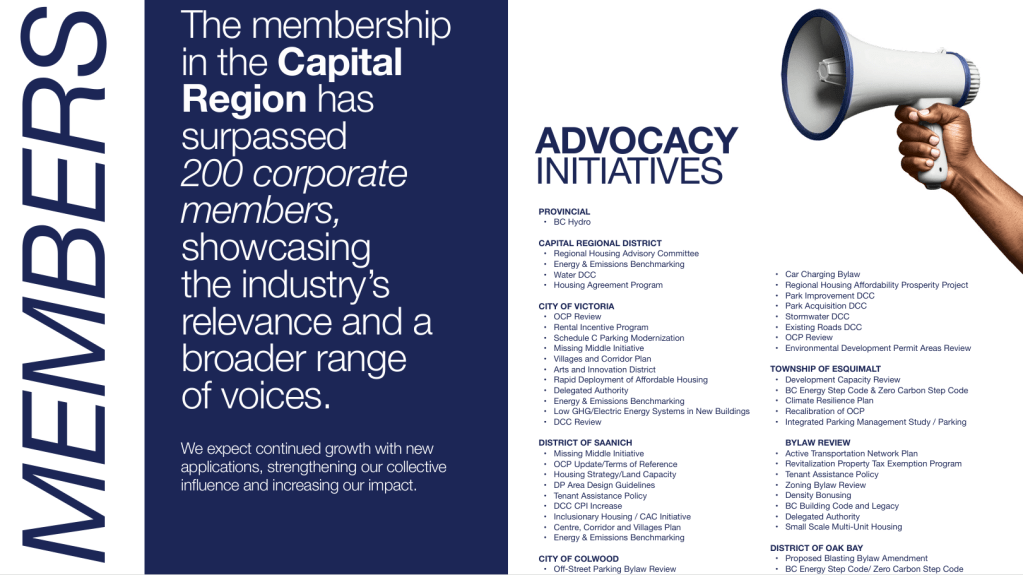
The Minutes already quoted from the RHAC Committee in 2022 reveal that when it comes to the UDI, advocacy and lobbying, go hand-in hand:
[The UDI Capital Region’s Executive Director during a meeting of the RHAC] “suggested RHAC members be more active in finding out what policies municipalities are working on and helping to push these policies forward via advocating and lobbying“
The Executive Director has been registered on the BC Lobbyists Registry as the UDI’s In-House Lobbyist with the Province of BC.
———————————————————————————————-
This isn’t the end of the story however, as the merger and collaboration of lobby and state becomes more and more exposed, and action is taken out of necessity to remove the overt appearances, and even less overt activities of it – the activities end up continuing, but in less overt and even more exclusive forms; so deep has the seemingly inseparable relation between lobby and state become.
The third item under UDI “Advocacy Initiatives” to the CRD was “Water DCC”. The UDI had a major campaign in 2024, regarding DCCs (Developer Cost Charges) and the CRD’s proposed water infrastructure expansion. The UDI’s paying member company Urban Systems offered consultation for the CRD on these issues and presented to various municipalities on them.
While the UDI promotes growth (it claims to deliver “steady growth”), in the form of increased development/construction, it also promotes the increases to public infrastructure that those necessitate. It would prefer however, that the public foot the bill for that, rather than its paying member companies that profit from the situation, and in whose interests are served by a steady growth-based agenda by government.
In September of 2024, the CRD engaged in an in-person meeting with the UDI on the issue surrounding the CRD’s proposed water infrastructure expansion.
On September 26, 2024, I sent the following FOI request to the CRD:
Hello CRD FOI,
I’d like to make an FOI request for all documentation regarding the in-person meeting between the CRD and the UDI as quoted in the text below from the CRD’s website. Please include the names of everyone who attended this meeting.
Thank you, Sasha Izard
https://www.crd.bc.ca/…/rwsc2024-09-25agendapkg.pdf…
“After hosting the two virtual information sessions, a request for further in-person engagement was received from the UDI. An in-person meeting was held at the CRD offices on September 10, 2024. Those in attendance included members of the development community, the CRD Chair, the Commission Chair, the MLA for Langford – Juan de Fuca and senior CRD staff. Questions were submitted in writing prior to the meeting and a letter of response is attached (Appendix C).”
———————————————————————————————-
I’m reminded of a section of dialogue from the 1974 film Chinatown: “Either you bring the water to L.A. or you bring L.A. to the water.“
———————————————————————————————-
A month later on Oct 26, I still had not received the CRD’s FOI response regarding the in-person meeting between the CRD and the UDI.
Conclusion:
Although the CRD has ended its paid membership with the UDI, and has been cleaning up its act regarding the RHAC, the relationship between the CRD and the UDI continues paradoxically to become ever more exclusive and less and less transparent.
However, I’ll let the last word regarding the alarming lack of transparency at the regional government level to go to the BC Office of the Registrar of Lobbyists (BCORL), as quoted from an email exchange that I had with them:
“consultant lobbyists and/or organizations that lobby regional districts/municipalities are not required to report their lobbying activities in the BC Lobbyists Registry as they do not fall under the Lobbyists Transparency Act.”
———————————————————————————————-
Yes, this is the Province of BC – to some it’s stranger than fiction, to some it’s still the wild west, although the closest genre perhaps could be said to be cinema noir. To most of the populace, looking deeper than what meets the eye, when it comes to lobbying and the state, is a pain more than they are willing to bear. Many Canadians prefer to go about their day-to-day lives not having to realize that this is the actual state the country is in.
Unfortunately, without dealing with these critical issues that I refer to as a crisis of democracy in Canada, means that we will be caught unawake and unaware when our public institutions act in the private interest, as opposed to the public interest; in a manner that is surprising and shocking to many only, when it affects their own front doorstep.
Regional levels of government, sometimes described colloquially as ‘fourth levels of government’, have immense power over our lives, communities, and the environment we live in, and yet for all that: they are entirely unregulated when it comes to lobbying, as the BCORL made apparent.
Is this incredible legislative oversight a mere coincidence? The responsibility for it rests with the Provincial Government of British Columbia.
They are perfectly aware of the situation, upon being asked, as their own quote made clear.
Frankly, I don’t think it is a coincidence at all. I consider the complete lack of regulation regarding lobbying at regional level of governments, as for municipal levels of government, and the wild west mayhem of undocumented lobbying that brings – to be on the part of the Province. I consider this continued situation to not only be a gross unaddressed double standard in law, but also willful and intentional neglect of office.

 CRD Watch Homepage
Leave a comment