After a Comedic Exchange of Emails, BC Transit Admits that it has a Membership with the Urban Development Institute (The Implications of that for BC, may be more Tragic than Comic.)
In doing so, BC Transit inadvertently confirmed what I had shown previously, that BC Assessment has been providing misinformation, by its repeated denials of its membership with the UDI – in spite of being presented with the direct evidence of their membership in the registered lobbying organization, in the form of a receipt. Both Crown Corporations purchased the exact same type of membership with the UDI.
As in the case of BC Assessment, BC Transit’s relation to the UDI deserves close scrutiny.
This is the fourth installment in a series of articles covering Crown Corporations’ paid memberships in the Urban Development Institute, after the UDI took to hiding its members directory from the public in late 2023.
By Sasha Izard
Oct 16, 2024
Many people know BC Transit as a public organization providing bus service in British Columbia. Few know of its relation to the development/real estate lobby and where these interests intersect with government, public policies, for-profit companies, and urban planning.
Placed at what is often the hub and nexus of these converging interests, is the Urban Development Institute; a nebulous organization registered on the BC Lobbyists Registry that simultaneously lobbies and advises government on key issues around urban planning, while offering representation and influence to its paying member companies involved in development and real estate.
To many people, and organizations, the Urban Development Institute is many things. Sometimes these can even be contradictory, and sometimes those that seem most confused as to what the UDI actually is and what it is for, seem even to be people running the UDI. I refer to this buzz of confusion around the nature of the organization collectively, as the UDIdentity Crisis.
Organizationally, the UDI is setup as a non-profit; but somewhat contradictorily, it has stated among its aims that it is “influencing the issues that affect your bottom line.”
If the UDI has appeared to many, as a hub of contradictions, while being a non-profit – the responsibility for that really sits on the footsteps of the Province, for having lax regulations (I suspect intentionally) regarding non-profits in the legislation; something that can allow the organization to act as many things simultaneously. This allows them to have a sort of shapeshifting ability, a dance of many faces to many different people, and organizations, including governmental.
The UDI simultaneously portray itself as an educational institute, key advisor to all levels of government on housing policy, the indispensable helping hand in implementing policy for all levels of government, the ever-present stakeholder, the registered organization lobbying the government for changes of policy on behalf of its paying members, an organization that is not lobbying,* a policy research outfit, a place where elected officials can receive education with public funds, a networking and career advancement opportunity, the liaison between government – the media – and the development industry, an information resource, a think-tank, partners and collaborators with the government, a helping hand for the development/real estate industries, a community organization, a community development organization, a professional organization, a professional development organization, defenders of the public interest, seekers of removing red tape around zoning, advancers of housing affordability, advancers of profit, a helper of non-profits and charities, a helper of First Nations, providers of steady-growth (although they never specifically elaborate how they manage to achieve that feat), advocates for smart urban planning (they don’t mention, while pushing deregulation of urban planning, through pushing to government policies that include vast blanket upzoning often regardless of infrastructure/environmental considerations), pusher of policies which allow for ever increasing development (they don’t like to mention including on unceded lands, but they don’t mind the occasional land acknowledgement). Certainly an incomplete list, and missing from it might as well be while we’re at it, unofficial shadow government on housing. Why not? They seem to be doing practically everything else in this regard, why not go for the gestalt?
*The UDI Capital Region’s Executive Directory told View Royal Council that “UDI is not a lobbying group”, despite being registered at the time on the BC Lobbyists Registry, as in-house lobbyist to the UDI See: The following article.
The list goes on and on, perhaps ad infinitum, as the UDI is ever reinventing itself and portraying itself as one thing here, and one thing there; regardless of how often contradictory the organizations’ many facades can be to each other.
Who is responsible for this? The government of BC, and the UDI donated directly to the party in power (the NDP, prior to the party finance reforms that took place in 2017), although it should be known that hundreds of thousands of dollars of corporate donations had also passed between UDI member companies/their employees to the BC Liberals in the past, and also hundreds of thousands of dollars, albeit significantly less so, to the BC NDP.
The media is is also responsible, for doing everything they can to not report and turn a blind eye to this situation. With vast amounts of ad revenue coming from developers and realtors and even from the government itself, sometimes it’s easier for them to simply partner with the UDI, as a member, media partner and sponsor of it, as did the Times Colonist and its parent company Glacier media.
As for reporters, they appear to have learned a skill in keeping their jobs and that is that it is better to turn a blind eye on this themselves, than face the disapproval of their editors and the corporate management of the news outlet. No reporter, nor editor that I have ever encountered has been willing to cover with a critical lens, the omnipresent, but ever uncritizable UDI that gave itself among its many missions that of officiating liaison between the media, government and development industry.
—————————————————————————————————
On October 6, 2024 I sent the following email to BC Transit at the following email address: TransitInfo@BCTransit.Com (I couldn’t find any other email on their website to contact them by):
Hello BC Transit,
I have a question.
Does BC Transit have a paid membership with the Urban Development Institute?
Thank you,
Sasha
—————————————————————————————————
About 5 and a half hours later, I received the following email response from: Victoria_Busline@BCTransit.com
Hello Sasha,
Thank you for your inquiry and allowing me to respond on behalf of BC Transit Victoria.
Typically, student U-passes are distributed by the Student Society at your school. Additionally, in Vancouver, the transit system is Translink which is separate from BC Transit.
I found this link on Translinks website, https://www.translink.ca/transit-fares/u-pass-bc, which may help. Please contact your Student Society or Translink (604-953-3333) for more information.
Kind regards,
—————————————————————————————————
Note: I didn’t tell them in my email that I reside in Victoria, nor did I tell them if I was attending a post-secondary institution, nor did I specifically email BC Transit’s Victoria Busline.
I responded:
Hi BC Transit Victoria,
You didn’t answer my question.
It appears you are the wrong department to contact, but I couldn’t find much in the way of contact information.
Could you provide me with the email contact of the corporate side of the organization?
Thank you,
Sasha
—————————————————————————————————
Over a week later on Oct 15, 2024, I received another email from BC Transit’s Victoria Bus Line:
Hello Sasha,
My apologies for the delay as we’ve have been looking into your inquiry and for the confusion.
I just received a response stating, “I can confirm that yes our CEO has a Urban Development Institute.”
Please let us know if you have any further questions.
Kind regards,
—————————————————————————————————
While I appreciate that they got back to me, the information they had received from presumably those higher up in the organization: “I can confirm that yes our CEO has a Urban Development Institute.” is patently absurd, although nothing that was particularly unexpected. This had fit a well established pattern regarding the responses to inquiries to Crown Corporations that I have made regarding the UDI.
They could have responded: I can confirm that yes our CEO has a collection of tonka toys sitting in front of them on their desk, and it would have been just as enlightening, in regards to answering my question.
I responded:
Hello,
Thank you for your response.
“I just received a response stating, “I can confirm that yes our CEO has a Urban Development Institute.””
The response that you received from those in BC Transit is inaccurate. The BC Transit CEO does not have an Urban Development Institute, although the answer to my question with another answer that does not make sense and is unrelated to the question is a notable and well documented pattern regarding responses to inquiries sent to the Government of BC and especially its Crown Corporations regarding the Urban Development Institute and its memberships.
My question was: “Does BC Transit have a paid membership with the Urban Development Institute?”
Do you mind putting me in touch directly with someone in BC Transit e.g. in its corporate/and or finance department, who can provide a direct and accurate answer to that question?
Thank you again,
Sasha
—————————————————————————————————
In just over an hour and a half I received a response from a Supervisor of Customer Service at BC Transit:
Good morning,
I can confirm BC Transit has a paid membership with the Urban Development Institute at the Capital Region Associate III level.
Thank you,
—————————————————————————————————
I responded:
Hi,
Thank you for the straightforward response,
Sasha
—————————————————————————————————
That was all it took. Sometimes just providing the exact straightforward, honest and exact answer is a lot better than doing what BC Assessment did, which was to keep doubling down on denials and making ever more absurd and sometimes contradictory statements, when the evidence in the form of their own receipt of their UDI membership was staring them right in front of their face on a computer screen.
BC Transit on the other hand, to their credit – had after a few emails, come clean on their UDI membership.
They provided exactly the answer I was looking for. In doing so, they did the right thing. They set the record straight, and were gasp, honest with a member of the public who was making an inquiry about a public institution. They even went so far as to transparently stating exactly what type of membership they have with the UDI.
Why did BC Transit shift direction and provide such a straightforward response? I suspect that it may have had to do with my use of the word: “documented”.
I think they realized that not only was I a member of the public, making an inquiry about their organization, but that in addition, they finally realized that their responses were being documented.
Their responses smartened up both quickly and accordingly.
—————————————————————————————————
In ultimately responding the way they did, not only did they do the exact right thing to do, but they also inadvertently provided a third proof that BC Assessment was providing false information by their denials of holding a membership with the UDI.
I had in a previous article, proven through a combination of both documentation and thorough research, that BC Assessment not only holds a membership with the UDI, but in addition, specifically, I proved that what they hold is an Associate III membership with the UDI Okanagan, that they had renewed through payment to the UDI on April 2, 2024 of this year.
BC Transit by writing “I can confirm BC Transit has a paid membership with the Urban Development Institute at the Capital Region Associate III level” confirmed that the Associate III membership with a branch (or chapter) of the UDI is a membership held with the UDI by Crown Corporations.
BC Assessment appeared to obscure that basic fact regarding their own Associate III membership with the UDI, by making nonsensical statements about the crown corporation making reimbursements for employee memberships in the UDI, that was unsubstantiated by documentation in a freedom of information response.
So, I would like to thank BC Transit for being the Crown Corporation to finally set the record straight on this type of UDI membership. BC Assessment on the other hand can continue digging themselves ever deeper into a hole through their repeated denials and evasions regarding their UDI membership, which I consider to serve as a form of record, of what I consider to be on an ethical basis, contempt for the public that they are supposed to represent, as they are a public governmental institution.
—————————————————————————————————
So once again, I thank BC Transit for their honest and straightforward response. Regardless of their response, however, they would still be subjected to scrutiny; perhaps something BC Assessment hadn’t realized, or realized too late.
Let’s take a look now at BC Transit’s relation to the UDI Capital Region, which it has a paid membership with:
On May 7, 2024 – The majority of Saanich Council voted to pass a new Official Community Plan (OCP) by unusually passing both third and fourth readings of the proposal that same evening, thus rendering a new OCP into existence on that date, while at the same time Saanich’s Local Area Plans (LAPs) were rendered legally non-binding by removing them from the OCP Bylaw (something the Mayor had referred to as “decoupling” the LAPs from the OCP. The new OCP wasn’t actually due until the end of 2025. Why was it as so many commented, rushed through so quickly?
The UDI’s 2023-2024 Annual Report has a section titled “Advocacy Initiatives”. The term advocacy is often used synonymously with lobbying, “influence” and “impact”, the latter quoted terms appearing on the same page. Under the subheading “District of Saanich” is written the following: “OCP Update/Terms of Reference” above the item “Housing Strategy/Land Capacity” among others including “Centre, Corridor and Villages Plan”. The first item under the subheading “BYLAW REVIEW” was listed: “Active Transportation Network Plan”.
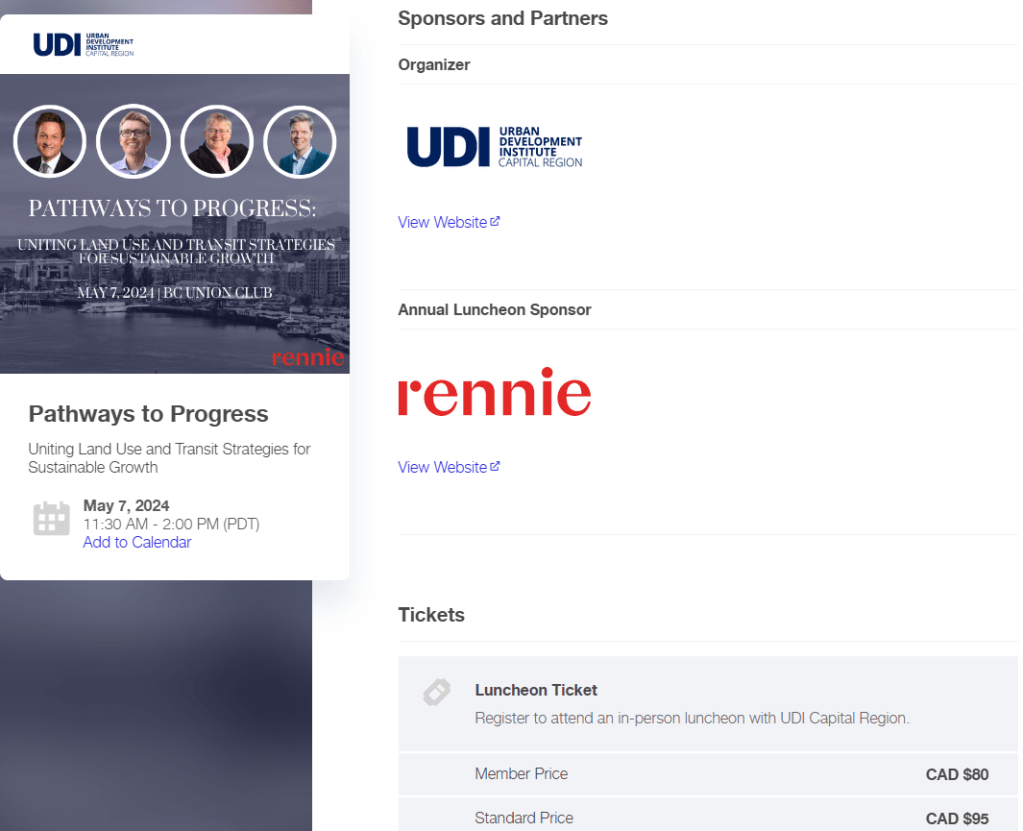
Earlier that day on May 7, 2024, Saanich’s Mayor, Dean Murdock presented at an Urban Development Institute event at the Union Club in downtown Victoria.
The event was called: “Pathways to Progress: Uniting Land Use and Transit Strategies for Sustainable Growth”

The speakers included the Minister of Transportation and Infrastructure Rob Fleming, Victoria’s Mayor Alto, Matthew Boyd (Director of Corporate & Strategic Planning at BC Transit), Mayor Murdock of Saanich, the Chair of the UDI Capital Region Ben Mycroft (Director of Development at Gablecraft Homes), and Ryan Berlin (Senior Economist and Vice President of Intelligence at Rennie)
The Sponsors of the Event were: Rennie, the company of Bob Rennie (the so-called “Condo-King” of Vancouver) and the Urban Development Institute itself.

Both Mayor Murdock and Minister Fleming who presented at the event have been proponents of pre-zoning along transportation corridors, something that the UDI has lobbied the province to achieve for years.
See: Article: “Placing housing near transit hubs will encourage use, Saanich councillor says Province plans to buy land, encourage development along transportation corridors“ Megan Atkins-Baker April 14, 2022 Saanich News https://www.saanichnews.com/news/placing-housing-near-transit-hubs-will-encourage-use-saanich-councillor-says/ (Accessed: Dec 1, 2022)
The following is quoted from the article:
“Transportation Minister Rob Fleming recently introduced changes that will allow a provincial agency to buy and develop land for housing and amenities along transit corridors – an opportunity Saanich Coun. Susan Brice sees as promising for Greater Victoria.
The province is moving to ensure development density follows transit routes. Bill 16, introduced on April 5 by Fleming – also Victoria-Swan Lake MLA – calls for changes to the Transportation Act that would give the BC Transportation Financing Authority the ability to purchase land not just for transportation projects, but to support the development of housing and amenities near stations or exchanges built as part of the public transit system.
Brice, who also chairs the Victoria Regional Transit Commission, said there is a total commitment in the region to connect transit with land-use planning.
“Our goal of reducing greenhouse gas emissions means that we plan in a manner that hopefully has people choose transit as their means of moving about the community whenever possible.” Making transit closer, more reliable and more frequent will get people in ‘transit mode,’ she added.
“I was so pleased to see the minister table this legislation,” said Dean Murdock, an advocate for active transportation and housing affordability and a declared Saanich mayoral candidate.
Creating centres where people can find good homes well-served by quality public transit is an important step forward, he said, and ticks the boxes for housing, climate and affordability.
The major centres identified in Saanich’s Official Community Plan (OCP): McKenzie and Quadra, McKenzie and Shelbourne, Tillicum, Uptown and Royal Oak, are examples of where the district can develop transit-oriented centres, Murdock said. With provincial support, Saanich will be able to move OCP plans forward more efficiently, he added.”
————————————————————————————————–
See also article: “B.C. to force higher-density development along transit lines”
Tom Fletcher April 5, 2022 https://www.mapleridgenews.com/business/b-c-to-force-higher-density-development-along-transit-lines/
—————————————————————————————————
Amazingly, given the prescience of that article, Murdock now Mayor of Saanich, would present with Minister Fleming at an Urban Development Institute event at the Union Club, alongside BC Transit’s Director of Corporate & Strategic Planning, on exactly the same day that Saanich’s new OCP was passed and the District’s local area plans (LAPs) were rendered legally non-binding, culminating in what appeared to have been many years in the making.
—————————————————————————————————
For developers, realtors, and investors – speculation along budding transportation corridors, and along budding infrastructure can result in millions made in profits. The relation between politics and land speculation was also a hallmark of New York City’s development in the 19th and 20th centuries.
Famous in this process was the presence of Tammany Hall in the 19th century.
The following has been said of the organization: “The business community appreciated its readiness, at moderate cost, to cut through regulatory and legislative mazes to facilitate rapid economic growth”1
In comparison, the UDI which has positioned itself to influence, guide, and implement policies at all levels of government, is well familiar with weaving through regulatory and legislative mazes to facilitate economic growth. Being able to provide “steady growth” has been one of its key claims/mission statements.
In a democracy, the people are supposed to be in charge, how then can an organization like the UDI ensure “steady growth”?
The Housing Bills put forward in 2023 e.g. Bills 44-47 contained major content lobbied to the Province by the UDI, including Bills 44 and 47, which involve prezoning (preventing public hearings on most types of rezonings/upzonings which in the Bills have been done en masse across the Province), and also with a focus of pre-zoning/upzoning along Transportation Corridors (Bill-47). The UDI has not been shy (to their members at least) about their involvement on the housing Bills. In their UDI’s 2023-2024 annual report they wrote:
“In the last 18 months alone, five pieces of Provincial housing legislation have required intense and ongoing engagement from the UDI Board, committees, and staff. This commitment has involved collaborating with members, municipal partners, and the Provincial Government to ensure these changes create a supportive policy environment for members working to deliver new housing supply across B.C.
Housing has also become a recent focus for the Federal Government. We have seen some positive first steps taken, and UDI has seized this window of opportunity to engage more closely with the Offices of the Minister of Finance, Minister of Housing, Infrastructure and Communities, and the Official Opposition. We intend to grow our Federal advocacy efforts over the coming year to support positive policy change at this level of government, and hope to replicate the success we have had at the Provincial level in B.C. through factual, data-driven advocacy.”
—————————————————————————————————
An offshoot of BC Transit, now its own organization, is the BC Statutory Authority TransLink. TransLink like BC Transit has been (and probably still is) a paying member of the UDI.
On October 6, 2024 the same day that I initially emailed BC Transit about whether or not the organization has a UDI membership, I wrote to TransLink:
Hello Translink,
I have a question,
Does TransLink have a paid membership with the Urban Development Institute?
Thank you,
Sasha Izard
—————————————————————————————————
As of October 18, TransLink still has not responded to my enquiry.
Previously, I had shown TransLink’s close links to the Urban Development Institute, which could be described as a source of considerable concern regarding potential for conflict of interest, particularly in light of Bill 47 (2023).
A brief look at UDI member TransLink and BC Bill 47 (2023) – Sasha Izard
—————————————————————————————————
Conclusion:
I appreciate the Crown Corporation, BC Transit’s decision to ultimately come clean about its membership status with the UDI and setting the record straight in the process, and also in doing so, inadvertently proving once again that BC Assessment has been less than honest about its own membership with the UDI.
However, BC Transit’s relationship with the UDI, a registered organization on the BC Lobbyists Registry that it holds a membership in, raises many uncomfortable questions about the state of democracy or lack thereof in BC (including an alarming decline in municipal sovereignty and public participation regarding zoning witnessed in the last year in particular), and raises in my view the issue of the critical and and far overdue importance of the separation of lobby and state, to as hair-raising a level as few others.
It also raises the alarming possibility in my view, of both state capture and regulatory capture; where the intersection of transportation corridors, land-use, water use, infrastructure, zoning, and property speculation converge.
For many residents, the Shelbourne Corridor in particular has turned into a nightmare, something that I see akin to Naomi Klein’s idea of Capitalism’s Shock Doctrine, thus compelling many more to leave, as developers buy up and upzone the properties with the infrastructure needed for massive densification being rammed through at the cost of the once mighty urban forest – to be replaced with a sweltering concrete heat jungle in its stead. I fear that that this is the dystopian, Orwellian, and ultimately destructive future that we have now firmly entered in British Columbia.
—————————————————————————————————
Articles in the series:
This was the fourth installment in a series of articles covering Crown Corporations’ paid memberships in the Urban Development Institute, after the UDI took to hiding its members directory from the public in late 2023.
The following links are of articles in the series so far:
1. BC Assessment denied that it is a paying member of a registered organization on the BC Lobbyists Registry. However, the evidence shows otherwise. – CRD Watch Homepage
2. How Crown Corporation BC Assessment’s Paid Membership with the Urban Development Institute is Being Obscured – CRD Watch Homepage
3. BC Assessment claims that its employees received reimbursements for memberships in a registered organization on the BC Lobbyists Registry that represents private companies involved in development and real estate. – CRD Watch Homepage
4. After a Comedic Exchange of Emails, BC Transit Admits that it has a Membership with the Urban Development Institute. The Implications of that for BC, may be more Tragic than Comic. – CRD Watch Homepage
5. The Land Title and Survey Authority of British Columbia (LTSA) is a paying member of a registered lobbying organization for real estate and development. – CRD Watch Homepage
6. It’s Official: B.C. Provincial Government entities are reimbursing government employees for expenses spent on a registered lobbying organization representing corporate interests, involved in development and real estate. – CRD Watch Homepage
The federal department Public Services and Procurement Canada had (or still has) paid memberships in a lobbying organization for development and real estate interests. – CRD Watch Homepage
—————————————————————————————————
Resources:
Pathways to Progress | Urban Development Institute (glueup.com) (Accessed: Oct 18, 2024)
How the Development and Real Estate Lobby Pressed Mandatory Housing Targets, Mass Upzoning, Captured Official Community Plans, and Made the Shutting Down of Public Hearings the Norm in British Columbia Under the NDP Government – CRD Watch Homepage
Footnote:

 CRD Watch Homepage
Leave a comment