Motion Debated at Oak Bay Council Meeting that the Urban Development Institute (UDI), Not Be Included as a Community Stakeholder on the District’s OCP Update.
By Sasha Izard
Oct 14, 2024
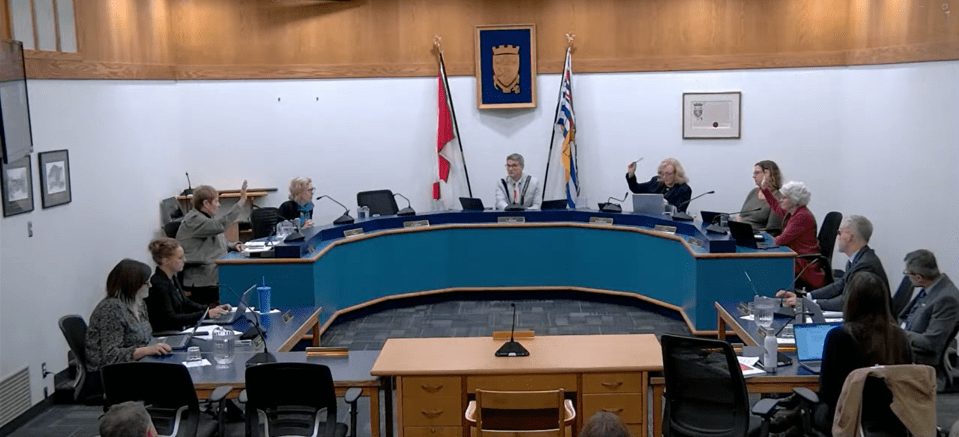
3 Oak Bay Councillors vote in favour of the motion put forth by Councillor Paterson (seated to the right with hand raised).
On Sept 23, 2024 Councillor Paterson in Oak Bay put forth a motion that the Urban Development Institute (UDI) not be a stakeholder on the district’s OCP update.
The motion resulted in a 3-3 vote and thus fail according to the procedure in place.
Councillors Paterson, Green, and Braithwaite voted in favour of the motion.
Councillors Watson, Smart, and Mayor Murdoch voted against the motion.
Councillor Appleton was not in the chambers that evening.
The video clip of the section of the deliberations on the motion can be viewed here.
The Urban Development Institute is a registered organization on the BC Lobbyists Registry. The UDI represents hundreds of paying corporate members involved in development, construction and real estate.
Cllr. Paterson’s motion was predicated on that the UDI makes it clear to its membership base that it offers advocacy (lobbying) towards government.
The councillor also cited a section of the UDI’s 2023-2024 annual report that reads:
“In the last 18 months alone, five pieces of Provincial housing legislation have required intense and ongoing engagement from the UDI Board, committees, and staff. This commitment has involved collaborating with members, municipal partners, and the Provincial Government to ensure these changes create a supportive policy environment for members working to deliver new housing supply across B.C.
Housing has also become a recent focus for the Federal Government. We have seen some positive first steps taken, and UDI has seized this window of opportunity to engage more closely with the Offices of the Minister of Finance, Minister of Housing, Infrastructure and Communities, and the Official Opposition. We intend to grow our Federal advocacy efforts over the coming year to support positive policy change at this level of government, and hope to replicate the success we have had at the Provincial level in B.C. through factual, data-driven advocacy.”
Cllr. Paterson noted that the UDI’s advocacy efforts “don’t necessarily align with a community stakeholder group”.
Cllr. Smart took issue with the motion stating: “The problem is the UDI is the only large organized group of developers in town and while I truly do understand the lobbying concerns, as well as some of the advocacy concerns with the group; developers are building the buildings and the housing that we need and I’m really concerned with the potential exclusion of in general, possibly consulting less with the development community, because if, I appreciate the fact that our government is now standing up and being in charge of building more housing, but we rely on developers to be our community builders, and I have concern with the motion as it stands, because I think we need to be partners with our development community, because they are helping to build our community.”
Cllr. Watson, then added that she concurs with Cllr. Smart in that regard.
Mayor Murdoch then spoke briefly, adding that he is not going to support the motion on the basis that the UDI should not be excluded from the discussions.
The Mayor subsequently called for the vote on the motion, which failed on a 3-3 tie, according to the procedure in place. The vote ended in a tie, as Councillor Appleton was not present during the meeting that evening.
Councillors Paterson, Green, and Braithwaite had voted in favour of the motion.
Councillors Watson, Smart, and Mayor Murdoch voted against the motion.
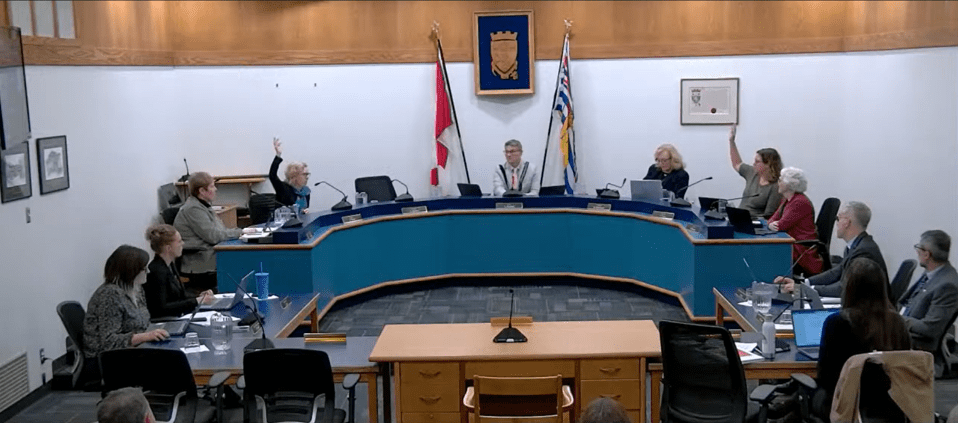
2 Councillors raise their hands in opposition to the motion that the UDI not be included in a list of community stakeholder groups on the district’s OCP update process. Mayor Murdoch (centre) also opposed the motion.
—————————————————————————————————
In the 2022 local government election – Watson, Smart, Murdoch and Appleton were endorsed by the third party electoral organization Homes for Living. Homes for Living takes a supply-based view of housing, similar to that pushed by the UDI. HFL, as it is sometimes abbreviated has had some notable overlaps with the UDI, including a UDI Chair at-the-time (early 2023), using HFL’s online Discord channel to recruit speakers to speak to Saanich Council in favour of his companies’ development application.
Councillor Smart, according to her Linkedin profile, worked full time as Project Architect for Cascadia Architects from May 2020-May 2024. She also worked as Intern Architect for D’Ambrosio architecture + urbanism from May 2001 – Oct 2009. Both Cascadia Architects and D’ambrosio architecture + urbanism, were paying member companies of the Urban Development Institute at the time that the UDI took to hiding its members directory from the general public last November.
As revealed by FOI, Councillors Watson and Smart attended an online event hosted by the UDI.
On April 3, 2019, Oak Bay’s Mayor Murdoch, through the CRD’s Hospital and Housing Committee Moved a motion to accept the proposed terms of reference for the CRD Regional Housing Advisory Committee, which passed at the meeting.
In the Terms of Reference, the Regional Housing Advisory Committee (RHAC) were allotted permanent member seats to the Urban Development Institute, Victoria Real Estate Board, and the Canadian Home Builders Association* – Vancouver Island Region.
All of the non-local governmental members given permanent seats on the committee have at one time, in one form or another, been paying members of the UDI.
These included:
BC Housing (from Development Services or local administration office)
Canada Mortgage and Housing Corporation
Urban Development Institute
Victoria Real Estate Board
Canadian Home Builders Association* – Vancouver Island Region
*The Canadian Homebuilders’ Association – Fraser Valley was listed as a member on the UDI Pacific Region website prior to the website being taken down on November 21, 2023.
The local governmental members of the RHAC included:
Six CRD Municipalities/Electoral Areas
As to the identity of the six CRD Municipalities/Electoral Areas, I have been unable to determine. The CRD has not been particularly cooperative when asked about the composition of the local governmental members of the committee. Quite likely the majority, if not all of these local governments may at one time or another have been UDI members as well.
The following are two quotes from the minutes of the June 29, 2022 Regional Housing Advisory Committee meeting at the CRD:
“UDI has been meeting with Minister Eby and have found him to be very receptive to hearing from and receiving feedback from groups like the RHAC.”
“What can we do as a committee? Kathy Whitcher suggested RHAC members be more active in finding out what policies municipalities are working on and helping to push these policies forward via advocating and lobbying (e.g., Victoria’s missing middle).”
It is worth noting that Whitcher while the Executive Director of the UDI, was simultaneously serving on the RHAC. Whitcher has also been registered on the BC Lobbyists Registry as the UDI’s in-house lobbyist with the Provincial Government, although at the Sept 12, 2023 View Royal Committee of the Whole she told View Royal Council that “UDI is not a lobbying group.”
Noting that the UDI is a lobbying group, as it is registered on the BC Lobbyists Registry and actively lobbies the Province, View Royal Council decided unanimously to discontinue their district’s membership through a motion made 2 months later at a council meeting on November 14, 2023.
View Royal had joined the UDI without a vote by elected officials. As revealed through FOI, Whitcher had encouraged staff members to make that decision, which they did, apparently without even informing the elected officials of that decision. Subsequent FOIs revealed that of the various municipalities in the CRD that became paying members of the UDI, only one municipality (Saanich) did so by a vote by elected officials. Saanich Council voted to discontinue its membership with the UDI last year, although the district continues to meet with the UDI behind doors closed to the public, and continues to pay for elected officials to attend UDI events.
In the CRD’s 2022-2023 Annual Report on page 6, under the heading “Advocacy Initiatives”, the first item to appear is the subheading “CRD”, followed under it by the point titled “Regional Housing Advisory Committee”.
Also included in the UDI’s advocacy initiatives has been Missing Middle, something that had been advocated by those involved with it for a number of years.1
Both Oak Bay and the CRD’s paid memberships in the UDI have been a subject of controversy. In May of 2024, the District of Oak Bay let its membership with the UDI expire, thus discontinuing it. The following month, the CRD itself after 23 years of being a member with the UDI did not renew its membership with the UDI, thus discontinuing it, after a senior staff decision was made to not renew it. Neither Oak Bay, nor the CRD had initially become UDI members by decisions made by elected officials.
After this decision was made I enquired to the CRD about the status of the Regional Housing Advisory Committee (RHAC). I was informed by the CRD that the RHAC was currently suspended, during an ongoing review of it.
On July 11, 2024 I had emailed a CRD official with the following question regarding the RHAC:
“”However, the Terms of Reference stipulate that at the request of a committee member, and with the consent of the Committee Chair, guests may be invited to attend meetings of the Committee.”
I see that this is in the terms of reference, but what is the legal basis for requiring members of the public to have both the request of a committee member and the consent of the Committee Chair to attend the meeting?”
All that seemed to be missing was a secret handshake.
On July 15, the CRD official responded: “I’ve reached out to my colleagues in our legal department to seek further clarification on this requirement to address your question. I will follow-up with you as soon as I have more information.
Thank you for your patience,”
As of October 14, 2024, I have still heard nothing about the follow-up.
Although I haven’t heard anything new about the RHAC since then. On Sept 27, I sent the following FOI for information about an in-person meeting between the CRD and the UDI:
“all documentation regarding the in-person meeting between the CRD and the UDI as quoted in the text below from the CRD’s website. Please include the names of everyone who attended this meeting.
“After hosting the two virtual information sessions, a request for further in-person engagement was received from the UDI. An in-person meeting was held at the CRD offices on September 10, 2024. Those in attendance included members of the development community, the CRD Chair, the Commission Chair, the MLA for Langford – Juan de Fuca and senior CRD staff. Questions were submitted in writing prior to the meeting and a letter of response is attached (Appendix C).”
https://www.crd.bc.ca/…/rwsc2024-09-25agendapkg.pdf
—————————————————————————————————
While the information on the CRD RHAC, may seem like a digression from the subject of this article, it does give important information and background on the UDI’s relation to various levels of government that can help provide the reader with some context to understand the deliberations, albeit brief, over the UDI’s stakeholder status on Oak Bay’s Official Community Plan (OCP).
The OCP must conform by law, to the CRD’s Regional Growth Strategy (RGS), which includes Housing Needs Reports prepared by paying UDI member company Urban Systems LTD. through its subsidiary Urban Matters. More information can be read here on that in this article. Housing Needs Reports tell municipalities how many units they must build over a certain amount of time.
The UDI had lobbied the Province to adopt Housing Needs Assessments/Reports for some time based on similar Housing Needs Assessments in the UK, as revealed by FOI. With almost monopoly status on the Housing Needs Reports going to Urban Systems, the company made hundreds of thousands of dollars as a result of the Province’s actions.
Not only have committees like the CRD RHAC been the subject of controversy, but UDI municipal liaison committees and other UDI liaison committee meetings with government have also been the subject of controversy.
The same night Sept 23, 2024 that Councillor Paterson put forth the motion regarding the UDI to Oak Bay Council; at Saanich Council, Councillor Chambers put forth the following motion: “That committee and other meetings that could include staff and/or members of Council with the Urban Development Institute are minuted, recorded and open to the public.”
Couns. Brownoff, Westhaver, Plant, Harper, Brice, De Vries, Bondaroff, and Mayor Murdock all failed to provide Chambers with a seconder for the motion, thus immediately ending it in its tracks.
Two weeks prior to that motion, the majority of Port Moody council voted to release details on an unlisted UDI liaison committee.
The District of Saanich has not listed on its website the UDI liaison committee that it meets with. Neither have the Districts of Esquimalt, the City of Victoria, and Colwood that also have UDI Liaison Committees. These 3 municipalities have also declined to list those committee meetings on their websites when asked.
The Province of BC, particularly the Ministry of Housing, has been especially uncooperative when asked to list the UDI liaison committees that the Provincial Government meets with, nor has it been willing to provide any information about them for that matter.
————————————————————————————————–
The presence of the UDI on the CRD RHAC (see the terms of reference for more detail) raises important questions about its repeated presence as a stakeholder, not only for the CRD, but for all levels of government in Canada.
The motion/deliberations at Oak Bay showed this at the local level, with Cllr. Paterson questioning how the UDI is being conflated as a community stakeholder – something that is absurd, in the light of that it represents massive outside interests among its paying membership base, and with the UDI lobbying all levels of government.
Oak Bay is not the only municipality in the CRD that has had issues with the UDI’s influence on its OCP.
Many residents in the District of North Saanich have taken issue to what they consider to be outside meddling in their municipal affairs by the UDI including, on their OCP update process.
https://www.vicnews.com/news/community-group-calls-on-north-saanich-to-stop-ocp-review-87714
LETTER: Report highlights development-driven agenda for North Saanich – Sooke News Mirror
North Saanich considers revisions to OCP process as Mayor Geoff Orr counters criticism – Goldstream News Gazette (goldstreamgazette.com)
—————————————————————————————————
Conclusion: Councillor Paterson’s motion to not include the UDI in a list of community stakeholders on the Oak Bay OCP update process, deserves commendation for going beyond token measures to separate lobby and state at the local governmental level and serves as a model of this to other municipalities.
While it is unfortunate that the motion failed at Council, this does form an important historical record of a Councillor in Oak Bay attempting to assert the District’s community sovereignty, in the face of the overwhelming outside interests of an immensely powerful registered lobbying organization, ever persistently seeking ways of wheedling its influence to government, and the Councillor almost succeeded in getting the motion passed.
While the counter-arguments put forth during the deliberations on the motion focussed on not discluding a well organized group representing developers, from the stakeholder consultation process on Oak Bay’s OCP update; I think that crucial grounds to discard the validity of those arguments, were unfortunately not presented that evening.
My reasoning is as follows:
The UDI is selling political influence to its paying corporate members. Thus, the government by repeatedly and consistently including them as stakeholder is enabling/contributing to a model that can provide them with cartel-like status to the development industry. The UDI’s model depends on government cooperation and collaboration, and the UDI and those in government have not been unknown to refer to the relation between the UDI and government as “partners”.
If those involved with development/real estate don’t pay in to the UDI and its model, they don’t get the same level of influence with government, of those that do pay in. The UDI has hundreds of paying corporate member companies. Sometimes it is difficult to find companies that are not involved in development/real estate that are not listed on the UDI’s now hidden members directory (a backed-up copy of it exists).
Thus, the UDI wields a sort of monopolization status, in terms of influence on government for development/real estate interests. That it is managing so many competing interests simultaneously is grounds for major potential conflict of interest concerns; and as I have stated previously, this handling of so many competing interests simultaneously provides a fertile fermenting ground for generating such issues.
In a democracy, the people are supposed to be in charge by definition.
Sure, the development/real estate industry can have input on government, but they should not do that by being positioned on a higher level than the actual population/residents themselves.
They should not be provided special access to government and especially should not be provided unrecorded access to the government, behind closed doors.
To make the process fair, and not encourage monopolization by a registered lobbyist organization, I propose that all corporate entities involved in development/real estate that wish to offer advice to government, be recorded on camera, minuted, and the public able to attend, just as it is for the general public during council meetings. Corporate entities can do this directly without the intercession of a registered lobbyist organization acting on their behalf.
Secretive committees involving outside government interests are a fertile breeding ground for potential undue influence and are undemocratic by their nature. The concept of unrecorded stakeholder advice to government is hardly different.
The District of Oak Bay would be wise, to review Councillor Paterson’s motion, and change course. Similarly, all other municipalities considering having a registered lobbying organization as a stakeholder on their new Official Community Plans (due by the Province at the end of 2025) should think very carefully, and twice, before doing so.
—————————————————————————————————
Resources:
Councillor Paterson put forward a motion in Oak Bay to not have the UDI included in a list of a community stakeholder groups on Oak Bay’s OCP Update. The section of the video can be watched at the link below at the following time section: 1:27:23 – 1:31:52
Council Meeting – 23 Sep 2024 – Agenda – Html (civicweb.net) (Accessed: Oct 14, 2024)
Oak Bay Candidate Rankings (homesforliving.ca) (Accessed: Oct 14, 2024)
Carrie Smart – District of Oak Bay | LinkedIn (Accessed: Oct 14, 2024)
RH-2022-01 RHAC Terms of Reference (crd.bc.ca) (Accessed: Oct 14, 2024)
Capital Regional District – File #: 19-379 (legistar.com) (Accessed: Oct 14, 2024)
Capital Regional District – Action Details (legistar.com) (Accessed: Oct 14, 2024)
Details
| File #: | 19379 Version: 1 |
| Type: | Action Report |
| Title: | Regional Housing Advisory Committee Terms of Reference Amendment |
| Mover: | Kevin Murdoch | Seconder: | Cliff McNeil-Smith |
| Result: | Pass |
| Agenda note: |
| Minutes note: |
| Action: | approved as amended |
| Action text: | MOVED by Director Murdoch, SECONDED by Director McNeil-Smith, That the amended Terms of Reference for the Regional Housing Advisory Committee as presented in Appendix A be approved. CARRIED |
| Person Name Vote Lisa Helps In Favour Kevin Murdoch In Favour Susan Brice In Favour Fred Haynes In Favour Gary Holman In Favour Cliff McNeil-Smith In Favour David Screech In Favour Lanny Seaton In Favour Ken Williams In Favour Denise Blackwell In Favour |
Meeting Minutes (crd.bc.ca) (Accessed: Oct 14, 2024)
Meeting Minutes
Hospitals and Housing Committee
Wednesday, April 3, 2019
1:30 PM 6th Floor Boardroom
625 Fisgard St.
Victoria, BC V8W 1R7
6.1. 19-379 Regional Housing Advisory Committee Terms of Reference Amendment
MOVED by Director Murdoch, SECONDED by Director McNeil-Smith,
That the amended Terms of Reference for the Regional Housing Advisory
Committee as presented in Appendix A be approved.
CARRIED
2019-04-03agendapkg.pdf (crd.bc.ca)
3.0 COMPOSITION
a) The Committee will include 11 organizational members representing the following
industry and government organizations:
BC Housing (from Development Services or local administration office)
Canada Mortgage and Housing Corporation
Urban Development Institute
Victoria Real Estate Board
Canadian Home Builders Association – Vancouver Island Region
Six CRD Municipalities/Electoral Areas
How the Development and Real Estate Lobby Pressed Mandatory Housing Targets, Mass Upzoning, Captured Official Community Plans, and Made the Shutting Down of Public Hearings the Norm in British Columbia Under the NDP Government – CRD Watch Homepage
LETTER: Saanich council limits public input – Saanich News
Port Moody to release details on unlisted development committee – Tri-Cities Dispatch (tricitiesdispatch.com)
Footnotes:
Will Victoria’s Old Town become a facade?
Victoria may have to try, as Gene Miller once advocated back in his Urban Development Institute days, to grab a bigger share of regional growth than forecast.
In my view, this distribution of new growth is too canted towards the Downtown and urban villages, where the predominant house form in the future will be apartments, whether rental or ownership. That works well for seniors and young singles, but less well for families with children. While some families are choosing to live in apartments, the majority would prefer a home with a yard of some kind, a challenge to provide in Victoria’s high-cost housing market, where a 5,000-square-foot lot with a modest house can cost upwards of $700,000 to $1 million depending on the neighbourhood. If we want to provide more opportunities for families to live in Victoria, we need to find room for more affordable ground-oriented housing—secondary suites, garden cottages, duplexes, four and six plexes, townhouses and freehold rowhouses—what current housing jargon calls “missing middle housing” in Victoria’s neighbourhoods, and not just in Burnside, Hillside-Quadra, Oaklands and Jubilee; in Fairfield, Rockland, and Gonzales too.

 CRD Watch Homepage
Leave a comment