Stonehouse Non-Redux:
The Sunday Block Party and Some History
By Joel Arthur McInnes
July 26, 2024

Part One – The Sunday Block Party and Some History
It was a splendid afternoon last Sunday, deserving of applause for both the organizers and the attendees. With music and food setting the stage under a sunny sky, it was an event to remember. Those who joined out of curiosity, community support, or an interest in local history were in for a treat. They embarked on a journey through the history of Stonehouse, located at 1734 Hollywood Crescent. The event began with a series of speeches, led by Professor Harold Kalman, (‘Hal’) an adjunct professor at UVic, who provided insightful commentary on the past.
“Kalman is an architectural historian and heritage planner with an extensive body of work of local, national, and international significance. He is well known within the heritage preservation community for both his scholarship and his practice. Kalman is the author of many articles and books including A History of Canadian Architecture and the Archives reading room favourite Exploring Vancouver, the recipient of numerous awards and honours, and was made a member of the Order of Canada in 2012 for his work to study, protect and share Canada’s built heritage.” (Glenn Dingwall, “Heritage Consultant Hal Kalman’s project files now available,”
posted Nov 18, 2023 on AuthentiCity, The City of Vancouver Archives Blog). (As an aside this story is about the substantial donation of Hal’s personal and professional records to the Archives comprising some 455 projects, 101 in Greater Vancouver, 100 in other parts of BC, 225 in Canada and 29 internationally.)
Hal currently resides in Victoria, directly across the street from the Stonehouse. He delivered an engaging and informative talk about the history of the Stonehouse and the art of cobblestone construction, especially as practiced in Norway. This is relevant because the second long-term owner of the Stonehouse, Andy Gilstein, was of Norwegian descent. Inspired by this heritage, Andy added cobblestones to the garage and built several “Norwegian follies” or “hermitages” on the property. Follies are typically decorative structures, such as miniature buildings or towers, created for pure enjoyment. The Stonehouse notably features a lighthouse and a waterwheel. Hal spoke sentimentally and whimsically about the history of the house and the
Gilstein family.
It was not just the construction that Hal talked about; he also detailed the gardens on the property. For many years, these gardens were a popular stop for bus tours visiting the neighborhood. The gardens were the passion of Mrs. Margarete Gilstein. The flower beds even extended to a sod roof on the Stonehouse, which was routinely covered in daffodil blooms. Andy and Margarete had several children, two of whom spoke about the personal significance of the property and their parents’ long stewardship. Now elderly, the sale of the property was partly intended to pass it on to another generation interested in preserving it. Efforts were made to find a buyer who would pursue a heritage designation for the house and Stonehouse on the property, and they came remarkably close.
After a presentation on its historical merits by Hallmark Heritage Society president Ken Johnson to the Victoria Heritage Advisory panel, the Society recommended approving the designation of 1734 Hollywood Crescent as a municipal heritage site. The house itself, a one-and-a-half-story craftsman-style bungalow, was built in 1922 for John Calvin Foote, a captain and sea pilot. Had it been approved, it would have joined 1844 Hollywood Crescent, just down the street, as a registered heritage property and another example of arts and crafts architecture. (Sidney
Coles, “Missing middle housing initiative catalyst for demolition of Fairfield heritage house,” 15 April 2024, Capital Daily).
Pam Madoff also spoke. She had been involved in discussions with the owner regarding the designation and their plans for the property. Pam Madoff, a former 25-year veteran of the Victoria City Council, has been synonymous with heritage protection throughout her career and continues to be a strong advocate today. David Screech, the former Mayor of View Royal, said of Pam:
“Pam has dedicated herself to preserving the character and heritage of Victoria, especially in the Old Town. She and her late husband, Mark Madoff, led the way in protecting heritage through their work with the Hallmark Society.” Screech also noted that Pam was instrumental in getting the rules and regulations in place to protect…Old Town now filled with unique heritage buildings housing many locally owned businesses, and is a major tourist attraction.
(Carla Wilson, “Coun. Pam Madoff worries about the future for Victoria heritage buildings, 21 October, 2018, Times Colonist).
Pam mentioned how close the property was to receiving a heritage designation and being redeveloped into 4 units. Initially, she was surprised by the delay as she passed by the house. Over time, Pam realized that the changes driven by the Missing Middle and the provincial Government’s Bill 44, or Housing Statutes (Residential Development Amendment) Act, 2023, likely led the current owner to decide that much more housing could now be built on the site. As a result, current plans propose 8 units with no heritage structures remaining. This property serves as a textbook example of the flaws in the current direction of City Council.
Part Two – Back to the Future
Not on the speakers’ list were the current owners Amit and Karishma Sethi, or the developer working on their behalf Joe A Calenda of Molto Bene (Very Good in English translation) Enterprises. Here is what the project might have looked back before a change in plans.
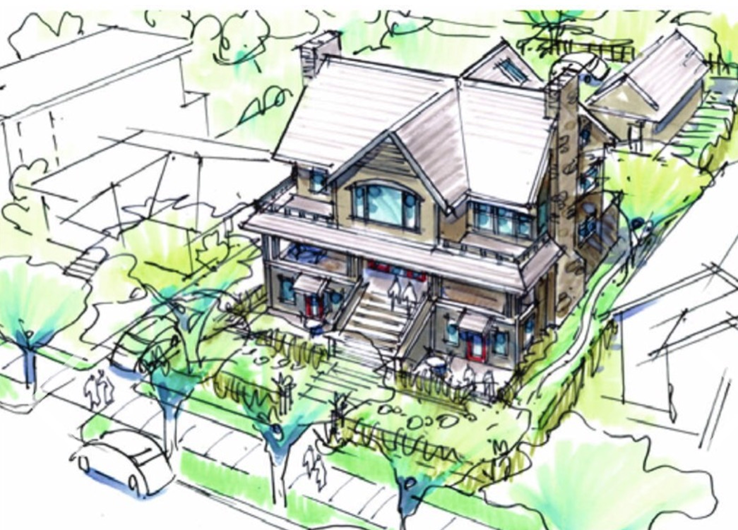
An illustration of a multi-unit house, or houseplex, from the City of Victoria document Missing Middle Design Guidelines, as set out in an article by Joe Calenda, “Comment: Missing-middle housing has not failed – give it a chance,” 27 September 2023, Times Colonist.
Mr. Calenda states in his article:
“Perhaps the greatest failing in missing-middle housing policy are the design guidelines themselves. These are intended to make redevelopment compatible with and/or complementary to the way the street was built 100 years ago. So we have the design guidelines and building envelope regulations as written. These may be the “mistakes” in the policy. What would be wrong with townhouses having more lot coverage, bigger building envelopes and footprints, more height and more floor space ratio? And why not have beefier and higher houseplexes? Would these designs not be as compatible with and complementary to the existing single- family houses as the approved missing-middle housing guidelines? If not, why not? Is it a matter of degree and subjective opinion? Simply put, townhouses and houseplexes
should be bigger than currently permitted. Perhaps that will encourage more redevelopment.”
Well, Mr. Calenda, seeing as you asked here is my answer.
While increased housing density can alleviate shortages it still raises concerns about
infrastructure strain, neighborhood character, quality of life, environmental impact, social equity, and gentrification, not to mention maintaining community aesthetics, balancing density with livability, prioritizing sustainability, and involving community input or otherwise it will be unlikely to work and people will be unhappy. Not the imaginary future people who someday may wish to move to Victoria but those living here currently.
Here’s what is being proposed by Mr. Calenda now for 1734 Hollywood Crescent:
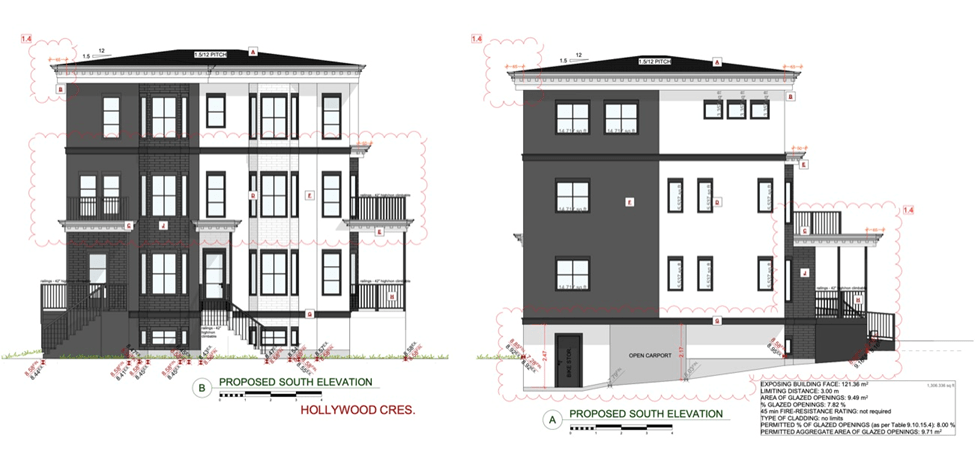
By Java Designs and as shown in the plans for the site and filed on the Development Tracker website. While I likely should not stray too far from my patch perhaps one day the architectural historians will label this as “Early Quarter-21st Century Box Design”, or something like that. They could even note that it was popular for a time with a few developers in the City of Victoria in between two municipal elections.
Part Three – So Just Where Does That Leave Us
Taking a step back, I must concede that there is nothing inherently wrong with plans for some densification and addition to the housing stock in Victoria. I understand this. So, I would suggest, let’s double the housing stock. Surely that would suffice, and it is an increase that we can manage reasonably and responsibly. Doubling seems significant. When was the last time your salary doubled, for instance? However, for this Council, doubling is not enough. Not nearly
enough.
In fact, neither is tripling.
Nor quadrupling.
Not even quintupling.
Would sextupling satisfy them? Nope.
Septupling—a seven-fold increase in the housing supply—then? Sorry, close, but no cigar. Try again.
Octupling. Yes, octupling. Increasing the housing supply by a factor of 8. Now you’ve got it.
We are going to octuple the housing supply in Victoria. Imagine how the city will look with housing, apartments, or condos up to 4 or 6 storeys (have your say) crammed onto practically every lot where something else can be torn down.
Part Four – And as for Captain John Calvin Foote
What’s wrong with you? Can’t you spell progress? Yes, I can but you will know just how variable spelling still was 100 years ago. So I will say this. If 8 units is how you spell progress now, it might have prompted Captain John Calvin Foote, who as we now know once dropped anchor in Victoria and Fairfield, to say today, “maybe it’s time for ‘anchors aweigh’.”

 CRD Watch Homepage
Leave a comment