There is a Serious Lack of Environmental Protections in Saanich’s New Proposed Official Community Plan (OCP) According to Former Resilient Saanich Technical Committee (RSTC) Member Dr. Kevin Brown’s Submission to Saanich
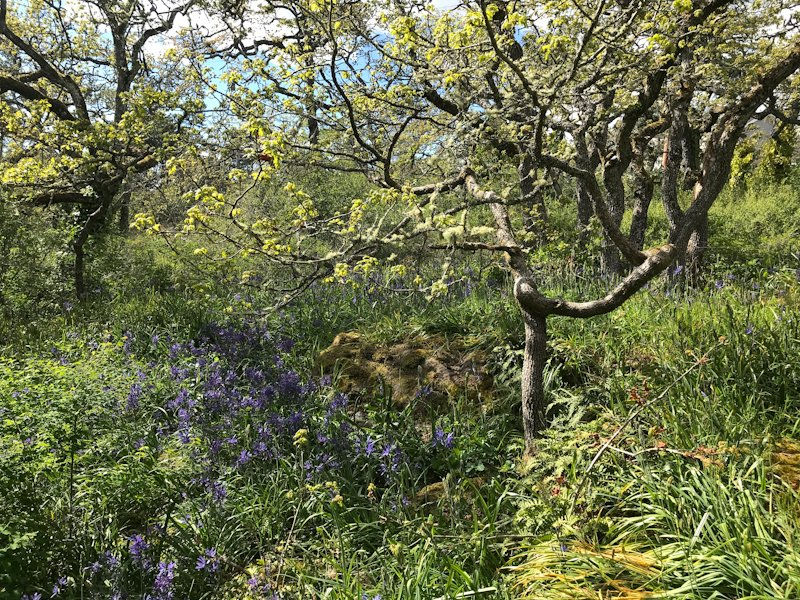
Vancouver Island’s unique Garry Oak Eco-Systems, which many species are dependent on for survival, are remaining now only in pockets.
They are under serious existential threat of annihilation from unscrupulous development and lack of environmental planning/protections. Saanich’s new Proposed OCP if passed unfortunately, could be the last proverbial ‘straw that broke the camel’s back’ for them.
May 3, 2024
The Following Submission was made by Dr. Kevin Brown Regarding the new proposed Official Community Plan (OCP) to Saanich Council.
Dr. Brown also noted serious repercussions to the environment, if Saanich is to disable its Local Area Plans (LAP)s, which it is poised to potentially do at the hearing on Monday May 7, 2024 by removing them from the OCP Bylaw.
Dr. Brown is a former member of the recent Resilient Saanich Technical Committee (RSTC), the purpose of which was to provide expert advice on the environment in the District.
The following is his letter to Saanich regarding the new proposed Official Community Plan, which can be read in the records of the official correspondence regarding it.
RE: OFFICIAL COMMUNITY PLAN BYLAW, 2023, NO. 10000Serious Lack of Environmental Protections in Saanich’s New Proposed Official Community Plan (OCP) According to Former Resilient Saanich Technical Committee Member Dr. Kevin Brown’s Submission to Saanich
Mayor and Council:
I am unable to speak at the hearing. However, I have prepared the following written comments. Thank you for considering this input.
As a member of the former Resilient Saanich Technical Committee (RSTC), I consider it very important how the OCP intends to protect and enhance Saanich’s natural environment. In that context, this document fails.
My focus here is on how the draft OCP addresses “natural environment”. But I also disagree with the dismissal of LAPs in guiding development. The LAPs involved the local community to a far greater extent than have the OCP consultations. This “new” approach appears to be a way of side-stepping neighborhood objections to a particular development, regardless of how reasonable the objections may be. Those desires may be to protect important trees and fragmented but otherwise-valuable habitat for plants, insect, birds, etc.
Population growth and increases in Saanich’s built environment threaten the extent and health of Saanich’s natural environment and those effects are likely exacerbated by climate change. Of course, the threats depend on how much and how fast population and built environment increase. Unfortunately, provincial mandates effectively remove the District’s ability to control where the growth occurs, aside from whether it is inside or outside the UCB. To deal with these threats, Saanich requires environmental policies that are much stronger than it has had in the past.
Given the District’s earlier “commitment” to the natural environment through development of a biodiversity conservation strategy (BCS), environmental policy framework (EPF), and updating of the urban forest strategy (UFS) and climate plan, I expected to see clear, strong policy intentions toward protecting and enhancing the natural environment. This document simply does not provide those commitments, despite such suggestions being made in various forms during earlier OCP consultations. Disappointingly, the draft OCP is being pushed forward for adoption without any public assessment or discussion of the delayed BCS, EPF, and UFS. No one in the community even knows yet what is in those documents.
With respect to the natural environment, there is much to clarify and improve in this draft OCP. Council should consider pausing adoption of the draft OCP, pending the arrival and assessment of the delayed BCS, EPF, and UFS. I recognize there is a rush to amend zoning laws to the satisfaction of the provincial government. Is that what is driving the adoption of this flawed draft?
General problem 1. The draft OCP doesn’t acknowledge conflicts between increasing the built environment and protecting/restoring the natural environment
The document is full of platitudes about the importance of Saanich’s natural environment in addition to the need to grow and be socially and economically “vibrant”. Through vague wording, it suggests that significant increases in the built environment are compatible with what it considers to be the “natural environment”. That is misleading- there will inevitably be conflicts and the OCP should clearly state that. The RSTC had considerable discussion about the importance of strategies and policies comprising Resilient Saanich in the grand scheme of Saanich policies. How would conflicts between an increasingly built environment and what constitutes Saanich’s natural environment be resolved? RSTC quite reasonably assumed that the OCP would give guidance in resolving conflicts between built and natural environment. I don’t see that in this document. Instead, we have a “feel-good” vision that Saanich can “have it all”; endless growth of population and the built environment while retaining and maybe even enhancing biodiversity and the urban forest, while reducing our greenhouse gas emissions and broader ecological footprint.
One related problem is the limited definition and understanding of what comprises Saanich’s natural environment. If one doesn’t recognize how broadly encompassing “natural environment” is, it becomes easier to not acknowledge what impacts that significant increases in population and the built environment have on the natural environment. A second related problem, pointed out early on by RSTC, is the District’s lack of monitoring data to assess the state of the natural environment. If one is ignorant, it becomes easier to claim that the natural environment is “fine” and meets (vague) objectives.
General problem 2. Vague, non-committal terminology encourages development potentially at the expense of protecting the “natural environment”.
I understand that OCPs are intended to be and need to be somewhat vague. This allows flexibility as issues and circumstances change. However, in a municipality experiencing significant pressures to build and densify, vague terms and policies benefit those who desire more built environment- it is much easier to claim that a proposed development is consistent with the OCP and therefore approvable without being obligated to get community input and buy-in. Conversely, using vague terms like “consider” rather than “do” (e.g. in development permit guidelines) when assessing development projects simply does not ensure protection of features of the natural environment local to a proposed project. RSTC was told by staff that the biodiversity conservation and urban forest strategies had to be “balanced” and reflect provincial densification mandates. In reading this draft OCP, “balance” seems to mean accelerated development and built environment, little opportunity for the surrounding community to be listened to, and no meaningful protection of the natural environment on private property. What am I missing?
Specific comments:
In the interest of communication among different parties, the OCP needs to clearly define “natural environment” and contrast it with “built” environment. RSTC discussed this in a report entitled “How do Saanich policies address the natural environment?”. This is attached, should you choose to refer to it.
4.4 page 28. The 15- minute community concept sounds appealing until one ponders what is considered “key amenities that support daily living”. Supermarkets? Liquor or cannabis stores? A pub? Pharmacy? Dentist? Coffee shop? A gym? A medical clinic or practice that actually accepts patients? A bookstore? It’s not clear how this might be achieved except without (a) massive densification, (b) for residents to accept fewer choices in where they shop, work, or seek services or (c) to rely even more heavily on home delivery. Do staff have any idea? Maybe the District should have asked this of residents during earlier “consultations”.
4.4 page 29. “…existing nodes will intensify…”. In other words, spread?
5.2 page 33. “In addition, compact, complete community development (when well designed) yields significant sustainability co-benefits, such as improved social networks and community health outcomes, and protection and enhancements of our ecosystems”. Some of this is probably true, some probably isn’t. As presented, the statement is an unsubstantiated assertion, stated as fact. People also prefer not sharing walls with noisy neighbors and having some outdoor space such as for gardens, trees, bird habitat, etc. Noise is an environmental and public health problem exacerbated by densification and the built environment but is never mentioned in this draft OCP. The only thing that is guaranteed with densification is that people are closer together.
The densification possible under the provincial mandates also seems incompatible with retaining abundance of the mature and large (native or otherwise) trees on streets and private property. The plan suggests otherwise. Details matter.
5.3.2. page 35. Climate action is one environmental area where the District has set targets and closely monitored whether it is achieving them, then making the information publicly available. The District needs to do more of this with respect to natural environment. It has not. The draft OCP only mentions better characterization and monitoring of the natural environment as a possibility. The OCP needs to more strongly commit to adequate monitoring and current, publicly- accessible reporting.
6.0 page 37.
I appreciate that the OCP recognizes the rarity of this combination of ecosystems in Canada and in Cascadia and of their component species. Thank you.
Under “objectives”, “improve” is the most meaningful action word, but only if Saanich has sufficient data to assess it over time. As noted above, Saanich does not have a good track record collecting, managing, and making publicly available data on the natural environment. Will Saanich commit to collecting appropriate date so that “improvements” can be verified?
Other terms such as “incorporate”, “recognize”, “support”, and “enhance” are effectively meaningless.
6.0 page 38. …Resilient Saanich process will “ensure”… The Resilient Saanich process does not ensure any protection of Saanich’s natural environment. That requires development and implementation of meaningful policies and subsequent monitoring to ensure the policies are working.
6.0 page 39. The statement recognizes that direct and indirect effects of [inappropriate] development threaten natural areas. That is good. However, it doesn’t acknowledge that smaller fragments of non-built environment (including rights of way, backyards, etc.) can contribute significantly to native biodiversity if given the chance. Similarly, for maximum ecological and climate (e.g., heat-island) mitigation benefits, the OCP should clearly acknowledge the need to retain sufficient large mature trees throughout the area within the urban containment boundary, not just effectively “zone” them into parks or other protected areas.
6.1 page 40. Polices. Unclear and misleading terminology, for example…
· 6.1.1 “This may include …”. So it may not include these things, such as data collection?
· 6.1.3 “compact urban development inside the UCB”. All private properties within the UCB now seem open to greatly intensified development- reduced setbacks, greater heights, increased numbers of residences per lot. That seems at odds with “compact”.
· 6.1.6 “address threats”. “Address” is a meaningless term like “consider”.
· 6.1.7 “Require restoration plans, prepared by a qualified environmental professional where an environmentally sensitive area has been disturbed through unauthorized activities”
Are restoration plans required for authorized activities?
6.2.2 page 41.
· “Work toward” Not ambitious enough.
· The 3-30-300 “principle” as presented is simplistic “bumper sticker” policy, excludes important nuance, and is prone to misinterpretation. The original reference (Konijnendijk 2023 Evidence‑ based guidelines for greener, healthier, more resilient neighbourhoods: Introducing the 3–30–300 rule. J For Res 34:821) should be included so users can evaluate it for themselves.
Questions:
· Is each resident allowed three unique trees to see or do the same 3 trees count for everyone in a multitude of surrounding high-rise buildings?
· Is the 30% canopy cover a minimum and applicable to smaller areas within neighborhoods, or will Saanich apply an average which includes Rural Saanich in determining whether tree cover is adequate?
· What will Saanich consider as a “tree” in attempting to meet targets? The State of Urban Forests, in attempting to estimate how many trees are in Saanich, used a minimum height of 2 metres. A two- metre- tall tree may eventually become something most of us consider a tree, but it doesn’t provide the benefits of a much larger tree and may not for decades, if ever. These details matter if Saanich is serious about setting and achieving ecologicallybeneficial urban forest targets.
· With respect to a 300m distance, what is a “green space” if not a park? A green artificial turf sports field? Green tennis court? I didn’t see it explained in the document.
6.2.3. “Incorporate and retain high value trees where possible”. Again, what is “high value” and what does “where possible” mean? We can probably all agree with these words, but we may be inadvertently agreeing on very different outcomes!
6.0 pages 37-45. Natural environment subheadings.
· Why are freshwater/marine shoreline habitats not considered “ecosystems”? Are “ecosystems” meant to refer to “terrestrial ecosystems”?
· Similarly, why is “urban forest” not part of “ecosystems”?
· I agree that abiotic components of ecosystems should be explicitly noted. Here the OCP refers to water quality and to air quality. Why would you not then refer to the sound/noise and artificial light components of the natural environment? People and the built environment contribute to both; both also have impacts on “biodiversity” and on us directly.
6.3.7. page 42. Any reason why Bowker Creek is specifically mentioned, but not the Colquitz watershed? It is entirely in Saanich and drains a larger area than Bowker Creek.
6.5 page 45. With respect to item 4, are there stewardship programs that are community-driven and not “partnership” programs (I assume this implies formal partnership with the District). Aren’t there stewardship activities that have minimal or no formal involvement by the District?
7.0 The section on land use within the UCB really does not “talk” to the previous section on natural environment. Here, it appears that Saanich is advocating for built environment on all private property within the UCB at the expense of natural environment, native biodiversity, etc.
7.0 page 47. “Containing and concentrating growth using the Urban Containment Boundary provides for better protection of rural areas and farmland as well as environmentally sensitive areas and green spaces”. Are we to assume environmentally- sensitive areas and “green spaces” are not given priority within the UCB?
7.2 Page 52 Map 2. “knowledge” is misspelled.
7.2 page 59. “Defer to the OCP when there is inconsistency in policy direction between the OCP and a Local Area Plan or Action plan.”
Here, there is a clear statement in how the OCP resolves conflict with another more local plan. In contrast, the OCP makes no attempt to say how conflicts between built and natural environment are to be resolved. Why not?
As noted earlier, I fundamentally disagree with the dismissal of LAPs in guiding development for reasons that others have brought forth. The LAPs involved the local community to a far greater extent than have the OCP consultations. This new approach appears to be a way of side-stepping neighborhood objections to a particular development, regardless of how reasonable the objections may be. Those desires may be to protect important trees and fragmented but otherwise-valuable habitat for plants, insect, birds, etc.
7.2.15, 7.2.17. page 61. “retain high value trees and natural habitat where possible”. Again, this is noble but meaningless without knowing what “high value” and “where possible” mean.
15.3 page 163 Monitoring and Evaluation. There is no mention of monitoring of the natural environment. This reiterates my point that, despite platitudes about “sustainability pillars” (section 4.2), there is little meaningful commitment by the District to ensure that densification and development of the built environment are compatible with the natural environment that makes Saanich a special and attractive place for we humans. Saanich can and must do better in this OCP.

 CRD Watch Homepage
Leave a comment